
In stock
- Solids loading + debind/sinter guidance in every order
- Mutual NDA before any file or spec review
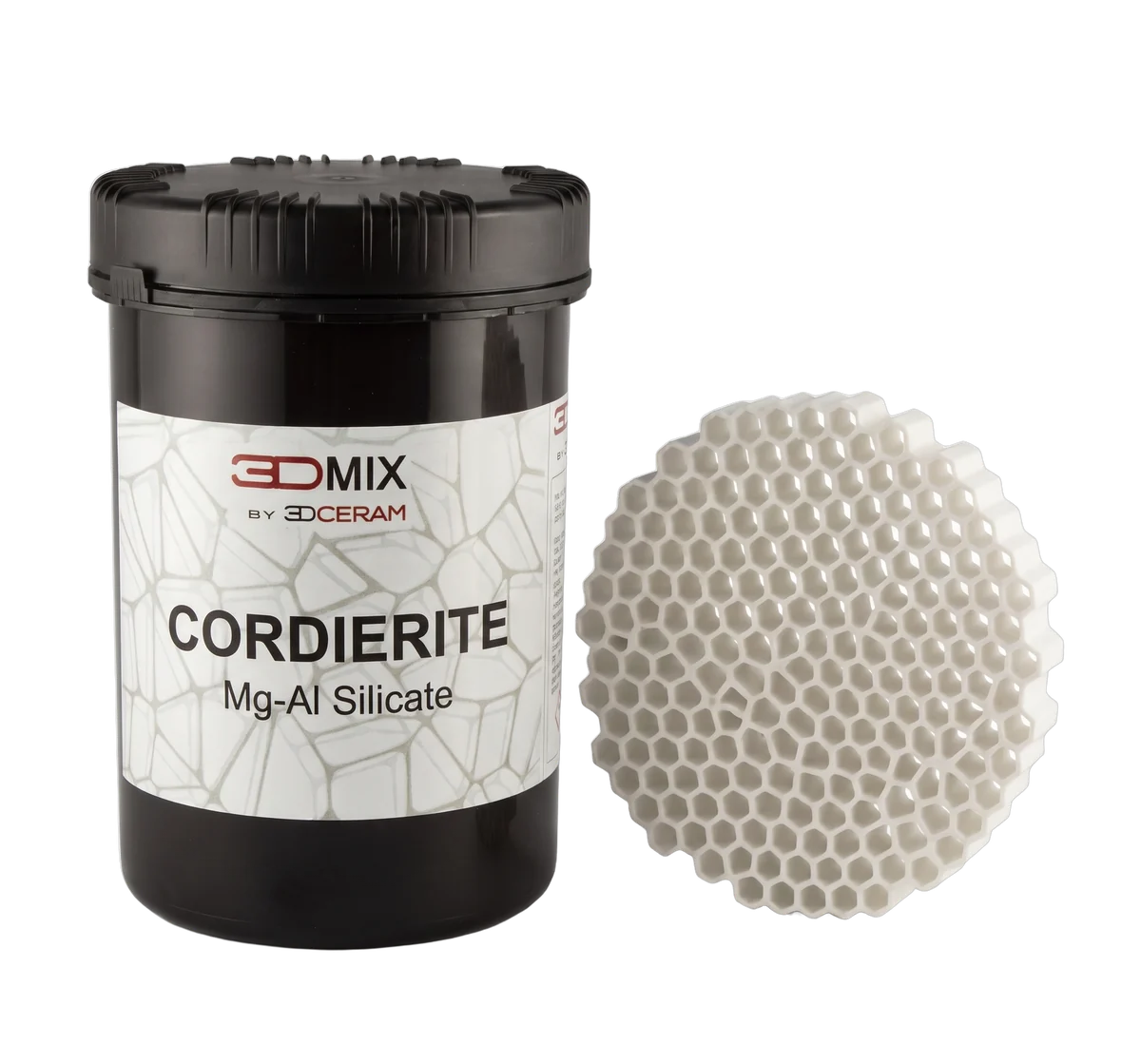
Cordierite 3D Printing Paste
Print near-zero-expansion cordierite parts on 3DCeram's Ceramaker laser-SLA platform, then debind and sinter to a dimensionally stable oxide ceramic.
- ✓ Coefficient of thermal expansion near zero — dimensional stability through thermal cycling
- ✓ Aerospace optics, metrology and vacuum hardware; >98% dense after sintering
- ✓ Ceramic SLA paste for the 3DCeram Ceramaker platform — quote-based, mutual NDA before spec review
What your process engineer actually checks
The property that matters
A CTE near zero (-0.10 ×10⁻⁶/K at 20 °C) is why cordierite exists in this range — dimensional stability, not raw strength. We ship the datasheet so you qualify against that number.
The full ceramic workflow
Every order ships with the debinding and sintering parameters. Cordierite is solid-state sintered to >98% density, and shrinkage is compensated in build prep so the first part lands on dimension.
A materials engineer on the line
Solids loading, shrinkage and cracking are where ceramic AM fails. Talk to an engineer who runs this paste — sub-4h reply, NDA on request.
Cordierite 3D Printing Paste is a 3DCeram cordierite paste for the Ceramaker laser-SLA platform — a near-zero-expansion oxide ceramic prized for dimensional stability under thermal cycling.
Why engineers choose this paste
Chosen for one property above all: it barely moves when temperature changes.
Near-zero CTE
Coefficient of thermal expansion close to zero (-0.10 ×10⁻⁶/K at 20 °C) — dimensionally stable through thermal cycling.
Low thermal conductivity
3.8 W/m·K — insulates and resists thermal shock.
Wear resistant
Durable oxide surface for metrology and optical mounting hardware.
Vacuum-compatible
Stable, low-outgassing ceramic suited to vacuum applications.
Print → debind → sinter
Ceramic stereolithography on the 3DCeram Ceramaker platform. The green part is larger than the finished part — shrinkage is compensated in build preparation.
Laser SLA print
The ceramic-loaded paste is cured layer-by-layer on a 3DCeram Ceramaker laser-SLA machine into a green part.
Debinding
The organic binder is removed in a controlled thermal cycle, leaving a fragile ceramic-only brown part.
Sintering
Solid-state sintered to >98% dense cordierite (>2.5 g/cc, ~0.89 µm grain) with near-zero expansion.
Typical applications
Where a part must hold its dimensions through temperature change.
Cordierite — physical & mechanical properties
Representative post-sinter values from the 3DCeram material datasheet. Final numbers depend on part geometry and your qualified sinter cycle.
| Property | Value |
|---|---|
| Densification rate | >98% |
| Density | >2.5 g/cm³ |
| Grain size after sintering | 0.89 µm |
| 4-pt bending strength | 150 MPa |
| Weibull modulus | 6.5 |
| Young’s modulus (theoretical) | 140 GPa |
| Thermal conductivity (RT) | 3.8 W/m·K |
| CTE (20 °C) | -0.10 ×10⁻⁶ K⁻¹ |
| Brand | 3DCeram |
| Country of origin | France |
| Printing Materials | Ceramic Pastes |
| Technology | CERAMIC SLA |
| Material | Cordierite |
| Application | Composite Tooling, Engineering, Jigs & Fixtures, Manufacturing |
We formulate and qualify. Custom variants on request.
Need a specific ceramic chemistry, solids loading, or a tuned binder for your process? Our materials team formulates and verifies rheology and sinter behavior before you commit. Typical lead 3–4 weeks.
Complete the workflow
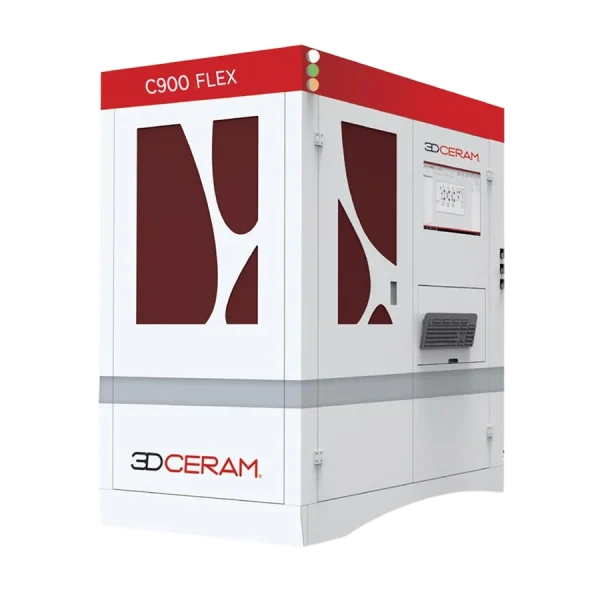
- ✓ 11+ ceramic materials — Al₂O₃, ZrO₂, Si₃N₄, TCP, HA, AlN, cordierite and more
- ✓ Top-down SLA — support-free complex internal geometries in dense ceramic
- ✓ SAM option — 100 mL minimum batch for R&D economy with expensive compositions
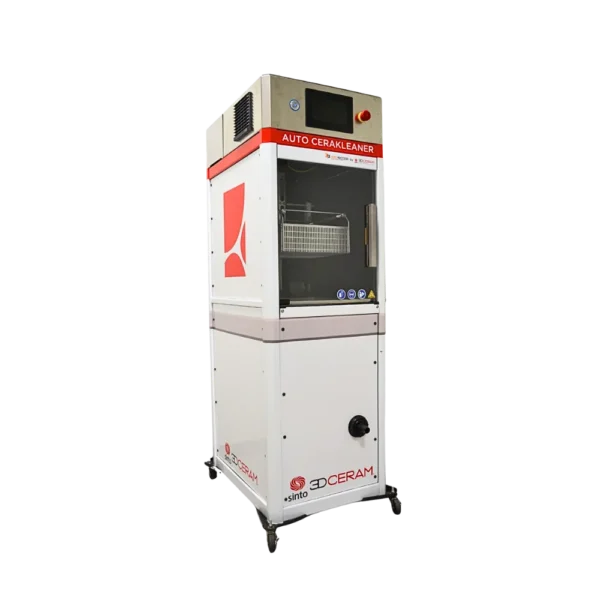
Automated cleaning system that removes excess ceramic paste from freshly printed green parts, leaving them ready to debind — replacing slow, hands-on solvent cleaning in the ceramic AM workflow.
- ✓ Gentle, low-mechanical-stress cleaning of fragile green parts
- ✓ Batch time cut dramatically vs manual (e.g. 60 min → 5 min on 70 alumina parts)
- ✓ Solvent longevity + recycling · no manual solvent contact
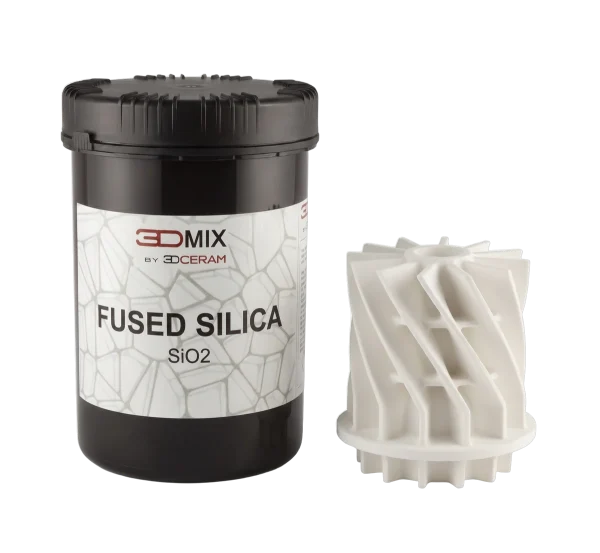
Print leachable fused-silica investment-casting cores on 3DCeram's Ceramaker laser-SLA platform for complex internal casting geometries.
- ✓ 40% porosity, excellent leachability — cleanly removed after casting
- ✓ Very low expansion (0.07% max dilatation to 1500 °C) holds core dimension through the pour
- ✓ Ceramic SLA paste for the 3DCeram Ceramaker platform — quote-based, mutual NDA before spec review
Other products teams run alongside Cordierite 3D Printing Paste
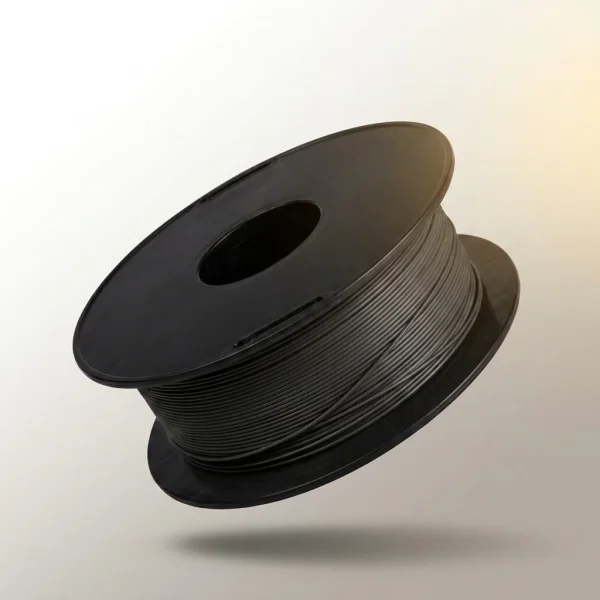
Print ultra-high-temperature ceramic parts on a standard FFF printer. A ZrB2–SiC–B4C composite formulated for pressureless sintering — built for aerospace and defence conditions.
- ✔ ZrB2 – SiC – B4C composite · pressureless sintering, no hot press
- ✔ Very high temperature and oxidation resistance
- ✔ Genuine Zetamix by Nanoe · 500 g spool · 1.75 mm
In stock
· Ships from California · 10–20 business days
Cost-effective ABS pellets qualified for large-format additive manufacturing (LFAM) — stiff, impact-tough parts and tooling at pellet cost, unreinforced or glass-fiber reinforced.
- ✓ Stiff and impact-tough — machines, sands, and paints cleanly for masters and tooling
- ✓ Ships dry with a lot datasheet + drying and extrusion parameters
- ✓ Lead time: 1–2 business days from L.A. stock — volume & PO on request
In stock
· 1–2 Business Days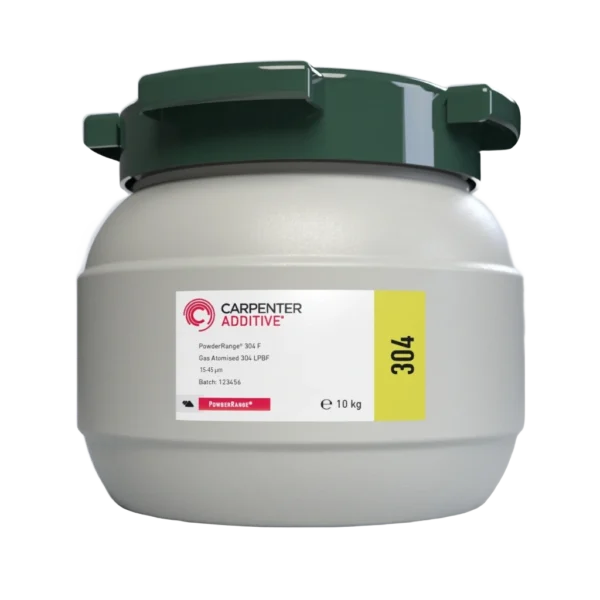
Versatile. Weldable. Cost-effective. Genuine Carpenter PowderRange® 304 / 304L austenitic stainless steel for LPBF & EBM metal 3D printing.
- ✓ Gas-atomized, low-oxygen — COA on request
- ✓ Sold in small, workable volumes — no large mill minimums
- ✓ In US stock — ready to ship
In stock
· In US stock · ready to ship
In stock
· In stock — ships in 1–2 business days from our Los Angeles warehouse.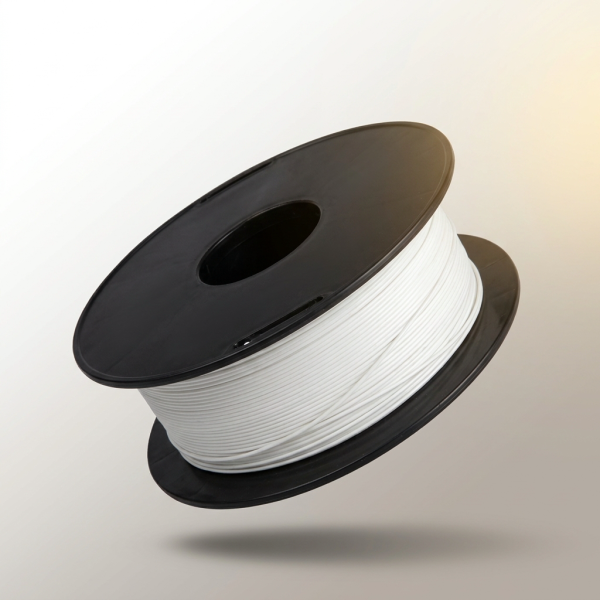
- ✔ Electrically insulating, very hard and wear-resistant, stable at high temperatures
- ✔ Print → debind → sinter to dense alumina — no powder bed, no special printer
- ✔ Genuine Zetamix by Nanoe · 500 g spool · lead time 10–20 business days (depending on order queue)
In stock
· Ships in 1–2 business days
In stock
· In stock — ships in 1–2 business days from our Los Angeles warehouse.
Maraging tool steel. Easy to harden. AM-proven. Genuine Carpenter PowderRange® M300 (1.2709) for DED & EBM metal 3D printing, in the coarser E cut (45–106 µm).
- ✓ Exceptional strength & hardness after simple aging
- ✓ Low-distortion AM processability (vs. H13/M2)
- ✓ Full COA on request · small volumes · in US stock, ready to ship
In stock
· In US stock · ready to ship
- 1K continuous carbon fiber engineered for FibreSeeker 3 co-extrusion
- ~60% fiber volume fraction, tensile strength up to 900 MPa
- Continuous load paths for strong, lightweight structural parts
In stock
· In stock · ships from the USWhat our customers say
“Harry and team were professional, effective communicators as we set up the order, then they executed quickly and produced an amazing product for us at a very competitive price. Am looking forward to our next print w Additive Plus!”
“Great 3D printing service and the resin parts look super smooth and clean. Really happy with how everything turned out!”
“Harry was very professional and helped me out with my 3D printing needs and explained what options I have in terms of filaments such as PEEK. Highly recommended.”
“I needed a 3D enclosure printed urgently in a specific time period, they did great!”
Common questions
Don't see yours? Email [email protected] — NDA on request, typical reply within 4 hours.
What makes cordierite worth printing?
Why choose cordierite over alumina or zirconia?
Why does the printed part shrink during processing?
Is cordierite suitable for vacuum applications?
Which printer runs this paste?
Can I order a sample first?
Place your order, or talk to an engineer first
Order Cordierite 3D Printing Paste direct, or talk to materials engineer