
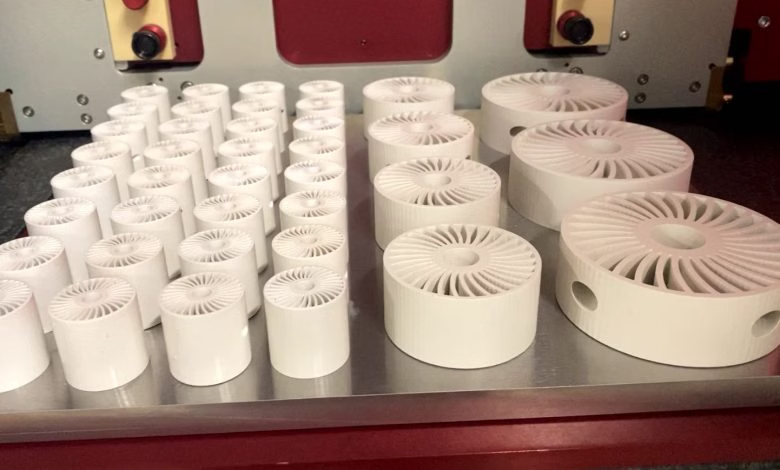
Imagine transforming advanced materials with properties like extreme heat resistance, chemical inertness, and superior hardness into intricate, functional components. This is the promise of ceramic 3D printing, a revolutionary additive manufacturing technology rapidly reshaping industries from aerospace to biomedical. Far beyond traditional ceramic fabrication methods, this cutting-edge approach enables the creation of complex geometries and custom designs with unprecedented precision, leveraging the inherent strength and durability of technical ceramics.
As industries increasingly demand lightweight yet robust parts capable of enduring harsh environments, the significance of ceramic 3D printing continues to grow. Its ability to produce bespoke components efficiently and with optimized performance makes it indispensable for high-stakes applications like 3D printing automotive parts, advanced electronics, and custom medical implants. Indeed, market projections underscore this surge, with the global ceramic 3D printing market anticipated to skyrocket from USD 365.15 million in 2025 to an impressive USD 3,497.81 million by 2034, demonstrating a robust 28.54% Compound Annual Growth Rate (CAGR). This exponential growth is largely fueled by the unparalleled customization and efficiency gains that additive manufacturing brings over conventional techniques.
In this definitive guide, we delve into the core processes, profound benefits, and critical challenges of ceramic 3D printing. We’ll explore how methods like resin 3D printing and FDM 3D printing are adapted for ceramics, the essential post-processing steps, and the diverse industrial applications that are driving its widespread adoption.
Understanding Ceramic Materials in Additive Manufacturing
Traditional ceramics, like those found in your everyday coffee mug, are known for their durability. However, advanced technical ceramics take these properties to an extreme. They are engineered to excel in environments where other materials fail, offering exceptional hardness, superior wear resistance, remarkable thermal stability, high temperature resistance, chemical inertness, and even biocompatibility. These traits make them indispensable in demanding sectors such as aerospace, medical, and energy.
Historically, working with these high-performance ceramics presented significant manufacturing hurdles. Creating complex shapes was challenging, and finished parts often suffered from issues like porosity, surface roughness, and difficulties in maintaining precise dimensional accuracy. These limitations restricted their application in intricate designs or serial production.
This is precisely where ceramic 3D printing offers a transformative solution. By enabling layer-by-layer construction, it allows for the creation of intricate, custom geometries and complex internal structures previously impossible with conventional methods. This additive approach not only reduces material waste but also facilitates rapid prototyping and the efficient production of specialized components.
Key Processes for Ceramic 3D Printing
The power of ceramic 3D printing lies in its diverse methodologies, each adapted to handle ceramic materials in various forms—from fine powders to viscous slurries or robust filaments. These processes build parts layer by layer, tailored to specific applications and material properties.
SLA Ceramic 3D Printing
SLA ceramic 3D printing, part of the vat polymerization family, encompasses technologies such as Stereolithography (SLA) and Digital Light Processing (DLP). In this process, fine ceramic powders are homogeneously dispersed within a photosensitive resin. A highly controlled light source—either a laser or digital projector—selectively cures the resin layer by layer, forming a precise “green” part that matches the digital model.
After printing, the component undergoes debinding to remove the polymer binder, followed by high-temperature sintering. This final step densifies the ceramic structure, delivering the required mechanical strength, thermal stability, and material performance.
The technology is seeing rapid adoption in applications that demand exceptional accuracy and complex geometries, including electronic components, medical fixtures and jigs, and detailed artistic pieces. Ongoing advancements in ceramic-filled and high-temperature resin formulations continue to broaden the range of achievable materials and end-use applications.
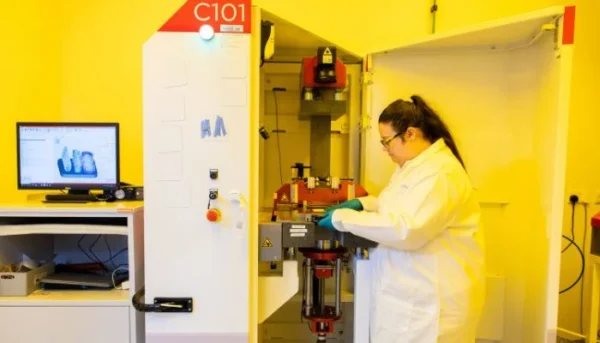
Discover 3D Ceram Ceramic 3D Printers >>
Binder Jetting
Binder Jetting is a powder-based additive manufacturing technique where a liquid binding agent is selectively jetted onto thin layers of ceramic powder. This binder effectively glues the ceramic particles together in the desired cross-section of the part. After each layer, a fresh layer of powder is spread, and the process repeats until the entire object is formed. The resulting “green” part is then depowdered and subsequently debound and sintered.
This method is highly attractive for its ability to produce complex internal geometries and delicate structures that would be nearly impossible with traditional artisan methods.
FDM 3D Printing (Fused Deposition Modeling)
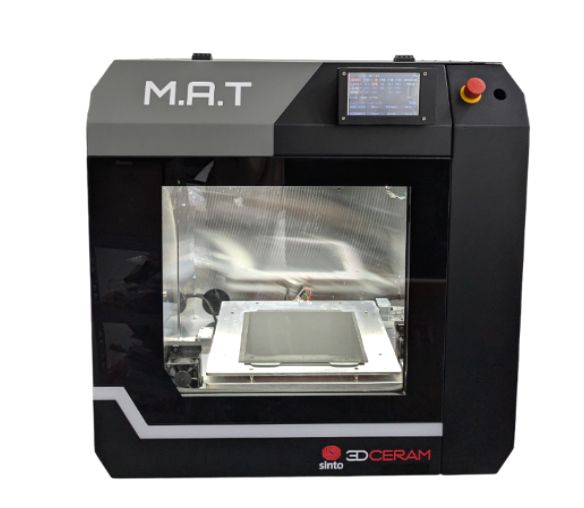
Fused Deposition Modeling (FDM), often referred to as Fused Filament Fabrication (FFF), is adapted for ceramics by using specialized thermoplastic-ceramic composite filaments. These filaments resemble a long strand of “clay spaghetti,” where ceramic particles are embedded within a polymer binder. The printer’s extruder heats and melts this filament, precisely depositing the material layer by layer to build the “green” part. After printing, similar to other methods, the plastic binder must be removed through debinding, followed by high-temperature sintering to achieve a fully dense ceramic component.
Emerging Processes
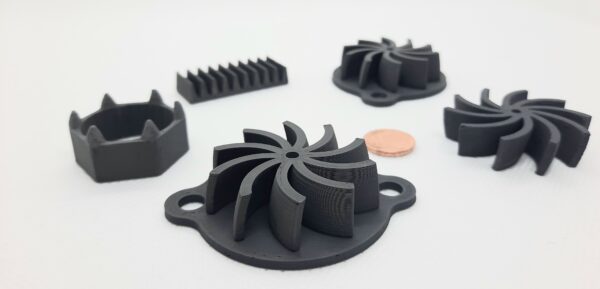
Beyond these established methods, the field of ceramic 3D printing continues to evolve with emerging techniques. Direct Ink Writing (DIW), for instance, involves extruding a highly viscous ceramic paste through a nozzle to create structures. Laser-based systems are also being refined to enhance the strength and heat resistance of printed ceramic parts. Furthermore, the integration of artificial intelligence (AI) is playing a crucial role in optimizing these processes, leading to greater efficiency and precision in material deposition and curing.
From Green Part to Functional Ceramic: Post-Processing Essentials
The journey from a “green” (unsintered) 3D-printed ceramic part to a fully dense, functional component is critical and involves two primary post-processing steps: debinding and sintering. These stages are where the material truly transforms, shedding its temporary binders and achieving its remarkable properties.
Debinding
Debinding is the initial stage where the non-ceramic binder material—whether it’s photopolymer resin, a liquid binder, or the thermoplastic from filaments—is carefully removed from the “green” part. This is typically achieved through a controlled high-temperature burnout process in a furnace. Precise control over temperature ramp rates and atmospheric conditions is essential to ensure the binder evaporates cleanly without causing defects such as cracks, delamination, or warping in the delicate ceramic structure. Incomplete or rapid debinding can compromise the final part’s integrity.
Sintering
Following debinding, the now porous ceramic body undergoes sintering. This involves subjecting the part to extremely high temperatures, often just below the ceramic’s melting point, in a specialized kiln or furnace. During sintering, the individual ceramic particles fuse together, densifying the material and shrinking the part by a significant margin, sometimes up to 20%. This process closes internal pores and significantly enhances the mechanical strength, hardness, and overall performance of the ceramic. However, sintering is a delicate balance, as uncontrolled heating or cooling can lead to issues like excessive shrinkage, warpage, cracks, or an uneven surface roughness. The success of the final component hinges on highly precise temperature profiles and atmospheric management.
Automating ceramic post-processing is becoming essential for achieving consistent quality and industrial-scale reliability. The video below demonstrates how automated systems like the Auto Cerakleaner streamline critical post-processing steps by efficiently removing residual material from ceramic 3D-printed parts. By reducing manual handling, improving repeatability, and minimizing the risk of defects before debinding and sintering, automated post-processing solutions play a key role in scaling ceramic additive manufacturing from prototyping to production.
Advantages and Benefits of Ceramic 3D Printing
The advent of ceramic 3D printing brings a host of compelling advantages that are redefining manufacturing capabilities for high-performance components:
- Unparalleled Design Freedom: One of the most significant benefits is the ability to create highly complex geometries and intricate internal structures that are impossible with traditional manufacturing methods. This design flexibility not only optimizes part performance but also significantly reduces lead times for development and minimizes material waste. This capability is especially beneficial for rapid prototyping with 3D printing, allowing for quick iteration and testing.
- Rapid Prototyping and Customization: Ceramic AM accelerates the product development cycle by enabling quick production of prototypes with superior surface finishes. This is crucial for applications like custom molds or iterative biomedical trials, where quick turnaround and precision are paramount.
- Exceptional Material Properties: Printed ceramic parts inherit the outstanding characteristics of technical ceramics, including extreme heat management, excellent wear resistance, biocompatibility for medical applications, and impressive lightweight strength. For example, specialized ceramic parts are vital for thermal management in particle detectors at CERN, while Bosch has leveraged ceramic 3D printing to create a 280-gram alumina ring blade that combines high strength with minimal weight.
- Cost-Effectiveness and Complementarity: While initial setup costs can be high, the ability to produce custom parts on demand, reduce material waste, and streamline production for small to medium batches often leads to overall cost-effectiveness. Ceramic 3D printing doesn’t always replace traditional methods but often complements them, particularly in high-stakes sectors where customization and precision are non-negotiable.
Challenges and Considerations in Ceramic Additive Manufacturing
Despite its numerous advantages, the widespread adoption of ceramic 3D printing still faces several notable challenges that require ongoing innovation and strategic solutions.
- Material Development: A significant hurdle lies in developing specialized ceramic powders, slurries, and binders that consistently yield dense parts with desired mechanical and chemical properties. Achieving optimal material formulations for diverse applications remains an active area of research, particularly for high-purity and exotic ceramic types.
- Process Control: The post-processing stages of debinding and sintering introduce complex variables. Parts can experience significant shrinkage (up to 20%), warpage, internal cracks, and porosity if temperature profiles and atmospheric conditions are not meticulously controlled. Scaling these processes from laboratory-scale prototypes to consistent industrial production presents a substantial engineering challenge.
- Cost: The high initial investment in specialized equipment, along with the expense of proprietary ceramic materials, can be a barrier to entry for many companies. While the integration of AI can help cut production overheads by optimizing processes and reducing waste, the upfront costs remain a consideration.
- Scaling to Production: Transitioning from successful pilot projects to reliable serial production is a critical challenge. The year 2025 is seen as a pivotal inflection point, with the industry maturing towards more robust, repeatable processes necessary for broader market presence. Discussions at events like AM Ceramics 2025 frequently center on strategies for large scale 3D printing with ceramics.
- Surface Finish: Ceramic 3D printing often results in parts with a degree of surface roughness that may require additional post-machining or polishing to meet stringent industrial specifications. Overcoming these surface finish hurdles is crucial for achieving full industrial readiness across a wider range of applications.
Here is a summary of key challenges and their potential mitigation strategies:
| Challenge | Impact | Mitigation Example |
|---|---|---|
| Shrinkage/Warpage | Dimensional inaccuracy, structural weakness | AI-driven process optimization for debinding and sintering; advanced simulation and compensation in design phase. |
| Cracking/Porosity | Reduced strength, poor performance | Refined material formulations; highly controlled atmospheric and temperature gradients during post-processing. |
| High Costs | Limits widespread adoption | Economies of scale through increased demand; AI and automation to reduce material waste and operational overhead; specialized services like Bosch Advanced Ceramics offering production. |
| Surface Roughness | Requires additional post-processing | Development of advanced resin-based printing methods offering smoother “green” parts; enhanced post-machining and polishing techniques. |
These challenges, while significant, are actively being addressed through ongoing research, technological advancements, and collaborative industry efforts, paving the way for the future of ceramic 3D printing.
The Technical Backbone: Diving Deeper into Ceramic 3D Printing Processes
While the foundational principles of ceramic 3D printing involve layer-by-layer construction, the choice of specific methods dictates the precision, material properties, and ultimately, the applications of the final product. Understanding these advanced processes reveals why this technology is carving out such a significant niche in high-performance manufacturing.
Precision Through Light: Advanced Resin 3D Printing
We previously touched upon resin 3D printing using goopy liquid filled with ceramic powder, but let’s delve into its nuances. This category primarily includes Stereolithography (SLA) and Digital Light Processing (DLP). In these methods, ceramic particles are uniformly suspended in a photopolymer resin. A precise light source, like a UV laser in SLA or a projector in DLP, selectively cures each layer. The unparalleled precision of these techniques allows for exceptionally fine details and smooth surface finishes, making them indispensable for intricate parts. The resin segment of the ceramic 3D printing market is a leading driver of growth, particularly for applications requiring high detail, such as advanced electronics, specialized medical jigs, and even high-fidelity artistic reproductions. The evolution of new resin formulations is continually expanding the range of printable ceramic materials and their post-sintering properties.
Binder Jetting: Freedom in Powder Beds
Binder Jetting, where a liquid binder selectively joins layers of ceramic powder, stands out for its ability to produce highly complex geometries that would be impossible with traditional manufacturing or even other additive methods. This process requires no support structures within the powder bed, granting designers immense freedom to create internal channels, intricate lattices, and undercuts.
FDM with Ceramic Filaments: Robust and Accessible
While seemingly more straightforward, FDM 3D printing (Fused Deposition Modeling or FFF) adapted for ceramics involves extruding specialized thermoplastic filaments heavily loaded with ceramic particles. This method creates what’s known as a “green” part, which, much like its counterparts from resin or binder jetting, requires meticulous post-processing. The use of ceramic-filled filaments extends the accessibility of ceramic 3d printing to a broader range of industrial and research applications, allowing for the creation of robust prototypes and functional components that benefit from ceramics’ inherent properties.
Building on this principle, the M.A.T. (Metal Additive Technology) system leverages the core strengths of FFF—controlled material deposition and post-sintering densification—to produce parts with exceptional density and mechanical performance. This same approach demonstrates the robustness and scalability of FFF-based technologies for advanced ceramic and metal applications requiring high structural integrity.
The Crucial Transformation: Mastering Post-Processing for Industrial Reliability
The journey from a “green” ceramic part to a fully functional, high-performance component is fraught with technical challenges, primarily revolving around debinding and sintering.
- Debinding: This initial post-processing step involves carefully removing the polymer binders that held the ceramic particles together during printing. This must be done under precisely controlled high-temperature conditions to prevent defects like cracking or delamination, which can occur if the binder removal is too rapid or uneven
- Sintering: The final stage, sintering, is where the ceramic truly comes to life. Under intense heat, the ceramic particles fuse, densifying the part and achieving its characteristic hardness, wear resistance, and thermal stability. However, this process also introduces significant risks: substantial shrinkage (potentially up to 20%), warpage, internal porosity, and surface roughness if not managed perfectly. The precise control of temperature ramps, dwell times, and atmospheric conditions during sintering is paramount to producing parts with consistent, reliable properties.
To address these complexities in industrial settings, advanced solutions are emerging. Automation and Artificial Intelligence (AI) are playing an increasingly vital role. Systems like 3DCeram’s CERIA leverage AI to optimize sintering profiles, predict and mitigate defects, and ensure industrial reliability, pushing ceramic 3D printing from a prototyping tool to a robust serial production method
Conclusion
From the precise requirements of biomedical implants to the extreme conditions of aerospace and automotive components, ceramic 3D printing stands as a transformative force in additive manufacturing. We’ve explored how this technology empowers industries to overcome the limitations of traditional methods, enabling the creation of complex, high-performance parts with unparalleled properties like high temperature resistance, chemical inertness, and exceptional wear resistance.
The rapid expansion of the ceramic 3D printing market, projected to reach billions by 2034, underscores its critical role. With 2025 marking a pivotal year for scaling to serial production, the fusion of advanced ceramic materials and optimized processes is providing industries with a significant competitive advantage in demanding environments. This evolution extends across various techniques, from sophisticated resin 3D printing to FDM and binder jetting, each pushing the boundaries of what is achievable.
The journey of ceramic 3D printing is just beginning. As ongoing research and development continue to refine materials, optimize processes, and integrate intelligent automation, this technology will undoubtedly unlock new frontiers in engineering, design, and manufacturing, shaping a future where the impossible becomes tangible, one durable, high-performance ceramic part at a time.
Frequently asked questions
What exactly is ceramic 3D printing?
Ceramic 3D printing is an advanced manufacturing method that builds three-dimensional objects, layer by layer, using specialized ceramic materials. This process allows for the creation of intricate designs and parts with the exceptional properties of technical ceramics, such as high temperature resistance, chemical resistance, and wear resistance, which are difficult or impossible to achieve with traditional manufacturing techniques.
How Does SLA Ceramic Printing with Ceramic Paste Work?
In SLA ceramic 3D printing, a highly loaded ceramic paste—composed of fine ceramic particles mixed with a photosensitive binder—is used instead of a standard liquid resin. This paste is spread in thin layers, and a controlled light source, such as a laser or digital projector, selectively cures each layer according to the digital model, forming a precise “green” part. Once printing is complete, the green component undergoes post-processing that includes debinding to remove the organic binder, followed by high-temperature sintering. During sintering, the ceramic particles fuse and densify, resulting in a fully ceramic part with high mechanical strength, thermal stability, and dimensional accuracy.
What are the primary advantages of using ceramic 3D printing over traditional methods?
The main advantages include unprecedented design freedom for complex geometries, significantly reduced lead times for prototyping and production, and minimal material waste. It also enables the creation of lightweight parts with superior performance characteristics, such as extreme heat management, excellent wear resistance, and biocompatibility, making it ideal for highly demanding applications.
What are "green parts" in ceramic 3D printing, and why are they important?
A "green part" refers to the ceramic object immediately after it has been 3D printed but before it has undergone debinding and sintering. At this stage, the part is held together by binders (like resin or polymers) and is still relatively fragile. It's an important intermediate step, as the properties and integrity of the final ceramic part heavily depend on the careful handling and precise post-processing of this green state.
What industries benefit most from ceramic 3D printing?
Several high-performance industries benefit significantly. The automotive industry uses it for parts like catalytic converters and sensor housings. Aerospace employs it for jet engine components and heat shields. Biomedical/Healthcare is a rapidly growing segment for custom implants and prosthetics. Electronics uses it for insulators and substrates, while energy and chemical sectors utilize it for filters and nozzles due to its high temp resin printing capabilities and resistance to harsh environments.
What are the main challenges in scaling ceramic 3D printing for production?
Key challenges include managing material development to ensure optimal density and properties, precise process control to mitigate shrinkage (which can be up to 20%), warpage, and cracking during debinding and sintering. While costs are reducing, the initial investment in specialized equipment and materials can be high. Achieving a consistently good surface finish often requires additional post-machining.
Have a question or a project? Let’s talk.
Tell us what you need — a real applications engineer replies within 24 hours. NDA on request, no sales script.