
1. Introduction
Titanium has long been a preferred material in advanced engineering applications thanks to its exceptional combination of high strength-to-weight ratio, corrosion resistance, and durability under extreme conditions. Unlike traditional metals, titanium delivers outstanding mechanical performance while remaining significantly lighter, making it ideal for industries where weight reduction directly impacts efficiency and performance. From structural aerospace components to medical implants and high-performance automotive parts, titanium continues to play a critical role in pushing engineering boundaries.
However, traditional manufacturing methods such as machining or casting titanium come with significant limitations. The material is notoriously difficult to machine, leads to high material waste, and often requires complex tooling and long production cycles. This is where additive manufacturing—also known as 3D printing—has begun to fundamentally transform how titanium parts are designed and produced.
With additive manufacturing, engineers can build parts layer by layer directly from digital files, eliminating many of the constraints associated with subtractive methods. This approach not only reduces material waste—especially important for costly materials like titanium—but also enables the creation of complex geometries, internal channels, and lightweight lattice structures that would be impossible or prohibitively expensive to achieve otherwise. As a result, companies can accelerate product development, improve part performance, and reduce overall production costs.
High-performance industries are leading the adoption of titanium 3D printing. In aerospace, lightweight yet strong components help improve fuel efficiency and reduce emissions. In the medical field, titanium’s biocompatibility makes it ideal for patient-specific implants and surgical devices. Meanwhile, the automotive and motorsport sectors leverage titanium additive manufacturing to produce high-strength, heat-resistant components optimized for performance and speed.
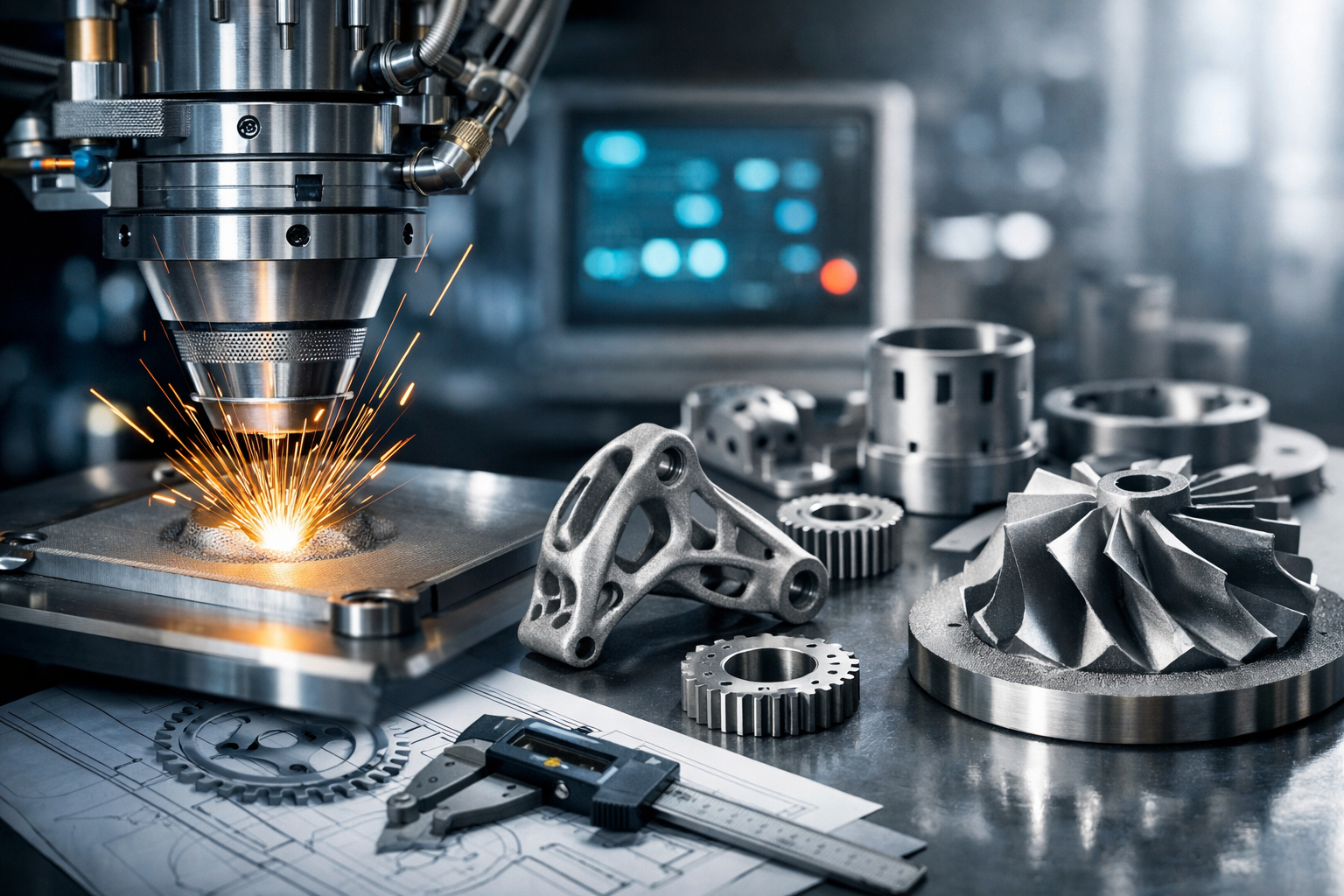
At the core of this transformation is Laser Powder Bed Fusion (LPBF)—also known as Direct Metal Laser Sintering (DMLS) or Selective Laser Melting (SLM). These technologies use high-powered lasers to selectively fuse fine titanium powder layer by layer, producing dense, high-precision parts with excellent mechanical properties. Today, LPBF/DMLS stands as the leading solution for manufacturing complex, high-performance titanium engineering parts, bridging the gap between prototyping and full-scale production.
2. What Is Titanium 3D Printing?
Titanium 3D printing refers to the use of metal additive manufacturing (AM) technologies to produce titanium parts directly from digital designs. Unlike traditional subtractive manufacturing—where material is removed from a solid block—metal AM builds components layer by layer, using fine metal powder as the raw material. This approach allows engineers to create highly complex, lightweight, and performance-optimized parts while significantly reducing material waste and production time.
At its core, metal additive manufacturing enables a shift from “design for manufacturing” to “design for performance.” Engineers are no longer constrained by tooling limitations, machining accessibility, or assembly requirements. Instead, they can design intricate geometries, consolidate multiple components into a single part, and optimize structures for strength, weight, and functionality—all of which are particularly valuable when working with high-cost materials like titanium.
Key Technologies Used in Titanium 3D Printing
Several advanced technologies are used to 3D print titanium, each with its own advantages depending on the application:
LPBF (Laser Powder Bed Fusion)
LPBF is the most widely used and precise method for titanium 3D printing. It uses a high-powered laser to selectively fuse thin layers of titanium powder, producing dense, high-resolution parts with excellent mechanical properties. LPBF is ideal for complex engineering components, tight tolerances, and functional end-use parts.
DMLS / SLM (Direct Metal Laser Sintering / Selective Laser Melting)
DMLS and SLM are often used interchangeably with LPBF, as they operate on the same fundamental principle. While there are slight technical distinctions in how the material is fused (sintering vs. full melting), in practice, both refer to laser-based powder bed fusion processes capable of producing high-density titanium parts. These technologies are commonly used across aerospace, medical, and industrial applications.
EBM (Electron Beam Melting)
EBM uses an electron beam instead of a laser to melt titanium powder. The process occurs in a vacuum environment, which is particularly beneficial for reactive metals like titanium. EBM is well-suited for larger parts, high-temperature applications, and industries like aerospace and orthopedics, where material integrity and internal stress control are critical.
How LPBF Works
Among these technologies, LPBF stands out as the industry standard for high-precision titanium parts. The process begins with a thin layer of titanium powder being evenly spread across a build platform inside a sealed chamber. A high-powered laser then selectively scans the surface, melting and fusing the powder according to the part’s cross-sectional geometry.
Once a layer is completed, the build platform lowers slightly, and a new layer of powder is applied. This process repeats layer by layer, gradually building the full 3D component from the ground up. Because each layer is extremely thin—often between 20 to 60 microns—LPBF can achieve exceptional detail and surface resolution.
A critical aspect of LPBF is the use of an inert gas atmosphere, typically argon or nitrogen, which prevents oxidation and contamination during the melting process. This controlled environment ensures that titanium retains its desired mechanical and chemical properties throughout the build.
The result is a fully dense, high-performance titanium part that often requires minimal assembly and can be further enhanced through post-processing steps such as heat treatment, machining, or surface finishing. LPBF not only delivers precision and repeatability but also enables the production of parts that would be impossible to manufacture using traditional methods.
3. Why Titanium for Engineering Parts?
Titanium stands out as one of the most advanced materials available for engineering applications, especially when performance, durability, and weight optimization are critical. Its unique combination of physical and chemical properties makes it a top choice across industries that demand reliability under extreme conditions. When paired with additive manufacturing, titanium becomes even more powerful—unlocking design possibilities and efficiencies that traditional methods simply cannot achieve.
Key Material Advantages
High Strength-to-Weight Ratio
Titanium offers strength comparable to many steels while being nearly 40–45% lighter, making it ideal for applications where reducing weight directly improves performance. Engineers can design thinner, lighter components without sacrificing structural integrity, which is particularly valuable in aerospace, robotics, and high-performance automotive systems.
Corrosion Resistance
One of titanium’s most valuable properties is its natural resistance to corrosion. It forms a stable oxide layer on its surface that protects it from moisture, chemicals, and even saltwater environments. This makes titanium an excellent choice for parts exposed to harsh operating conditions, including marine, chemical processing, and energy applications.
Biocompatibility
Titanium is widely used in the medical field because it is non-toxic and biocompatible, meaning it can safely interact with the human body without causing adverse reactions. It also supports osseointegration, allowing bone to grow around implants. This makes it ideal for orthopedic implants, dental components, and surgical devices that require both strength and long-term stability.
High-Temperature Performance
Titanium maintains its mechanical properties at elevated temperatures better than many conventional metals. It offers excellent heat resistance, fatigue strength, and creep resistance, making it suitable for demanding environments such as aerospace engines, exhaust systems, and energy sector components.
Why 3D Printing Titanium Makes Sense
While titanium is an exceptional material, it has historically been expensive and difficult to manufacture using traditional methods. Additive manufacturing changes that equation by making titanium not only more accessible but also more efficient and practical for modern engineering needs.
Reduces Material Waste
Traditional machining of titanium often results in significant material waste, sometimes removing up to 80–90% of the original billet to achieve the final shape. Given the high cost of titanium, this is both economically and environmentally inefficient. With 3D printing, material is used only where needed, drastically reducing waste and improving overall cost efficiency.
Enables Complex Geometries
Additive manufacturing allows engineers to create intricate geometries that are impossible or extremely costly with CNC machining. This includes internal channels, lattice structures, topology-optimized designs, and part consolidation (combining multiple components into a single piece). These capabilities not only enhance performance but also reduce assembly requirements and potential failure points.
Faster Iteration and Production Cycles
3D printing eliminates the need for tooling, molds, and complex setup processes, enabling rapid prototyping and faster production timelines. Engineers can quickly iterate designs, test functional prototypes, and move to production without the delays associated with traditional manufacturing. This agility is especially valuable in industries where speed to market and continuous innovation are critical.
4. Capabilities of Titanium 3D Printing Services
Titanium 3D printing services offer far more than just part production—they provide a complete engineering manufacturing solution. By combining advanced LPBF technology with expert design and post-processing support, these services enable companies to produce highly optimized, production-ready components that meet strict performance requirements across demanding industries.
4.1 Complex Geometries & Design Freedom
One of the most powerful advantages of titanium additive manufacturing is the ability to produce geometries that are impossible or impractical using traditional methods.
Internal channels and optimized flow structures can be integrated directly into a single component, improving thermal management, fluid flow, or weight distribution without the need for additional assemblies or machining steps. This is especially valuable in aerospace and energy applications where efficiency and performance are critical.
Lattice structures allow engineers to dramatically reduce weight while maintaining structural strength. These internal architectures can be precisely tuned for stiffness, energy absorption, or flexibility depending on the application. This level of control is not achievable through conventional manufacturing.
Another major benefit is part consolidation, where multiple individual components are redesigned into a single printed part. This reduces the need for fasteners, welding, or assembly operations, which in turn lowers production time, cost, and potential points of mechanical failure.
Finally, titanium 3D printing enables advanced lightweight optimization, often through topology optimization techniques. Material is placed only where it is structurally required, resulting in parts that are significantly lighter yet fully functional and robust.
4.2 High Precision & Mechanical Performance
Titanium 3D printing via LPBF delivers exceptional precision, making it suitable for engineering applications where dimensional accuracy is critical.
Modern systems can achieve tight tolerances, allowing parts to fit seamlessly into complex assemblies with minimal post-machining required. This precision is essential in aerospace, medical, and industrial applications where even small deviations can impact performance.
In addition, LPBF technology is capable of producing high-density parts exceeding 99.9% material density, meaning the final components closely match or even match the mechanical properties of wrought titanium. This results in excellent strength, fatigue resistance, and durability, making printed titanium parts suitable for functional, load-bearing applications.
4.3 Functional Prototyping & End-Use Parts
Titanium 3D printing is not limited to prototyping—it is widely used for functional testing and production-ready components.
Engineers can rapidly produce prototypes that behave like final parts, allowing them to validate performance under real-world conditions before committing to full-scale production. This significantly reduces development risk and accelerates product design cycles.
Beyond prototyping, titanium additive manufacturing is also ideal for small-batch production, especially for industries that require customized or low-volume high-performance parts. This includes aerospace brackets, medical implants, motorsport components, and specialized industrial tools.
4.4 Post-Processing Capabilities
To achieve engineering-grade performance, titanium 3D printed parts often undergo a series of critical post-processing steps.
Heat treatment and Hot Isostatic Pressing (HIP) are commonly used to relieve internal stresses, improve mechanical properties, and ensure full material density. These processes help optimize fatigue strength and long-term durability, especially in high-load applications.
Precision machining may also be applied to achieve extremely tight tolerances on critical surfaces or interfaces. This hybrid approach combines the flexibility of additive manufacturing with the precision of subtractive finishing.
Additionally, surface finishing techniques such as polishing, blasting, or chemical treatment are used to improve surface quality, reduce roughness, and enhance performance in applications where friction or aesthetics matter.
In some cases, protective coatings may be applied to further enhance wear resistance, corrosion resistance, or thermal performance, depending on the end-use environment.
4.5 Engineering Support & DfAM
A key advantage of professional titanium 3D printing services is access to engineering expertise and Design for Additive Manufacturing (DfAM) support.
DfAM involves optimizing part designs specifically for additive processes, ensuring that components are not just manufacturable but also efficient, reliable, and cost-effective. This includes redesigning parts to reduce support structures, improve strength distribution, and minimize build time.
Engineers also analyze and optimize wall thickness, overhang angles, and structural supports to reduce the risk of distortion or failure during the printing process. These adjustments are crucial for achieving high-quality, repeatable results in titanium manufacturing.
In addition, distortion control strategies are applied to compensate for thermal stresses that occur during laser melting. This ensures that final parts meet dimensional requirements after printing and post-processing.
5. Use Cases of Titanium 3D Printing in Engineering
Titanium 3D printing has moved far beyond prototyping and is now widely used for high-performance, mission-critical applications across multiple industries. Its combination of strength, lightweight characteristics, and corrosion resistance—paired with the design freedom of additive manufacturing—makes it ideal for engineering environments where efficiency, durability, and precision are essential.
5.1 Aerospace Components
The aerospace industry is one of the earliest and most active adopters of titanium additive manufacturing. In this sector, every gram of weight matters, and even small improvements in component design can lead to significant gains in fuel efficiency and overall performance.
Lightweight brackets and structural parts are among the most common applications. These components must withstand extreme mechanical loads while minimizing weight, and titanium 3D printing enables optimized designs that reduce material usage without compromising strength.
Titanium is also widely used for fuel system and airflow components, where internal channels and complex geometries are required to manage flow efficiency, pressure distribution, and thermal behavior. Additive manufacturing makes it possible to integrate these complex internal features into a single consolidated part.
Overall, the ability to achieve performance optimization through weight reduction is a key driver in aerospace adoption. By redesigning components with topology optimization and lattice structures, manufacturers can significantly improve aircraft efficiency, reduce emissions, and enhance payload capacity.
5.2 Medical & Healthcare
Titanium plays a critical role in the medical field due to its biocompatibility and long-term stability inside the human body. When combined with 3D printing, it enables highly personalized and anatomically precise solutions.
One of the most important applications is custom orthopedic and dental implants. These implants can be designed based on patient-specific scans, ensuring a perfect fit that improves recovery outcomes and reduces surgical complications. Additive manufacturing also allows for porous structures that promote osseointegration, helping bone grow naturally into the implant.
In addition, titanium 3D printing is used for patient-specific medical devices, including surgical guides, cranial plates, and reconstructive components. These customized solutions improve surgical accuracy and reduce operating time, while also enhancing patient comfort and long-term performance.
5.3 Automotive & Motorsport
The automotive and motorsport industries rely on titanium 3D printing to achieve maximum performance, weight reduction, and thermal resistance in highly demanding environments.
High-performance parts such as suspension components, brackets, and engine-related elements are commonly produced using additive manufacturing. These parts benefit from reduced weight and improved structural efficiency, directly contributing to better speed, handling, and fuel efficiency.
Titanium is also ideal for heat-resistant components, particularly in areas exposed to extreme engine temperatures or exhaust systems. Its ability to maintain mechanical stability under heat stress makes it a reliable choice for performance-driven engineering.
Additionally, titanium 3D printing is widely used for rapid prototyping in R&D environments, allowing automotive engineers to quickly test, iterate, and validate new designs without the long lead times associated with traditional manufacturing processes.
5.4 Industrial & Energy Applications
In industrial and energy sectors, titanium is valued for its corrosion resistance, durability, and performance in harsh environments.
Heat exchangers benefit significantly from additive manufacturing, as complex internal channel designs can be created to maximize thermal efficiency and improve energy transfer performance. These optimized geometries are difficult or impossible to achieve with conventional manufacturing.
Turbine components are another important use case, where titanium’s strength and heat resistance make it suitable for high-speed, high-temperature environments. Additive manufacturing allows for weight reduction and aerodynamic improvements that enhance overall system efficiency.
Titanium is also widely used for corrosion-resistant parts in chemical processing, marine, and offshore applications. Its natural resistance to aggressive environments extends component lifespan and reduces maintenance requirements.
5.5 Tooling & Manufacturing Aids
Beyond end-use parts, titanium 3D printing is also highly effective in the production of advanced tooling and manufacturing support components.
Jigs and fixtures can be custom-designed to improve production accuracy, assembly efficiency, and repeatability. Because these tools can be quickly produced and customized, manufacturers can adapt faster to changing production needs.
In more advanced applications, titanium is used to create custom tools with internal cooling channels. These channels help regulate temperature during manufacturing processes such as molding or machining, improving cycle times, reducing wear, and increasing tool lifespan.
6. Additive Plus Titanium 3D Printing Services
Additive Plus provides advanced Laser Powder Bed Fusion (LPBF) titanium 3D printing services designed specifically for high-performance engineering applications. The focus is not just on printing parts, but on delivering engineering-ready, production-grade components that meet strict industry requirements across aerospace, medical, automotive, and industrial sectors. By combining industrial-grade equipment with expert engineering support, Additive Plus helps companies move faster from concept to final part production.
What Makes Additive Plus Different
Additive Plus stands out as a full-service manufacturing partner rather than just a printing provider. The service is built around speed, precision, and engineering reliability.
One of the key advantages is the use of aerospace-grade materials, including titanium, ensuring that every part meets the mechanical and performance standards required for demanding applications. These materials are selected specifically for strength, durability, and consistency in real-world operating conditions.
Another major differentiator is fast lead times, with production capabilities that can deliver parts in as fast as the next business day depending on complexity and post-processing requirements. This enables engineering teams to significantly reduce development bottlenecks and accelerate product iteration cycles.
Additive Plus also offers an instant quote system, allowing customers to quickly upload CAD files and receive immediate pricing feedback. This streamlines the project initiation process and eliminates delays typically associated with traditional manufacturing quotations.
Every project goes through expert file review and engineering validation, ensuring that designs are optimized for LPBF production. This includes checking for manufacturability, support structure requirements, distortion risks, and overall print success probability—reducing failures and improving first-time print success rates.
In addition, Additive Plus supports a wide range of high-performance materials, including titanium, Inconel, aluminum, and stainless steel. This versatility allows engineers to select the optimal material for each application while working with a single manufacturing partner.
Key Benefits for Engineering Teams
Additive Plus is designed to support engineering teams from early-stage prototyping all the way to production deployment.
One of the most significant benefits is faster product development cycles. By eliminating tooling requirements and reducing lead times, teams can iterate designs quickly, test functional prototypes, and bring products to market faster than with traditional manufacturing methods.
Another major advantage is reduced tooling costs. Since LPBF is a tool-less manufacturing process, there is no need for molds, dies, or fixtures for production, which significantly reduces upfront investment—especially for low to medium volume production runs.
The service also delivers high-performance, production-ready parts. Titanium components produced through LPBF offer excellent density, strength, and reliability, making them suitable not just for prototyping but also for final end-use applications in critical industries.
Finally, Additive Plus offers scalability from prototype to low-volume production, making it ideal for companies that need flexibility. Whether producing a single prototype, a batch of functional test parts, or a small production run, the process remains consistent, efficient, and cost-effective.
7. Advantages Over Traditional Manufacturing
Titanium 3D printing offers a major shift in how engineering parts are designed and produced, especially when compared to traditional manufacturing methods such as CNC machining, casting, and forging. While conventional processes have been industry standards for decades, they come with inherent limitations—particularly when working with high-value materials like titanium. Additive manufacturing directly addresses these challenges and introduces a more efficient, flexible, and performance-driven approach.
Less Material Waste (Critical for Titanium)
One of the most significant advantages of titanium 3D printing is the drastic reduction in material waste. In traditional CNC machining, parts are typically carved out of solid titanium blocks, often resulting in 70–90% of the material being removed and discarded. Given the high cost of titanium and the energy required to process it, this waste becomes extremely expensive and inefficient.
With additive manufacturing, material is deposited only where it is needed, building the part layer by layer based on the digital model. This near-net-shape process ensures that titanium powder is used with maximum efficiency, significantly reducing scrap and overall material consumption. For industries where titanium cost is a major factor—such as aerospace and medical—this efficiency translates directly into substantial cost savings and improved sustainability.
No Tooling Required
Traditional manufacturing often depends on expensive and time-consuming tooling, including molds, dies, and specialized fixtures. These tools not only require high upfront investment but also add significant lead time before production can even begin. For low-volume or custom parts, tooling costs can become a major barrier to production.
Titanium 3D printing eliminates the need for tooling entirely. Parts are produced directly from digital CAD files, allowing engineers to move from design to production without additional setup. This tool-less approach dramatically reduces initial costs and makes it economically viable to produce complex or low-volume parts that would otherwise be too expensive using traditional methods.
Faster Turnaround
Speed is another key advantage of additive manufacturing. Traditional processes often involve multiple stages—design finalization, tooling fabrication, machining, assembly, and finishing—which can take weeks or even months before a final part is delivered.
With titanium 3D printing, production begins almost immediately after design validation. Because there is no need for tooling or extensive setup, parts can move directly into production, significantly reducing lead times. In many cases, functional prototypes or end-use components can be produced in a matter of days, enabling rapid iteration and faster product development cycles.
This speed advantage is especially valuable in industries where time-to-market is critical, such as aerospace innovation programs, medical device development, and motorsport engineering.
Ability to Produce Complex Internal Features
Traditional manufacturing methods are limited by tool access and machining constraints, making it difficult—or impossible—to produce internal geometries such as channels, cavities, or lattice structures. As a result, engineers are often forced to simplify designs or assemble multiple parts to achieve the desired functionality.
Titanium 3D printing removes these limitations entirely. Because parts are built layer by layer, it is possible to create highly complex internal features that would be impossible with subtractive methods. This includes cooling channels, lightweight lattice structures, optimized fluid pathways, and integrated multi-function components.
These design freedoms enable engineers to create parts that are not only lighter and stronger but also more efficient in terms of thermal management, fluid dynamics, and structural performance. Additionally, part consolidation reduces assembly requirements, improving reliability and reducing potential failure points.
8. Challenges & Considerations
While titanium 3D printing offers significant advantages in performance, design freedom, and efficiency, it is still an advanced manufacturing process that comes with important technical and economic considerations. Understanding these challenges helps engineers make informed decisions and ensures successful part production, especially for critical applications.
Higher Upfront Cost Compared to Simple Parts
One of the most common considerations is the higher initial cost of titanium 3D printing compared to simpler manufacturing methods, especially for low-complexity parts. The equipment, materials, and process control required for LPBF systems are highly advanced, which contributes to higher per-part costs for basic geometries.
However, this cost needs to be evaluated in context. For complex or high-performance components, additive manufacturing often becomes more cost-effective when factoring in tooling elimination, reduced assembly, and minimized material waste. In many cases, titanium 3D printing shifts costs from upfront tooling and machining into a more flexible, on-demand production model, which is especially beneficial for low-volume or custom engineering parts.
Design Constraints (Supports, Overhangs)
Despite its design freedom, titanium 3D printing still requires careful consideration of process-specific design constraints. One of the key factors is the need for support structures during printing.
Overhangs, steep angles, and unsupported geometries often require additional supports to prevent deformation, warping, or collapse during the layer-by-layer build process. These supports must later be removed, which can add time and complexity to post-processing.
Additionally, certain design choices can influence print quality, surface finish, and internal stress distribution. Engineers must consider factors such as heat dissipation, build orientation, and residual stress accumulation, all of which can affect the final part’s accuracy and mechanical performance. This makes Design for Additive Manufacturing (DfAM) an essential part of the workflow.
Material Handling (Titanium Reactivity and Safety)
Titanium powder is highly reactive, especially in fine particulate form, which introduces important handling and safety considerations during the manufacturing process. In its powdered state, titanium can be flammable under certain conditions and requires strict environmental control.
For this reason, LPBF systems operate in inert gas environments (such as argon) or controlled atmospheres to prevent oxidation and reduce the risk of combustion during printing. Proper powder storage, handling protocols, and recycling systems are also critical to ensure safety and material consistency.
Manufacturing environments must follow strict health and safety regulations, including proper ventilation, protective equipment, and controlled powder management systems. These measures ensure safe operation while maintaining the high quality and purity required for engineering-grade titanium parts.
Need for Post-Processing
Unlike some traditional manufacturing methods that produce near-finished parts, titanium 3D printed components typically require post-processing steps to achieve final performance and surface quality.
Common post-processing procedures include heat treatment and Hot Isostatic Pressing (HIP), which help relieve internal stresses, improve density, and enhance mechanical properties. Without these steps, parts may not reach their full fatigue resistance or long-term durability potential.
In many cases, machining is also required for critical surfaces or tight-tolerance features. This hybrid approach combines the design freedom of additive manufacturing with the precision of traditional subtractive processes.
Additionally, surface finishing techniques such as blasting, polishing, or chemical treatments are often applied to improve surface roughness, reduce friction, or meet aesthetic and functional requirements.
While post-processing adds additional steps to the workflow, it is essential for ensuring that titanium 3D printed parts meet the strict performance standards required in aerospace, medical, and industrial applications.
9. When to Use Titanium 3D Printing
Titanium 3D printing is not meant to replace all traditional manufacturing methods—it is most powerful when applied to the right use cases. Understanding when to use it is essential for maximizing both performance and cost efficiency. In general, titanium additive manufacturing is the best choice when performance, complexity, weight reduction, and customization are more important than low-cost, high-volume production.
High-Performance Applications
Titanium 3D printing is ideally suited for applications where mechanical performance and reliability under extreme conditions are critical requirements. This includes components that must withstand high stress, elevated temperatures, vibration, or corrosive environments.
Industries such as aerospace, medical, defense, and motorsport rely on titanium because failure is not an option. In these cases, additive manufacturing enables engineers to produce parts with optimized internal structures and superior material efficiency, ensuring they meet strict performance standards while maintaining safety and durability.
If a part must perform under demanding operational conditions—where strength, fatigue resistance, and material integrity are essential—titanium 3D printing becomes a strong and often necessary solution.
Lightweighting Is Critical
One of the most important use cases for titanium additive manufacturing is weight reduction without compromising strength. In industries like aerospace and automotive engineering, reducing weight directly improves fuel efficiency, speed, payload capacity, and overall system performance.
Titanium already offers a high strength-to-weight ratio, but 3D printing takes this further by enabling topology-optimized and lattice-based designs that remove unnecessary material while preserving structural integrity. This allows engineers to create components that are significantly lighter than traditionally manufactured equivalents.
When every gram matters—such as in aircraft components, spacecraft systems, or high-performance racing parts—titanium 3D printing becomes a highly effective manufacturing approach.
Complex Geometries Required
Titanium 3D printing should be used when a design includes complex geometries that cannot be manufactured using conventional methods. Traditional machining is limited by tool access, while casting often struggles with intricate internal structures.
Additive manufacturing removes these barriers entirely by building parts layer by layer. This makes it possible to produce internal channels, hollow structures, integrated cooling systems, and highly complex lattice geometries in a single component.
It is especially valuable when part consolidation is required—combining multiple assemblies into one optimized design. This reduces assembly time, improves reliability, and eliminates potential failure points such as welds, bolts, or joints.
If a design cannot be easily machined, cast, or assembled, titanium 3D printing is often the most efficient and practical solution.
Low-Volume or Custom Parts
Titanium 3D printing is particularly cost-effective for low-volume production and highly customized components. Traditional manufacturing typically requires expensive tooling, molds, or setup costs, which are only justified in mass production scenarios.
Additive manufacturing removes these barriers by enabling tool-less production, meaning parts can be manufactured directly from digital files without additional infrastructure. This makes it ideal for small production runs, prototypes, and custom-engineered solutions.
This is especially valuable in industries such as medical (patient-specific implants), aerospace (custom brackets and replacement parts), and industrial engineering (specialized tooling or one-off components). In these cases, flexibility and speed are more important than economies of scale.
10. Conclusion
Titanium 3D printing represents a major step forward in modern engineering, fundamentally changing how high-performance components are designed and manufactured. By combining the exceptional material properties of titanium with the flexibility of additive manufacturing, engineers are no longer limited by the constraints of traditional production methods. Instead, they can create parts that are lighter, stronger, more efficient, and highly optimized for real-world performance demands.
At the center of this transformation is Laser Powder Bed Fusion (LPBF) technology, which enables the production of highly complex geometries with exceptional precision and material integrity. LPBF unlocks new possibilities in design, allowing for features such as internal channels, lattice structures, and part consolidation that were previously impossible or too expensive to manufacture. This capability not only improves component performance but also reduces assembly complexity and enhances overall system reliability.
Within this evolving landscape, Additive Plus provides a dependable and scalable titanium 3D printing solution for engineering teams. By combining advanced LPBF systems, engineering expertise, and streamlined production workflows, Additive Plus supports projects from early-stage prototyping through to low-volume production. Fast turnaround times, material versatility, and expert file validation ensure that each part is optimized for both manufacturability and performance.
Ultimately, titanium 3D printing is a perfect fit for industries that demand precision, strength, lightweight performance, and customization. Whether in aerospace, medical, automotive, or industrial engineering, this technology enables companies to innovate faster, reduce inefficiencies, and bring high-performance products to market with greater confidence and speed.
Frequently asked questions
What are titanium 3D printing services in Los Angeles?
Titanium 3D printing services in Los Angeles provide advanced manufacturing using LPBF/DMLS technology to produce high-strength, lightweight engineering parts for industries like aerospace, automotive, and healthcare.
Can I order titanium 3D printed parts in Los Angeles?
Yes, companies like Additive Plus offer titanium 3D printing services with fast turnaround times and engineering support for both prototypes and production parts.
What industries in Los Angeles use titanium 3D printing?
Aerospace, medical, automotive, and energy industries in Los Angeles widely use titanium additive manufacturing for high-performance components.
How long does titanium 3D printing take in Los Angeles?
Lead times typically range from a few days to 1–2 weeks depending on part complexity and post-processing requirements.
Is titanium 3D printing cost-effective in Los Angeles?
For complex, high-performance parts, titanium 3D printing is cost-effective because it reduces material waste, eliminates tooling, and shortens production cycles.
What technologies are used for titanium 3D printing in Los Angeles?
The most common technologies include LPBF (Laser Powder Bed Fusion), DMLS, and EBM, each suited for different applications and part sizes.
Have a question or a project? Let’s talk.
Tell us what you need — a real applications engineer replies within 24 hours. NDA on request, no sales script.