

- What Is Composite 3D Printing?
- Key Benefits Of 3D Printing with Composite Materials
- Core Composite 3D Printing Techniques
- Common Composite Materials Used in 3D Printing
- Industry Applications Of Composite 3D Printing
- Getting Started: What You Need For Composite 3D Printing
- Additive Plus Solutions For Composite 3D Printing
- FAQ
Composite 3D printing combines two or more materials to create parts with enhanced properties. The process typically involves a base polymer reinforced with fibers, particles, or other additives. Think of it like reinforced concrete, the base material provides shape while the reinforcement adds strength.
Traditional 3D printing uses homogeneous materials, such as pure PLA or ABS. Composite 3D printing materials incorporate reinforcements that dramatically improve mechanical properties. Carbon fiber strands might run through a nylon base. Glass particles could strengthen a polymer matrix. Metal powders can be blended with plastic to impart unique thermal properties.
The concept isn’t new to manufacturing. Engineers have used 3d printing composite materials in aerospace and automotive applications for decades. What’s revolutionary is bringing these advanced materials to additive manufacturing. According to research from Oak Ridge National Laboratory, composites enable 3D printed parts to match or exceed traditionally manufactured components in many applications.
The shift from prototyping to production depends heavily on material performance. Composite 3D printing bridges that gap by delivering strength, stiffness, and durability that standard polymers can’t match.
Why does this matter for your business? Parts that once required metal can now be 3D printed in composite of materials. Components that needed multiple pieces can consolidate into single print. Production timelines compress from weeks to days.
Key Benefits Of 3D Printing With Composite Materials
Superior Strength-to-Weight Ratio
Composite materials deliver exceptional strength without adding significant weight. A carbon fiber reinforced nylon part might be 40% lighter than an aluminum equivalent while maintaining comparable strength.
This advantage compounds in applications where weight matters:
- Aircraft components reduce fuel consumption
- Automotive parts improve vehicle efficiency
- Handheld devices become more comfortable for extended use
- Robotic arms move faster with less motor strain
The strength-to-weight benefit makes 3D-printed composite materials particularly valuable in the transportation and aerospace sectors, where every gram counts.
Enhanced Durability and Performance
Standard 3D printing materials often fail under stress, heat, or chemical exposure. Composites handle harsh environments better. Carbon fiber composites resist fatigue from repeated loading cycles. Glass fiber reinforcements improve impact resistance. Specialized additives provide chemical resistance or high-temperature stability.
Consider a manufacturing fixture exposed to cutting fluids and mechanical stress. A standard PLA or ABS part would degrade quickly. A composite 3D printer that produces nylon reinforced with glass fiber creates fixtures that last thousands of cycles.
Parts maintain dimensional stability under conditions that would warp or fail traditional materials. This reliability matters when tolerances are tight and downtime is expensive.
Design Freedom and Complexity
Composite 3D printing maintains all the geometric freedom of standard additive manufacturing while adding material performance. You can create:
- Organic shapes impossible to machine
- Internal lattice structures for optimized strength
- Integrated mounting features and fasteners
- Parts consolidating multiple components
The combination of complex geometry and high-performance materials opens design possibilities unavailable through traditional manufacturing. Engineers can optimize for function rather than manufacturing limitations.
Cost Efficiency for Low-Volume Production
Tooling for traditional composite manufacturing costs thousands or tens of thousands of dollars. Molds, fixtures, and layup tools make low-volume production prohibitively expensive. 3D composite printing eliminates tooling costs entirely.
This economic shift enables:
- Custom parts for specific applications
- Small batch production without minimum order quantities
- Rapid design iteration without retooling expenses
- Just-in-time manufacturing reducing inventory costs
The break-even point between 3D printing and traditional methods keeps rising as printer speeds increase and material costs decrease. Many companies now produce hundreds or thousands of composite parts additively.
Core Composite 3D Printing Techniques
Fused Filament Fabrication (FFF) with Composites
FFF represents the most accessible approach to composite 3D printing. Desktop and industrial FFF printers can handle many composite materials with proper hardware.
Continuous Fiber Reinforcement
Advanced systems embed continuous fiber strands during printing. The fiber runs through the part along load paths optimized by analysis software. This technique delivers the highest strength possible from FFF processes.
Continuous fiber systems use specialized print heads that place both thermoplastic and reinforcement simultaneously. The fiber follows the toolpath, creating reinforcement exactly where stress analysis indicates it’s needed.
Applications requiring maximum strength-to-weight ratios justify the equipment investment. Aerospace brackets, automotive components, and structural parts benefit most from continuous reinforcement.
Chopped Fiber Composites
More common are filaments with short fibers pre-mixed into the polymer. Carbon fiber PLA, glass-filled nylon, and similar materials contain chopped reinforcement distributed throughout the base material.
These materials work in standard FFF printers with upgraded components:
- Hardened steel or ruby nozzles resist abrasive wear
- Higher-temperature hotends for engineering polymers
- Reinforced extruder gears to handle stiffer filaments
- Enclosed chambers for materials like nylon
The resulting parts show improved stiffness and strength compared to unreinforced materials. Properties remain isotropic across the build volume, unlike continuous fiber parts.
Selective Laser Sintering (SLS) for Composite Powders
SLS technology fuses polymer powders using laser energy. Composite powders for SLS incorporate glass beads, carbon particles, or other reinforcements into the base material.
SLS composites offer unique advantages:
- No support structures required regardless of geometry
- Isotropic mechanical properties in all directions
- Excellent surface finish compared to FFF
- Higher production throughput for batch manufacturing
Materials like glass-filled nylon powder create production-grade parts with excellent mechanical properties and chemical resistance. Check out Additive Plus’s selection of composite nylon powders for SLS applications.
SLS composite parts frequently match injection-molded equivalents in functional testing. This performance level enables true production use rather than just prototyping.
Hybrid Manufacturing Approaches
Cutting-edge systems combine additive and subtractive processes. Parts print with composite materials, then get machined to final tolerances. This hybrid approach delivers the complexity of 3D printing with the precision of CNC machining.
Other hybrid systems embed continuous fibers during a modified FFF process, then consolidate the part under heat and pressure. These techniques push composite 3D printing closer to traditional composite manufacturing quality.
Common Composite Materials Used In 3D Printing
Carbon Fiber Composites
Carbon fiber reinforced polymers represent the premium option in composite 3D printing materials. The fibers provide exceptional stiffness and strength while remaining lightweight.
Two types dominate the market:
Short carbon fiber filaments blend chopped fibers (typically 5-20% by weight) into base polymers like PLA, PETG, or nylon. These materials improve stiffness significantly but don’t achieve the strength of continuous fiber parts.
Continuous carbon fiber systems place unbroken strands strategically during printing. Parts can achieve aluminum-like strength-to-weight ratios with proper fiber placement.
Applications include drone frames, automotive components, and sporting goods where weight reduction drives value.
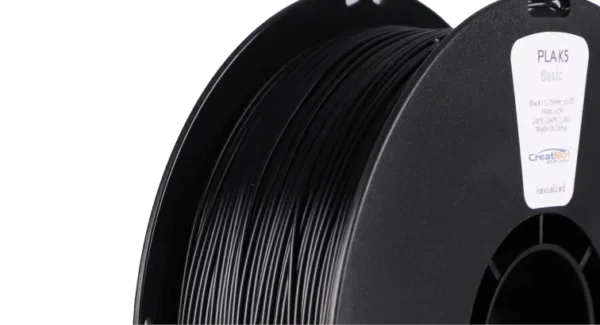
Creatbot PLA Filament – 1kg
Glass Fiber Composites
Glass-filled materials cost less than carbon fiber while providing excellent improvements over unreinforced polymers. Glass fiber composites offer:
- Significant stiffness increase (2-3x over base material)
- Improved heat deflection temperature
- Better dimensional stability
- Enhanced surface finish
- Lower cost than carbon fiber alternatives
Glass fiber works particularly well in nylon-based materials. The combination handles mechanical stress and elevated temperatures effectively.
Industrial fixtures, manufacturing jigs, and functional prototypes benefit from glass-reinforced materials. The cost savings compared to carbon fiber makes glass composites attractive for high-volume applications.
Kevlar and Aramid Fiber Composites
Kevlar and other aramid fibers excel in impact resistance and abrasion resistance. These materials create parts that withstand drops, impacts, and wear better than other composites.
The unique properties suit specific applications:
- Protective equipment and enclosures
- Wear-resistant components in manufacturing equipment
- Parts subject to vibration and shock loading
- Applications requiring cut resistance
Aramid fiber composites cost more than glass or carbon options. The specialized properties justify the premium in demanding applications.
Nylon-Based Composite Materials
Nylon (polyamide) serves as an excellent base for composite materials. Its inherent toughness, chemical resistance, and temperature stability make it ideal for reinforcement.
Common nylon composite formulations include:
- PA12 with glass fiber for manufacturing applications
- PA6 with carbon fiber for automotive components
- Nylon with mineral fillers for dimensional stability
Additive Plus offers several nylon 3D printer filament options suitable for composite printing. These materials require proper drying and enclosed chamber printing for best results.
The hygroscopic nature of nylon demands attention to storage and handling. Dry materials before printing and store in sealed containers with desiccant. Moisture causes print defects and weakens mechanical properties.
Learn more about working with nylon in our comprehensive guide on polyamide vs nylon to understand which formulation suits your application best.
PLA Composite Blends
PLA composites provide the easiest entry point into composite 3D printing. Wood-filled, metal-filled, and carbon fiber PLA variants print similarly to standard PLA with minor adjustments.
These materials work well for:
- Aesthetic parts requiring unique finishes
- Prototypes demonstrating design intent
- Low-stress components benefiting from improved stiffness
- Learning composite printing techniques before advancing to engineering materials
While PLA composites don’t match engineering-grade materials in performance, they offer a low-risk introduction to composite printing. Standard desktop printers handle them with just a hardened nozzle upgrade.
Browse quality PLA filament options to start experimenting with composite materials affordably. When bonding PLA composite parts, follow best practices for gluing PLA together to ensure strong joints.
| Material Type | Relative Strength | Temperature Resistance | Ease of Printing | Cost Level |
| Carbon Fiber Nylon | Very High | High | Moderate | High |
| Glass Fiber Nylon | High | High | Moderate | Medium |
| Carbon Fiber PLA | Medium | Low | Easy | Medium |
| Kevlar | High (impact) | Medium | Difficult | Very High |
| Glass Fiber PLA | Medium | Low | Easy | Low |
Ready to explore composite materials for your applications? Contact Additive Plus to discuss which composite 3D printer and material combination will deliver the performance your projects demand.
Industry Applications Of Composite 3D Printing
Aerospace and Aviation
Weight reduction drives significant value in aerospace applications. Every kilogram removed from an aircraft saves thousands of dollars in fuel over the vehicle’s lifetime. Composite 3D printing enables:
- Interior cabin components with complex geometries and low weight
- Lightweight brackets and fixtures reducing overall aircraft mass
- Custom tooling for maintenance and assembly operations
- Rapid prototyping of aerodynamic surfaces for testing
The combination of geometric freedom and high strength-to-weight ratios makes composite printing essential for next-generation aerospace development. Companies produce certified flight-ready components using advanced composite 3D printing systems.
Automotive Manufacturing
The automotive industry embraces composite 3D printing across multiple applications. Engineers use these technologies for:
- Functional prototypes testing form, fit, and basic function
- Custom performance parts for motorsports applications
- Manufacturing fixtures and assembly jigs
- Under-hood components requiring temperature resistance
- Interior trim pieces with weight reduction goals
Electric vehicle manufacturers particularly value weight reduction. Every kilogram saved extends vehicle range. Composite parts replace metal components throughout the vehicle while maintaining structural requirements.
Prototyping timelines compress from months to weeks using 3D composite printing. Design iterations happen quickly without expensive tooling modifications.
Industrial Manufacturing
Factories worldwide deploy composite 3D printing for operational efficiency. Common applications include:
- Custom jigs and fixtures tailored to specific production runs
- Replacement parts for legacy equipment no longer in production
- End effectors for robotic systems
- Protective guards and safety equipment
- Wear components in processing equipment
The economic case is compelling. A custom fixture costing $5,000 to machine traditionally might cost $500 to print. Lead time drops from weeks to days. Small batch production becomes economically viable.
According to additive manufacturing industry data, manufacturers adopting composite 3D printing report significant reductions in tooling costs and lead times.
Medical and Healthcare
Medical applications demand biocompatible materials with specific mechanical properties. Composite 3D printing serves multiple needs:
- Patient-specific surgical guides improving procedure accuracy
- Custom prosthetics and orthotics fitting individual anatomy
- Lightweight, strong components for assistive devices
- Prototypes for medical device development
- Training models with realistic mechanical properties
The ability to customize each part to individual patient anatomy provides outcomes impossible with mass-produced alternatives. Composite materials deliver the durability required for devices experiencing daily wear.
Consumer Products and Sporting Goods
Product designers use composite 3D printing to push performance boundaries. Applications include:
- High-performance sporting equipment optimized for individual athletes
- Custom tools with ergonomic handles fitted to specific users
- Protective equipment with impact-resistant composite materials
- Limited edition products requiring low-volume production
- Rapid iteration on consumer product designs before mass production
The technology enables small companies to compete with established brands. Custom products tailored to niche markets become economically viable without mass production volumes.
Getting Started: What You Need For Composite 3D Printing
Choosing the Right Composite 3D Printer
Not every 3D printer handles composite materials equally well. Key hardware requirements include:
Reinforced extrusion systems capable of handling abrasive materials without excessive wear. Standard brass nozzles fail quickly with composite filaments. Hardened steel, tool steel, or ruby nozzles last significantly longer.
Higher-temperature capabilities matter for engineering polymers. Nylon-based composites often require nozzle temperatures above 260°C. Hotends rated for standard materials may not reach required temperatures reliably.
Enclosed chambers provide temperature control crucial for high-performance materials. Nylon, carbon fiber, PETG, and similar materials warp without stable ambient temperatures.
Rigid frames minimize artifacts from printer vibration. Composite materials often print at high speeds. Frame flex creates quality issues that don’t appear with slower standard materials.
Direct drive extruders handle flexible and composite materials better than Bowden systems. The shorter filament path provides better control and reduces jamming with unusual materials.
Material Selection Guide
Matching materials to applications prevents wasted time and money. Start with these guidelines:
- For structural parts under load: Carbon fiber nylon, or glass fiber nylon
- For impact resistance: Kevlar composites or tough nylon blends
- For temperature exposure: Glass-filled nylon or carbon fiber PETG
- For cost-effective stiffness: Glass fiber PLA or carbon fiber PLA
- For learning and experimentation: Standard PLA composites
Test materials with your specific application requirements. Mechanical properties vary between manufacturers and formulations. Small test prints validate material choices before committing to full production.
Post-Processing Techniques
Composite parts often benefit from post-processing to achieve final requirements. Common techniques include:
Bonding composite parts requires compatible adhesives. Cyanoacrylate works for many applications. Epoxy provides stronger bonds for high-stress joints. Some materials require surface preparation for good adhesion. Our guide on the best ways to bond PLA 3D prints covers techniques applicable to many composite materials.
Sanding and finishing composite parts to achieve a smooth, finished appearance. The fiber content makes sanding more challenging than pure polymers. Use progressively finer grits. Respirators are essential as composite dust poses health risks.
Annealing improves dimensional stability and, in some cases, enhances mechanical properties. Heat-treating nylon composites in a controlled environment can increase crystallinity and strength. Follow material-specific guidelines to avoid part deformation.
Coating and sealing protect parts from environmental exposure. Composite materials may require UV protection, chemical resistance, or waterproofing, depending on the application.
Design Considerations
Composite materials behave differently from isotropic materials, such as metals. Consider these factors during design:
Fiber orientation affects strength directionally. Parts are strongest along print paths where fibers align with stress directions. Design part orientation and infill patterns to align reinforcement with expected loads.
Anisotropic properties mean that the strength varies by direction. Z-axis strength (between layers) is typically lower than XY strength—design parts to load primarily in-plane when possible.
Support structures for overhangs require removal. Support interfaces on composite parts may need more aggressive finishing than standard materials. Design to minimize supports where aesthetic or functional surfaces matter.
Wall thickness and infill density trade off strength against weight and material consumption. Composite materials often achieve target strength with less infill than standard materials, reducing weight and print time.
Additive Plus Solutions For Composite 3D Printing
Additive Plus provides complete solutions for implementing composite 3D printing in your operations. Our portfolio includes equipment, materials, and expertise to ensure successful deployment.
Equipment Portfolio
We offer composite 3D printers across multiple price points and capabilities:
- Entry-level FFF systems with hardened components for composite filaments
- Industrial FFF printers with enclosed chambers and high-temperature capabilities
- SLS systems for composite powder materials
- Continuous fiber systems for maximum strength applications
Each printer class serves different needs. Our team helps match equipment to your specific requirements and budget.
Materials Available
Our material selection includes:
- Nylon-based composites with glass and carbon fiber reinforcement
- PLA composite blends for entry-level applications
- Engineering-grade materials for demanding environments
- Specialty composites for unique property requirements
We stock proven materials that deliver consistent results. Access our complete range of nylon materials, including pellets and powders for various printing technologies.
For those starting with more forgiving materials, explore our best PLA filament options to understand material quality before advancing to engineering composites.
Expert Consultation Services
Selecting the right combination of printer, material, and process parameters determines success or failure. Our engineers have extensive experience deploying composite 3D printing across industries.
We provide:
- Application analysis to match materials and equipment to your needs
- Print parameter development for optimal results with your chosen materials
- Design for additive manufacturing guidance, maximizing composite material benefits
- Workflow optimization to integrate composite printing into your operations
Training and Support
Equipment means nothing without the knowledge to use it effectively. Additive Plus provides comprehensive training covering:
- Safe handling of composite materials and finished parts
- Printer operation and maintenance specific to composite applications
- Material drying, storage, and preparation procedures
- Troubleshooting common issues with composite printing
- Design principles for composite additive manufacturing
Ongoing support ensures your team can solve problems independently. We’re available for consultation when challenging applications arise.
Transform your production capabilities with composite 3D printing technology. Contact Additive Plus today to discuss how composite materials can solve your manufacturing challenges. Our team will help you navigate equipment selection, material choices, and implementation planning to ensure your composite printing initiative succeeds from day one.
FAQ
What’s the difference between composite 3D printing and standard 3D printing?
Standard 3D printing uses homogeneous materials like pure PLA, ABS, or nylon. Composite 3D printing incorporates reinforcements, fibers, particles, or additives into the base polymer. The reinforcement dramatically improves mechanical properties like strength, stiffness, temperature resistance, and durability. Think of it as the difference between plain concrete and reinforced concrete. The base material provides shape, while reinforcement includes performance.
Can any 3D printer handle composite materials?
No. Composite materials require specific hardware upgrades. At a minimum, you need hardened nozzles (steel, tool steel, or ruby) because composite materials are abrasive and destroy standard brass nozzles quickly. Many composite materials also require higher temperatures, enclosed chambers for temperature stability, and robust extrusion systems. Entry-level composite filaments like carbon fiber PLA work in upgraded desktop printers. Engineering-grade composites like carbon fiber nylon need industrial equipment with proper temperature control and reinforced components.
Are composite 3D prints stronger than metal?
It depends on the comparison. Composite 3D prints typically cannot match the absolute strength of steel. However, when comparing strength-to-weight ratios, many composite materials match or exceed aluminum. A carbon fiber nylon part might be 40-50% lighter than an aluminum equivalent while providing comparable strength, making it a good choice for applications where weight matters. Aerospace, automotive, robotics, and composites often outperform metals. The choice depends on your specific requirements for strength, weight, temperature resistance, and cost.
How much more expensive is composite 3D printing?
Composite materials typically cost 2-5 times as much as standard filaments. Carbon fiber nylon might cost $80-150 per kilogram versus $20-30 for standard PLA. However, total cost comparisons favor composites for many applications. A composite part might replace a machined metal component, which would cost significantly more in materials and labor. Tooling elimination for low-volume production often makes composite 3D printing the most economical option despite higher material costs. Calculate total cost, including design time, tooling, inventory, and lead time rather than just material price.
What’s the learning curve for composite 3D printing?
If you’re already familiar with 3D printing, composite materials add moderate complexity. You’ll need to learn material-specific handling, such as drying hygroscopic materials, adjusting print parameters for reinforced filaments, and managing more complex post-processing. Plan on 2-4 weeks of experimentation to achieve consistent results with a new composite material. Working with simpler composites, like carbon fiber-PLA, first builds skills before advancing to demanding materials like carbon fiber nylon. Proper training significantly accelerates the learning process.
Which composite material should I start with?
Carbon fiber PLA provides the easiest entry point into composite 3D printing. It prints similarly to standard PLA with minor temperature and speed adjustments. You’ll need a hardened nozzle, but otherwise, standard desktop 3D printers handle it well. This material helps you learn composite-specific considerations, such as abrasive wear on nozzles, fiber orientation effects, and surface finishing techniques. Once comfortable with carbon fiber PLA, progress to glass fiber nylon for improved temperature resistance, then carbon fiber nylon for maximum performance. This progression builds skills without overwhelming you with too many variables simultaneously.
Frequently asked questions
What is composite 3D printing?
Composite 3D printing combines two or more materials to create parts with enhanced properties, typically a base polymer reinforced with fibers, particles, or additives. Like reinforced concrete, the base gives shape while reinforcement adds strength, for example carbon fiber strands in a nylon base or glass particles strengthening a polymer matrix.
What are the benefits of 3D printing with composite materials?
Composite materials deliver a superior strength-to-weight ratio, enhanced durability, design freedom, and cost efficiency for low-volume production. A carbon-fiber-reinforced nylon part can be about 40% lighter than an aluminum equivalent at comparable strength, and 3D printing eliminates the tooling costs that make traditional composite manufacturing expensive.
What is the difference between continuous fiber and chopped fiber composites?
Continuous fiber reinforcement embeds unbroken fiber strands along load paths using specialized print heads, delivering the highest strength from FFF processes. Chopped fiber composites instead mix short fibers into the polymer, as in carbon fiber PLA or glass-filled nylon, and print in standard FFF machines fitted with upgraded components.
What hardware do you need to print chopped fiber composites?
Printing chopped fiber composites in a standard FFF printer requires upgraded components: a hardened steel or ruby nozzle to resist abrasive wear, a higher-temperature hotend for engineering polymers, and reinforced extruder parts. These upgrades handle abrasive materials like carbon fiber PLA and glass-filled nylon without excessive wear.
Which industries use composite 3D printing?
Transportation and aerospace sectors rely most on composite 3D printing because their strength-to-weight advantage matters where every gram counts. Applications include aerospace brackets, automotive components, structural parts, and manufacturing fixtures, where glass-fiber-reinforced nylon fixtures last thousands of cycles under cutting fluids and mechanical stress.
Can composite 3D printed parts replace metal parts?
In many applications, yes. Composite 3D printing delivers strength, stiffness, and durability that standard polymers cannot match, so parts that once required metal can now be printed in composite. Research from Oak Ridge National Laboratory notes composites can match or exceed traditionally manufactured components while consolidating multiple pieces into a single print.
Have a question or a project? Let’s talk.
Tell us what you need — a real applications engineer replies within 24 hours. NDA on request, no sales script.