
Overview
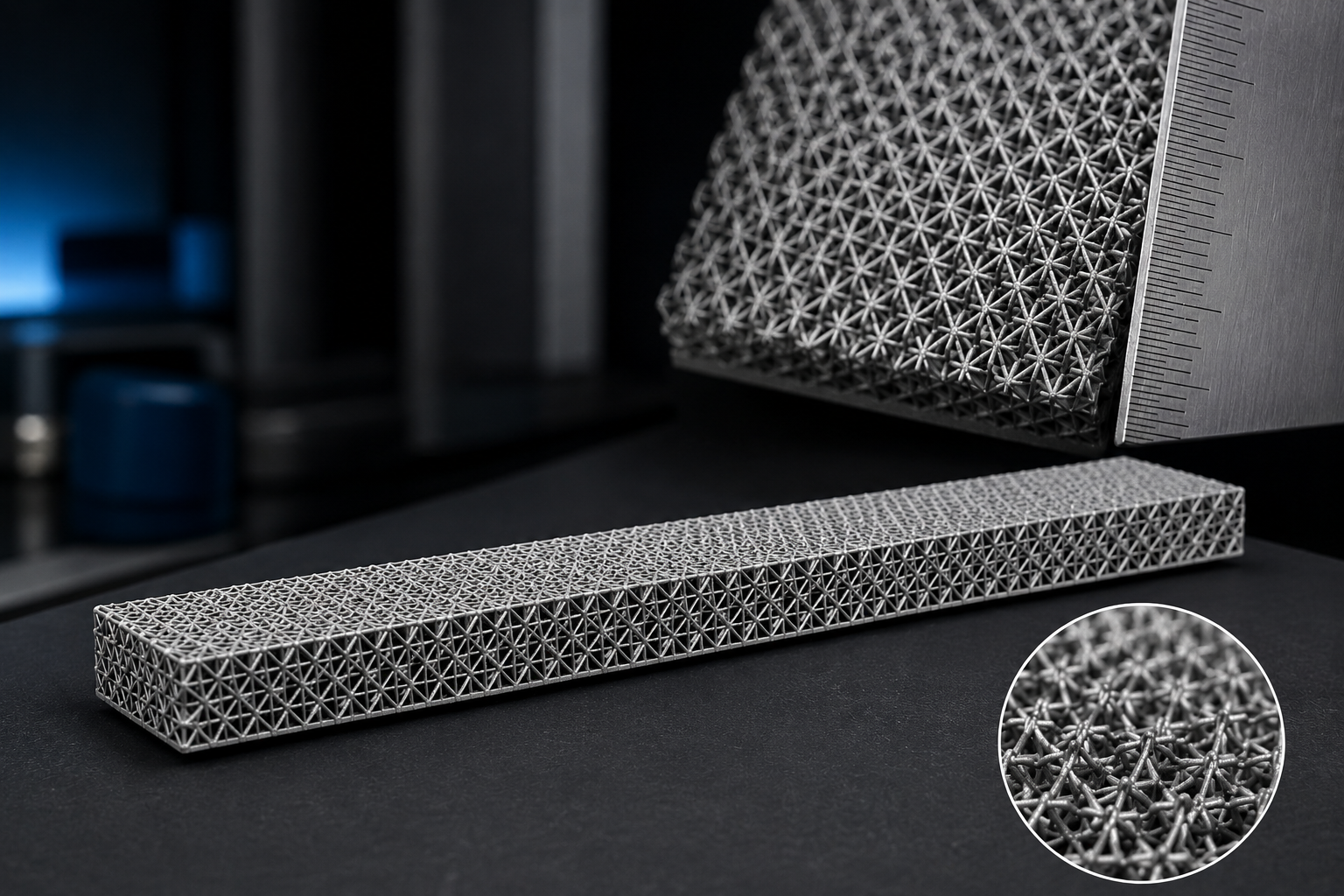
Additive Plus collaborated with a senior design team from the University of California, Irvine (UC Irvine) to manufacture an advanced metal lattice structure designed for vibration-damping research. Produced using Laser Powder Bed Fusion (LPBF) technology on a Farsoon metal 3D printer, the project demonstrates how additive manufacturing enables the creation of highly complex geometries that would be impossible to produce through conventional manufacturing methods.
The final component was a 240 × 24 × 6 mm AlSi10Mg lattice bar built entirely from a fine FBCCZ (Face-Centered Cubic with Z reinforcement) lattice structure featuring 2 mm unit cells and 0.4 mm struts. The specimen will be used to investigate how lattice geometry can improve structural damping and reduce unwanted vibrations in engineering applications.
Project Background
Vibration management remains a critical challenge across industries, including aerospace, automotive, robotics, and precision manufacturing. Excessive vibration can reduce component lifespan, decrease performance, and negatively impact reliability.
Traditionally, engineers address vibration through additional damping materials or increased mass. However, these approaches often introduce weight penalties and design constraints.
The UC Irvine team explored an alternative approach: using the geometry of a metal lattice itself to dissipate vibrational energy. By leveraging insights from published research, the team identified a lattice configuration that showed promising damping characteristics and sought to validate those findings through physical testing.
To bring the design from simulation and theory into reality, UC Irvine partnered with Additive Plus to manufacture a highly precise test specimen using metal additive manufacturing.
Why the FBCCZ Lattice Was Selected
After reviewing available research, the team selected a 2 mm FBCCZ unit cell with a 0.4 mm strut diameter as the optimal configuration for vibration damping performance.
The effectiveness of this structure stems from its exceptionally high internal surface area. As vibration waves travel through the lattice, the complex network of interconnected struts creates additional opportunities for energy dissipation. This mechanism allows the structure to reduce vibration without significantly increasing mass.
To ensure consistent testing conditions, the FBCCZ unit cell was repeated uniformly throughout the entire 240 mm length of the bar.
Engineering a Print Strategy for Fine Metal Features
Producing a lattice composed of thousands of interconnected 0.4 mm struts presents significant manufacturing challenges. Residual thermal stresses generated during the LPBF process can distort delicate geometries if not properly managed.
To address this challenge, the design incorporated:
- A 1 mm base plate
- 1 mm extruded support struts on the underside of the lattice
- Stress-distribution features to stabilize the structure throughout the build
This strategy helped anchor the lattice during printing, distribute thermal loads, and maintain dimensional accuracy from the first layer to the final completed part.
The result was a fully formed lattice structure with clean, repeatable strut geometry across the entire component.
Why AlSi10Mg Was Chosen
The project utilized AlSi10Mg, one of the most widely used aluminum alloys in metal additive manufacturing.
The material was selected to replicate the conditions used in the reference research while also providing excellent printability characteristics.
Key advantages of AlSi10Mg include:
- Consistent powder flow behavior
- Reliable recoating performance
- Stable LPBF processing
- Excellent dimensional accuracy
- Strong mechanical properties
These characteristics are particularly important when manufacturing components composed almost entirely of sub-millimeter lattice features.
Manufacturing Outcome
Using Farsoon LPBF technology, Additive Plus successfully produced a 240 mm lattice bar featuring thousands of precisely repeated FBCCZ cells and 0.4 mm struts.
The completed component provides UC Irvine with a physical test specimen for vibration-damping analysis while demonstrating the capabilities of modern metal additive manufacturing for research and industrial applications.
Key Results
Fine-Feature Resolution
Successfully manufactured 0.4 mm metal struts with excellent consistency and definition.
Repeatability Across Large Structures
Produced thousands of identical FBCCZ unit cells across a 240 mm build length.
Effective Stress Management
Implemented a print strategy that minimized distortion and maintained geometric accuracy.
Research-to-Reality Validation
Enabled academic research to move from theoretical models to physical testing.
Lightweight Functional Design
Demonstrated how lattice structures can simultaneously reduce weight and introduce vibration-damping functionality.
Looking Ahead
This project highlights the growing role of metal additive manufacturing in developing next-generation engineered structures. As industries seek lighter, smarter, and more functional components, advanced lattice designs offer opportunities to combine structural performance with vibration control, energy absorption, and lightweighting.
By partnering with research institutions such as UC Irvine, Additive Plus continues to help transform innovative concepts into manufacturable solutions that accelerate engineering development and real-world testing.
Frequently asked questions
What is an FBCCZ lattice and why was it used for vibration damping?
FBCCZ stands for Face-Centered Cubic with Z reinforcement, a lattice geometry selected for its ability to dissipate vibrational energy. Additive Plus and UC Irvine used a 2 mm FBCCZ unit cell with 0.4 mm struts because its high internal surface area lets the interconnected strut network absorb vibration waves without significantly adding mass.
Why is AlSi10Mg used for LPBF metal lattice structures?
AlSi10Mg is one of the most widely used aluminum alloys in metal additive manufacturing because it combines excellent printability with strong mechanical properties. It offers consistent powder flow, reliable recoating, stable LPBF processing, and excellent dimensional accuracy - all critical when a part is built almost entirely from sub-millimeter lattice features.
How do you print fine 0.4 mm metal struts without distortion?
Manage residual thermal stress with a dedicated print strategy that anchors the lattice during the build. Additive Plus added a 1 mm base plate, 1 mm extruded support struts on the underside, and stress-distribution features to stabilize the geometry, distribute thermal loads, and hold dimensional accuracy from the first layer to the last.
What were the dimensions of the printed AlSi10Mg lattice bar?
The final component was a 240 x 24 x 6 mm AlSi10Mg lattice bar built entirely from a fine FBCCZ structure. It used 2 mm unit cells and 0.4 mm struts repeated uniformly across the full 240 mm length to ensure consistent testing conditions for vibration-damping analysis.
Can metal 3D printing produce lattice structures that reduce vibration without adding weight?
Yes. As vibration waves travel through a fine metal lattice, the complex network of interconnected struts creates additional paths for energy dissipation, reducing vibration without significantly increasing mass. This lets engineers use geometry itself for damping instead of adding damping materials or extra mass that carry weight penalties.
What printer and technology did Additive Plus use for this project?
Additive Plus produced the lattice bar using Laser Powder Bed Fusion (LPBF) on a Farsoon metal 3D printer. The process successfully manufactured thousands of precisely repeated FBCCZ unit cells and consistent 0.4 mm struts across the 240 mm build length, demonstrating fine-feature resolution and repeatability at scale.
Have a question or a project? Let’s talk.
Tell us what you need — a real applications engineer replies within 24 hours. NDA standard, no sales script.