
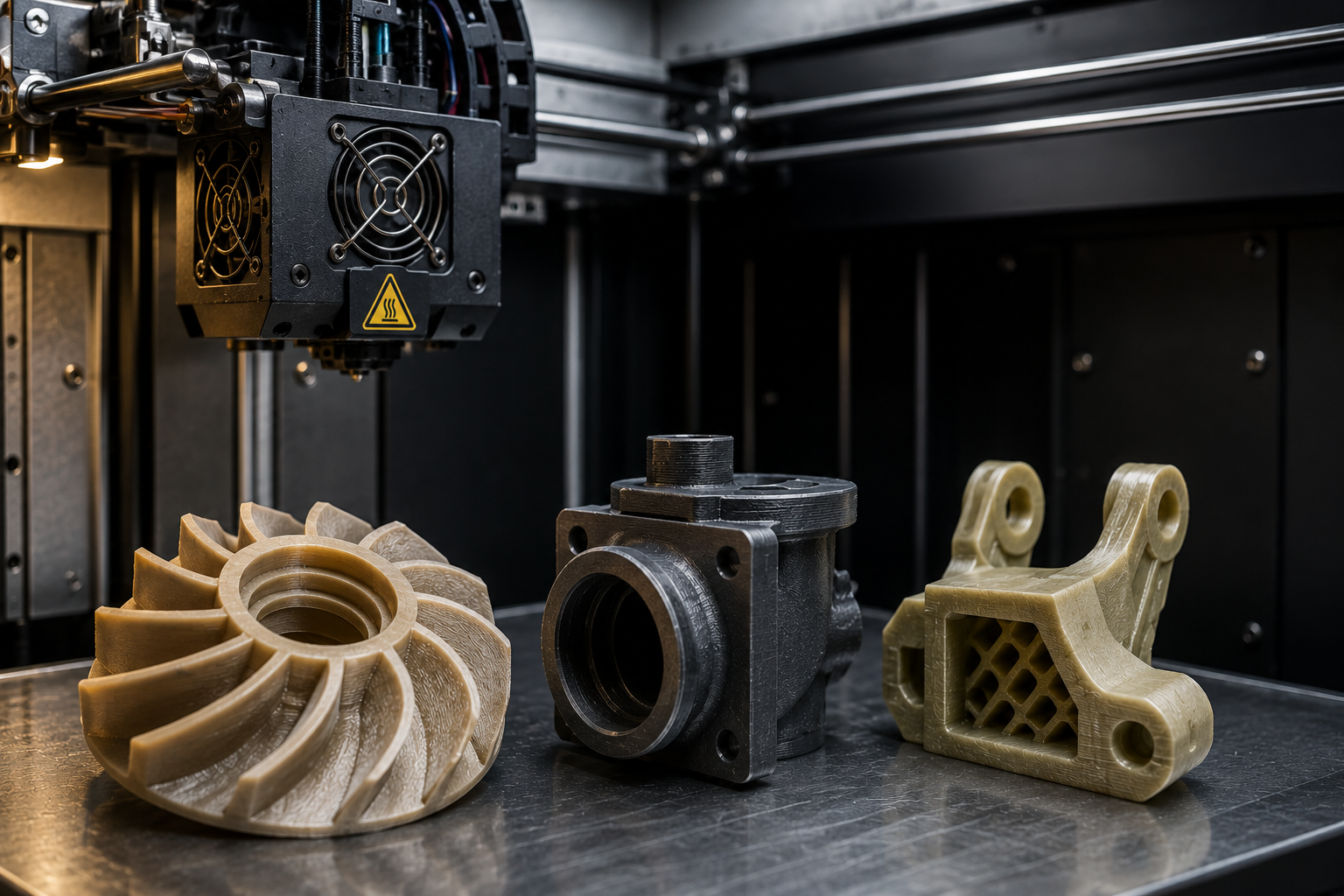
As additive manufacturing continues to advance, manufacturers are increasingly turning to 3D printing for applications that require exceptional thermal performance. From aerospace engines and automotive powertrain components to industrial tooling and energy systems, many parts must operate reliably in environments where temperatures can reach hundreds of degrees Celsius.
Choosing the right 3D printing service for high-temperature resistant materials is critical. The wrong manufacturing process can result in parts that deform, lose strength, or fail prematurely under thermal stress. The right process, however, can produce durable components that perform in some of the most demanding conditions imaginable.
This guide explores the leading 3D printing technologies for high-temperature applications, compares their strengths and limitations, and helps determine which solution is best for your project.
Understanding High-Temperature 3D Printing
High-temperature 3D printing refers to the production of parts using materials specifically engineered to maintain their structural integrity when exposed to elevated temperatures. Unlike standard plastics such as PLA and ABS, these materials are designed to resist thermal deformation, maintain mechanical strength, and withstand prolonged heat exposure.
In industrial environments, components may be subjected to:
- Continuous operating temperatures above 150°C
- Rapid heating and cooling cycles
- Direct exposure to flames or hot gases
- Harsh chemical environments combined with heat
- High mechanical loads at elevated temperatures
These conditions require specialized materials and manufacturing processes capable of delivering consistent performance.
Why Heat Resistance Matters in Additive Manufacturing
Temperature affects nearly every aspect of a material’s behavior. As heat increases, many materials soften, expand, or lose mechanical strength. In critical applications, even minor dimensional changes can compromise performance and safety.
High-temperature resistant materials help solve these challenges by providing:
Superior Dimensional Stability
Components maintain their shape and accuracy even when exposed to prolonged heat. This is particularly important for precision assemblies where tight tolerances are required.
Extended Service Life
Heat-resistant materials experience less degradation over time, reducing maintenance requirements and replacement costs.
Improved Mechanical Performance
Many advanced materials retain their strength, stiffness, and fatigue resistance at temperatures where standard materials would fail.
Enhanced Chemical Resistance
Industrial environments often combine high temperatures with corrosive chemicals, oils, fuels, and solvents. High-performance materials can withstand both thermal and chemical exposure.
Greater Design Freedom
Additive manufacturing enables the production of lightweight structures, internal channels, and complex geometries that would be difficult or impossible to create using traditional manufacturing methods.
Key Factors When Selecting a High-Temperature 3D Printing Service
Before choosing a manufacturing technology, engineers should evaluate several critical factors.
Maximum Operating Temperature
The first consideration is the highest temperature the component will experience during operation. Some applications may only require resistance to 100–150°C, while others may exceed 700°C.
For example:
- Electronic housings may operate below 150°C.
- Automotive engine components may exceed 300°C.
- Turbine applications can reach temperatures above 700°C.
Understanding the operating environment helps narrow down suitable material options.
Mechanical Load Requirements
A part exposed to high temperatures and significant mechanical loads will require a stronger material than a component serving primarily as a protective enclosure.
Questions to consider include:
- Will the part support heavy loads?
- Will it experience vibration or fatigue?
- Does it need impact resistance?
- Is long-term durability required?
Production Volume
The ideal technology may differ depending on whether you need:
- A single prototype
- Small-batch production
- Continuous manufacturing
Certain technologies become more cost-effective as production volumes increase.
Regulatory Requirements
Industries such as aerospace, defense, and medical manufacturing often require certified materials and validated production processes. These requirements can influence technology selection.
Metal Laser Powder Bed Fusion (LPBF): The Leading Choice for Extreme Temperatures
For applications requiring the highest levels of heat resistance, LPBF is often considered the gold standard.
This process uses a high-powered laser to selectively melt layers of metal powder, creating fully dense components with excellent mechanical properties.
Why LPBF Excels in High-Temperature Applications
LPBF enables manufacturers to process advanced engineering alloys specifically designed for extreme environments.
Benefits include:
- Exceptional thermal stability
- Near-wrought material properties
- Complex internal cooling channels
- Lightweight lattice structures
- High precision and repeatability
- Reduced material waste
These advantages make LPBF particularly attractive for industries seeking both performance and design flexibility.
Common High-Temperature LPBF Materials
Inconel 718
Inconel 718 is one of the most widely used nickel-based superalloys in additive manufacturing.
It offers:
- Excellent oxidation resistance
- Outstanding creep resistance
- High tensile strength
- Performance at temperatures exceeding 700°C
Common applications include turbine components, aerospace hardware, and energy systems.
Inconel 625
Known for its corrosion resistance and thermal stability, Inconel 625 performs exceptionally well in harsh industrial environments.
Titanium Ti6Al4V
Titanium combines:
- High strength
- Low weight
- Corrosion resistance
- Good thermal performance
This makes it ideal for aerospace and high-performance engineering applications.
Cobalt Chrome
Cobalt Chrome provides excellent wear resistance and maintains its mechanical properties under elevated temperatures.
High-Temperature FDM Printing: The Best Polymer Alternative
While metal printing dominates extreme-temperature applications, industrial FDM systems have become increasingly capable thanks to advances in engineering thermoplastics.
Modern industrial printers can process materials that rival some metals in specific applications.
Advantages of High-Temperature FDM
Organizations often choose FDM because it offers:
- Lower manufacturing costs
- Faster turnaround times
- Lightweight components
- Reduced material waste
- Easier post-processing
- Excellent chemical resistance
For many applications, these benefits outweigh the performance advantages of metal.
PEEK: The Gold Standard of High-Performance Polymers
PEEK is widely recognized as one of the most advanced thermoplastics available.
Its advantages include:
- Continuous use temperatures above 250°C
- Exceptional chemical resistance
- Outstanding fatigue performance
- High strength-to-weight ratio
- Low moisture absorption
PEEK is frequently used in aerospace, medical, and industrial sectors where reliability is critical.
PEKK
PEKK offers many of the same benefits as PEEK while providing improved printability and processing flexibility.
It is increasingly used in aerospace applications where lightweighting is a priority.
ULTEM™ (PEI)
ULTEM is a popular aerospace-grade thermoplastic known for:
- Flame retardancy
- Thermal stability
- Electrical insulation properties
- Regulatory compliance for transportation industries
Selective Laser Sintering (SLS) for Engineering Thermoplastics
SLS is another excellent option for heat-resistant applications.
Rather than extruding filament, SLS uses a laser to fuse polymer powder layer by layer.
The technology enables manufacturers to produce highly complex geometries without support structures.
Benefits of SLS
SLS provides several advantages:
- Excellent design freedom
- Strong and durable parts
- Uniform mechanical properties
- Efficient batch production
- Minimal material waste
Because multiple parts can be nested within a single build volume, SLS is often more efficient than other polymer technologies.
Best Applications for SLS
SLS is particularly well-suited for:
- Functional prototypes
- Automotive components
- Manufacturing fixtures
- Industrial housings
- Aerospace ducting systems
Although SLS materials generally cannot match the heat resistance of PEEK or metal alloys, they provide an excellent balance between performance and cost.
SLA for Heat-Resistant Prototypes
Stereolithography (SLA) is best known for producing highly detailed parts with exceptional surface quality.
While standard resins have limited heat resistance, specialized engineering resins can tolerate moderate temperatures.
Advantages of SLA
Key benefits include:
- Extremely smooth surface finishes
- High dimensional accuracy
- Fine feature resolution
- Fast prototype production
- Excellent visual quality
For engineers evaluating heat-resistant designs before moving to production materials, SLA can be a valuable tool.
Comparing High-Temperature Materials
Selecting the right high-temperature material is one of the most important decisions in any additive manufacturing project. The ideal material depends on factors such as operating temperature, mechanical requirements, environmental exposure, weight restrictions, and budget. While both metal alloys and high-performance polymers are designed to withstand elevated temperatures, each offers unique advantages that make them suitable for different applications.
Metal Alloys
Metal alloys remain the preferred choice for the most demanding high-temperature applications. These materials offer exceptional mechanical strength, thermal stability, and long-term durability, making them suitable for environments where failure is not an option.
Advanced manufacturing technologies such as Direct Metal Laser Sintering (DMLS), Selective Laser Melting (SLM), and Electron Beam Melting (EBM) allow manufacturers to produce highly complex metal components while maintaining excellent material properties.
Metal alloys are typically selected when:
- Maximum strength is required
- Components are exposed to extreme temperatures
- Long-term durability is critical
- Structural integrity is essential
- High mechanical loads are expected
- Wear and fatigue resistance are important
Advantages of Metal Alloys
Superior Heat Resistance
Many metal alloys can withstand temperatures far beyond the limits of polymer-based materials. Depending on the alloy, operating temperatures can exceed 1,000°C (1,832°F), making them suitable for aerospace engines, power generation systems, and industrial equipment.
Exceptional Mechanical Strength
Metal components maintain their structural performance under heavy loads, vibration, and repeated stress cycles. This makes them ideal for safety-critical applications where reliability is essential.
Long Service Life
Metal parts typically offer outstanding resistance to fatigue, wear, and deformation, allowing them to perform reliably over extended periods in harsh operating environments.
Complex Geometries
Metal additive manufacturing enables engineers to design lightweight lattice structures, internal cooling channels, and optimized geometries that improve performance while reducing weight.
Common High-Temperature Metal Materials
Popular metal alloys used in additive manufacturing include:
- Inconel® alloys
- Titanium alloys
- Stainless steel
- Cobalt-chrome alloys
- Tool steels
- Nickel-based superalloys
Typical Applications
Metal high-temperature materials are widely used in:
- Aerospace turbine components
- Rocket and spacecraft parts
- Defense equipment
- Energy and power generation systems
- Industrial machinery
- Oil and gas equipment
- Heat exchangers
For applications involving extreme heat, heavy mechanical loads, or long-term operation in harsh environments, metal alloys often provide the highest level of performance.
High-Performance Polymers
High-performance polymers offer a compelling alternative to metals when lightweight construction, corrosion resistance, and cost efficiency are priorities. These advanced thermoplastics are specifically engineered to maintain their strength and dimensional stability at elevated temperatures.
Modern high-temperature polymers have significantly expanded the capabilities of additive manufacturing, allowing engineers to replace metal components in many applications while reducing weight and simplifying production.
High-performance polymers are typically selected when:
- Weight reduction is important
- Corrosion resistance is required
- Electrical insulation is necessary
- Production costs must be controlled
- Complex geometries are needed
- Faster manufacturing turnaround is desired
Advantages of High-Performance Polymers
Lightweight Performance
One of the biggest advantages of advanced polymers is their low weight. Components can be significantly lighter than metal alternatives while still providing excellent mechanical performance.
This is especially valuable in industries such as aerospace and automotive, where reducing weight can improve fuel efficiency and overall system performance.
Excellent Chemical Resistance
Many high-performance polymers resist chemicals, fuels, oils, solvents, and corrosive environments better than certain metal materials. This makes them ideal for industrial and chemical processing applications.
Electrical Insulation Properties
Unlike metals, advanced polymers naturally provide electrical insulation, making them suitable for electronic housings, connectors, and electrical systems operating at elevated temperatures.
Lower Manufacturing Costs
Polymer 3D printing generally requires less expensive equipment and materials compared to metal additive manufacturing. Production costs are often lower, particularly for prototypes, low-volume production, and custom components.
Common High-Temperature Polymer Materials
Popular high-performance polymers include:
- PEEK (Polyether Ether Ketone)
- PEKK (Polyether Ketone Ketone)
- ULTEM™ (PEI)
- PPSU (Polyphenylsulfone)
- PPS (Polyphenylene Sulfide)
- High-temperature nylon composites
- Carbon fiber-reinforced thermoplastics
Typical Applications
High-performance polymers are commonly used in:
- Aerospace interior components
- Automotive under-the-hood parts
- Medical devices
- Semiconductor manufacturing equipment
- Industrial tooling
- Electrical housings and connectors
- Lightweight structural components
These materials provide an excellent balance between thermal performance, durability, and cost-effectiveness.
Industries That Rely on High-Temperature 3D Printing
High-temperature 3D printing has become a critical manufacturing solution for industries that require parts capable of withstanding extreme heat, mechanical stress, chemical exposure, and demanding operating conditions. Advanced materials such as PEEK, PEKK, ULTEM™, ceramic-filled polymers, and metal alloys allow engineers to produce durable components that perform reliably where standard plastics would fail.
Aerospace
The aerospace industry is one of the largest adopters of high-temperature additive manufacturing. Aircraft and spacecraft components are often exposed to extreme temperatures, pressure fluctuations, vibration, and harsh environmental conditions. Traditional manufacturing methods can be expensive and time-consuming when producing complex aerospace parts, making 3D printing an attractive alternative.
High-temperature materials enable the production of lightweight yet durable components that help reduce overall aircraft weight, improve fuel efficiency, and maintain performance under demanding conditions.
Common aerospace applications include:
- Turbine components
- Fuel system parts
- Heat exchangers
- Lightweight structural brackets
- Environmental control system components
- Aircraft ducting and airflow systems
- Satellite and spacecraft hardware
By utilizing advanced materials such as PEEK and PEKK, aerospace manufacturers can create parts that meet stringent industry requirements while reducing production lead times and material waste.
Automotive
Automotive manufacturers increasingly use high-temperature 3D printing to accelerate product development and produce components that must endure elevated operating temperatures. Modern engines, exhaust systems, and under-the-hood assemblies generate significant heat, requiring materials that maintain dimensional stability and mechanical strength.
Additive manufacturing also allows automotive engineers to rapidly prototype new designs, test performance, and manufacture custom or low-volume parts without investing in costly tooling.
Common automotive applications include:
- Engine bay components
- Exhaust system parts
- Air intake systems
- Production tooling and fixtures
- Jigs and assembly aids
- Performance vehicle components
- Custom motorsport parts
For electric vehicle manufacturers, high-temperature materials are also used in battery system components and thermal management solutions where heat resistance is essential for safety and performance.
Energy and Power Generation
The energy sector operates equipment in some of the most demanding environments, where components are routinely exposed to high temperatures, corrosive substances, and continuous mechanical stress. High-temperature 3D printing enables the production of complex geometries that improve efficiency, reduce weight, and enhance thermal performance.
Power generation facilities, renewable energy providers, and oil and gas companies use additive manufacturing to develop specialized parts that would be difficult or expensive to produce using conventional methods.
Common energy applications include:
- Turbine blades and vanes
- Burner components
- Heat management systems
- Oil and gas equipment
- Flow control components
- Energy plant maintenance parts
- Custom replacement components
The ability to quickly manufacture replacement parts can significantly reduce downtime and maintenance costs in critical energy infrastructure.
Industrial Manufacturing
Industrial manufacturers rely on high-temperature materials to create tools, fixtures, and production equipment that can withstand harsh factory environments. These applications often require excellent thermal stability, wear resistance, and long-term durability.
Additive manufacturing helps manufacturers streamline production by reducing lead times, lowering tooling costs, and enabling rapid customization.
Common industrial applications include:
- Production tooling
- Injection molding inserts
- Molds and dies
- Machine components
- Inspection fixtures
- Welding and assembly jigs
- End-of-arm tooling for robotics
High-temperature 3D printing also allows manufacturers to optimize designs with internal cooling channels, lightweight structures, and complex geometries that improve operational efficiency and extend component lifespan.
Medical and Healthcare
The medical industry increasingly uses high-temperature materials for applications requiring sterilization resistance and biocompatibility. Many medical devices must withstand repeated autoclave cycles without deforming or losing performance.
Common healthcare applications include:
- Surgical guides
- Sterilizable medical tools
- Orthopedic device components
- Dental manufacturing tools
- Laboratory equipment
- Medical device prototypes
Materials such as PEEK are particularly valuable in healthcare because they offer excellent strength, chemical resistance, and compatibility with sterilization processes.
Defense and Military
Defense organizations require highly durable components capable of operating in extreme environments, including high temperatures, sand, moisture, and mechanical impact. High-temperature additive manufacturing supports rapid production, field repairs, and mission-specific customization.
Common defense applications include:
- Vehicle components
- Aerospace defense systems
- Communication equipment housings
- Maintenance and repair parts
- Custom mission-critical tools
- Thermal protection components
The ability to produce replacement parts quickly can significantly improve equipment readiness and operational flexibility.
Electronics and Semiconductor Manufacturing
High-temperature 3D printing is also valuable in electronics manufacturing, where components often encounter elevated temperatures during production and operation.
Common applications include:
- Semiconductor manufacturing fixtures
- Electronics assembly tooling
- Thermal management components
- Test fixtures
- Insulating parts
- High-temperature housings and enclosures
Advanced polymers with excellent electrical insulation properties and thermal stability help ensure reliable performance in sensitive manufacturing environments.
Why High-Temperature 3D Printing Matters Across Industries
Across aerospace, automotive, energy, industrial manufacturing, healthcare, defense, and electronics, high-temperature 3D printing enables companies to create parts that combine heat resistance, strength, and design freedom. These capabilities make additive manufacturing an increasingly important solution for producing high-performance components that can operate reliably in demanding real-world environments.
How Additive Plus Supports High-Temperature Applications
Additive Plus provides advanced additive manufacturing solutions for organizations working with demanding thermal applications.
The company’s portfolio includes industrial metal and polymer 3D printing technologies, atomization equipment, advanced powders, and engineering support services. These solutions help manufacturers develop parts capable of operating in aerospace, automotive, research, and industrial environments where heat resistance is critical.
Whether companies are evaluating LPBF systems for Inconel production or exploring high-performance polymers such as PEEK and PEKK, Additive Plus offers access to the technologies and expertise needed to accelerate development and production.
Conclusion
There is no single best 3D printing service for every high-temperature application. The ideal solution depends on operating temperatures, mechanical requirements, regulatory standards, and budget constraints.
For the most demanding environments, LPBF metal printing remains the preferred choice due to its compatibility with high-performance alloys such as Inconel, Titanium, and Cobalt Chrome.
For lightweight applications requiring excellent thermal performance, industrial FDM systems processing PEEK, PEKK, and ULTEM offer an attractive alternative.
Meanwhile, SLS provides a strong balance between cost and performance, while SLA remains valuable for detailed heat-resistant prototypes.
By carefully matching the manufacturing technology to the application’s requirements, organizations can achieve reliable performance, longer component life, and greater design freedom.
Frequently asked questions
What is the best 3D printing technology for parts exposed to temperatures above 500°C?
LPBF metal printing is generally the best choice for temperatures above 500°C because it supports high-performance alloys such as Inconel 718 and Inconel 625, which maintain strength and stability in extreme environments.
Which 3D printing material has the highest temperature resistance?
Nickel-based superalloys such as Inconel 718 are among the most heat-resistant materials available for additive manufacturing and can perform at temperatures exceeding 700°C.
Is PEEK suitable for industrial production?
Yes. PEEK is widely used in aerospace, medical, semiconductor, and industrial manufacturing applications due to its excellent thermal, chemical, and mechanical properties.
Can SLS parts be used in high-temperature environments?
Yes, SLS parts can withstand moderate heat and are often used for functional industrial applications. However, they generally do not offer the same thermal performance as PEEK or metal alloys.
Is metal 3D printing always better than polymer 3D printing?
Not necessarily. While metal parts offer superior temperature resistance and strength, high-performance polymers can provide sufficient performance at a lower cost while significantly reducing weight.
What industries benefit most from high-temperature 3D printing?
Aerospace, automotive, energy, defense, medical, research, and industrial manufacturing sectors are among the largest adopters of high-temperature additive manufacturing technologies.
How much does high-temperature 3D printing cost?
Costs vary depending on the material, technology, part size, and production volume. Metal LPBF is typically the most expensive option, while engineering polymers offer a more affordable alternative for many applications.
What is the difference between PEEK and ULTEM?
PEEK generally offers higher mechanical strength and chemical resistance, while ULTEM provides excellent flame resistance and is often chosen for aerospace and transportation applications.
Have a question or a project? Let’s talk.
Tell us what you need — a real applications engineer replies within 24 hours. NDA standard, no sales script.