
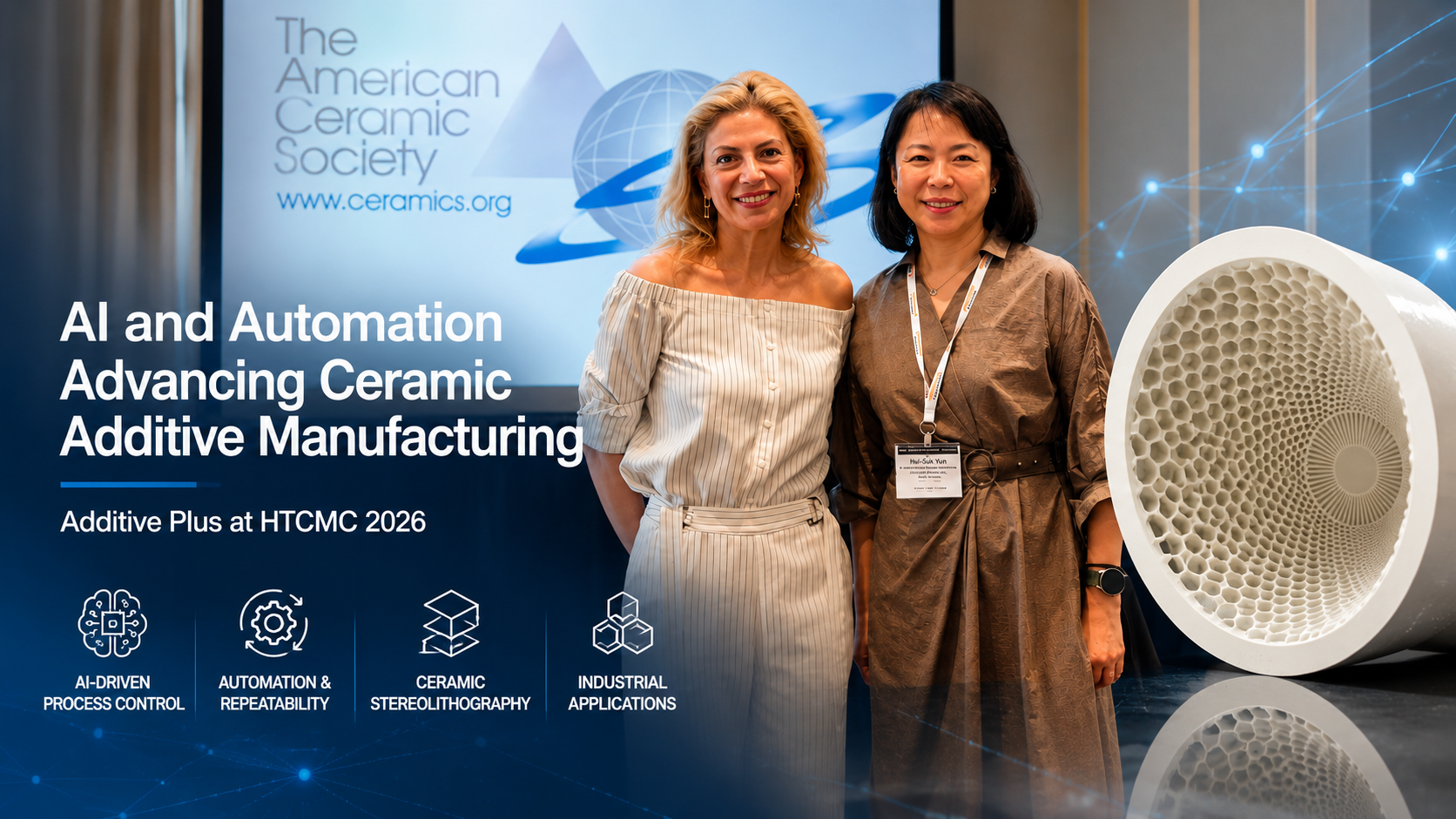
Additive Plus participated in the 12th International Conference on High Temperature Ceramic Matrix Composites (HTCMC), where our CEO, Ashkhen Ovsepyan, joined the technical session Additive Manufacturing Technologies and Applications to discuss how artificial intelligence and automation are helping transform ceramic additive manufacturing from a research-driven technology into a repeatable industrial process.
The presentation focused on one of the key developments shaping the future of ceramic 3D printing: the growing role of AI-assisted process control. As ceramic additive manufacturing moves beyond prototyping and into production environments, manufacturers are increasingly focused on reliability, repeatability, and process stability rather than machine speed alone.
A central topic of the discussion was 3DCeram’s CERIA ecosystem, which applies artificial intelligence to support process optimization and production control. By combining data-driven parameter management, real-time monitoring, and automated decision-making, the platform helps reduce operator dependency and improve manufacturing consistency.
“Industrial adoption requires more than the ability to print a part,” said Ashkhen Ovsepyan. “The challenge is achieving consistent results across production runs while minimizing waste, reducing human error, and maintaining process control. This is where AI and automation are beginning to make a measurable impact.”
The presentation highlighted several advantages of AI-assisted ceramic additive manufacturing, including:
- Improved process reliability and repeatability
- Reduced dependence on operator expertise
- Automated process monitoring and optimization
- Lower material waste through improved slurry management
- Enhanced production efficiency and scalability
The discussion also addressed why ceramic stereolithography is particularly well positioned for automation. Its top-down process architecture enables efficient integration of sensors, software control, and automated workflows while supporting scalable production configurations ranging from single-laser to multi-laser systems.
These capabilities are becoming increasingly important for industries that rely on advanced ceramic components, including aerospace, defense, medical technology, semiconductors, and other high-performance technical ceramic applications. Examples discussed during the presentation included RF-transparent radomes, structural aerospace components, semiconductor manufacturing parts, and complex technical ceramics that are difficult to produce using conventional methods.
As ceramic additive manufacturing continues to mature, AI-driven process control is expected to play a critical role in accelerating industrial adoption and enabling reliable production at scale.
Additive Plus would be pleased to share additional information about the CERIA AI ecosystem and its industrial applications. The presentation is available upon request for organizations interested in exploring the future of industrial ceramic 3D printing.
Have a question or a project? Let’s talk.
Tell us what you need — a real applications engineer replies within 24 hours. NDA on request, no sales script.