
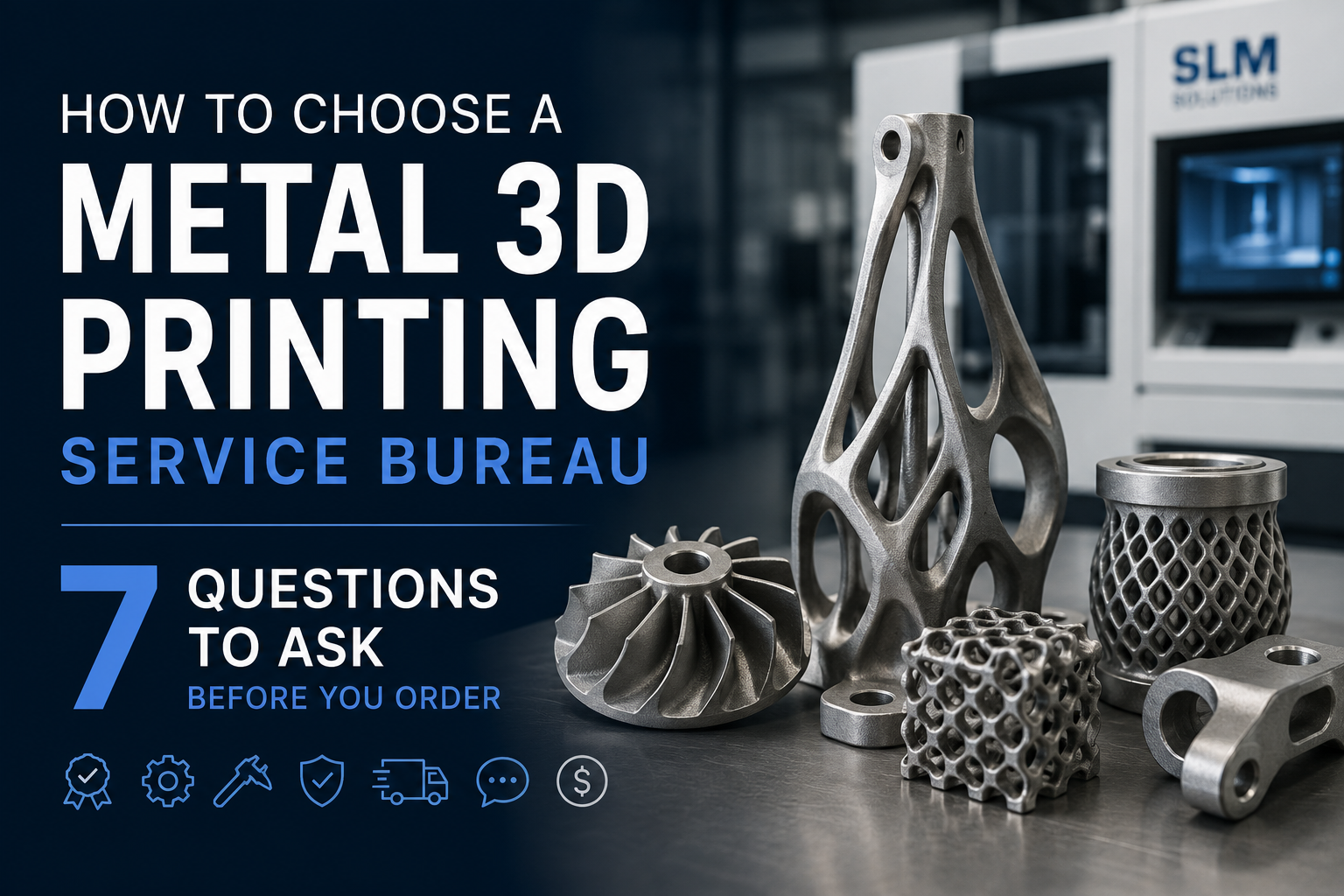
Metal additive manufacturing has transformed the way companies develop prototypes, tooling, and end-use production parts. However, the quality of your finished component depends heavily on the capabilities of the metal 3D printing service bureau you choose.
Not all service providers offer the same equipment, expertise, quality control procedures, or material options. Before placing an order, it’s important to ask the right questions to ensure your project meets performance, budget, and timeline requirements.
Here are seven essential questions every engineer, product developer, and manufacturer should ask before selecting a metal 3D printing partner.
1. What Metal 3D Printing Technologies Do You Offer?
One of the first questions you should ask any metal 3D printing service bureau is which additive manufacturing technologies they offer. Not all metal 3D printing processes are the same, and choosing the right technology can significantly impact part quality, mechanical performance, production speed, lead times, and overall project cost.
A reputable service provider should offer multiple technologies or, at minimum, have the expertise to explain why a specific process is best suited for your application. The goal is not simply to print your design but to ensure the final part meets your functional, dimensional, and performance requirements.
Common Metal 3D Printing Technologies
Selective Laser Melting (SLM)
Selective Laser Melting (SLM) uses a high-powered laser to fully melt metal powder layer by layer, producing dense, fully functional metal components. SLM is widely used in aerospace, automotive, medical, and industrial manufacturing because it delivers excellent mechanical properties and high dimensional accuracy.
Advantages:
- Near-wrought material properties
- High density and strength
- Excellent accuracy and detail
- Suitable for complex geometries and internal channels
Ideal for:
- Functional prototypes
- End-use production parts
- Lightweight structures
- High-performance engineering applications
Direct Metal Laser Sintering (DMLS)
DMLS is similar to SLM and is often used interchangeably in industry discussions. The process uses a laser to fuse metal powder into solid components. DMLS is particularly popular for producing intricate designs that would be difficult or impossible to manufacture using traditional machining methods.
Advantages:
- Complex geometric freedom
- Reduced material waste
- Strong mechanical performance
- Excellent repeatability
Ideal for:
- Aerospace components
- Medical implants
- Tooling inserts
- Small-batch manufacturing
Laser Powder Bed Fusion (LPBF)
LPBF is the broader category that includes technologies such as SLM and DMLS. During the process, a thin layer of metal powder is spread across a build platform, and a laser selectively melts specific areas according to the digital design.
LPBF systems are among the most widely adopted metal additive manufacturing technologies due to their ability to produce highly detailed, precise parts.
Advantages:
- Exceptional surface quality
- Tight tolerances
- Wide material compatibility
- Proven industrial adoption
Ideal for:
- Precision engineering
- Aerospace and defense applications
- Medical devices
- Production-grade metal parts
Electron Beam Melting (EBM)
EBM uses an electron beam instead of a laser to melt metal powder inside a vacuum chamber. This technology is particularly effective for titanium and other reactive metals.
Because the build environment is maintained under vacuum and elevated temperatures, EBM often produces parts with lower residual stress compared to laser-based processes.
Advantages:
- Faster build speeds for certain applications
- Reduced residual stress
- Excellent titanium processing capabilities
- Strong mechanical properties
Ideal for:
- Aerospace structures
- Orthopedic implants
- Titanium components
- High-performance engineering parts
Binder Jetting
Binder Jetting differs significantly from powder bed fusion technologies. Instead of melting powder during printing, a liquid binder selectively joins powder particles together. The printed part is then sintered in a furnace to achieve its final density and strength.
This process can be highly cost-effective for larger production volumes.
Advantages:
- Faster printing speeds
- Lower production costs
- No support structures required
- Scalable for mass production
Ideal for:
- Large production runs
- Cost-sensitive projects
- Complex geometries
- Manufacturing spare parts
Directed Energy Deposition (DED)
DED uses focused thermal energy, such as a laser or electron beam, to melt metal as it is deposited. Unlike powder bed technologies, DED can build onto existing components and is frequently used for repairs, modifications, and large-scale manufacturing.
Advantages:
- Large build volumes
- Component repair capabilities
- Material addition to existing parts
- High deposition rates
Ideal for:
- Repairing high-value components
- Large industrial parts
- Aerospace maintenance
- Hybrid manufacturing applications
Why Technology Selection Matters
Choosing the wrong printing technology can lead to unnecessary costs, longer lead times, excessive post-processing, or parts that fail to meet performance requirements. For example, a component requiring extremely fine detail and tight tolerances may be best suited for LPBF or SLM, while a larger, lower-cost production run may benefit from Binder Jetting.
Similarly, if your project involves repairing an existing metal component, DED may be far more practical than starting from scratch with a powder bed fusion process.
An experienced service bureau should evaluate factors such as:
- Part size and geometry
- Mechanical performance requirements
- Material selection
- Surface finish expectations
- Production quantity
- Budget constraints
- Lead time requirements
- Certification or industry compliance needs
Questions to Ask the Service Bureau
Before moving forward, ask the provider:
- Which metal 3D printing technologies do you offer in-house?
- Which process do you recommend for my application and why?
- What are the advantages and limitations of that technology?
- What materials are available for each process?
- What tolerances can you achieve?
- What post-processing services are included?
- Do you have case studies or examples of similar projects?
A knowledgeable service bureau should be able to clearly explain the tradeoffs between technologies and provide recommendations based on engineering requirements rather than simply offering the process they happen to own. Their expertise can help optimize your design, reduce production costs, and improve final part performance.
2. What Materials Are Available?
The metal 3D printing technology is only one part of the equation—the material you choose is equally important. Material selection directly affects a part’s strength, durability, corrosion resistance, heat resistance, weight, machinability, and overall performance. Even the most advanced printing process cannot compensate for using a material that is poorly suited to the application’s requirements.
When evaluating a metal 3D printing service bureau, ask about their available material portfolio and whether they have experience working with the specific alloy your project requires. An experienced provider should be able to guide you toward the most suitable material based on your operating environment, performance expectations, and budget.
Why Material Selection Matters
Different industries have vastly different material requirements. Aerospace components often require lightweight, high-strength alloys such as titanium, while medical devices may require biocompatible materials. Industrial tooling applications frequently rely on hardened tool steels, while marine or chemical processing equipment may prioritize corrosion resistance.
The right material can help you achieve:
- Higher mechanical strength
- Improved wear resistance
- Better corrosion protection
- Reduced component weight
- Enhanced thermal performance
- Longer service life
- Compliance with industry regulations
Selecting the wrong material can result in premature part failure, costly redesigns, production delays, or increased manufacturing expenses.
Common Metal 3D Printing Materials
Stainless Steel 316L
316L stainless steel is one of the most widely used materials in metal additive manufacturing. It offers excellent corrosion resistance, good strength, and strong resistance to chemicals and moisture.
Key Benefits:
- Outstanding corrosion resistance
- Good weldability
- Excellent surface finish potential
- Suitable for harsh environments
Common Applications:
- Medical devices
- Food processing equipment
- Marine components
- Industrial tooling
- Chemical processing systems
Stainless Steel 17-4 PH
17-4 PH is a precipitation-hardening stainless steel known for its combination of strength, hardness, and corrosion resistance. It is frequently selected for engineering applications requiring high mechanical performance.
Key Benefits:
- High tensile strength
- Excellent hardness
- Good corrosion resistance
- Heat-treatable for enhanced performance
Common Applications:
- Aerospace components
- Industrial machinery
- Manufacturing tools
- Mechanical assemblies
Aluminum AlSi10Mg
AlSi10Mg is a lightweight aluminum alloy commonly used in aerospace, automotive, and industrial applications. It provides an excellent balance of strength, weight reduction, and thermal performance.
Key Benefits:
- Lightweight construction
- Good strength-to-weight ratio
- Excellent thermal conductivity
- Corrosion resistance
Common Applications:
- Aerospace structures
- Automotive components
- Heat exchangers
- Lightweight prototypes
Titanium Ti-6Al-4V (Ti64)
Titanium Ti64 is one of the most sought-after materials in metal additive manufacturing due to its exceptional strength-to-weight ratio, corrosion resistance, and biocompatibility.
Key Benefits:
- Extremely high strength
- Lightweight performance
- Excellent corrosion resistance
- Biocompatible properties
Common Applications:
- Aerospace components
- Medical implants
- Orthopedic devices
- High-performance automotive parts
Inconel 625
Inconel 625 is a nickel-based superalloy designed for extreme environments involving high temperatures and corrosive conditions.
Key Benefits:
- Exceptional corrosion resistance
- High-temperature performance
- Strong fatigue resistance
- Excellent oxidation resistance
Common Applications:
- Oil and gas equipment
- Marine systems
- Aerospace engines
- Energy generation components
Inconel 718
Inconel 718 is another high-performance nickel superalloy that maintains strength even under extreme temperatures and mechanical stress.
Key Benefits:
- Excellent high-temperature strength
- Superior creep resistance
- Outstanding fatigue performance
- Strong oxidation resistance
Common Applications:
- Jet engine components
- Turbine systems
- Aerospace hardware
- Power generation equipment
Cobalt Chrome
Cobalt Chrome offers exceptional wear resistance, hardness, and biocompatibility, making it a popular choice in medical and dental applications.
Key Benefits:
- High hardness
- Excellent wear resistance
- Strong corrosion resistance
- Biocompatible material properties
Common Applications:
- Dental restorations
- Orthopedic implants
- Surgical instruments
- High-wear industrial components
Tool Steels
Tool steels are engineered to withstand high stress, wear, and repeated use. They are commonly used for molds, dies, and manufacturing tools.
Key Benefits:
- Exceptional hardness
- High wear resistance
- Excellent durability
- Suitable for heat treatment
Common Applications:
- Injection molding tools
- Manufacturing fixtures
- Dies and molds
- Production tooling
Material Availability Is Just as Important as Material Selection
Not every service bureau maintains inventory for every alloy. Some providers regularly stock popular materials like 316L, 17-4 PH, Ti64, and AlSi10Mg, while specialty alloys may require additional sourcing, qualification, and lead time.
Before placing an order, ask:
- Is the material stocked in-house?
- How often is it used in production?
- Are there minimum order quantities?
- Will special material sourcing increase lead times?
- Is the material qualified for your specific industry?
A provider with extensive experience using your chosen material can often deliver better quality, more predictable results, and faster turnaround times.
Ask About Material Certifications and Traceability
For aerospace, medical, defense, automotive, and regulated manufacturing projects, documentation can be just as important as the printed part itself.
A qualified metal 3D printing service bureau should be able to provide:
- Material certificates (CoC and CoA)
- Powder batch documentation
- Material traceability records
- Process qualification reports
- Inspection and quality control records
- Mechanical testing results when required
These documents help verify that the material meets industry standards and regulatory requirements.
Questions to Ask the Service Bureau
When discussing materials with a potential provider, consider asking:
- Which metal materials do you offer regularly?
- Which material do you recommend for my application?
- Can you provide material certifications?
- Do you offer full material traceability?
- Are specialty alloys available upon request?
- What mechanical properties can I expect?
- Have you manufactured similar parts using this material?
- Are post-processing and heat-treatment options available?
A reliable service bureau should not simply provide a list of available materials. They should help you select the alloy that delivers the best balance of performance, manufacturability, lead time, and cost for your specific application.
3. What Quality Control and Certification Standards Do You Follow?
When ordering metal 3D printed parts, quality is just as important as design and material selection. Even a perfectly engineered component can fail if the manufacturing process lacks proper quality controls. This is why evaluating a service bureau’s quality management system should be one of your top priorities.
For industries such as aerospace, medical, automotive, defense, energy, and industrial manufacturing, quality assurance is often a non-negotiable requirement. Parts may be subjected to extreme temperatures, heavy loads, corrosive environments, or strict regulatory standards. In these cases, consistency, traceability, and documented quality processes are essential.
A reputable metal 3D printing service bureau should be transparent about its quality management practices, inspection procedures, certifications, and testing capabilities. If a provider struggles to explain how they ensure part quality, it may be a sign that their processes are not fully mature.
Why Quality Control Matters in Metal Additive Manufacturing
Metal 3D printing involves numerous variables that can affect the final part, including:
- Powder quality
- Machine calibration
- Laser parameters
- Layer thickness
- Build orientation
- Heat treatment processes
- Support removal procedures
- Post-processing methods
Without rigorous process controls, these variables can introduce defects such as:
- Porosity
- Dimensional inaccuracies
- Warping and distortion
- Surface defects
- Internal voids
- Reduced mechanical performance
Strong quality control systems help identify and eliminate these issues before parts reach the customer.
Look for Recognized Certifications
One of the first indicators of a service bureau’s commitment to quality is certification to recognized industry standards.
ISO 9001 Certification
ISO 9001 is one of the most widely recognized quality management standards worldwide. It demonstrates that a company has established documented procedures for maintaining quality, managing risks, and continuously improving operations.
A service bureau with ISO 9001 certification typically has:
- Documented quality management systems
- Standardized manufacturing procedures
- Corrective and preventive action processes
- Ongoing quality monitoring
- Traceable production records
While ISO 9001 does not guarantee perfect parts, it shows that the organization has implemented structured quality controls.
Industry-Specific Certifications
Depending on your application, additional certifications may be necessary.
Examples include:
AS9100
- Aerospace and aviation quality management systems
- Required by many aerospace manufacturers and suppliers
ISO 13485
- Medical device manufacturing quality standards
- Common for healthcare and implant applications
IATF 16949
- Automotive industry quality requirements
- Supports high-volume manufacturing environments
NADCAP Accreditation
- Specialized aerospace process certification
- Often required for critical aerospace components
If your project operates within a regulated industry, verify that the service bureau holds the necessary certifications before placing an order.
What Inspection Equipment Do You Use?
Advanced inspection equipment is essential for verifying that printed components meet dimensional and quality requirements.
Ask the service bureau what tools and technologies they use for inspection.
Common inspection equipment includes:
Coordinate Measuring Machines (CMM)
CMM systems provide highly accurate dimensional measurements and help verify critical tolerances.
Used for:
- Precision dimensional validation
- Tolerance verification
- Geometric inspection
3D Scanners
Industrial 3D scanners compare printed parts against CAD models to identify deviations and ensure dimensional accuracy.
Used for:
- First article inspections
- Reverse engineering verification
- Surface analysis
CT Scanning (Computed Tomography)
CT scanning allows engineers to inspect internal features without destroying the part.
Used for:
- Internal defect detection
- Porosity analysis
- Verification of internal channels
- Complex lattice inspection
Optical Measurement Systems
These systems provide fast and accurate dimensional inspection for production environments.
Used for:
- Surface measurements
- Feature verification
- Production quality checks
A service bureau equipped with advanced inspection technologies can often identify potential issues before they become costly production problems.
Can You Provide Dimensional Inspection Reports?
For critical applications, dimensional accuracy should never be assumed.
Ask whether the provider can supply:
- First article inspection reports (FAI)
- Dimensional verification reports
- GD&T inspection documentation
- CMM reports
- Final quality inspection records
These reports provide objective evidence that your part meets specified tolerances and design requirements.
This documentation can be especially valuable for regulated industries, production qualification, and customer approvals.
Do You Perform Density Testing?
Density is a key indicator of part quality in metal additive manufacturing. Low-density parts may contain internal voids or porosity that can negatively impact performance.
Many leading service bureaus perform density testing to verify that printed parts meet quality requirements.
Common methods include:
- Archimedes density testing
- Metallographic analysis
- CT scanning verification
- Process qualification testing
High-density parts generally exhibit stronger mechanical properties and improved reliability.
Do You Perform Mechanical Testing?
Mechanical testing provides direct evidence that a printed material performs as expected.
Testing may include:
Tensile Testing
Measures:
- Ultimate tensile strength
- Yield strength
- Elongation
Hardness Testing
Measures material resistance to deformation and wear.
Fatigue Testing
Evaluates how components perform under repeated loading cycles.
Impact Testing
Determines a material’s resistance to sudden forces and shocks.
Metallurgical Analysis
Examines:
- Microstructure
- Grain formation
- Material consistency
- Heat treatment effectiveness
These tests are especially important for aerospace, medical, automotive, and mission-critical applications where part failure is not an option.
Process Monitoring and Build Validation
Modern metal 3D printing systems often include in-process monitoring technologies that help detect issues during production.
Ask whether the bureau uses:
- Melt pool monitoring
- Layer-by-layer imaging
- Process parameter tracking
- Build quality monitoring systems
- Machine calibration verification
These tools can improve consistency and reduce the risk of manufacturing defects.
Questions to Ask a Metal 3D Printing Service Bureau
When evaluating a potential provider, consider asking:
- Are you ISO 9001 certified?
- Do you hold AS9100, ISO 13485, or other industry certifications?
- What quality management systems do you follow?
- What inspection equipment is available in-house?
- Can you provide dimensional inspection reports?
- Do you perform CT scanning or non-destructive testing?
- Do you offer density testing and material validation?
- Can you provide mechanical testing reports?
- How do you ensure process consistency between builds?
- What documentation is included with finished parts?
Quality Should Never Be an Afterthought
The lowest quote is not always the best value if the provider lacks the quality controls needed to ensure consistent results. A qualified metal 3D printing service bureau should be able to demonstrate a clear commitment to quality through certifications, inspection capabilities, testing procedures, and documented manufacturing processes.
By carefully evaluating a provider’s quality management system, you can reduce risk, improve reliability, and ensure your metal 3D printed parts meet both performance expectations and industry requirements.
4. What Post-Processing Services Are Available?
Metal 3D printing is only one part of the manufacturing process. In most cases, a freshly printed component is not immediately ready for final use. Depending on the application, metal additive manufacturing parts often require a variety of post-processing operations to achieve the desired mechanical properties, dimensional accuracy, surface finish, and aesthetic appearance.
When evaluating a metal 3D printing service bureau, it is important to understand what post-processing services are available and whether they are performed in-house or outsourced. A provider that offers a complete manufacturing workflow can significantly simplify project management, improve quality consistency, reduce lead times, and eliminate the need to coordinate multiple vendors.
Why Post-Processing Matters
Metal additive manufacturing creates parts layer by layer, which can result in support structures, surface roughness, residual stresses, and dimensional variations that must be addressed before the part is ready for production use.
Post-processing can improve:
- Surface quality
- Dimensional accuracy
- Mechanical properties
- Fatigue resistance
- Corrosion resistance
- Wear resistance
- Aesthetic appearance
For critical aerospace, medical, automotive, and industrial applications, post-processing is often essential rather than optional.
Common Metal 3D Printing Post-Processing Services
Support Removal
Most powder bed fusion processes require support structures to anchor parts during printing and manage thermal stresses.
After printing, these supports must be removed carefully without damaging the component.
Benefits include:
- Improved part functionality
- Better appearance
- Preparation for additional finishing processes
CNC Machining
Many metal 3D printed parts require secondary machining to achieve tight tolerances or create precision features.
CNC machining is commonly used for:
- Critical mating surfaces
- Precision holes
- Threads
- Tight tolerance features
- Functional interfaces
A service bureau that combines additive manufacturing with CNC machining can often deliver near-net-shape parts that meet strict engineering specifications.
Surface Finishing
As-printed metal components may have visible layer lines or rough surfaces depending on the printing process and geometry.
Surface finishing methods help improve both appearance and functionality.
Benefits include:
- Reduced roughness
- Enhanced aesthetics
- Improved sealing surfaces
- Better aerodynamic or fluid-flow performance
Sandblasting and Bead Blasting
Blasting processes remove powder residue and create a more uniform surface finish.
Benefits include:
- Cleaner appearance
- Consistent surface texture
- Improved preparation for coatings
- Enhanced cosmetic quality
Heat Treatment
Metal additive manufacturing can introduce residual stresses during the printing process.
Heat treatment helps optimize material properties and improve performance.
Benefits include:
- Stress relief
- Improved mechanical properties
- Enhanced durability
- Greater dimensional stability
Hot Isostatic Pressing (HIP)
HIP is a specialized process that applies high temperature and pressure simultaneously to reduce internal porosity and improve material density.
HIP is commonly used for:
- Aerospace components
- Medical implants
- High-performance industrial parts
Benefits include:
- Improved fatigue strength
- Reduced internal defects
- Enhanced reliability
- Increased material density
Polishing
Applications requiring smooth or mirror-like surfaces may benefit from polishing.
Polishing is particularly common in:
- Medical devices
- Consumer products
- Mold tooling
- High-end industrial applications
Benefits include:
- Improved appearance
- Better cleanability
- Reduced friction
- Enhanced performance
Threading and Tapping
Many functional components require threaded features for assembly.
Rather than printing threads directly, service bureaus often machine or tap threads after printing for greater accuracy and durability.
Coating and Anodizing
Protective coatings can improve wear resistance, corrosion resistance, conductivity, or aesthetics.
Examples include:
- Anodizing
- Powder coating
- Nickel plating
- Ceramic coatings
- Hard coatings
These treatments can significantly extend part lifespan in demanding environments.
In-House vs. Outsourced Post-Processing
One of the most important questions to ask is whether post-processing services are performed internally or outsourced to external vendors.
In-house post-processing often provides:
- Faster turnaround times
- Better quality control
- Simplified communication
- Reduced shipping delays
- Greater accountability
If services are outsourced, ask how quality is managed and whether additional lead times should be expected.
Questions to Ask the Service Bureau
- What post-processing services do you offer?
- Which services are performed in-house?
- Do you provide CNC machining and finishing?
- Can you perform HIP treatment?
- What surface finishes are available?
- Do you offer coating and plating services?
- How do post-processing requirements affect lead times and costs?
The most capable service bureaus act as full manufacturing partners, helping customers move from design to finished production-ready parts through a single streamlined process.
5. What Is Your Experience with Similar Applications?
Not all metal 3D printing projects are created equal. Producing a lightweight aerospace bracket requires a different level of expertise than manufacturing a medical implant, industrial tooling insert, or automotive component. That is why one of the most valuable questions you can ask a service bureau is whether they have experience with projects similar to yours.
A provider with relevant industry experience can often identify design challenges early, recommend material and process improvements, and help avoid costly mistakes before production begins.
Why Industry Experience Matters
Experienced service bureaus understand more than just how to operate metal 3D printers. They understand how parts perform in real-world environments and how specific industry requirements influence design and manufacturing decisions.
This knowledge can help:
- Reduce development time
- Improve manufacturability
- Lower production costs
- Minimize design iterations
- Enhance part performance
- Accelerate product launches
In many cases, the insights gained from previous projects can save weeks or even months of development effort.
Aerospace Applications
Aerospace manufacturers frequently use metal additive manufacturing to create lightweight structures, fuel system components, brackets, heat exchangers, and engine parts.
Experienced aerospace suppliers understand:
- Weight optimization strategies
- Certification requirements
- Traceability standards
- Fatigue performance considerations
- High-temperature material selection
Automotive Applications
Automotive companies increasingly rely on metal 3D printing for prototyping, motorsports, tooling, and low-volume production.
Relevant expertise may include:
- Lightweighting initiatives
- Rapid development cycles
- Thermal management components
- Tooling and fixtures
- Performance optimization
Medical Device Applications
Medical manufacturing often requires strict regulatory compliance and exceptional quality standards.
Experienced providers understand:
- Biocompatible materials
- Implant design considerations
- Surface finishing requirements
- Patient-specific manufacturing
- Validation and documentation processes
Industrial Manufacturing
Industrial customers use metal additive manufacturing to produce tooling, replacement parts, production aids, and custom equipment components.
Industry experience can help optimize:
- Wear resistance
- Maintenance schedules
- Cost efficiency
- Equipment uptime
- Production reliability
Consumer Products and Product Development
Consumer product companies frequently use additive manufacturing to accelerate product development and bring innovative designs to market faster.
Experienced service bureaus can help:
- Improve product aesthetics
- Reduce assembly complexity
- Consolidate components
- Optimize production economics
Research and Development Projects
Universities, research organizations, and advanced technology companies often push additive manufacturing beyond traditional production applications.
An experienced service bureau can support:
- Experimental alloys
- Novel geometries
- Design validation
- Prototype testing
- Material development programs
Review Case Studies and Previous Work
One of the best ways to evaluate a provider’s expertise is to review previous projects.
Ask for:
- Industry-specific case studies
- Sample parts
- Customer success stories
- Application examples
- Engineering recommendations
Case studies can reveal whether the bureau has solved challenges similar to yours and demonstrate their ability to deliver successful outcomes.
Questions to Ask the Service Bureau
- Have you worked on projects similar to mine?
- Can you share relevant case studies?
- What challenges did you encounter and solve?
- Which materials and technologies were used?
- Can you provide engineering support and design feedback?
- Have you worked with companies in my industry?
A service bureau with proven application experience can often provide far more value than simply printing a CAD file. Their knowledge can help improve manufacturability, reduce risk, and maximize the performance of the final product.
6. What Are Your Lead Times and Production Capacity?
Even the highest-quality metal 3D printing provider may not be the right fit if they cannot meet your production schedule. Lead times and manufacturing capacity play a critical role in supplier selection, especially when projects involve product launches, urgent replacement parts, prototyping deadlines, or ongoing production requirements.
Before placing an order, it is important to understand how quickly a service bureau can deliver parts and whether they have the resources to support future growth.
Why Lead Times Matter
Production schedules can impact every stage of a project, including:
- Product development
- Prototype validation
- Testing and certification
- Manufacturing launches
- Supply chain planning
- Customer delivery commitments
Unexpected delays can increase costs and disrupt critical business operations.
Factors That Affect Lead Times
Several variables influence how quickly parts can be delivered.
Machine Availability
A bureau with multiple metal printers can often accommodate urgent jobs more easily than a provider operating a single system.
Ask:
- How many metal printers are currently in production?
- Are machines dedicated to specific materials?
- What is your average machine utilization rate?
Material Availability
Lead times can increase if materials need to be specially sourced.
Providers that maintain inventory of commonly used alloys can often begin production much faster.
Post-Processing Requirements
Additional finishing operations such as machining, HIP treatment, polishing, and coating can add days or weeks to a project schedule.
Ask for a complete timeline that includes all secondary operations.
Order Volume
A single prototype may be completed quickly, while larger production runs require more machine time and planning.
Understanding how the provider manages production scheduling can help prevent delays.
Do You Offer Expedited Production?
Many projects require accelerated delivery schedules.
Some service bureaus offer:
- Priority scheduling
- Rush production services
- Dedicated manufacturing capacity
- Emergency replacement part programs
If timing is critical, ask about expedited manufacturing options and associated costs.
Can You Scale Beyond Prototypes?
Many companies begin with prototypes and later transition into production.
Your manufacturing partner should be able to support both phases of growth.
Look for providers capable of handling:
- Single prototypes
- Low-volume production
- Bridge manufacturing
- Batch production
- Long-term manufacturing programs
A scalable service bureau can help eliminate the need to qualify new suppliers as production demand increases.
Production Capacity Considerations
Ask about:
- Number of production systems
- Available build volume
- Monthly manufacturing capacity
- Staffing levels
- Multiple-shift operations
- Backup production systems
A provider with substantial capacity is typically better positioned to manage unexpected demand increases and maintain consistent delivery schedules.
Questions to Ask the Service Bureau
- What is your standard lead time?
- Do you offer expedited production services?
- How many metal 3D printers do you operate?
- What materials are available immediately?
- Can you support ongoing production requirements?
- How do you handle sudden increases in demand?
- What factors most commonly affect delivery schedules?
Look Beyond the Initial Order
The ideal service bureau should not only meet your current timeline but also support your future growth. A provider with strong production capacity, reliable workflows, and scalable operations can become a long-term manufacturing partner capable of supporting projects from initial prototypes through full-scale production.
7. Can You Help Optimize My Design for Additive Manufacturing?
Designing specifically for additive manufacturing can significantly improve results.
Experienced service providers often offer Design for Additive Manufacturing (DfAM) support to help customers:
- Reduce material usage
- Minimize support structures
- Improve part strength
- Reduce build time
- Consolidate assemblies
- Lower overall production costs
A knowledgeable engineering team can identify opportunities that may not be obvious during the initial design phase.
The best metal 3D printing partners act as manufacturing consultants, not just print providers.
Final Thoughts
Choosing the right metal 3D printing service bureau can have a significant impact on part quality, project timelines, and overall manufacturing costs. By asking the right questions about technology, materials, quality control, post-processing, experience, capacity, and design support, you can confidently select a provider that aligns with your project goals.
Whether you’re producing a functional prototype, tooling component, or end-use production part, investing time in evaluating your manufacturing partner can help ensure a successful outcome and maximize the benefits of metal additive manufacturing.
Frequently asked questions
What is a metal 3D printing service bureau?
A metal 3D printing service bureau is a company that provides additive manufacturing services using industrial metal 3D printers. These providers help customers produce prototypes, tooling, replacement parts, and end-use components without the need to invest in expensive equipment and specialized expertise.
How do I choose the right metal 3D printing service provider?
Start by evaluating the provider's printing technologies, available materials, quality certifications, post-processing capabilities, industry experience, production capacity, and engineering support. The best service bureaus act as manufacturing partners and provide guidance throughout the entire project.
What metal 3D printing technologies are commonly available?
Most service bureaus offer technologies such as Selective Laser Melting (SLM), Direct Metal Laser Sintering (DMLS), Laser Powder Bed Fusion (LPBF), Electron Beam Melting (EBM), Binder Jetting, and Directed Energy Deposition (DED). Each technology has unique advantages depending on part requirements and production goals.
What metals can be used for metal 3D printing?
Common materials include Stainless Steel 316L, Stainless Steel 17-4 PH, Aluminum AlSi10Mg, Titanium Ti-6Al-4V (Ti64), Inconel 625, Inconel 718, Cobalt Chrome, Copper alloys, and various tool steels. Material availability may vary between service providers.
Which metal is best for aerospace applications?
Titanium Ti-6Al-4V and nickel-based superalloys such as Inconel 718 are among the most popular materials for aerospace applications due to their high strength-to-weight ratio, corrosion resistance, and performance in demanding environments.
What is the most commonly used metal for additive manufacturing?
Stainless Steel 316L is one of the most widely used materials because it offers excellent corrosion resistance, good mechanical properties, and cost-effective production for a broad range of applications.
Can metal 3D printed parts be used as end-use production components?
Yes. Modern metal additive manufacturing technologies can produce fully functional end-use parts with mechanical properties comparable to traditionally manufactured components. Many industries use metal 3D printing for production applications.
Are metal 3D printed parts as strong as machined parts?
In many cases, metal 3D printed parts can achieve comparable or even superior mechanical properties after proper heat treatment and post-processing. Material selection, printing parameters, and quality control all play important roles in final part performance.
What certifications should a metal 3D printing service bureau have?
Many reputable providers hold ISO 9001 certification. Depending on the industry, additional certifications such as AS9100 for aerospace, ISO 13485 for medical devices, and IATF 16949 for automotive manufacturing may also be important.
Why is quality control important in metal additive manufacturing?
Quality control helps ensure that printed parts meet dimensional, mechanical, and material requirements. Proper inspection and testing reduce the risk of defects, improve consistency, and provide documentation for regulated industries.
What inspection methods are used for metal 3D printed parts?
Common inspection methods include Coordinate Measuring Machine (CMM) inspection, 3D scanning, CT scanning, dimensional verification, density testing, hardness testing, tensile testing, and metallurgical analysis.
What post-processing is required for metal 3D printed parts?
Most metal parts require some level of post-processing, including support removal, heat treatment, CNC machining, sandblasting, polishing, coating, threading, or Hot Isostatic Pressing (HIP), depending on application requirements.
What is Hot Isostatic Pressing (HIP)?
HIP is a post-processing technique that uses high temperature and pressure to reduce internal porosity and improve material density. It is commonly used for aerospace, medical, and high-performance industrial applications.
Can a service bureau help optimize my design for additive manufacturing?
Yes. Many providers offer Design for Additive Manufacturing (DfAM) services that help improve part performance, reduce material usage, minimize support structures, lower costs, and shorten production times.
How long does metal 3D printing typically take?
Lead times vary depending on part complexity, material availability, machine capacity, post-processing requirements, and order volume. Prototype projects may take a few days, while production orders can require several weeks.
Do metal 3D printing service bureaus offer rapid turnaround services?
Many providers offer expedited manufacturing options, including priority scheduling and rush production services for time-sensitive projects.
What industries use metal 3D printing services?
Metal additive manufacturing is widely used in aerospace, automotive, medical devices, dental, defense, energy, industrial manufacturing, consumer products, research and development, and higher education.
Can metal 3D printing reduce manufacturing costs?
Yes. Metal 3D printing can reduce costs by consolidating assemblies, minimizing material waste, eliminating tooling requirements, shortening development cycles, and enabling on-demand production.
What information should I provide when requesting a quote?
Most service bureaus require a CAD file, preferred material, quantity, application details, tolerance requirements, surface finish expectations, and any post-processing or certification requirements.
Is metal 3D printing suitable for low-volume production?
Absolutely. Metal additive manufacturing is particularly effective for prototypes, custom parts, spare parts, bridge manufacturing, and low-volume production runs where traditional tooling costs would be difficult to justify.
What are the benefits of working with a full-service metal 3D printing provider?
A full-service provider can manage design optimization, printing, inspection, post-processing, machining, finishing, and quality documentation under one roof. This simplifies project management, improves quality consistency, and often reduces overall lead times.
How can I ensure a successful metal 3D printing project?
Choose a service bureau with proven experience, qualified engineers, robust quality systems, advanced inspection capabilities, comprehensive post-processing services, and a track record of producing parts similar to your application.
Have a question or a project? Let’s talk.
Tell us what you need — a real applications engineer replies within 24 hours. NDA standard, no sales script.