
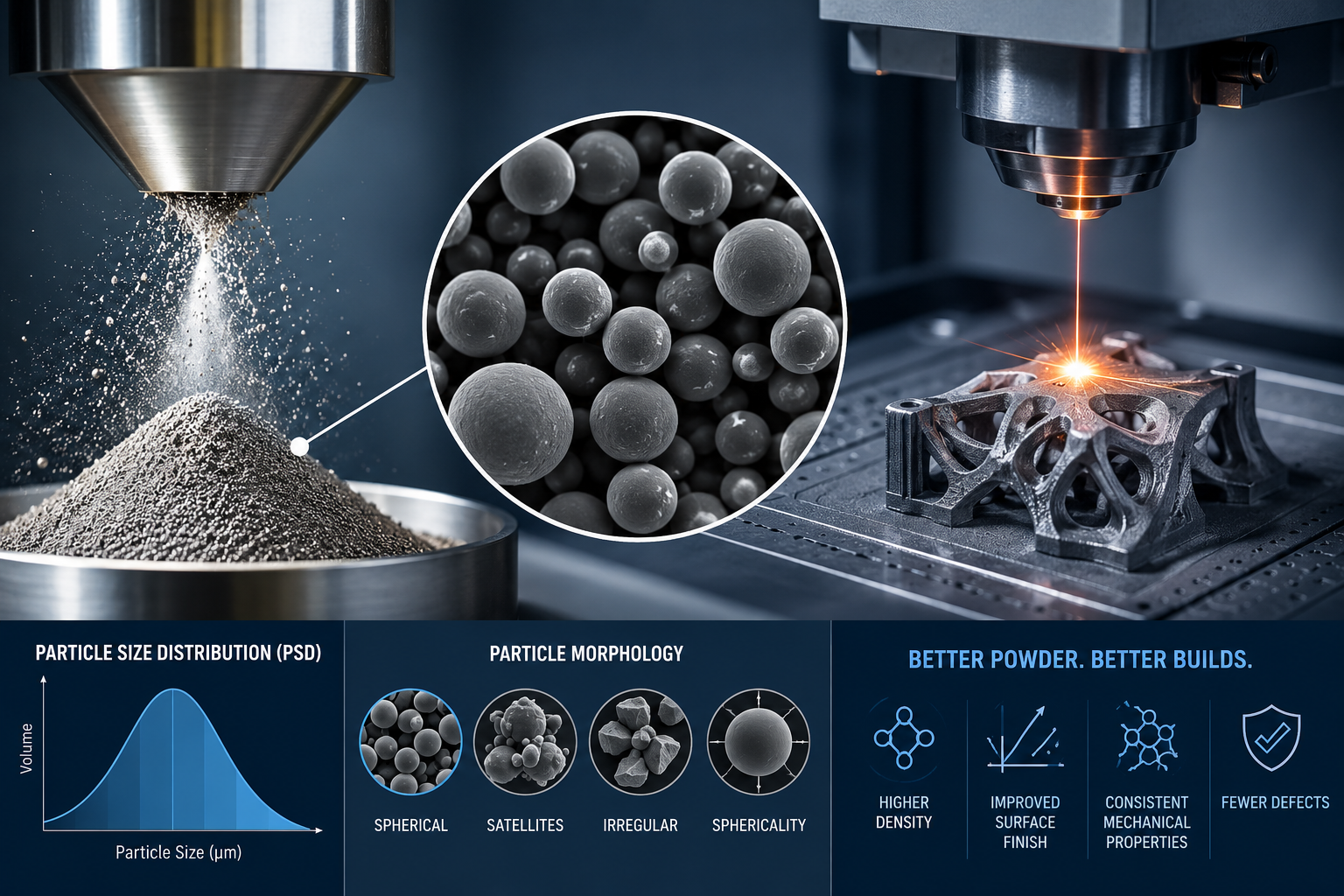
Metal powder is the foundation of every successful metal additive manufacturing process. Whether you’re producing aerospace components, medical implants, tooling, or research prototypes, the quality of your metal powder directly impacts the quality of your finished parts. Even the most advanced Laser Powder Bed Fusion (LPBF) system cannot consistently produce high-performance components if the powder has poor flowability, irregular particle shapes, or an inconsistent particle size distribution (PSD).
This is why metal powder atomization is one of the most critical stages in the metal additive manufacturing workflow. The atomization process determines the size, shape, purity, and flow characteristics of metal powder, all of which influence print quality, mechanical performance, and production efficiency.
As demand for metal 3D printing continues to grow across industries such as aerospace, medical, automotive, defense, and energy, manufacturers are placing greater emphasis on powder quality and in-house powder production. Modern atomization technologies make it possible to develop new alloys, reduce dependence on external suppliers, and produce powders optimized for specific additive manufacturing applications.
In this guide, you’ll learn how metal powder atomization works, why particle size distribution and particle morphology are so important, how different atomization methods compare, and how ultrasonic atomization systems from Additive Plus help manufacturers produce high-quality powders for LPBF and other advanced manufacturing processes.
Why Metal Powder Quality Is More Important Than the Printer
When discussing metal additive manufacturing, it’s easy to focus on the printer itself. Laser power, scan speed, build volume, and software features often receive the most attention. However, experienced engineers know that powder quality has an equally significant—if not greater—impact on the final result.
Metal powder serves as the raw material for every printed layer. During LPBF, the printer spreads a thin layer of powder across the build plate before the laser selectively melts it. This process is repeated hundreds or even thousands of times throughout the build.
If the powder does not spread evenly or contains irregular particles, defects can begin forming long before the laser starts melting the material.
Poor-quality powder can lead to:
- Uneven powder layers
- Poor laser absorption
- Lack-of-fusion defects
- Increased porosity
- Surface imperfections
- Reduced dimensional accuracy
- Lower mechanical strength
- Failed builds
These issues often cannot be corrected through machine settings alone. Even careful adjustments to laser parameters cannot fully compensate for inconsistent powder characteristics.
High-quality powder enables:
- Stable powder spreading
- Uniform layer thickness
- Consistent melt pools
- Higher part density
- Better repeatability
- Improved surface finish
- Reduced post-processing
- More reliable production
For manufacturers producing critical components, powder quality is one of the most important variables affecting productivity and part performance.
What Is Metal Powder Atomization?
Metal powder atomization is the process of transforming molten metal into fine powder particles suitable for additive manufacturing and other powder metallurgy applications.
During atomization, metal is first melted in a controlled environment. The molten stream is then broken into thousands—or even millions—of tiny droplets. As these droplets cool rapidly, they solidify into individual powder particles that can later be classified by size and prepared for manufacturing processes such as LPBF.
The goal of atomization is not simply to produce powder but to create powder with consistent physical characteristics that support reliable printing.
High-quality atomized powder typically features:
- Highly spherical particle shapes
- Controlled particle size distribution (PSD)
- Low oxygen content
- High chemical purity
- Excellent flowability
- Consistent batch-to-batch properties
These characteristics are essential for maintaining stable additive manufacturing processes and producing repeatable, high-quality parts.
Industries That Depend on Atomized Metal Powder
Atomized metal powder is used in far more than metal 3D printing. Many advanced manufacturing industries rely on high-quality powders for precision production.
Common applications include:
Aerospace
Manufacturers produce lightweight structural components, engine parts, heat exchangers, and fuel system components using high-performance alloys such as titanium and nickel superalloys.
Medical
Metal powders are used to manufacture orthopedic implants, dental restorations, surgical instruments, and patient-specific medical devices that require exceptional material consistency and biocompatibility.
Automotive
Automotive companies use atomized powders to develop lightweight components, tooling inserts, and performance parts while reducing material waste and production costs.
Energy
The energy sector relies on atomized powders for components that operate under extreme temperatures and pressures, including turbine parts and heat-resistant assemblies.
Research and Material Development
Universities, national laboratories, and industrial R&D centers continuously develop new metal alloys to improve mechanical properties, corrosion resistance, thermal performance, and manufacturability.
As additive manufacturing expands into production environments, demand for high-quality metal powder continues to increase.
Why Powder Quality Matters for LPBF
Laser Powder Bed Fusion builds components layer by layer using extremely thin layers of metal powder. Depending on the application, each layer is typically between 20 and 60 microns thick.
Because every layer depends on the one before it, even small inconsistencies in the powder bed can affect the final part.
For successful printing, powder must:
- Spread evenly across the build plate
- Form a uniform powder bed
- Flow consistently during recoating
- Melt predictably under laser exposure
- Produce dense, defect-free layers
When these conditions are met, manufacturers achieve higher-quality parts with fewer defects and greater production consistency.
Conversely, poor powder quality may cause:
- Incomplete melting
- Balling
- Surface roughness
- Lack of fusion
- Warping
- Internal porosity
- Reduced fatigue life
- Dimensional inaccuracies
These problems increase production costs by requiring additional inspection, machining, or even complete rebuilds.
The Relationship Between Powder Quality and Build Success
Every LPBF build depends on thousands of individual powder layers.
Each layer must:
- Spread evenly.
- Maintain consistent thickness.
- Absorb laser energy uniformly.
- Fuse completely with the previous layer.
Any variation in powder characteristics can interrupt this process.
For example, irregular particles may prevent smooth powder spreading, while excessively fine powder can reduce flowability and increase oxygen absorption. Oversized particles may remain partially melted, creating defects that weaken the finished component.
This is why powder quality affects every stage of the printing process—from recoating and laser melting to final part inspection.
Consistent powder properties ultimately lead to:
- Improved production repeatability
- Lower scrap rates
- Higher machine utilization
- Better dimensional accuracy
- Stronger mechanical performance
How Metal Powder Is Atomized
Several atomization technologies are used to manufacture metal powder. Each method offers unique advantages depending on production volume, material type, and intended application.
The choice of atomization process influences particle size distribution, morphology, oxygen content, and overall powder quality.
The three most common methods are gas atomization, water atomization, and ultrasonic atomization.
Gas Atomization
Gas atomization is the most widely used process for producing metal powders for additive manufacturing.
In this method, molten metal flows through a nozzle while high-pressure inert gases—typically argon or nitrogen—break the liquid stream into extremely fine droplets. These droplets cool rapidly inside an enclosed chamber and solidify into powder particles before collection.
Gas atomization produces powders with excellent sphericity and relatively low oxygen content, making it suitable for many commercial LPBF materials.
Advantages
- Excellent particle sphericity
- High powder purity
- Suitable for large-scale production
- Widely adopted across industry
- Compatible with many metal alloys
Limitations
- High capital investment
- Significant inert gas consumption
- Large production infrastructure
- Less economical for research or small production batches
Water Atomization
Water atomization uses high-pressure water jets to break molten metal into powder particles.
This method is significantly less expensive than gas atomization and is commonly used in conventional powder metallurgy.
However, because the water rapidly cools the metal, particles tend to have irregular shapes and higher oxygen content.
For this reason, water-atomized powders are generally not preferred for Laser Powder Bed Fusion, where flowability and particle sphericity are critical.
Advantages
- Lower production cost
- High production throughput
- Suitable for conventional powder metallurgy
- Efficient for large production volumes
Limitations
- Irregular particle morphology
- Higher oxygen contamination
- Lower flowability
- Reduced suitability for LPBF applications
Ultrasonic Atomization
Ultrasonic atomization is an advanced powder production technology designed to generate highly spherical metal powders with exceptional control over particle size distribution.
Instead of relying on high-pressure gas or water, ultrasonic atomization uses high-frequency mechanical vibrations to break molten metal into microscopic droplets. These droplets solidify rapidly within an inert atmosphere, producing powder with high sphericity, low oxygen levels, and excellent consistency.
One of the key advantages of ultrasonic atomization is its ability to produce smaller batches while maintaining precise control over powder characteristics. This makes it particularly valuable for research laboratories, universities, material developers, and manufacturers creating custom alloys or evaluating new materials for additive manufacturing.
Compared with traditional methods, ultrasonic atomization also helps reduce material waste—an important advantage when processing expensive metals such as titanium, nickel superalloys, or precious metals.
In the next section, we’ll explore how particle size distribution (PSD) and particle morphology influence powder performance and why these characteristics are critical for producing reliable LPBF builds.
Understanding Particle Size Distribution (PSD)
One of the most important characteristics of metal powder is its Particle Size Distribution (PSD). While every powder contains particles of different sizes, the goal is to achieve a controlled and predictable distribution that supports stable printing and consistent part quality.
PSD describes the range and proportion of particle sizes within a powder batch. Rather than focusing on a single particle size, manufacturers evaluate how particles are distributed across the entire sample. This information helps determine whether a powder is suitable for a specific additive manufacturing process, such as Laser Powder Bed Fusion (LPBF), Directed Energy Deposition (DED), or Binder Jetting.
Powders with a narrow, well-controlled PSD generally provide better flowability, more consistent layer deposition, and improved packing density. These characteristics contribute to stronger, denser parts with fewer defects.
Why Particle Size Distribution Matters
Every stage of the LPBF process depends on the consistency of the powder bed. During printing, a recoater spreads a thin layer of powder before the laser selectively melts the desired geometry. If the particles vary too widely in size, the powder may not spread evenly, leading to defects that affect the final component.
A controlled PSD offers several advantages:
- Smooth and uniform powder spreading
- Higher packing density
- Consistent layer thickness
- Stable laser absorption
- Improved melt pool formation
- Better dimensional accuracy
- Increased part density
- More repeatable production
For manufacturers producing mission-critical components, maintaining a consistent PSD is essential for achieving reliable mechanical properties and minimizing rejected parts.
Typical Particle Size Ranges for LPBF
Different metal 3D printing systems require different particle size distributions (PSD) based on factors such as laser power, layer thickness, material type, and the required part quality. Selecting the correct powder size range helps ensure consistent powder spreading, stable melting behavior, and high-density finished parts.
For fine-detail LPBF applications, powders typically range from 10–25 μm. These finer particles allow thinner layer deposition and produce excellent surface finish and intricate geometries, making them suitable for precision components.
Standard LPBF systems generally use powders in the 15–45 μm range. This is the most common specification for industrial laser powder bed fusion because it provides an effective balance between flowability, packing density, print quality, and productivity.
For large-scale industrial LPBF production, manufacturers often recommend powders between 20–63 μm. The slightly coarser distribution supports faster powder handling and thicker build layers while maintaining reliable printing performance for larger components.
Binder Jetting systems commonly utilize powders within the 15–45 μm range, although the exact specification varies depending on the printer manufacturer, binder chemistry, and sintering process requirements.
In Directed Energy Deposition (DED), significantly coarser powders are typically required. Most DED systems operate with particle sizes between 45–150 μm, as the powder is delivered directly into the melt pool rather than spread into thin layers.
It’s important to note that these particle size ranges serve as general industry guidelines rather than strict standards. Every metal 3D printer manufacturer may specify its own powder requirements based on machine design, laser configuration, recoating system, and qualified process parameters. Always consult your equipment manufacturer’s recommended powder specifications to achieve the best print quality, repeatability, and mechanical performance.
The Relationship Between PSD and Layer Thickness
Layer thickness and particle size are closely connected.
As a general rule, the largest particles should be smaller than the thickness of the deposited powder layer. If oversized particles are present, they can interfere with the recoating process and create uneven surfaces.
Thin Layers (20–30 μm)
Smaller powder particles are preferred because they produce:
- Higher resolution
- Better surface finish
- Improved dimensional accuracy
- Greater feature detail
However, thinner layers also increase build time.
Medium Layers (30–40 μm)
Medium particle sizes offer a balance between:
- Print quality
- Production speed
- Surface finish
- Build efficiency
This range is commonly used in production environments.
Thick Layers (50–60 μm)
Larger particles allow for:
- Faster builds
- Higher productivity
- Reduced manufacturing costs
The trade-off is reduced surface quality and lower geometric resolution.
Selecting the appropriate PSD is therefore a balance between productivity and print quality.
What Happens When PSD Is Poorly Controlled?
Powder with an inconsistent particle size distribution can create several manufacturing challenges.
Too Many Fine Particles
Very fine particles often:
- Reduce powder flowability
- Increase oxygen absorption
- Produce excessive dust
- Increase explosion risk during handling
- Cause powder agglomeration
Fine particles also tend to stick together because of stronger surface forces, making it more difficult for the recoater to distribute the powder evenly.
Too Many Large Particles
Oversized particles may:
- Produce rough powder beds
- Reduce packing density
- Melt incompletely
- Increase surface defects
- Create dimensional inaccuracies
If large particles are not fully melted, they may become internal defects that weaken the finished component.
Understanding Particle Morphology
Particle size is only one aspect of powder quality. Equally important is particle morphology, which refers to the shape, surface texture, and structural characteristics of individual powder particles.
The closer particles are to a perfect sphere, the better they generally perform in LPBF.
Why Spherical Particles Are Preferred
Spherical particles provide numerous advantages during additive manufacturing.
Their smooth shape allows them to roll freely across the build platform, reducing friction and creating uniform powder layers.
Benefits include:
- Excellent flowability
- Uniform powder spreading
- Higher packing density
- Consistent laser melting
- Improved surface finish
- Reduced build defects
- Better repeatability
This is why atomization technologies are designed to maximize particle sphericity.
Satellite Particles
Satellite particles are tiny powder particles that become attached to larger particles during production.
Although common in many atomization processes, excessive satellites can negatively affect powder performance.
Potential issues include:
- Reduced flowability
- Increased friction
- Lower packing density
- Less consistent recoating
- More difficult powder recycling
Advanced atomization systems aim to minimize satellite formation to improve powder consistency.
Surface Roughness
The surface texture of each particle also affects powder behavior.
Smooth particles move more easily across the powder bed, while rough particles create greater friction.
Smoother particles generally provide:
- Better recoating
- Higher powder flow
- Reduced interlocking
- More consistent layer thickness
This contributes to improved printing stability throughout the build.
Internal Porosity
Some powder particles contain microscopic gas pockets formed during solidification.
These hollow particles may:
- Reduce powder density
- Affect laser absorption
- Produce pores in printed parts
- Lower mechanical properties
High-quality atomization processes are designed to minimize internal porosity and produce dense, solid particles.
Powder Flowability
Flowability describes how easily powder moves under gravity or mechanical force.
For LPBF, excellent flowability is essential because every layer depends on smooth and consistent powder spreading.
Poor-flowing powder can result in:
- Uneven layers
- Recoater streaks
- Missing powder regions
- Increased print failures
- Reduced productivity
Flowability is influenced by several factors:
- Particle shape
- PSD
- Surface roughness
- Moisture
- Oxygen content
- Particle cleanliness
Highly spherical powder with a controlled PSD generally offers the best flow performance.
How Powder Flowability Is Measured
Manufacturers use standardized tests to evaluate powder flow characteristics before production.
Common methods include:
Hall Flow Test
Measures how quickly powder flows through a standardized funnel.
Carney Flow Test
Designed for powders that do not flow easily through a Hall funnel.
Angle of Repose
Measures the slope formed when powder is poured into a pile.
Lower angles generally indicate better flowability.
Apparent Density Testing
Determines how efficiently powder packs under gravity.
These tests help ensure powders meet quality requirements before being introduced into production.
Powder Recycling in LPBF
One advantage of LPBF is that unused powder can often be recovered and reused.
After each build, unmelted powder is collected, sieved, inspected, and blended with virgin powder before the next production cycle.
While recycling can reduce material costs, repeated reuse changes powder characteristics over time.
Potential changes include:
- Increased oxygen content
- Satellite formation
- Broader PSD
- Reduced flowability
- Surface oxidation
- Moisture absorption
Because of these changes, manufacturers regularly monitor recycled powder to ensure it still meets quality specifications.
Many production facilities maintain specific blend ratios between recycled and virgin powder to preserve consistent printing performance.
Common Metals Used in Atomization
Modern atomization systems support a wide range of engineering alloys for additive manufacturing.
Stainless Steel
Stainless steel remains one of the most commonly atomized materials due to its corrosion resistance, strength, and versatility.
Applications include:
- Industrial tooling
- Medical devices
- Food processing equipment
- Mechanical components
Titanium
Titanium powders are widely used in aerospace and medical industries because they offer an exceptional strength-to-weight ratio and excellent corrosion resistance.
Applications include:
- Aerospace brackets
- Medical implants
- Orthopedic devices
- High-performance engineering components
Aluminum
Aluminum alloys provide lightweight performance with excellent thermal conductivity.
Applications include:
- Automotive components
- Aerospace structures
- Heat exchangers
- Consumer products
Nickel Superalloys
Nickel-based alloys maintain strength at extremely high temperatures.
Common applications include:
- Gas turbines
- Jet engines
- Energy systems
- High-temperature industrial equipment
Copper
Copper powders are increasingly used in additive manufacturing because of their excellent electrical and thermal conductivity.
Applications include:
- Electrical contacts
- Heat sinks
- Induction components
- Cooling systems
Precious Metals
Precious metal powders continue to gain popularity in advanced manufacturing, jewelry production, dental applications, and electronics.
Common materials include:
- Gold
- Silver
- Platinum
- Palladium
Because these materials are expensive, minimizing powder loss is especially important. Ultrasonic atomization systems with optimized powder recovery can significantly reduce material waste while producing highly spherical powders suitable for precision applications.
Why Ultrasonic Atomization Is Gaining Popularity
As additive manufacturing continues to evolve, manufacturers are increasingly seeking atomization technologies that provide greater flexibility, lower material waste, and tighter control over powder characteristics.
Ultrasonic atomization addresses many of these needs by producing highly spherical powders with narrow particle size distributions in compact systems that are well suited for research, alloy development, and small-batch production.
Unlike large-scale atomization systems designed primarily for mass production, ultrasonic technology allows engineers to quickly evaluate new materials, optimize powder characteristics, and produce powders tailored to specific additive manufacturing processes.
In the next section, we’ll explore how Additive Plus ultrasonic atomizers—including the ATO Lab Ultrasonic Atomizer and ATO Noble—help organizations produce high-quality metal powders while accelerating material development and reducing production costs.
Producing High-Quality Metal Powder with Additive Plus Atomizers
As additive manufacturing continues to move from prototyping to full-scale production, manufacturers are looking for greater control over their powder supply. Developing powders in-house reduces dependence on suppliers, shortens development cycles, and enables organizations to qualify new materials faster.
Additive Plus offers advanced ultrasonic atomization solutions that enable manufacturers, universities, and research laboratories to produce high-quality spherical metal powders with excellent particle size control.
Unlike conventional atomization methods that often require large industrial facilities, the ATO series is designed for efficient research, alloy development, pilot production, and specialty powder manufacturing.
Why Produce Metal Powder In-House?
Many manufacturers purchase metal powder from third-party suppliers. While this works well for standard materials, it can limit innovation when developing custom alloys or qualifying new materials.
Producing powder in-house offers several advantages.
Faster Material Development
Researchers can quickly produce and evaluate new alloys without waiting weeks or months for external suppliers.
Better Quality Control
Every batch can be analyzed and optimized for:
- Particle size distribution
- Particle morphology
- Oxygen content
- Flowability
- Chemical composition
This level of control improves consistency across production runs.
Reduced Supply Chain Risks
Global supply chains continue to experience disruptions and fluctuating lead times. In-house powder production gives manufacturers greater independence and helps maintain production schedules.
Lower Development Costs
Producing smaller batches eliminates the need to purchase large quantities of experimental powders that may never be used in production.
Greater Flexibility
Manufacturers can rapidly adjust powder specifications for different materials, printer requirements, or research projects.
ATO Lab Ultrasonic Atomizer
The ATO Lab Ultrasonic Atomizer is designed for research laboratories, universities, material scientists, and manufacturers developing new metal powders for additive manufacturing.
Instead of relying on large industrial atomization systems, the ATO Lab provides a compact solution capable of producing highly spherical powder with exceptional consistency.
Its ultrasonic technology allows engineers to precisely control particle formation while minimizing oxidation and contamination.
Key Benefits
- Highly spherical powder particles
- Narrow particle size distribution
- Low oxygen content
- Excellent powder flowability
- Compact laboratory footprint
- High process repeatability
- Efficient small-batch production
The system supports a wide variety of materials, including:
- Stainless steel
- Titanium
- Aluminum alloys
- Copper
- Nickel superalloys
- Cobalt chrome
- Custom alloy development
Because of its flexibility, the ATO Lab is an excellent solution for organizations conducting alloy research, validating powders for LPBF, or developing new materials for industrial applications.
ATO Noble Atomizer
Producing powder from precious metals presents unique challenges. Every gram of material has significant value, making powder recovery one of the most important considerations.
The ATO Noble Atomizer has been specifically engineered for processing precious metals while maximizing material recovery and maintaining excellent powder quality.
The system is ideal for producing powders from:
- Gold
- Silver
- Platinum
- Palladium
- Jewelry alloys
- Dental alloys
Its optimized recovery system helps reduce material waste, making it particularly valuable for industries where raw material costs are high.
In addition to improved recovery, ultrasonic atomization produces highly spherical particles with a controlled PSD, making the powder suitable for advanced manufacturing and precision applications.
Gas Atomization vs. Ultrasonic Atomization
Choosing the right metal powder atomization technology depends on your production volume, material requirements, budget, and target applications. Both gas atomization and ultrasonic atomization produce high-quality spherical metal powders, but each technology excels in different environments.
Gas Atomization
Gas atomization is the preferred solution for large-scale industrial powder production. By using high-pressure inert gas to break up a stream of molten metal, it produces highly spherical powders suitable for additive manufacturing, metal injection molding (MIM), hot isostatic pressing (HIP), and other advanced manufacturing processes.
This method is ideal for companies that require continuous, high-volume production of standard metal alloys. While gas atomization provides excellent powder quality, it typically requires larger production facilities, higher energy consumption, and more substantial infrastructure investment. Producing small experimental batches can also be less economical due to material losses during startup and shutdown.
Ultrasonic Atomization
Ultrasonic atomization uses high-frequency vibrations to separate molten metal into extremely fine droplets that solidify into highly spherical powders. This process offers exceptional control over particle size distribution (PSD), making it especially valuable when consistent powder quality is essential.
Unlike traditional gas atomization, ultrasonic systems are designed for flexibility. They can efficiently produce small batches with minimal material waste, making them an excellent choice for research laboratories, universities, aerospace development, medical device manufacturing, and custom alloy development. The compact design also reduces facility requirements while improving powder recovery rates, especially when processing expensive materials such as titanium, cobalt-chrome, nickel superalloys, and precious metals.
Which Technology Is Better?
Neither technology is universally better—the right choice depends on your manufacturing goals.
If your objective is high-volume commercial production of commonly used metal powders, gas atomization remains one of the most efficient and widely adopted manufacturing methods. Its ability to consistently produce large quantities makes it the standard for industrial powder suppliers.
On the other hand, ultrasonic atomization is better suited for organizations focused on innovation, rapid material development, or specialized production. It provides greater flexibility, superior particle size control, lower material waste, and excellent efficiency when working with expensive or experimental alloys. These advantages make it particularly attractive for research and development environments where precision and repeatability are more important than maximum production volume.
When to Choose Each Method
Choose gas atomization if your operation requires:
- Large-scale commercial powder production
- High production throughput
- Proven manufacturing processes for standard alloys
- Continuous industrial manufacturing
Choose ultrasonic atomization if your operation focuses on:
- Research and development
- Small-batch powder production
- New alloy development
- Processing expensive or precious metals
- Superior particle size consistency
- Reduced material waste and higher powder recovery
Both technologies play an essential role in modern powder manufacturing. Gas atomization continues to dominate large-scale industrial production, while ultrasonic atomization is becoming the preferred choice for advanced research, specialty alloy development, and precision powder manufacturing where flexibility and powder quality are the highest priorities.
Choosing the Right Atomizer
Selecting an atomization system depends on your production objectives, materials, and application requirements.
Choose the ATO Lab Ultrasonic Atomizer If You Need:
- Research and development capabilities
- New alloy development
- University or laboratory use
- Pilot-scale powder production
- Powder qualification before commercialization
- Flexible processing of multiple metal alloys
The ATO Lab is ideal for organizations focused on innovation and material development, where rapid iteration and powder quality are critical.
Choose the ATO Noble Atomizer If You Need:
- Precious metal powder production
- High powder recovery
- Gold and silver processing
- Platinum and palladium alloys
- Jewelry manufacturing
- Dental material development
For high-value materials, reducing powder loss can significantly improve production efficiency and lower operating costs.
The Future of Metal Powder Atomization
As metal additive manufacturing becomes more widely adopted, the demand for specialized powders will continue to grow.
Manufacturers are increasingly developing:
- Custom alloy compositions
- High-performance aerospace materials
- Lightweight automotive alloys
- Advanced medical materials
- Functionally graded materials
- Multi-material systems
To support these innovations, powder production technologies must provide greater precision, flexibility, and repeatability.
Ultrasonic atomization is expected to play an increasingly important role because it enables rapid material development while producing powders with exceptional sphericity and controlled particle size distribution.
Conclusion
Metal powder atomization is much more than a manufacturing step—it is the foundation of successful metal additive manufacturing.
The particle size distribution, morphology, flowability, and purity of metal powder all influence how material spreads across the build plate, absorbs laser energy, and ultimately determines the quality of the finished part. Even the most advanced LPBF systems depend on consistent, high-quality powder to achieve reliable, repeatable results.
While traditional gas atomization remains the preferred solution for large-scale commercial powder production, ultrasonic atomization offers significant advantages for research laboratories, universities, material developers, and manufacturers producing specialty powders. Its ability to generate highly spherical particles with narrow particle size distributions makes it particularly well suited for alloy development, powder qualification, and small-batch production.
The Additive Plus ATO Lab Ultrasonic Atomizer and ATO Noble Atomizer demonstrate how modern ultrasonic atomization technology can help organizations accelerate material innovation, improve powder quality, reduce waste, and gain greater control over their additive manufacturing supply chain. As demand for advanced metal powders continues to increase, in-house atomization will become an increasingly valuable capability for companies looking to stay competitive in the evolving world of additive manufacturing.
Frequently asked questions
What is metal powder atomization?
Metal powder atomization is the process of converting molten metal into fine powder particles by breaking the liquid metal into droplets that rapidly solidify. The resulting powder is used in additive manufacturing, powder metallurgy, and other advanced manufacturing processes.
What is Particle Size Distribution (PSD)?
Particle Size Distribution (PSD) refers to the range and proportion of particle sizes within a powder batch. A controlled PSD helps ensure consistent powder spreading, stable laser melting, and reliable part quality.
Why is PSD important in LPBF?
PSD affects powder flowability, layer uniformity, packing density, and melt pool stability. A narrow and consistent PSD improves print quality, reduces defects, and increases production repeatability.
Why are spherical particles preferred?
Spherical particles flow more easily, spread uniformly across the build plate, and pack more efficiently than irregular particles. This leads to better layer consistency and stronger printed parts.
What is particle morphology?
Particle morphology describes the shape, surface texture, and structural characteristics of powder particles. Morphology directly influences flowability, packing density, and printing performance.
What causes poor powder flowability?
Poor flowability can result from irregular particle shapes, excessive fine particles, surface roughness, oxidation, moisture, or contamination. These factors can cause uneven powder layers and increase the likelihood of printing defects.
Can LPBF powder be recycled?
Yes. Unused powder is often recovered, sieved, and blended with virgin powder for reuse. However, manufacturers should regularly monitor particle size distribution, oxygen content, and flowability to ensure consistent quality over multiple build cycles.
What metals can be atomized?
Common atomized materials include stainless steel, titanium, aluminum, copper, nickel superalloys, cobalt chrome, gold, silver, platinum, palladium, and many custom alloy compositions.
What is the difference between gas atomization and ultrasonic atomization?
Gas atomization uses high-pressure inert gas to break molten metal into droplets and is commonly used for high-volume powder production. Ultrasonic atomization uses high-frequency vibrations to create droplets, offering excellent particle size control and making it ideal for research, alloy development, and small-batch production.
Which industries use atomized metal powders?
Atomized powders are widely used in aerospace, medical, automotive, energy, defense, electronics, jewelry, dental, and research applications.
Why do research laboratories use ultrasonic atomization?
Ultrasonic atomization allows researchers to rapidly develop and test new alloys, produce small batches of powder, and maintain excellent control over particle characteristics without the need for large-scale production equipment.
Which Additive Plus atomizer is best for alloy development?
The ATO Lab Ultrasonic Atomizer is designed specifically for research laboratories, universities, and manufacturers developing or qualifying new metal powders for additive manufacturing.
Which atomizer is recommended for precious metals?
The ATO Noble Atomizer is designed for processing gold, silver, platinum, palladium, and other precious metals while maximizing powder recovery and minimizing material waste.
Can manufacturers produce their own LPBF powder?
Yes. Modern ultrasonic atomization systems enable manufacturers to produce high-quality metal powders in-house, giving them greater control over powder quality, material development, and supply chain flexibility.
Why is powder quality critical for metal additive manufacturing?
Powder quality directly affects layer deposition, laser absorption, melt pool stability, and the mechanical properties of the finished part. Consistent, high-quality powder is essential for achieving repeatable, defect-free LPBF builds.
Have a question or a project? Let’s talk.
Tell us what you need — a real applications engineer replies within 24 hours. NDA on request, no sales script.