
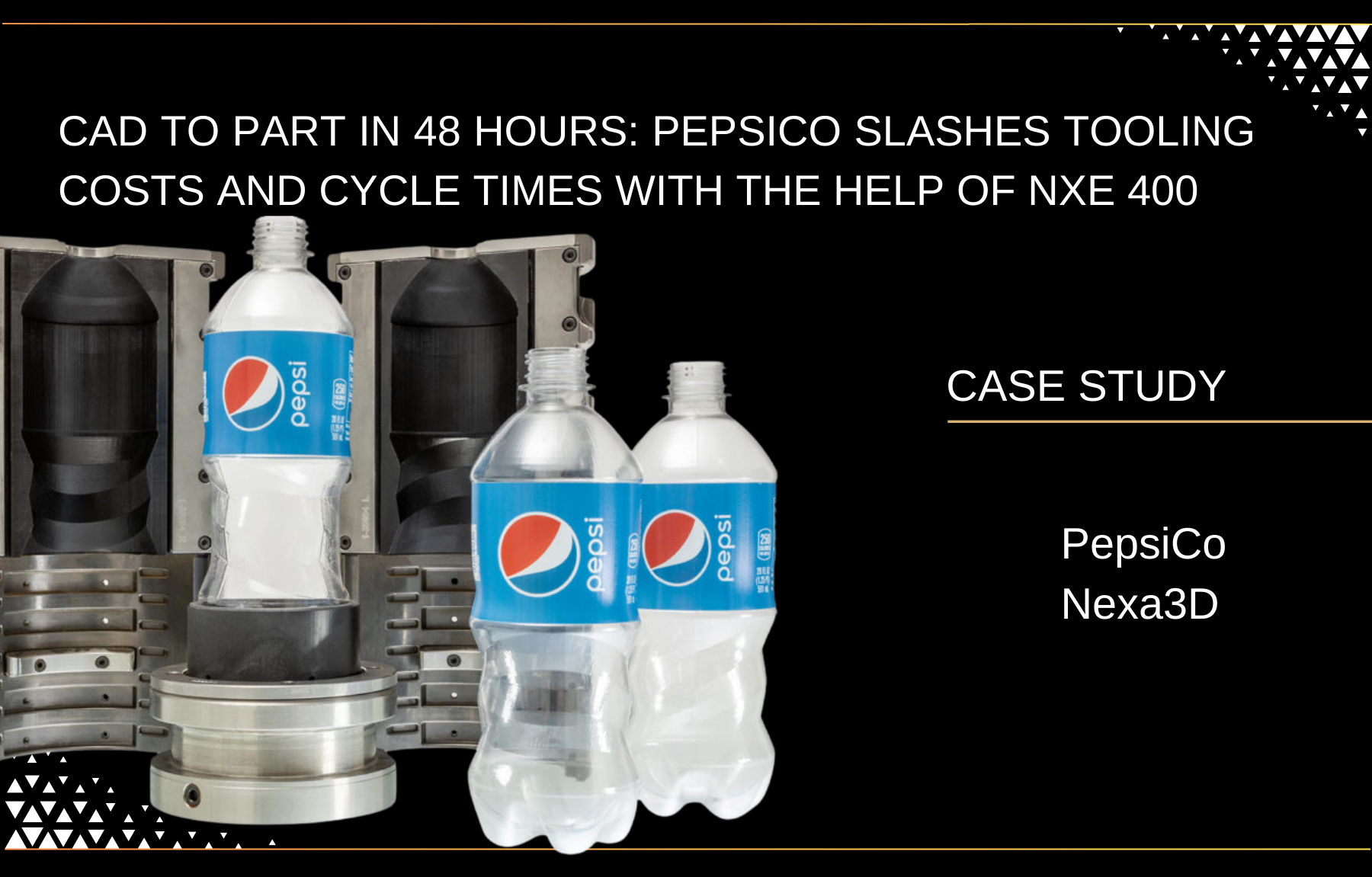


Iconic PepsiCo Brand Finds Best Alternative to Expensive, Time-Consuming Conventional Metal Tooling
PepsiCo products are enjoyed by consumers more than one billion times a day in more than 200 countries and territories around the world. PepsiCo generated more than $79 billion in net revenue in 2021, driven by a complementary beverage and convenient foods portfolio that includes Lay’s, Doritos, Cheetos, Gatorade, Pepsi-Cola, Mountain Dew, Quaker, and SodaStream. PepsiCo’s product portfolio includes a wide range of enjoyable foods and beverages, including many iconic brands that generate more than $1 billion each in estimated annual retail sales.
The Challenge
Speed to market is crucial in the consumer goods industry, where companies are constantly striving to create new bottle and package designs that cater to changing customer preferences. However, the traditional method of making metal tooling for blow molding bottles is both costly and time-consuming. After designing a package using CAD software, it can take up to four weeks to manufacture a metal tool, followed by an additional two weeks to test the blow molding process. According to Max Rodriguez, a senior manager at PepsiCo’s Valhalla research center, the production of a single metal tool set can cost up to $10,000 depending on its complexity.
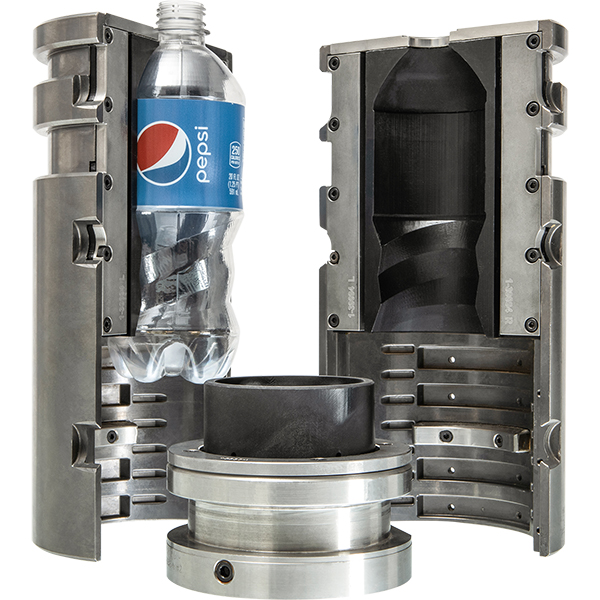
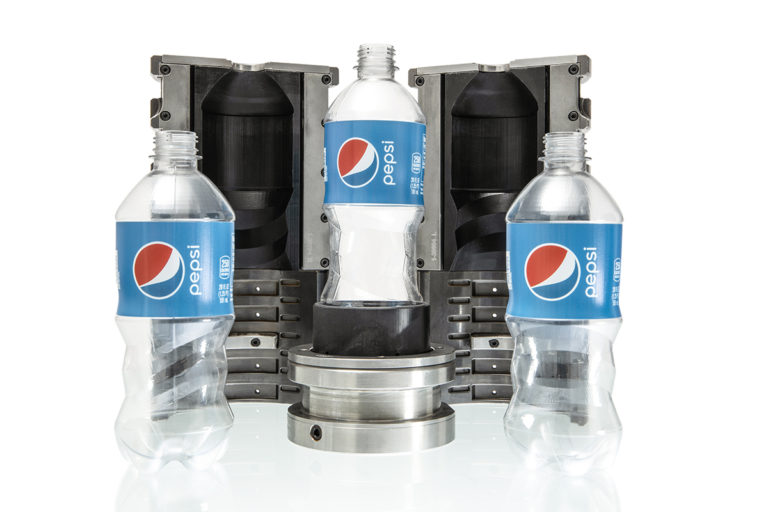
In an effort to expedite this process, many have turned to 3D printing, but previous attempts at rapid tooling had their limitations. Printing a blow molding tool from Digital ABS material on a PolyJet 3D printer costing $250,000 would take two to three days, but the resulting tool lacked durability and could only produce around 100 bottles before failing. To address these challenges, Rodriguez and his team are now exploring a hybrid approach that combines elements of a traditional metal mold with 3D printed inserts.
Company
PepsiCo Inc.
Industry
Consumer goods packaging, food & beverage
Printer
Nexa3D NXE 400 Printer
Material
xPEEK147 by Henkel Loctite
Application
Applying its patented technology and a hybrid approach, PepsiCo is using additive manufacturing as an enabler in various aspects of bottle development – accelerating and enhancing performance simulation, advanced system analysis and the production of high-quality, functional prototypes.
Advantages
- Compress prototype tooling development time from 4 weeks to 48 hours
- Slash prototype tooling costs from $10,000 to $350 per mold set
- Create durable tooling that can produce more than 10,000 bottles per mold
- Enable multiple design iterations to allow for timely verification of downstream activities
More Than 10,000 Bottles at 96% Reduction in Cost
PepsiCo went with Nexa3D’s xPEEK147 from Henkel Loctite for the 3D printed tool inserts because of its strength and impressive performance features, like its high heat-deflection temperature. This hybrid approach can work with different types of 3D printers, but PepsiCo has found that the super-fast, high-capacity Nexa3D NXE 400 3D printer and its materials are perfect for making the mold parts they need.
A full set of molds can be produced in just 12 hours, with 8 hours of printing and 4 hours of curing. These hybrid molds can then be used for over 10,000 bottles before needing replacement – all at a cost reduction of up to 96% compared to traditional metal tooling.
https://youtu.be/i8XBI9OF-Jc
Explore What’s New in 3D Printing
-
The Power of Two: FLIGHT 403P. Explore Farsoon Dual Laser System. Webinar record.
-
Explosion-Proof Solutions: Vacuum Systems for LPBF Powder Collection. Webinar record.
-
Pushing the Boundaries 3DCERAM’s Additive Manufacturing Technology Empowering New Space.
Frequently asked questions
How did PepsiCo cut blow molding tooling time with the Nexa3D NXE 400?
PepsiCo compressed prototype tooling development from four weeks to 48 hours using the Nexa3D NXE 400. A full set of molds is produced in about 12 hours, with 8 hours of printing and 4 hours of curing. This accelerated bottle design iteration significantly.
What was the tooling cost problem PepsiCo faced?
Traditional metal tooling for blow molding bottles cost up to $10,000 per tool set and took about four weeks to manufacture, plus two weeks to test. A PolyJet-printed Digital ABS tool cost less but lasted only around 100 bottles. Both approaches limited speed to market.
How much did PepsiCo reduce tooling costs with 3D printing?
PepsiCo slashed prototype tooling costs from $10,000 to $350 per mold set, a reduction of up to 96%. The hybrid approach combines a traditional metal mold with 3D printed inserts. This preserved durability while cutting cost dramatically.
How many bottles can PepsiCo's 3D printed hybrid molds produce?
The hybrid molds produce more than 10,000 bottles per mold before needing replacement. This far exceeds the roughly 100 bottles a Digital ABS PolyJet tool could manage. The durable inserts enable multiple design iterations and timely downstream verification.
What material did PepsiCo use for the 3D printed tool inserts?
PepsiCo used xPEEK147 by Henkel Loctite for the 3D printed tool inserts because of its strength and high heat-deflection temperature. These performance features let the inserts withstand the blow molding process. The material paired with the Nexa3D NXE 400 to make the mold parts.
What is the hybrid tooling approach PepsiCo used?
The hybrid approach combines elements of a traditional metal mold with 3D printed inserts, rather than printing an entire tool. This retains metal durability while gaining additive speed and low cost. It works with different printers, though the fast, high-capacity NXE 400 proved ideal.
Have a question or a project? Let’s talk.
Tell us what you need — a real applications engineer replies within 24 hours. NDA on request, no sales script.