
Ceramic 3D Printing for Space and Aerospace
Space and aerospace hardware runs at the edge of what materials can survive. Parts see extreme heat, thermal cycling, vacuum, radiation, and mechanical loads, often at the same time. Technical ceramics hold their properties under these conditions, which is why engineers reach for alumina, zirconia, silicon carbide, silicon nitride, and cordierite when metals and polymers fall short. Additive manufacturing now brings these materials into geometries that traditional ceramic processing cannot reach.
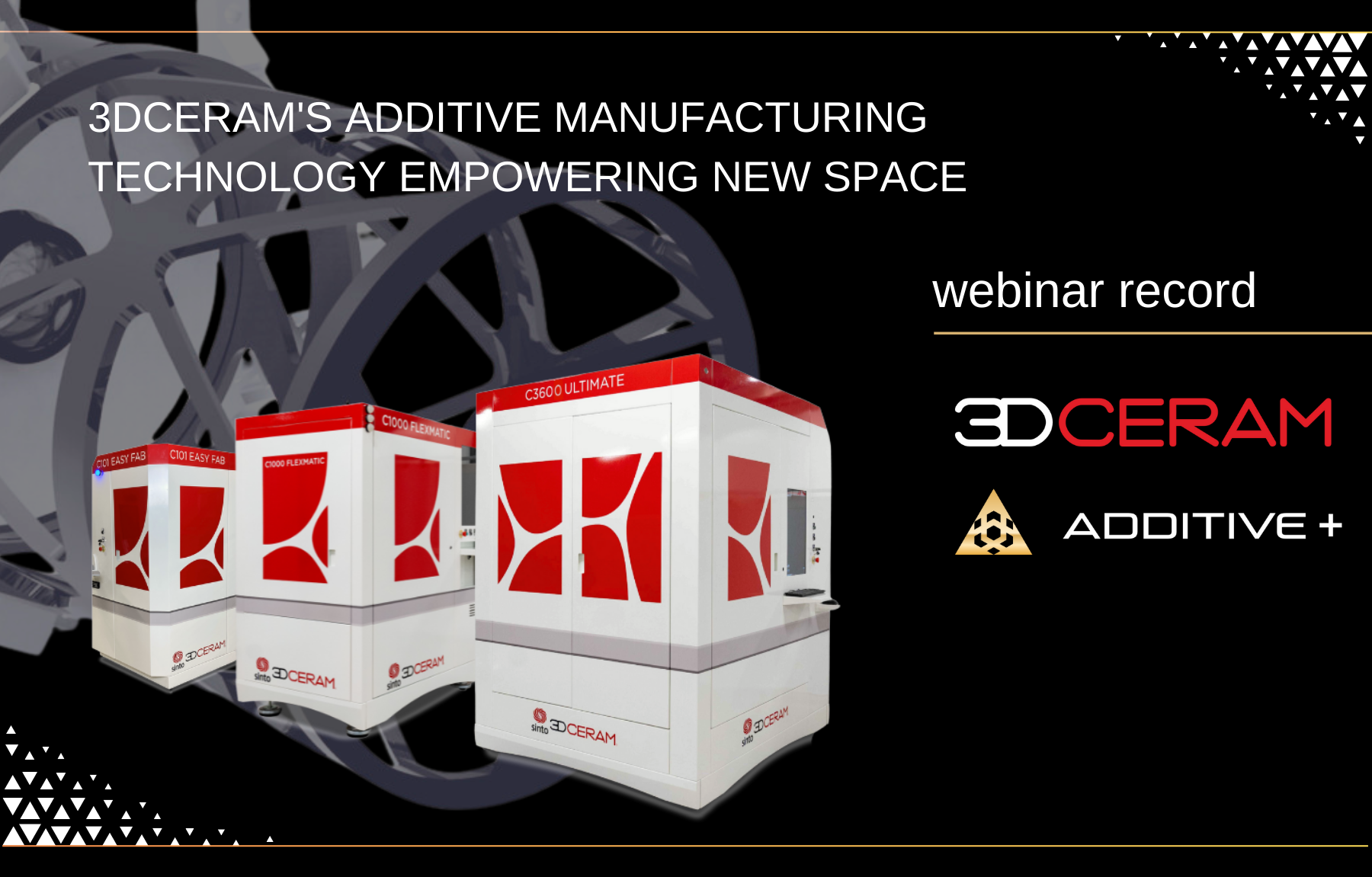
Additive Plus supports ceramic additive manufacturing through 3DCeram ceramic stereolithography systems, giving space and aerospace teams a route to printed ceramic parts backed by qualified materials.
What ceramic additive manufacturing is
Ceramic 3D printing on 3DCeram systems uses stereolithography. The machine builds a part layer by layer from a photocurable ceramic slurry, a suspension of fine ceramic powder in a light-sensitive resin. A light source cures each layer to shape, producing a green part that holds the ceramic particles in a polymer binder.
The green part is not the finished component. Two thermal steps follow. Debinding removes the polymer binder through controlled heating. Sintering then fires the part at high temperature so the ceramic particles fuse into a dense, solid body. The result is a fully ceramic component with the mechanical and thermal properties the base material is known for.
This workflow handles the technical ceramics that aerospace programs specify most often:
- Alumina, for electrical insulation, wear resistance, and general structural use
- Zirconia, for toughness and thermal barrier behavior
- Silicon carbide, for stiffness, thermal conductivity, and high-temperature strength
- Silicon nitride, for thermal shock resistance and mechanical durability
- Cordierite, for low thermal expansion and thermal management parts
Why ceramics suit space and aerospace
Ceramics bring a property set that is hard to match with other material families. High-temperature stability lets parts keep their strength where metals soften. Low thermal expansion keeps dimensions stable across the temperature swings a spacecraft sees between sunlight and shadow.
The dielectric and RF properties of ceramics matter for electronics and communications hardware. Ceramics work well as substrates and structures in antennas, radomes, and waveguides, where predictable dielectric behavior is a design requirement rather than a bonus. Add wear resistance, corrosion resistance, and chemical inertness, and ceramics hold up in propulsion environments and long-duration missions where maintenance is not an option.
Density is another factor. Many technical ceramics are lighter than the metals they replace, which helps every gram-sensitive launch budget, while stiffness keeps structures rigid under load. Taken together, these traits explain why ceramics keep appearing in demanding flight hardware.
Applications across space hardware
Ceramic additive manufacturing serves a range of space and aerospace roles. The examples below are general categories, not specific programs:
- RF and antenna components. Dielectric parts, antenna structures, radomes, and waveguide elements benefit from stable RF behavior and dimensional control.
- Satellite structural and thermal parts. Brackets, supports, and thermal-management pieces use low expansion and stiffness to hold alignment in orbit.
- Propulsion and thruster components. Parts exposed to hot gas and aggressive chemistry rely on high-temperature strength and chemical inertness.
- Sensor housings. Ceramic enclosures protect instruments while providing electrical insulation and thermal stability.
- Heat-management parts. Components that spread, block, or route heat use the thermal properties of the chosen ceramic.
Why additive manufacturing over traditional ceramic machining
Technical ceramics are hard and brittle, which makes conventional machining slow and costly. Grinding a complex ceramic part from a fired blank wastes material and limits the shapes you can produce. Additive manufacturing changes the economics and the design freedom.
Printing builds complex geometries directly, including internal channels and lattice structures that a cutting tool cannot reach. It supports part consolidation, combining several machined pieces into one printed component and removing joints and assembly steps. There is no hard tooling, so there are no molds or dies to fund and wait for. That matters for space hardware, which tends to be low volume and highly specific.
The lack of tooling also speeds iteration. Design teams can revise a part and print the next version without retooling, which shortens development cycles for one-off and small-batch flight hardware. For programs that build a handful of qualified units rather than thousands, this is a practical fit.
Working with Additive Plus
Additive Plus provides access to 3DCeram ceramic stereolithography systems and the ceramic materials that run on them. Teams evaluating ceramic printing for flight or ground-test hardware can review the ceramic 3D printers and the ceramic materials catalog to match a system and material to their application.
Ceramic additive manufacturing does not replace every metal or composite part in a spacecraft. It earns its place where high temperature, RF performance, wear, or chemical resistance drive the design, and where complex geometry or low volume makes traditional ceramic machining impractical. For those cases, printed technical ceramics give aerospace engineers a manufacturing path that fits the demands of the mission.
Frequently asked questions
What is ceramic 3D printing?
It is an additive process, most often ceramic stereolithography, that builds parts layer by layer from a photocurable ceramic slurry. The printed green part is then debound to remove the binder and sintered at high temperature to form a dense, fully ceramic component.
Which ceramics are used for aerospace parts?
Common technical ceramics include alumina, zirconia, silicon carbide, silicon nitride, and cordierite. The choice depends on the requirement, such as high-temperature strength, thermal shock resistance, low thermal expansion, or electrical insulation.
Why use ceramics instead of metals in space hardware?
Ceramics keep their strength at high temperatures, expand little across thermal cycles, resist wear and corrosion, and offer useful dielectric and RF behavior. Many are also lighter than the metals they replace, which helps mass-constrained designs.
What space and aerospace parts can be printed in ceramic?
Typical categories include RF and antenna components such as radomes and waveguide elements, satellite structural and thermal parts, propulsion and thruster components, sensor housings, and heat-management parts.
Why choose additive manufacturing over machining ceramics?
Technical ceramics are hard and brittle, so machining is slow and wasteful. Printing produces complex geometries and internal channels directly, consolidates multiple parts into one, needs no hard tooling, and speeds iteration for the low-volume hardware common in space programs.
Have a question or a project? Let’s talk.
Tell us what you need — a real applications engineer replies within 24 hours. NDA on request, no sales script.