
Made to order
- TURBISOFT — free license multi-user software with free updates
- Install + training on-site setup and a stability method on your sample
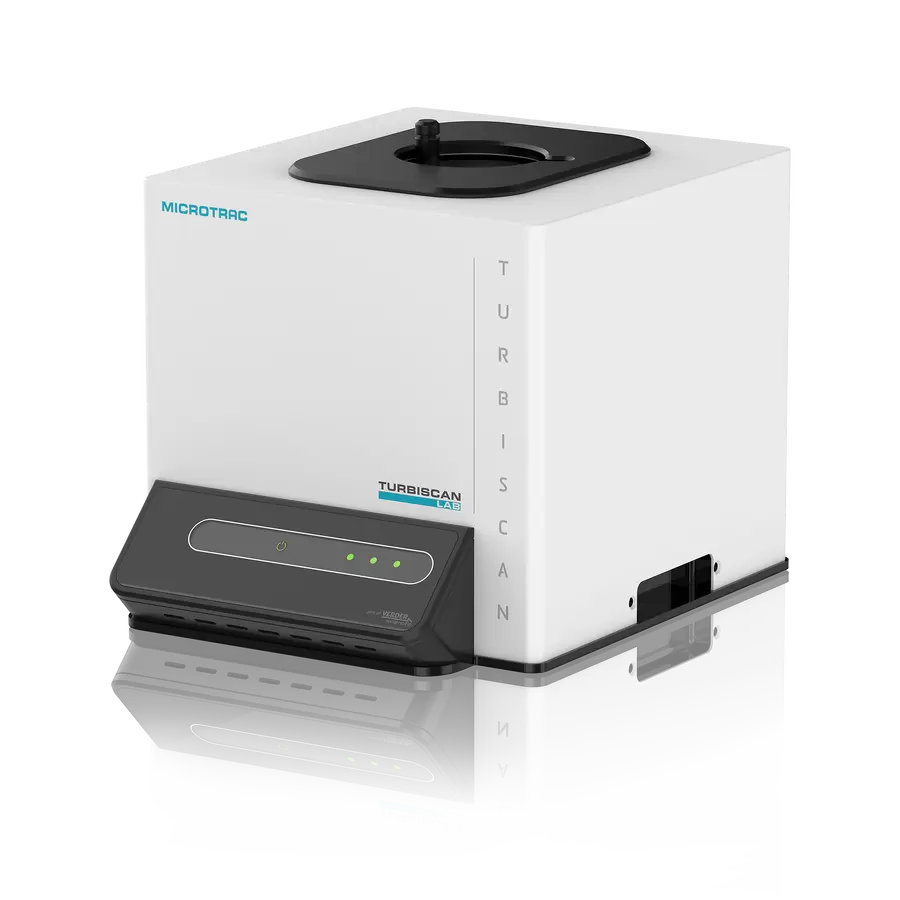
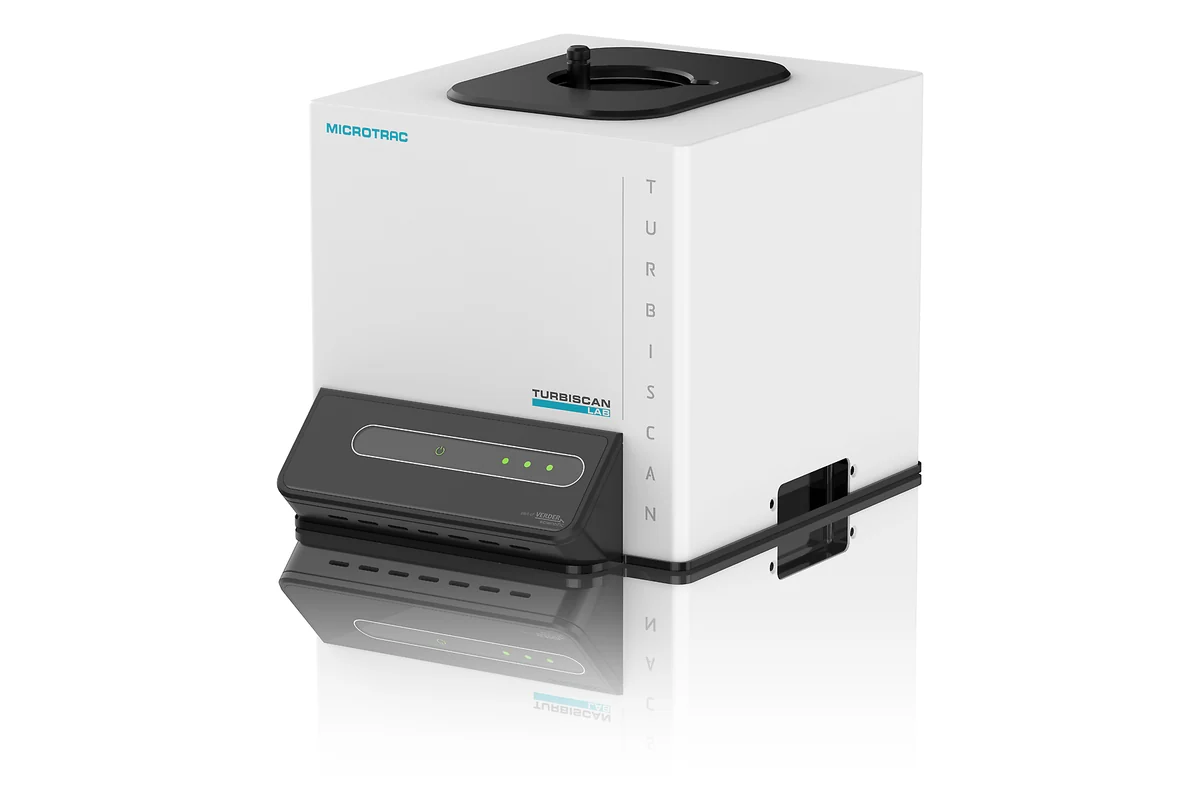
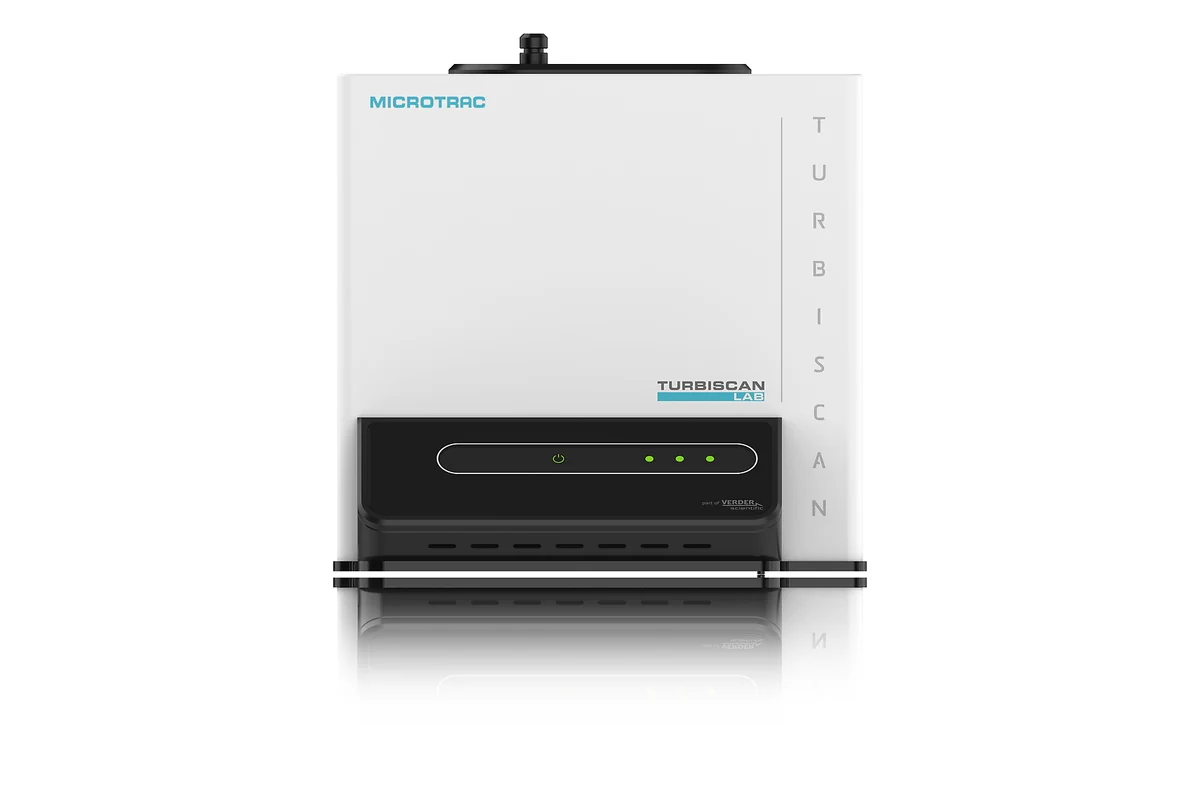
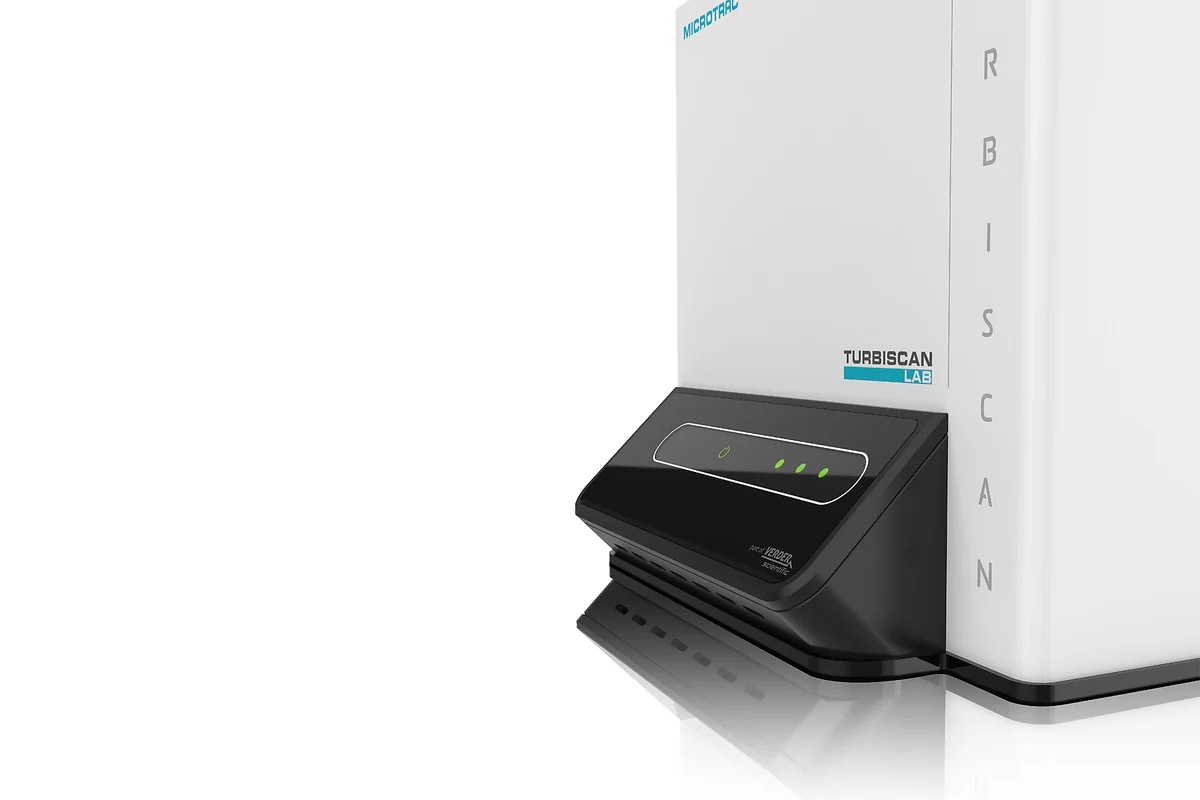
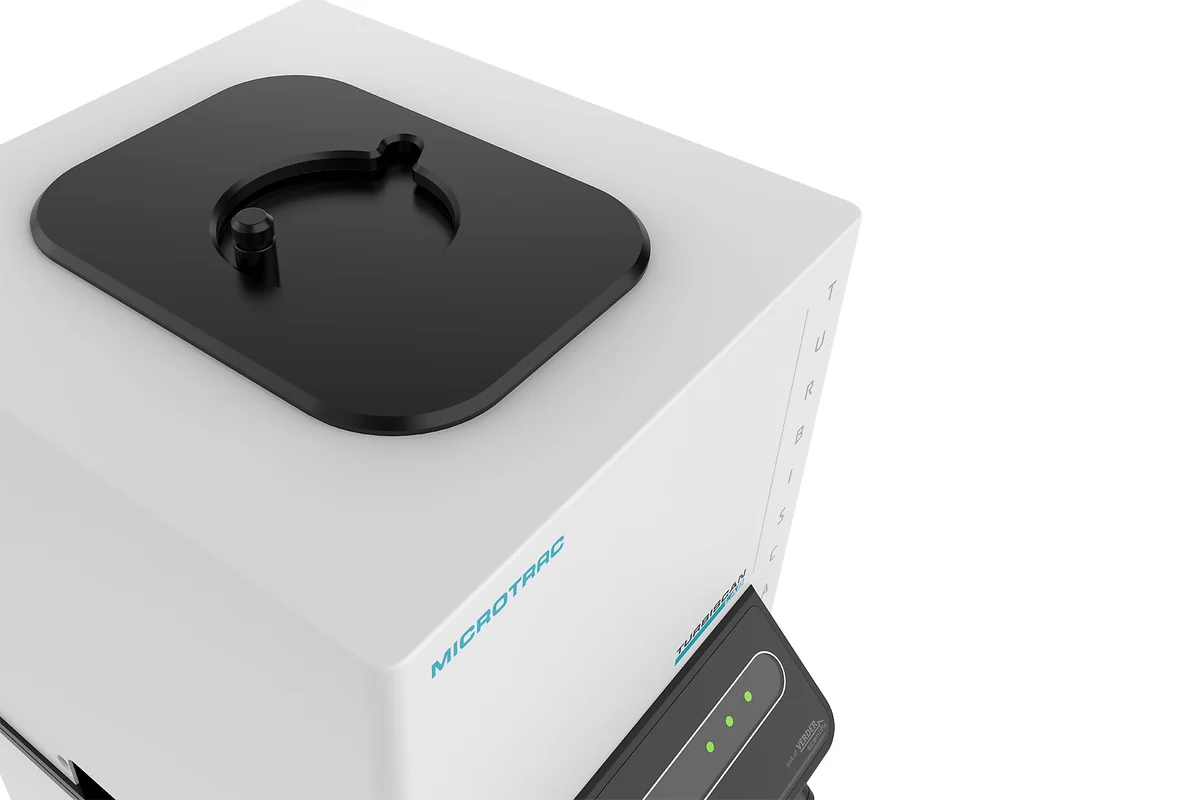
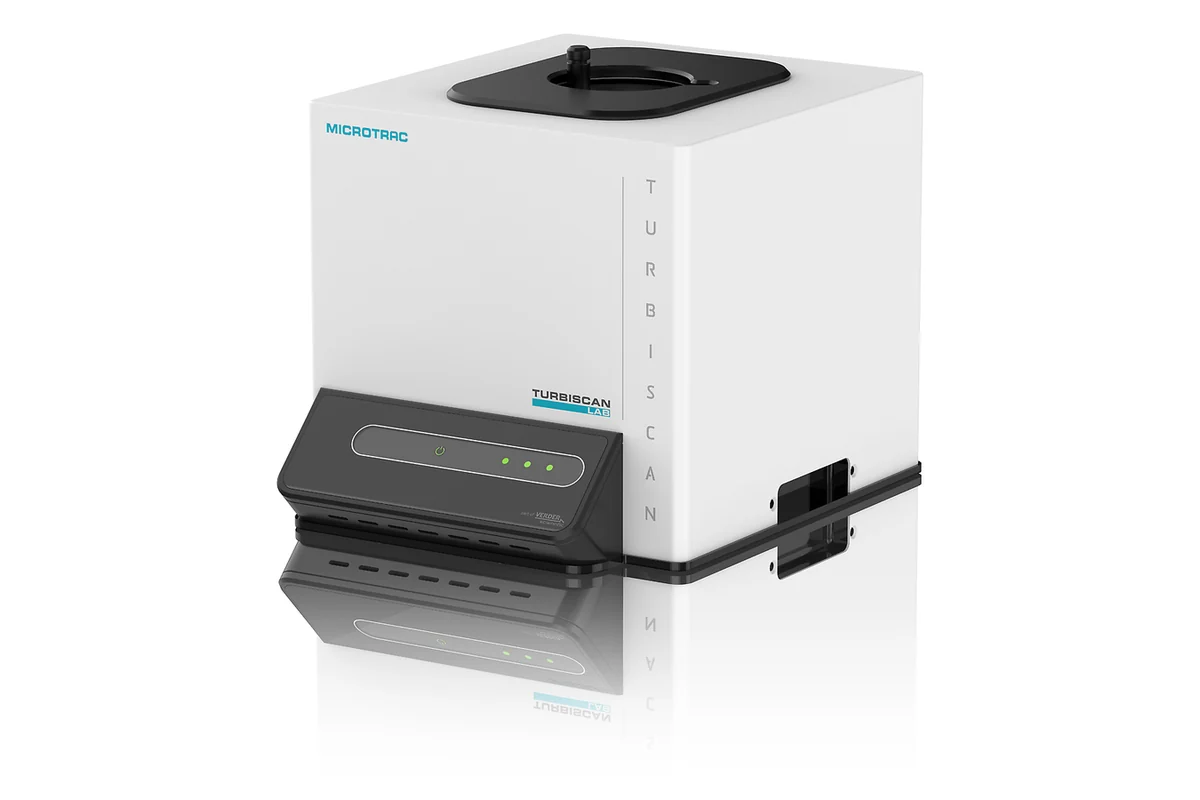
Microtrac TURBISCAN LAB Dispersion Stability Analyzer
Physical stability of emulsions, suspensions and foams measured on the native sample — up to 1,000× faster than visual observation, 0.0001–95 % v/v, no dilution.
- Sedimentation, creaming, flocculation and coalescence detected and quantified
- One-click Turbiscan Stability Index · room temperature to 60 °C
- Installation and on-site training included · free test analysis of your sample
- Configured to order · lead time from 4 weeks
What your formulation lab actually checks
Real stability, no dilution
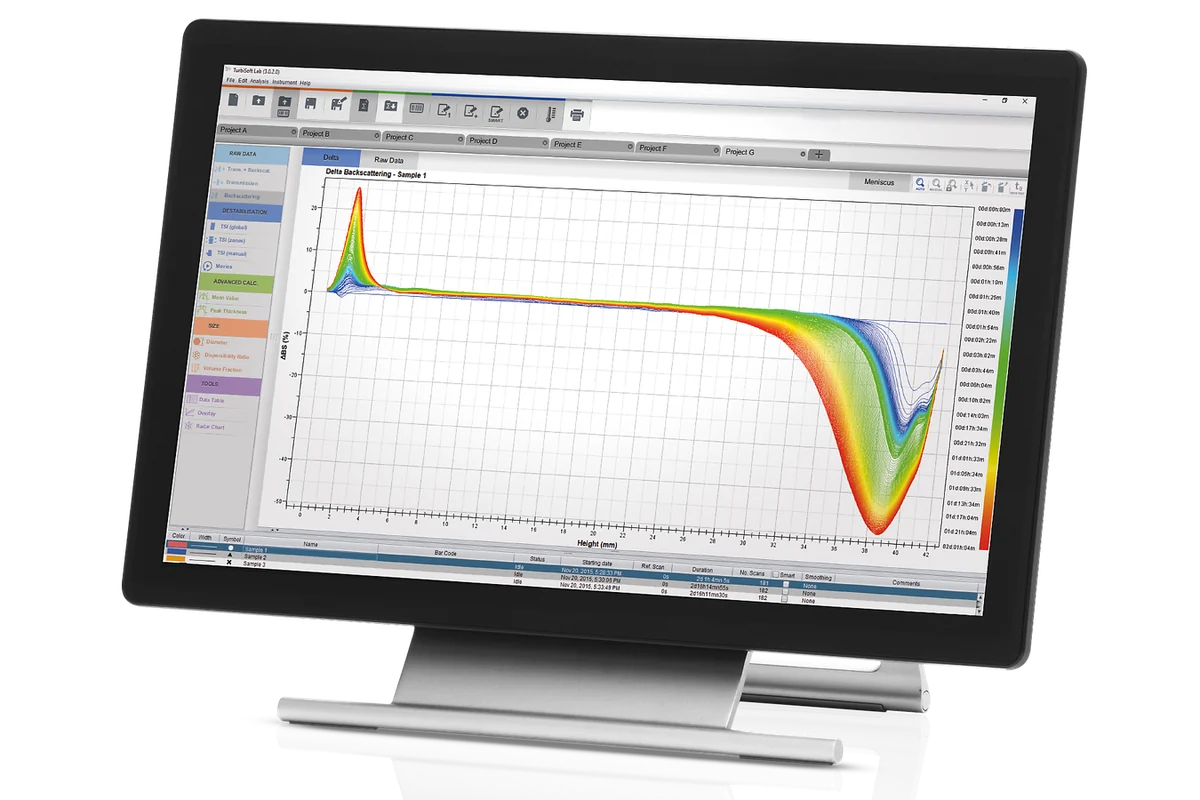
SMLS scans transmission and backscatter along the sample height to detect sedimentation, creaming and flocculation up to 1,000× faster than the eye — on native dispersions up to 95% concentration, no dilution or stress. The Turbiscan Stability Index turns each scan into an objective, rankable number and predicts shelf-life.
An applications engineer on the line
- TURBISCAN LAB — one measurement position, 880 nm light source, transmission and backscattering detectors, temperature-controlled cell up to 60 °C
- TURBISOFT software — free license on multiple computers, free updates
- Calibration standards with a guided check-up procedure, supplied with every TURBISCAN
- Vials: standard 20 mL, small-volume 4 mL with adapter (from 2 mL), coring vials, on-demand adapters
- TURBISIZE software for particle size and migration-speed distribution (ISO 13317)
- Installation and on-site operator training — included in every quotation
What the TURBISCAN LAB is
The TURBISCAN LAB is a benchtop stability analyzer from Microtrac built on Static Multiple Light Scattering (SMLS). A near-infrared light source at 880 nm scans the vial from bottom to top, and two synchronized detectors record transmitted light at 0° for clear samples and backscattered light at 135° for opaque ones, every 20 µm along the height. The scans are repeated over time. If particles or droplets migrate, the signal changes locally at the bottom or the top; if they grow by flocculation or coalescence, it changes along the whole height. The sample is read as it is, in its own vial: no dilution, no pumping and nothing that alters the dispersion you are trying to judge.
Specifications
| Measuring principle | Static Multiple Light Scattering (SMLS) |
| Light source | near-infrared, 880 nm |
| Detection | transmission at 0° · backscattering at 135° |
| Acquisition scan step | 20 µm along the sample height |
| Measured size range | 10 nm – 1 mm |
| Sample concentration | 0.0001 – 95 % v/v |
| Sample volume | 2 – 20 mL |
| Number of samples | 1 |
| Temperature range | room temperature to 60 °C |
| Reproducibility / repeatability | ±0.05 % / 0.05 % on latex standards |
| Sample recognition | barcode reader |
| Standards | ISO/TR 13097:2013, ISO/TR 18811:2018, ISO 13317-3:2001, ISO/TS 22107:2021, ISO/TS 21357:2022 |
| Software | TURBISOFT, free license |
| Dimensions | 26 × 28 × 25 cm (10.2 × 11.0 × 9.8 in) |
| Weight | 8 kg (17.6 lb) |
| CE certified | yes |
| Installation and training | on site, included in every quotation |
| Lead time | from 4 weeks, depending on configuration |
Download: TURBISCAN LAB datasheet (PDF) · TURBISCAN range brochure (PDF)
What it tells you about a dispersion
The scans show where and how the sample changes, and TURBISOFT turns that into numbers:
| Change at the bottom | sedimentation, with its migration rate |
| Change at the top | creaming of an emulsion |
| Change along the whole height | particle size increase: flocculation, coalescence, aggregation |
| TSI | Turbiscan Stability Index — all variations along the height summed into one number; the higher the TSI, the lower the stability |
| Kinetics and size | migration velocity, mean particle size evolution, phase separation thickness; size distribution with TURBISIZE (ISO 13317) |
The TSI is computed in one click, without any data input, so formulas, trials and batches are ranked by operator-independent numbers instead of a pass or fail at the jar. That is what you need to fine-tune the dose of a surfactant or stabilizer for a target shelf life.
A video of the destabilization can be reconstructed from the scans and compared for up to six samples.
Three ways to hold the sample
Where the TURBISCAN LAB stops — and what to take instead
The TURBISCAN LAB measures one sample at a time, from room temperature to 60 °C. It measures physical stability — migration, aggregation, phase separation — and does not measure surface charge. When you need to know the charge that keeps a dispersion stable, the STABINO ZETA measures zeta potential with pH, polyelectrolyte and salt titration, and the NANOTRAC WAVE II measures nanoparticle size and zeta potential by dynamic light scattering.
In pictures
Availability, payment and delivery
Why buy it through Additive Plus
What usually stops people — and the honest answer
Ready when you are
| Brand | Microtrac |
| Acquisition scan step | 20 µm |
| Certification | CE |
| Dimensions | 10.24 x 11.02 x 9.84 in / 260 х 280 х 250 mm |
| Standards | ISO/TR 13097:2013, ISO/TR 18811:2018, ISO 13317-3:2001, ISO/TS 22107:2021, ISO/TS 21357:2022 |
| Measured size range | 10 nm - 1 mm |
| Measuring Principle | Static Multiple Light Scattering (SMLS) |
| Number of Samples | 1 |
| Reproducibility | 0.05% |
| Sample concentration | 0.0001 - 95% |
| Software | Turbisoft - Free license |
| Temperature range | RT - 60°C |
| Weight | 2 - 20 mL, 8 kg |
We run this lab daily. Send a sample.
Send us a powder sample and we'll run PSD and morphology on the actual instrument, then share the data and method — so you see repeatability before you buy. We can also run analysis as a service while you evaluate.
Other products teams run alongside Microtrac TURBISCAN LAB Dispersion Stability Analyzer
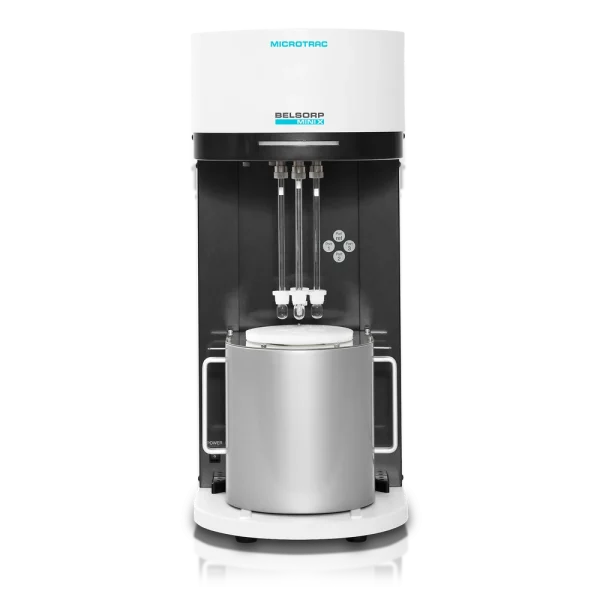
Compact BET surface area and pore size analyzer — up to four samples at once, from 0.01 m²/g with nitrogen, pores 0.7 to 500 nm.
- Each port with its own transducer, helium-free AFSM™2 measurement
- Quick BET: three-point BET of several samples in about 15 minutes
- Installation and on-site training included · free test analysis of your sample
- Configured to order · lead time from 4 weeks
Made to order
· Lead time from 4 weeks · installation included
BET surface area and pore size from 0.35 to 500 nm on up to four samples at once — gas and vapor isotherms from P/P₀ = 10⁻⁸.
- Surface area from 0.01 m²/g with N₂, from 0.0005 m²/g with krypton
- Micropore to macropore analysis: BET, BJH, HK, SF, NLDFT / GCMC
- Installation and on-site training included · free test analysis of your sample
- Configured to order · lead time from 4 weeks
Made to order
· Lead time from 4 weeks · installation included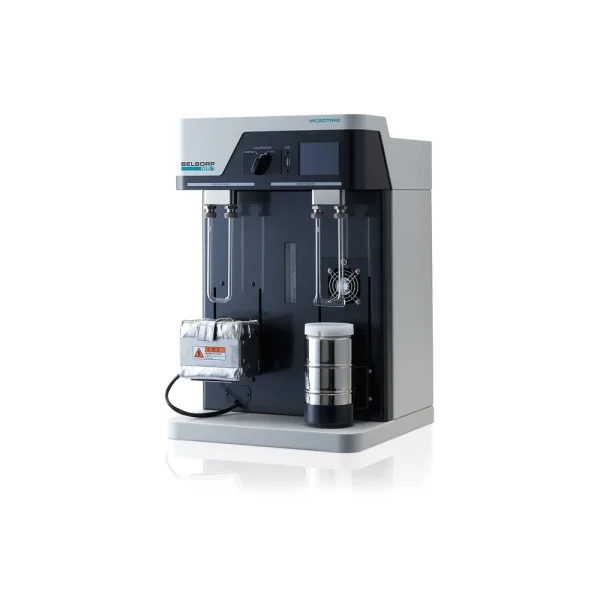
Single-point BET surface area in about 15 minutes — dynamic flow method, from 0.01 m²/g, repeatability within ±1.0 %.
- Pretreatment up to 400 °C at the same time as the measurement
- Touch panel, automatic Dewar, results to USB without manual calculation
- Installation and on-site training included · free test analysis of your sample
- Configured to order · lead time from 4 weeks
Made to order
· Lead time from 4 weeks · installation included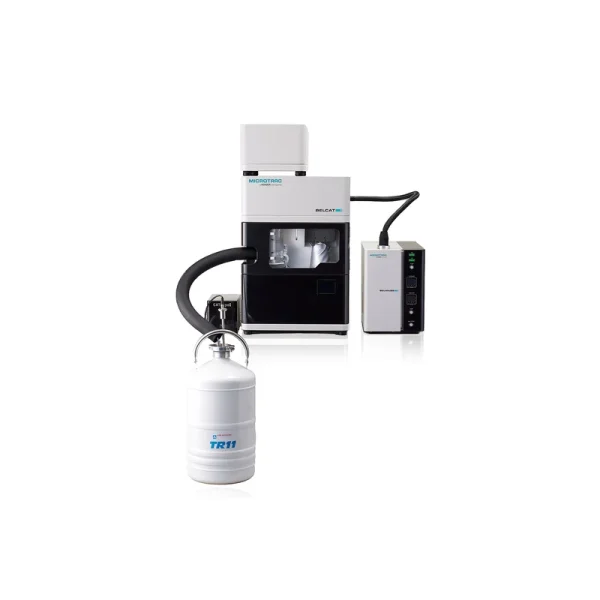
An add-on mass spectrometer for the BELCAT II that tells you which gases evolve in TPD, TPR and breakthrough runs — m/z 1 to 200, up to 16 mass numbers followed at once.
- Faraday cup or SEM detector, resolution M/ΔM ≥ 2M
- Heated hose up to 200 °C for vapors, including ammonia
- Installation and on-site training included · free test analysis of your sample
- Configured to order · lead time from 4 weeks
Made to order
· Lead time from 4 weeks · installation included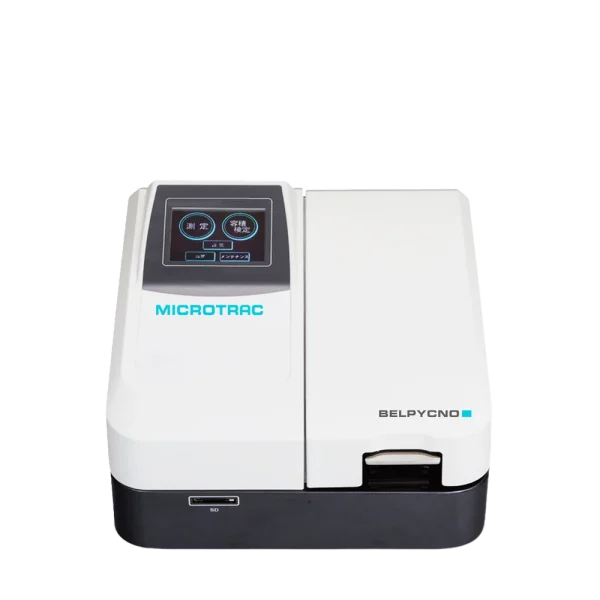
True (skeletal) density of powders and porous solids by gas displacement — helium or nitrogen, 10, 3.5 and 1 cm³ sample cells.
- Accuracy 0.03% of full scale + 0.03% of reading · repeatability 0.02%
- Benchtop, 8 kg · the reference value for porosity calculations
- Installation and on-site training included · free test analysis of your sample
- Configured to order · lead time from 4 weeks
Made to order
· Lead time from 4 weeks · installation included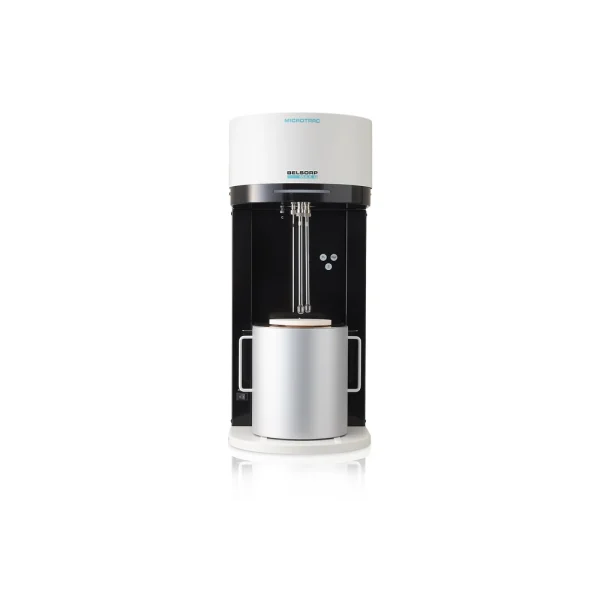
Micropore-capable BET surface area and pore size analyzer — isotherms from P/P₀ = 10⁻⁸, pores 0.35 to 500 nm, krypton down to 0.0005 m²/g.
- One measurement port with dedicated p₀ and free-space ports, AFSM™ accuracy
- BET, BJH, HK, SF and NLDFT / GCMC analysis in BELMASTER 7
- Installation and on-site training included · free test analysis of your sample
- Configured to order · lead time from 4 weeks
Made to order
· Lead time from 4 weeks · installation included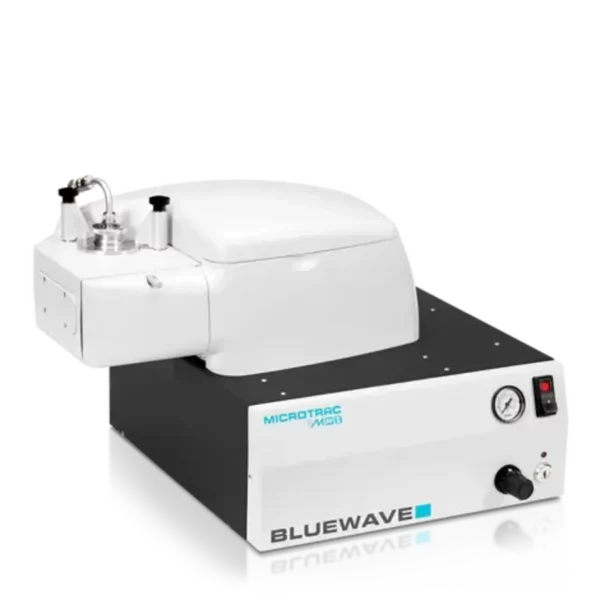
Laser diffraction particle size from 0.01 to 2800 µm, optimized below 1 µm — one red and two blue lasers, wet or dry, in about 10 to 30 seconds.
- Modified Mie for irregular and reflecting particles such as metal powders
- Complies with or exceeds ISO 13320-1; FDA 21 CFR Part 11 data security
- Installation and on-site training included · free test measurement
- Configured to order · lead time from 4 weeks
Made to order
· Lead time from 4 weeks · installation included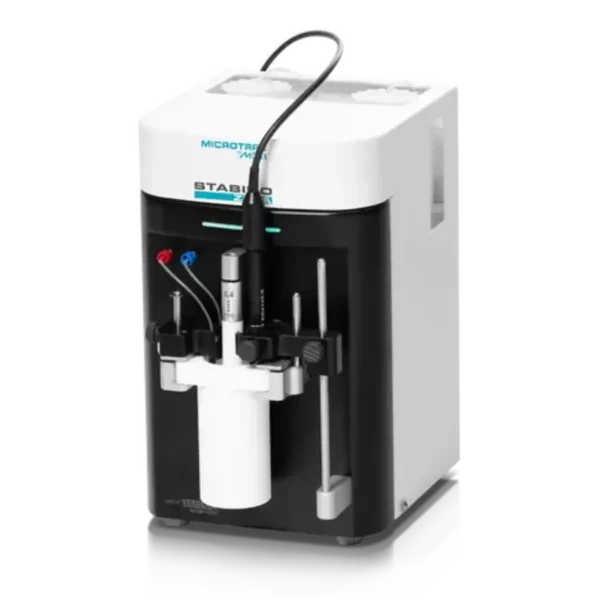
Zeta potential and surface charge by streaming potential, with built-in titration — five parameters at every point, particles 0.3 nm to 300 µm, up to 40 % concentration.
- pH, polyelectrolyte and salt titration in 5–15 minutes
- Add a NANOTRAC FLEX probe for particle size in the same sample
- Installation and on-site training included · free test measurement
- Configured to order · lead time from 4 weeks
Made to order
· Lead time from 4 weeks · installation includedWhat our customers say
“Harry and team were professional, effective communicators as we set up the order, then they executed quickly and produced an amazing product for us at a very competitive price. Am looking forward to our next print w Additive Plus!”
“Great 3D printing service and the resin parts look super smooth and clean. Really happy with how everything turned out!”
“Harry was very professional and helped me out with my 3D printing needs and explained what options I have in terms of filaments such as PEEK. Highly recommended.”
“I needed a 3D enclosure printed urgently in a specific time period, they did great!”
Common questions
Don't see yours? Email [email protected] — NDA on request, typical reply within 4 hours.
What does the TURBISCAN LAB measure?
How does Static Multiple Light Scattering work?
Do I need to dilute the sample?
How much faster is it than visual observation?
What particle sizes and samples can it handle?
What is the Turbiscan Stability Index (TSI)?
Can it measure battery electrode slurries?
How much does a TURBISCAN LAB cost?
Can I test my dispersion before buying?
What is the lead time, and what comes with the TURBISCAN LAB?
Place your order, or talk to an engineer first
Order Microtrac TURBISCAN LAB Dispersion Stability Analyzer direct, or talk to materials engineer