
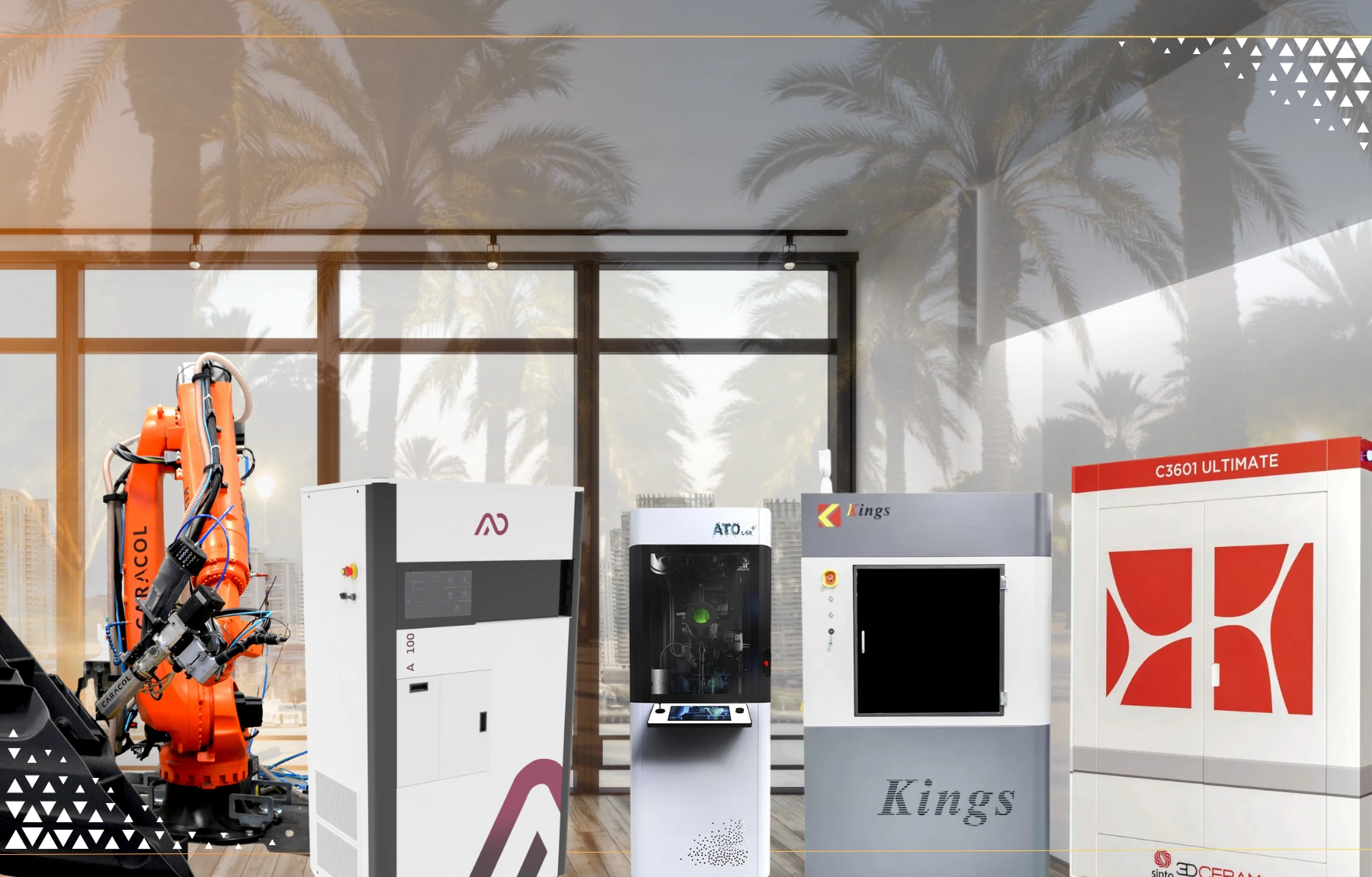
Los Angeles keeps growing as a center for advanced manufacturing, and 3D printing now sits in the daily workflow of engineers, designers, medical teams, filmmakers, and product developers. Additive Plus supports that work with industrial 3D printers, printing services, and full 3D technology support. Whether you need a 3D print shop in Los Angeles, are searching for West LA 3D printing, or want high-precision 3D scanning, we combine the equipment, engineering knowledge, and hands-on support to move a design from concept to finished part.
Why teams in Los Angeles work with Additive Plus
Additive Plus is not only a reseller. We are a full industrial 3D technology partner with our own 3D printing laboratory in Los Angeles. As a woman-owned company, we work with aerospace, healthcare, jewelry, education, automotive, consumer goods, and research organizations. We provide:
- Access to industrial 3D printers across metal, resin, polymer, and composite technologies
- In-person demos and equipment walk-throughs in Los Angeles
- Turnaround on prints and prototypes
- Engineering guidance from application to production
- Installation, integration, and operator training
- Financing and consulting options
From early prototyping to industrial production, the goal is direct: help Los Angeles teams build faster and more efficiently with additive manufacturing.
A range of 3D printers for every industry
Additive Plus carries a broad selection of industrial 3D printers, which makes it easier to compare technologies and match a system to what your team actually builds.
1. Metal 3D printers (SLM / L-PBF)
Our AO Metal printers are built for industries that cannot compromise on precision, from aerospace components that face extreme conditions to medical devices with complex geometries and detailed jewelry. AO Metal systems use Selective Laser Melting (SLM) and Laser Powder Bed Fusion (L-PBF) to fuse metal powder layer by layer, producing dense metal parts that compare with traditional machining.
Key features of AO Metal systems:
- Blue-laser technology for fine detail. Blue lasers absorb into reflective metals such as copper, silver, and gold better than infrared lasers, which supports cleaner melting, finer detail, and better surface finish for electronics, medical, and jewelry work.
- Accuracy and repeatability. AO Metal printers hold consistent dimensional accuracy across prints, which matters for aerospace and medical parts where small deviations affect safety, performance, or certification.
- Material testing with small powder quantities. The powder-handling system lets R&D teams test new materials, blends, and parameters using minimal powder, which reduces waste and cost for labs, universities, and material developers.
- Built for research, prototyping, and small-batch production. The systems suit one-off prototypes, design validation, and limited-run metal components.
- Broad alloy support. AO Metal printers run stainless steel, titanium, aluminum, tool steels, cobalt-chrome, and specialty research materials.
If you are planning a metal workflow, see our metal powders and our guide to additive metal printing with powder.
2. SLA 3D printers
SLA (Stereolithography) produces smooth, highly detailed parts with strong dimensional accuracy. Our SLA systems suit professionals who need crisp surface finishes, sharp edges, and precise geometries that FDM or SLS cannot match. An SLA printer cures liquid resin layer by layer with a laser, which makes it a fit for work where visual quality and detail matter.
Common SLA applications in Los Angeles:
- Dental manufacturing. Crowns, bridges, surgical guides, aligner models, and restorative workflows that need repeatable accuracy.
- Jewelry molds and casting patterns. Intricate wax-like patterns that capture fine texture and small features before casting.
- Medical models. Anatomical models, surgical planning tools, and prosthetic design, where precision affects outcomes.
- Engineering prototypes. Functional fit-testing, concept modeling, and detailed mechanical prototypes.
- Film, TV, and props. Props, miniatures, costume elements, and detailed set pieces for the LA entertainment industry.
What our SLA systems offer:
- Large build volumes for oversized parts without losing resolution.
- A full material range, from biocompatible resins to castable, flexible, high-temperature, and engineering-grade options.
- Smooth surface quality that keeps post-processing to a minimum.
- Steady performance through long production cycles.
To compare models, browse our resin 3D printers and read how to choose the right SLA 3D printer.
3. SLS 3D printers
SLS (Selective Laser Sintering) produces strong, functional, end-use parts. Our Kings SLS systems are built for durability and industrial-grade performance, which makes them a fit for companies that need production-ready results. Unlike SLA or FDM, SLS needs no support structures: parts build inside a bed of powder, which allows complex internal geometries and greater design freedom.
Why Kings SLS systems fit production work:
- High-strength, functional parts. SLS parts hold up under stress, heat, and repeated use, and behave close to injection-molded plastics.
- Powder reuse. Kings systems reuse leftover powder from previous prints, which cuts material waste and keeps higher-volume production economical.
- Complex geometries. With no support structures, SLS handles designs that other technologies build inefficiently or not at all.
- Consistent output across long production runs.
Common SLS applications in Los Angeles include robotics parts with strong strength-to-weight ratios, engineering components such as housings, hinges, gears, and brackets, low- to mid-volume end-use production where tooling is not cost-effective, and functional prototypes that must perform under real conditions. For teams that need durable plastic parts in useful quantities, SLS balances strength, material efficiency, and design freedom in a single process.
4. FFF / FDM 3D printers
FFF (Fused Filament Fabrication), also called FDM (Fused Deposition Modeling), is the most widely used 3D printing technology because it is reliable, affordable, and versatile. Our FFF/FDM printers suit educators, engineers, product designers, and research teams that need dependable daily printing without the running cost of larger industrial systems. They extrude melted filament layer by layer, and their straightforward setup and low maintenance make them a staple in labs, classrooms, and design studios.
Why FFF/FDM printers are a common choice:
- Cost-effective and reliable for everyday prototyping, concept models, fixtures, jigs, and teaching.
- Simple to operate and maintain, with quick setup and minimal calibration for beginners and professionals.
- Wide material compatibility, including PLA for clean prototyping, ABS for tough heat-resistant parts, nylon for durable engineering components, carbon fiber composites for lightweight high-strength parts, and other specialty filaments.
- A fit for education and design, from STEM courses and student projects to concept models and product mockups.
These printers show up in schools and universities for engineering courses, in engineering labs for functional prototypes and design validation, and in design studios for concept modeling and client-ready visual prototypes.
5. Large-format 3D printers
Large-format printing covers projects that desktop or mid-size systems cannot handle. Our large-format printers are built for industrial teams, designers, and creators producing oversized, structurally strong parts. They offer large build volumes, reinforced gantry systems, and high-output extrusion, which suits work at scale, from full-size prototypes and architectural models to large production tooling.
Why large-format matters:
- Print large parts in one piece, without splitting designs or assembling multiple prints.
- High-strength materials, including reinforced filaments, engineering-grade polymers, and composites with real structural performance.
- Faster production for big builds, with high-speed extrusion and efficient motion systems.
- A fit for creative and engineering work across automotive, architecture, and film.
Common applications include automotive tooling such as jigs, fixtures, molds, and interior panels; scaled and full-size architectural models and façade elements; oversized engineering prototypes for full-scale testing; and film props, character sculptures, and set pieces for Hollywood studios.
6. Ceramic, polymer, and composite printers
For applications that need advanced materials, Additive Plus offers ceramic, reinforced polymer, and composite 3D printers. These systems handle work where standard plastics or metals fall short, delivering strength, heat resistance, chemical stability, and precision. Ceramic printers build complex geometries in technical ceramics used for biomedical devices, high-temperature components, and research, while reinforced polymer and composite printers produce lightweight, strong parts for aerospace, automotive, and industrial engineering.
What these systems provide:
- Reinforced materials, including carbon fiber, glass fiber, and other composite filaments for stiffness and mechanical strength.
- Technical ceramics for biomedical implants, heat-resistant components, microfluidics, and precision instruments.
- Durable functional parts that withstand heat, stress, chemicals, or long-term use.
- Research-grade results for labs, universities, and R&D facilities that need accurate, repeatable, material-specific output.
7. Production and post-processing systems
Additive Plus supports the full production workflow, not just the printers, with post-processing and industrial tools that improve part quality and help teams scale from prototyping to production. Whether you build metal, polymer, or composite parts, the right post-processing equipment drives consistent, professional results.
Our production ecosystem includes:
- Ultrasonic atomizers for producing uniform metal powders and supporting material development.
- Metallographic cutters for material testing, sectioning, and quality analysis.
- Hardness testers to confirm parts meet mechanical and performance standards.
- Powder drying systems to maintain powder quality in metal and SLS workflows and reduce defects.
- IoT-enabled monitoring for real-time tracking of machine performance, environmental conditions, and production metrics.
- Finishing and polishing tools for smoothing and refining parts to a ready-to-use finish.
By combining printers, materials, scanning, and post-processing equipment, Additive Plus works as a single source for Los Angeles companies scaling their additive manufacturing, from concept and prototyping through to industrial production.
High-precision 3D scanning in Los Angeles
Our 3D scanning services turn physical objects into accurate digital models, which supports engineering, quality control, and design. Using structured-light and laser scanning, we capture detail at micron-level accuracy, so digital models are ready for engineering, production, or creative workflows.
Where 3D scanning applies:
- Reverse engineering. Capture complex parts and rebuild their CAD models, which suits legacy components, replacement parts, or design improvements.
- Inspection and quality control. Identify defects, verify tolerances, and compare manufactured parts against original CAD.
- Medical device modeling. Scan anatomical models, surgical guides, prosthetics, and implants for accurate fit.
- Jewelry design. Capture intricate patterns and textures for prototyping, replication, or custom production.
- Film, TV, and VFX. Create digital doubles, props, and set elements from real objects to support visual effects and post-production.
- Custom product development. Support prototypes and small-batch runs that need precise measurement and fine detail.
Why teams choose Additive Plus for scanning:
- Structured-light and laser systems that capture curves, surfaces, and detail for use in CAD, simulation, or printing.
- Clean, ready-to-use data compatible with 3D printing, CNC manufacturing, and digital design tools.
- Handling for complex projects, from small precision components to large-scale models, held to engineering and production standards.
Serving West LA and greater Los Angeles
Whether the search is for West LA 3D printing, West 3D, or general LA 3D printing, Additive Plus supports the region with:
- Technology consultations
- Workflow optimization
- On-site training
- Installation and setup
- Material testing
- Long-term maintenance support
From creative studios to large manufacturers, we help businesses across the region adopt 3D technology with confidence. Because the lab is local, demos, installation, and support happen in person rather than over a shipping label, which shortens the path from evaluation to a working process on your floor.
Los Angeles source for industrial 3D printers
For engineers, creators, and companies comparing 3D printers in Los Angeles, Additive Plus offers a fully equipped LA lab, industrial-grade scanning, and a deep portfolio of metal, SLA, SLS, FFF, ceramic, and composite systems. We support every stage of the process, from first prototype to production. If you are ready to move your manufacturing or product development forward, the Additive Plus team is here to help.
Frequently asked questions
What is a blue-laser metal 3D printer and why does it matter?
A blue-laser metal 3D printer uses a blue wavelength that reflective metals absorb far better than conventional infrared lasers. AO Metal systems apply this to fuse copper, silver, and gold with cleaner melting, finer detail, and higher-quality surface finishes, which matters for electronics, medical, and jewelry parts.
Which 3D printing technologies does Additive Plus offer in Los Angeles?
Additive Plus offers metal SLM/L-PBF printers, SLA resin printers, plus SLS and FDM systems from its own LA 3D printing laboratory. AO Metal machines fuse metal powder layer by layer for dense parts, while SLA cures liquid resin with a laser for ultra-smooth, high-detail parts used in dental, jewelry, and medical work.
What metals can AO Metal 3D printers process?
AO Metal printers support stainless steel, titanium, aluminum, tool steels, cobalt-chrome, and specialty research materials. They also handle reflective metals like copper, silver, and gold thanks to blue-laser technology, giving R&D labs and small-batch producers full alloy flexibility across aerospace, medical, and jewelry applications.
What is SLA 3D printing best used for?
SLA 3D printing is best for ultra-smooth, high-detail parts with sharp edges and precise geometry. Additive Plus customers in Los Angeles use it for dental crowns, bridges and surgical guides, jewelry casting patterns, anatomical medical models, engineering prototypes, and film props, because SLA cures liquid resin layer by layer with minimal post-processing.
Why do AO Metal printers use less powder for material testing?
AO Metal printers use an innovative powder system that lets R&D teams test new materials, blends, and parameters with very small powder quantities. This reduces waste and cost for research labs, universities, and material developers, making the systems well suited to experimentation, prototyping, and limited-run metal production.
Does Additive Plus support printer installation and training?
Yes. Additive Plus provides installation, integration, and training alongside equipment sales, plus local in-person demos, engineering guidance, and flexible financing. As a full industrial 3D technology partner with its own Los Angeles laboratory, it supports customers from early prototyping through full industrial production.
Have a question or a project? Let’s talk.
Tell us what you need — a real applications engineer replies within 24 hours. NDA standard, no sales script.