
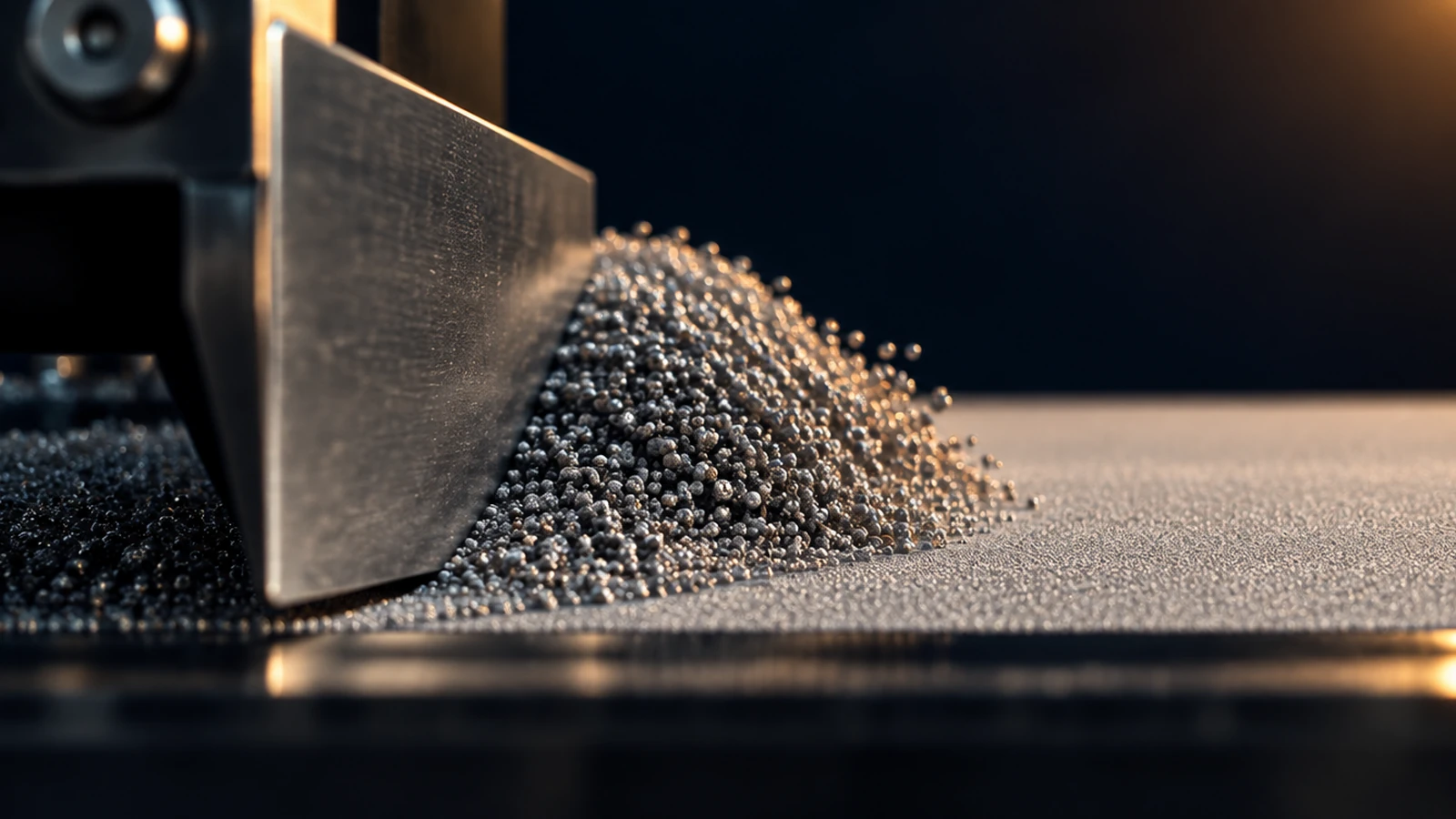
Powder flowability is the property that decides whether a build runs clean or fails at layer 400. A recoater has a few hundred milliseconds to spread a layer 20–60 µm thick, and it repeats that tens of thousands of times without supervision. If the powder hesitates, the layer comes up short. This guide covers how flow is actually tested, what each test can and cannot tell you, and which particle properties to measure when the flow number alone is not enough. The powders are in our metal powders catalog, the instruments in our analysis equipment range.
It follows on from our guide to metal powder characterization, which covers the full property set and the standards behind it.
October 15, 2026 · UC Irvine, California
A full day on part qualification, organized by Verder Scientific and hosted by the ACRC at UC Irvine. Our founder is on the panel, and the afternoon session puts the instruments on the floor.
·Two morning panels ·Hands-on afternoon with the instruments ·Evening networking ·Pre-registration required
Why flow is a symptom, not a root cause
Flow is the easiest powder property to measure and the hardest to act on. A funnel time tells you the lot is slow; it does not tell you why. The causes sit upstream, in the geometry of the particles themselves: satellites welded onto spheres, irregular fragments from an unstable atomization run, an excess of fines that increases cohesion, or moisture picked up in storage.
That is why a flow result is a starting point for an investigation rather than a verdict. Two lots with identical funnel times can behave differently on the machine, because the recoater applies forces a funnel never reproduces.
Hall and Carney: what the funnel tests measure
The standard flow tests pour a fixed mass of powder through a calibrated funnel and time it.
| Test | Standard | What it does | Limitation |
|---|---|---|---|
| Hall flowmeter | ASTM B213 · ISO 4490 | 50 g through a 2.5 mm orifice, reported in seconds | Many fine AM powders will not flow through it at all — a non-result, not a failure |
| Carney funnel | ASTM B964 | Same principle, 5 mm orifice for powders that will not pass a Hall | Numbers are not comparable with Hall values |
| Apparent density | ASTM B212 (Hall) · ASTM B417 (Carney) · ASTM B329 (Scott) | Mass per unit volume as the powder settles naturally | Says nothing about behaviour under the recoater blade |
| Tap density | ASTM B527 | Density after a defined number of taps | Meaningful mainly in ratio with apparent density |
The ratio of tap to apparent density — the Hausner ratio — is the more useful number of the pair. A ratio near 1.1 indicates a free-flowing powder; values climbing toward 1.4 and above indicate cohesion that will show up as inconsistent spreading.
Key takeaway. A powder that will not pass a Hall funnel is not automatically unusable. Plenty of well-behaved 15–45 µm LPBF powders fail the Hall and run perfectly on a machine, because the recoater applies mechanical force that gravity in a funnel does not. Report the method with the number, and never compare a Carney result against a Hall specification.
The particle properties behind the flow number
When flow drifts, the answer is in the shape data. Dynamic image analysis photographs particles individually as they fall, which is what makes these parameters measurable at production sample sizes. ISO 9276-6 governs how particle shape and morphology are described, and ISO 13322-2 covers dynamic image analysis as a method.
| Parameter | What it describes | Why flow depends on it |
|---|---|---|
| Sphericity (roundness) | How close the projected outline is to a circle | Spheres roll past each other; angular particles interlock |
| Width/length ratio | Aspect ratio of the particle | Elongated particles bridge over openings and pack unevenly |
| Convexity | Surface regularity — dents, necks, attached satellites | Satellites are the most common flow killer in gas-atomized powder |
| Symmetry | How evenly mass is distributed around the centre | Irregular fragments from unstable atomization show up here first |
These are measured on the dynamic image analysis systems such as the CAMSIZER X2, or on the SYNC, which runs laser diffraction and image analysis on the same sample so the size number stays comparable with historical data while the shape data is captured alongside it.
Sampling: the error that happens before the measurement
A shape distribution measured on a badly taken sample describes the scoop, not the lot. Powder segregates in every container it sits in — fines migrate, coarse particles rise under vibration in transport. A spoonful from the top of a drum is not the lot.
ISO 14488 covers sampling and sample splitting for determining particulate properties, and it is the least glamorous standard in the qualification chain and the one most often skipped. Use a rotary splitter rather than coning and quartering, sample the flowing stream rather than the static bed where possible, and record where in the lot the sample came from.
How flow drifts across reuse cycles
- Satellites and spatter return to the lot. Condensate and partially sintered agglomerates come back with the recovered powder and drive convexity down.
- The distribution coarsens. Fines are consumed and lost to the filter, so the curve moves upward with each cycle.
- Moisture accumulates. Every open handling step is an opportunity for pickup, and cohesion rises with it.
- Flow degrades last. By the time the funnel time changes visibly, the shape distribution has been drifting for several builds.
This is the argument for tracking shape alongside flow across the reuse cycle, rather than waiting for the flow number to move.
Writing flow into a specification that works
- Name the method, not just the limit — Hall or Carney, with the standard cited.
- Specify the Hausner ratio rather than apparent and tap density in isolation.
- Add shape acceptance limits — sphericity and convexity as distributions with a percentile, not an average.
- Define the sampling procedure by reference to ISO 14488, including where in the lot samples are taken.
- Set a re-test cadence for reused powder tied to cycles or blend ratio, covering shape as well as flow.
Testing powder through Additive Plus
We supply both the powder and the instruments that qualify it, and we run these measurements on our own material before it ships. That means a specification conversation starts from real numbers on a real lot. Based in California, with characterization and printing under one roof.
Instruments: Particle size & shape analysis · All analysis equipment
Materials: Metal powders · Guide: Metal powder characterization
Frequently asked questions
What is powder flowability in additive manufacturing?
Powder flowability describes how readily a metal powder moves and spreads under the forces applied to it. In laser powder bed fusion it determines whether the recoater lays a uniform layer 20 to 60 micrometres thick, tens of thousands of times per build. It is measured by timed funnel tests such as ASTM B213 and ASTM B964, but the underlying causes are particle shape, size distribution and moisture.
Why will some AM powders not flow through a Hall funnel?
Fine powders in the 15 to 45 micrometre range are cohesive enough that gravity alone will not move them through the 2.5 mm Hall orifice. That is a non-result rather than a failure, and many of those powders spread perfectly well because the recoater applies mechanical force a funnel does not. The Carney funnel with its 5 mm orifice covers these cases, and its numbers must never be compared against a Hall specification.
What is the Hausner ratio and what value is acceptable?
The Hausner ratio is tap density divided by apparent density, measured under ASTM B527 and ASTM B212 or B417. A ratio near 1.1 indicates a free-flowing powder, while values approaching 1.4 and above indicate cohesion that tends to show up as inconsistent spreading. It is more informative than either density value on its own.
Which particle shape parameters affect powder flow?
Sphericity, width to length ratio, convexity and symmetry are the four that matter most, all described under ISO 9276-6 and measured by dynamic image analysis under ISO 13322-2. Convexity is the parameter that exposes satellites — partially welded particles from gas atomization — which are the most common cause of a flow number drifting in reused powder.
Have a question or a project? Let’s talk.
Tell us what you need — a real applications engineer replies within 24 hours. NDA on request, no sales script.