
Research labs rarely print one material for years. They screen new alloys, qualify powders from different suppliers and tune process windows for a paper or a customer. A closed printer that only runs its own cartridges and locked parameter sets slows that work down. An open printer turns the machine into an instrument: you own the parameters, the powder and the results.
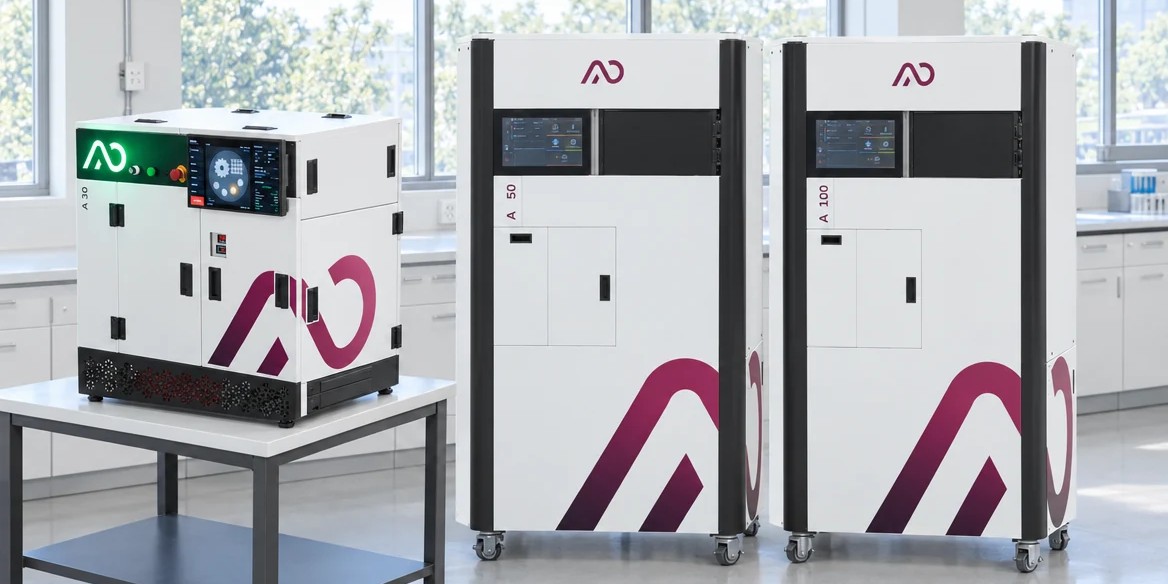
This guide lists what to check when you shortlist an open metal 3D printer for R&D, and shows how the AO Metal printers, designed and built by Additive Plus in the USA, answer each point.
What “open” should mean in a metal 3D printer
- You control the process: laser power, scan speed and strategy, hatch spacing, layer thickness, and contour and infill exposure per zone.
- You keep your own parameter sets and reuse them across builds, in AO Build Studio.
- No cartridges and no chipped powder: you can run a powder you bought or made yourself.
- No approved-material list and no annual software subscription: the AO Build Studio and AO Build Slicer licence is perpetual.
- A starting point you can trust: the print programs we have validated for standard alloys are handed over with the machine, and for an alloy we have not run yet our process engineers develop and validate the parameters and hand over the program.
How to shortlist an open metal 3D printer for alloy development
1. Powder needed to start a build
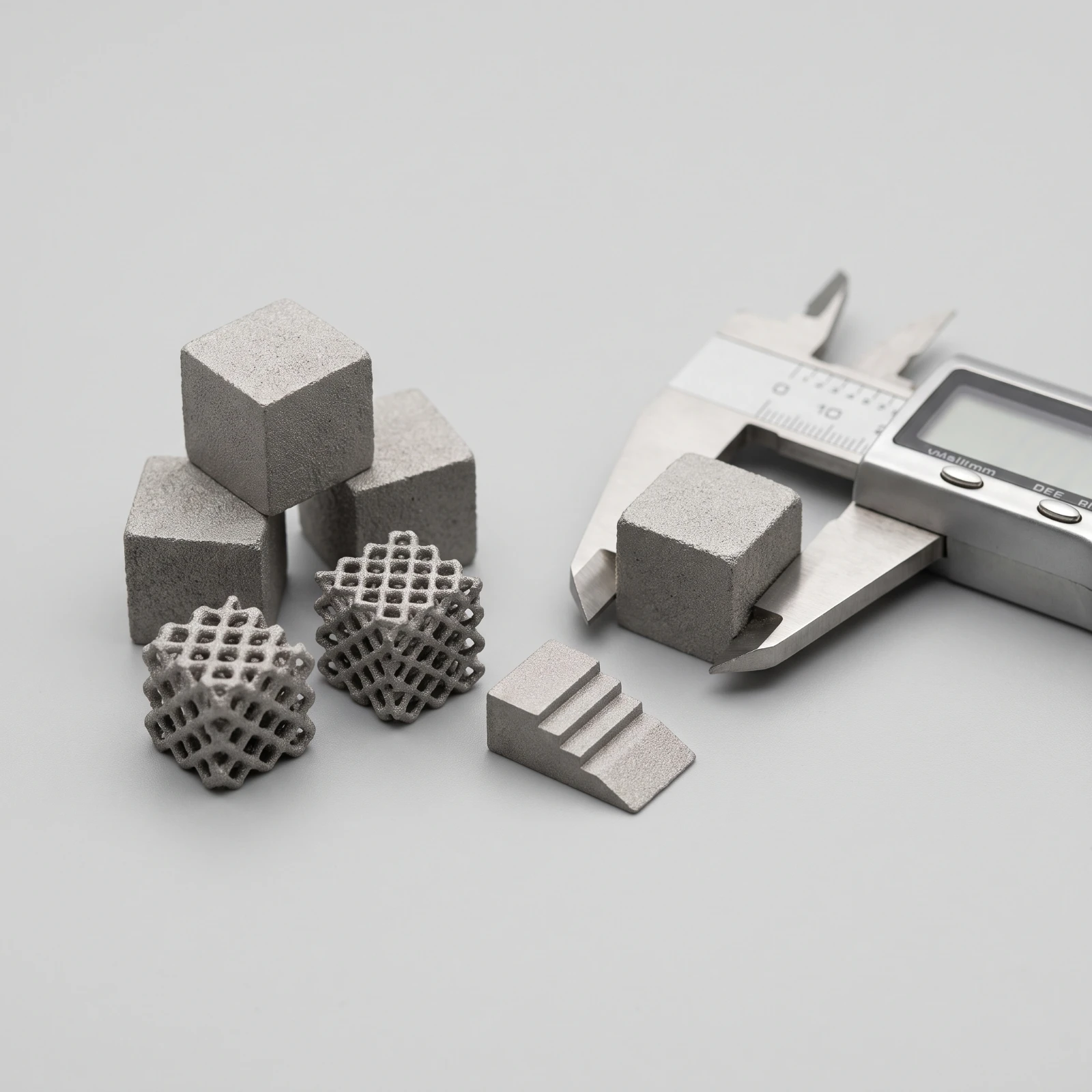
Experimental alloys are expensive and often made in small batches. A small build envelope keeps a test build in grams, not kilograms. On the benchtop AO Metal A30, a set of test coupons 10 mm tall takes about 71 g of 316L, 41 g of Ti-6Al-4V or 25 g of AlSi10Mg. On the A50-HT the same set takes 128 g of 316L, and on the A100-HT about 527 g.
2. Time to change material
If you screen several alloys a week, changeover time decides how many you can test. Changing material on the A30 takes about an hour, so a lab can move between alloys within the same day; it takes about 2 hours on the A50 and A50-HT and about 3 hours on the A100 and A100-HT.
3. Build plate temperature
Crack-prone grades such as H13 tool steel and refractory metals such as tungsten, tantalum, niobium and molybdenum build up thermal stress as each layer cools. The A50 and A100 plate runs at 250 °C; the A50-HT and A100-HT are built around an induction-heated plate that reaches 900 °C, set per job in AO Build Studio.
4. The right laser for your metal
Fiber lasers at 1064 nm handle steels, titanium, nickel alloys and aluminum. Copper, gold and silver reflect most of that infrared light and absorb blue light far better; the A50 and A100 offer an optional 455 nm blue laser for them.
5. Make and measure your own powder
Alloy development closes the loop when you can make powder, measure it and print it in one lab. We supply the ATO Lab ultrasonic atomizer and the Microtrac CAMSIZER X2+ particle analyzer, also as an R&D bundle with the A50.
AO Metal printers compared for R&D
| Printer | Build volume | Laser | Build plate | Material change | Price |
|---|---|---|---|---|---|
| A30, benchtop | Ø30 × 60 mm | 200 W fiber (300 W option) | — | About 1 hour | $59,000 |
| A50 | Ø50 × 100 mm | 300–1000 W fiber, 455 nm blue option | 250 °C | About 2 hours | From $89,000 |
| A100 | Ø100 × 100 mm | 300–1000 W fiber, 455 nm blue option | 250 °C | About 3 hours | From $99,000 |
| A50-HT | Ø50 × 100 mm | 300, 500 or 1000 W fiber | 900 °C, induction | About 2 hours | Quoted |
| A100-HT | Ø100 × 100 mm | 300, 500 or 1000 W fiber | 900 °C, induction | About 3 hours | Quoted |
All AO Metal printers are designed and built in the USA, ship 8–14 weeks from order, and come with installation, operator training and a named engineer. To put a configuration together and plan it in your room, use the AO Metal configurator; for the full budget, see how much a metal 3D printer costs.
Frequently asked questions
What is an open metal 3D printer?
A metal 3D printer on which you set every laser process parameter yourself and run any metal powder you qualify, with no cartridges, approved-material list or annual software licence.
Which metal 3D printer is best for alloy development?
One that needs little powder per build, changes material quickly and gives full parameter access. The AO Metal A30 builds a set of test coupons from about 71 g of 316L and changes material in about an hour, at $59,000.
Can I use powder from any supplier or my own atomizer?
Yes. AO Metal printers have no chipped powder or approved-material list; you can run a powder you bought or made yourself, for example with an ATO Lab ultrasonic atomizer.
Which printer do I need for crack-prone or refractory alloys?
The AO Metal A50-HT or A100-HT, built around an induction-heated build plate that reaches 900 °C. The A50 and A100 plate runs at 250 °C.
Which printer prints copper, gold and silver?
The AO Metal A50 and A100 with the optional 455 nm blue laser; these metals absorb blue light far better than infrared.
Have a question or a project? Let’s talk.
Tell us what you need — a real applications engineer replies within 24 hours. NDA on request, no sales script.