
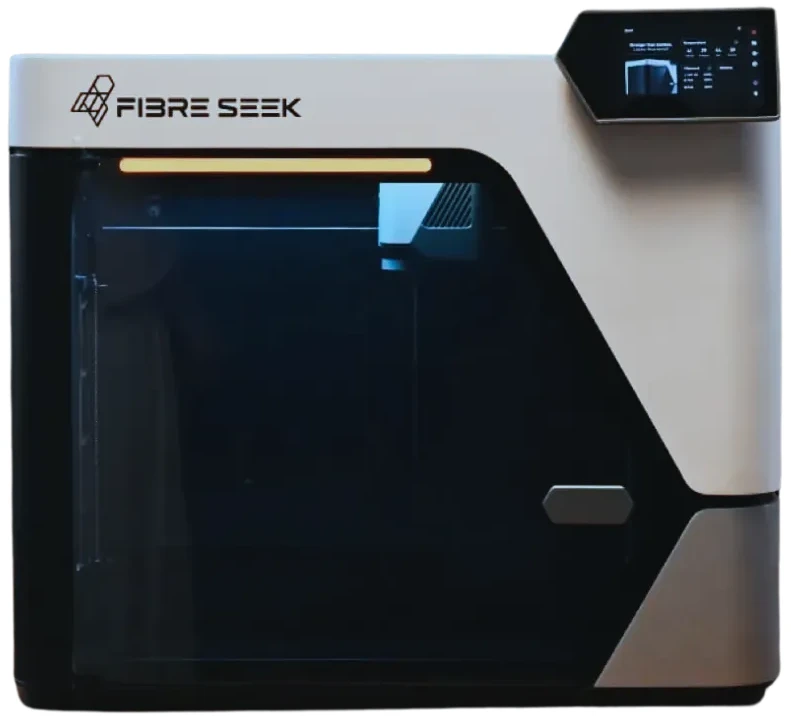
Industrial continuous-fiber 3D printers proved that printed composite parts can replace machined metal in fixtures, brackets and end-use parts. A new class of desktop continuous-fiber printers now does the same job at a fraction of the price. If you are choosing between the two, this is an honest look at what you gain and what you give up.
What both do
Both lay a continuous strand of carbon or glass fiber inside a thermoplastic part, along paths set in the slicer. In both cases the fiber, not the plastic, carries the load — which is why these parts can stand in for aluminum where a chopped carbon fiber filament cannot.
Where industrial systems lead
- Track record. They have been used in production for years, with published application data across many industries.
- Ecosystem. Larger material libraries, fleet software, and in some cases in-process inspection.
- Enterprise purchasing. Service contracts and qualification paperwork that some procurement teams require.
If your part has to be qualified on a specific platform, or your team already runs a fleet, an industrial system may be the right choice.
Where a desktop continuous-fiber printer wins
- Price. The FibreSeeker 3 starts at $2,999 — low enough to put one in a lab, a machine shop or an engineering team without a capital-equipment process.
- Co-extrusion. Fiber and plastic come from one dual-nozzle head, so you reinforce the load path and keep the rest of the part light.
- Running cost. Fiber comes on 500 m spools, and the printer also runs standard 1.75 mm PLA, PETG, PC and PA filaments.
- Speed. Up to 500 mm/s print speed, so prototypes and fixtures come off the bed the same day.
What you give up
A desktop machine is not a fleet system. The build volume is 300 × 300 × 245 mm, the material list is focused on carbon and glass fiber plus common FFF plastics, and qualification data for regulated parts is still building up. For many fixtures, brackets, drone and robot structures and R&D parts, that is not a limitation; for flight hardware it can be.
How to decide
| If you… | Lean toward |
|---|---|
| Need to qualify parts on an established platform | Industrial system |
| Want strong composite parts for fixtures, tooling and R&D on a team budget | Desktop continuous-fiber |
| Want to test continuous fiber before a larger investment | Desktop continuous-fiber |
| Already run a fleet and its software | Stay on your platform |
Support matters as much as the machine
A low-cost printer is only low-cost if someone helps you get good parts out of it. Additive Plus sells the FibreSeeker 3 with US service, onboarding, warranty handling and fiber and spare parts shipped from US stock. Book a 30-minute live demo and bring a part you want to replace — or read our guide to carbon fiber 3D printers first.
Have a question or a project? Let’s talk.
Tell us what you need — a real applications engineer replies within 24 hours. NDA on request, no sales script.