
Automotive additive manufacturing stopped being a prototyping story some time ago. The parts that matter now are bodywork printed straight from CAD without tooling, titanium components going into series production on electric vehicles, layup moulds for carbon bodywork, and the post-processing cells that make printed parts repeatable enough for an automotive quality system. This is the third instalment of our industry series, and every case below is documented on the vendor’s own site.
Four cases, four different processes, one pattern: additive wins in automotive where the tooling cost or the lead time of the conventional route is the actual problem.
Caracol: a complete race car body, printed without tooling
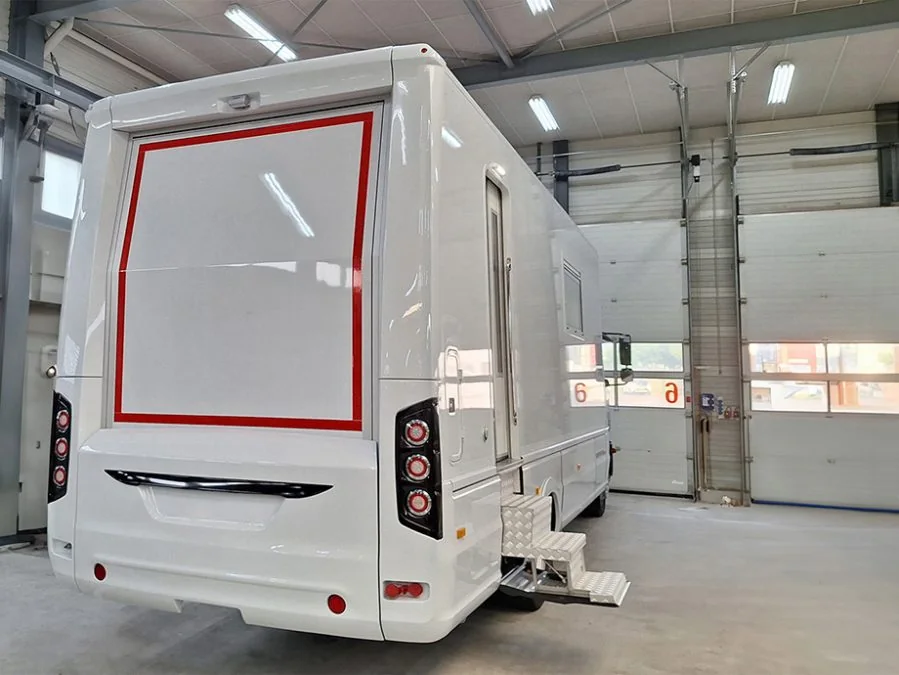
Caracol’s robotic LFAM platform was used to produce the entire bodywork of a Legend Car racing vehicle in ABS reinforced with 20 percent carbon fibre. The build came to 173 kg of parts across roughly 150 hours of deposition, assembling into a body 3.6 m long, sliced directly from CAD. The documented outcome is a lead time cut by up to 50 percent against the traditional route, with no tools, no moulds and no CNC machining in the bodywork path at all.
The same platform produced a 1,900 × 300 × 500 mm front grille mock-up as a single piece in a 10-hour cycle, reported as a 70 percent reduction in production time and 60 percent in cost against conventional methods. For carbon bodywork there is a third route: Duqueine laminated the carbon fibre engine cover for its LMP3 racing car on carbon-reinforced polycarbonate moulds printed on the same system.
Sources: Caracol case studies.
Farsoon: metal LPBF moving into automotive series production
Two documented programmes show metal powder bed fusion crossing from prototype to series in automotive. Farsoon built a metal system around the FS721M-8-CAMS platform for Brose, the largest privately owned German automotive supplier, with a 720 × 420 × 390 mm build volume and eight lasers configured for component production rather than development work.
The second is electric. Stark Future invested in the FS721M-H-8-CAMS with a 720 × 420 × 650 mm build cylinder for series production of premium electric motorcycle components, with the stated aim of being the first manufacturer in the sector to mass-produce parts in printed titanium. Both machines sit on the same platform we supply as the Farsoon FS721M.
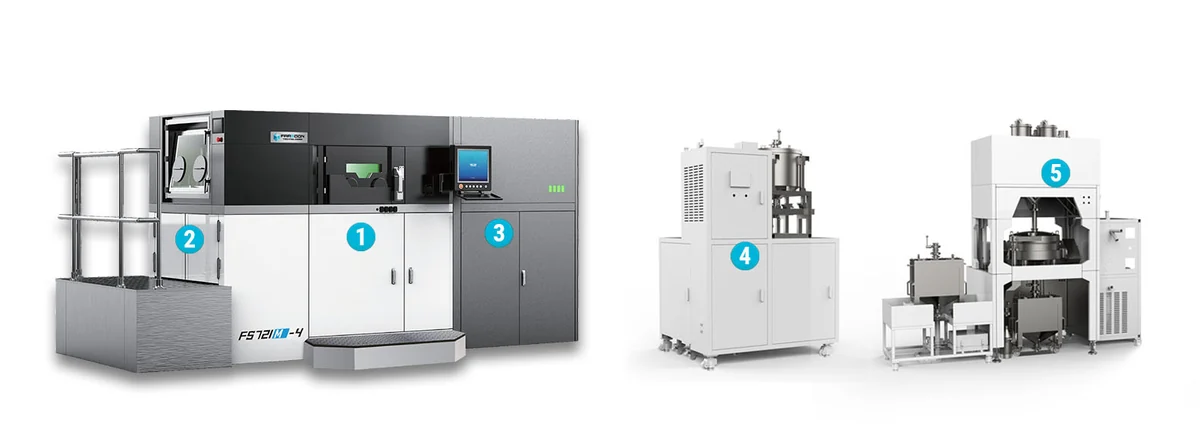
The technical detail worth taking from these two is CAMS, the continuous additive manufacturing arrangement that lets a completed build leave the machine immediately so the next one can start. In a series-production context, machine utilisation is the cost driver, not print speed.
Sources: Farsoon and Brose, Farsoon and Stark Future.
AM Solutions: post-processing as the gate to volume
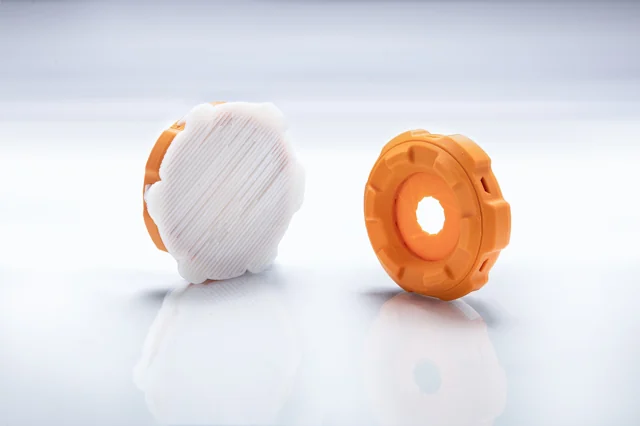
OECHSLER, one of the largest volume producers of 3D printed polymer components, brought in an automated S1 post-processing system from AM Solutions to run a lattice-structure product for a German carmaker. The part was printed in a newly developed material, and the reason the machine was bought is stated plainly in the case: to meet automotive demands for quality, repeatability of processing results, traceability and cost efficiency at volume.
The pattern nobody puts on a slide. Printing the part is rarely what blocks an automotive programme. Finishing thousands of them identically, with a record for each, is. Post-processing is where a pilot becomes a supply contract.
Sources: AM Solutions — volume production of AM plastic components for the automobile industry.
InssTek: DED for moulds and repair rather than new parts
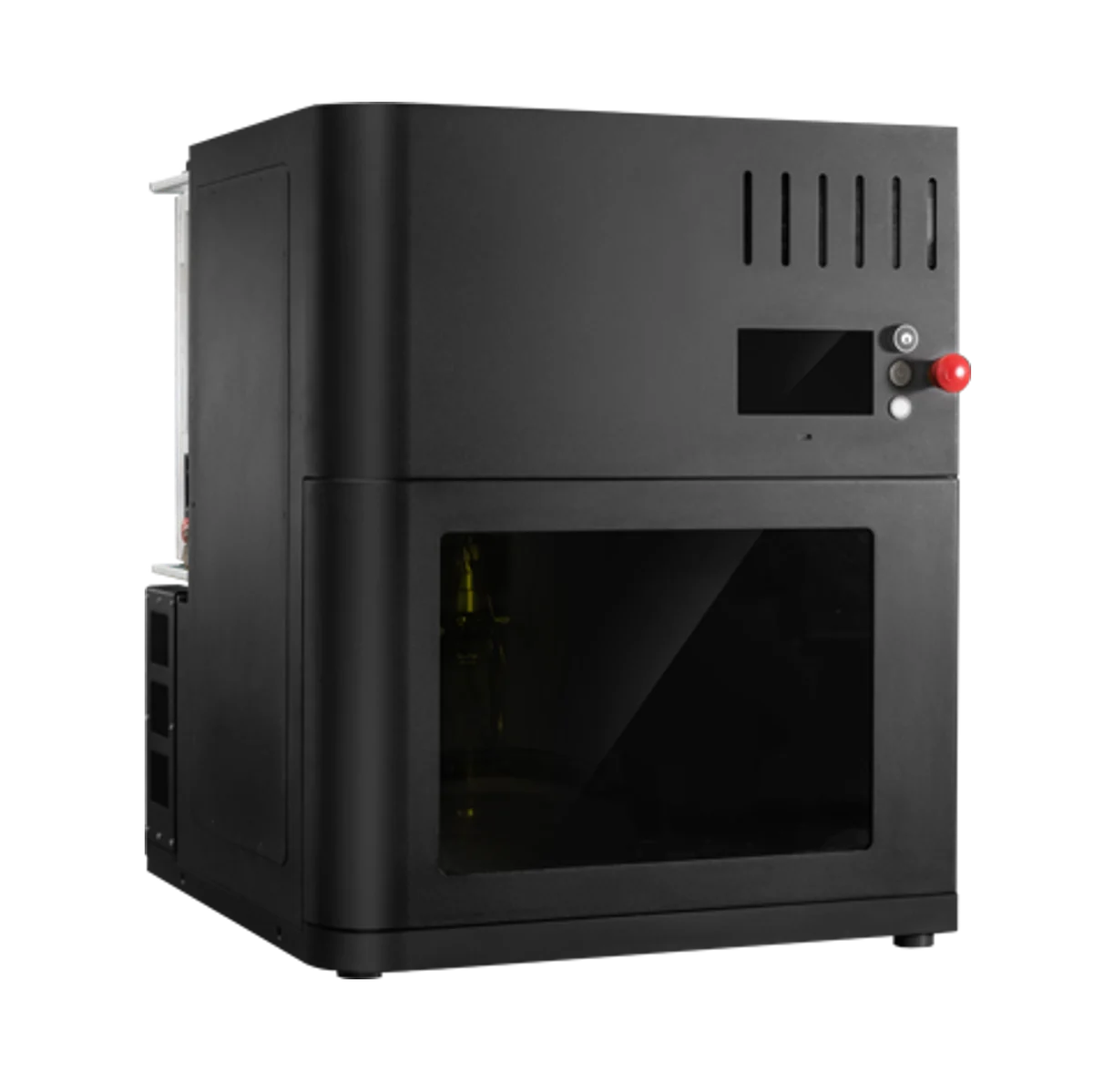
InssTek applies directed energy deposition to automotive tooling — multi-material moulds and the remodelling of headlamp moulds — rather than to printing parts from scratch. DED deposits metal onto an existing component, so the economics are different from powder bed fusion: the value is in adding material to a tool that already exists, changing its geometry or rebuilding a worn surface, instead of replacing it.
For a tooling department this is the most immediately usable form of metal additive in the building. The MX-Lab covers process and alloy development, and the MX-Fab takes it to production scale.
Sources: InssTek applications.
What these automotive additive manufacturing cases have in common
| Case | Process | What additive replaced | Documented outcome |
|---|---|---|---|
| Legend Car bodywork | LFAM, ABS + 20% CF | Moulds, tooling and CNC work | 173 kg over ~150 h; lead time down up to 50% |
| Front grille mock-up | LFAM, single piece | Multi-part fabrication | 10-hour cycle; −70% time, −60% cost |
| Brose and Stark Future components | Metal LPBF, 8 lasers | Conventional metal part routes at series volume | Series production, including printed titanium |
| OECHSLER lattice part | Automated post-processing | Manual finishing | Repeatable, traceable finishing at volume |
| Headlamp mould work | DED | Replacing or re-cutting the tool | Mould remodelling and repair in place |
Three things repeat across all of them. The first is that tooling is the target: half of these cases are about not making a mould, and the other half are about fixing or feeding one. The second is that the winning parts are either very large or very few — the two regions where the conventional cost curve is worst. The third is less comfortable: every case that reached volume needed an answer for finishing and documentation before it reached volume, not after.
Nothing here required a new material science breakthrough. It required matching the process to the part: LFAM for anything measured in metres, LPBF for dense metal parts at series volume, DED for adding metal to something that already exists, and automated post-processing for anything that has to ship by the thousand.
Where to start
If the bottleneck is tooling lead time on large parts, the entry point is LFAM and pellet extrusion. If it is metal parts at series volume, it is LPBF systems and the qualified powder behind them. If it is finishing consistency, it is the post-processing line. We supply all three and run parts on them from California, so the conversation can start with a part rather than a machine.
Send us the component and the volume you need, and we will tell you which of these four routes fits it — including when the answer is that none of them do.
Systems: Heron AM HV ·
Farsoon FS721M ·
InssTek MX-Fab ·
AM Solutions M4
Frequently asked questions
Is additive manufacturing qualified for automotive production parts?
Yes, in specific programmes. Farsoon systems are in series production at Brose, the largest privately owned German automotive supplier, and at Stark Future for electric motorcycle components including printed titanium. Qualification is programme by programme rather than blanket, and the gating item is usually repeatable post-processing and traceability rather than the printing itself.
Which 3D printing process fits an automotive part?
Match the process to the part. Large format pellet extrusion, or LFAM, suits anything measured in metres such as bodywork, mock-ups and layup moulds. Laser powder bed fusion suits dense metal parts at series volume. Directed energy deposition suits adding metal to a tool that already exists, including mould remodelling and repair.
How much time does 3D printing save on automotive tooling?
The documented figures from Caracol's automotive cases are a lead time reduction of up to 50 percent on a complete Legend Car bodywork build of 173 kg, and a 70 percent reduction in production time with 60 percent cost saving on a 1,900 mm front grille mock-up printed as a single piece in a 10-hour cycle.
What stops a 3D printed automotive part from reaching volume?
Finishing and documentation, more often than printing. The OECHSLER case turned on automating post-processing so that a lattice component for a German carmaker could meet automotive requirements for quality, repeatability, traceability and cost at volume. Programmes that plan finishing late tend to stall between pilot and supply contract.
Have a question or a project? Let’s talk.
Tell us what you need — a real applications engineer replies within 24 hours. NDA standard, no sales script.