
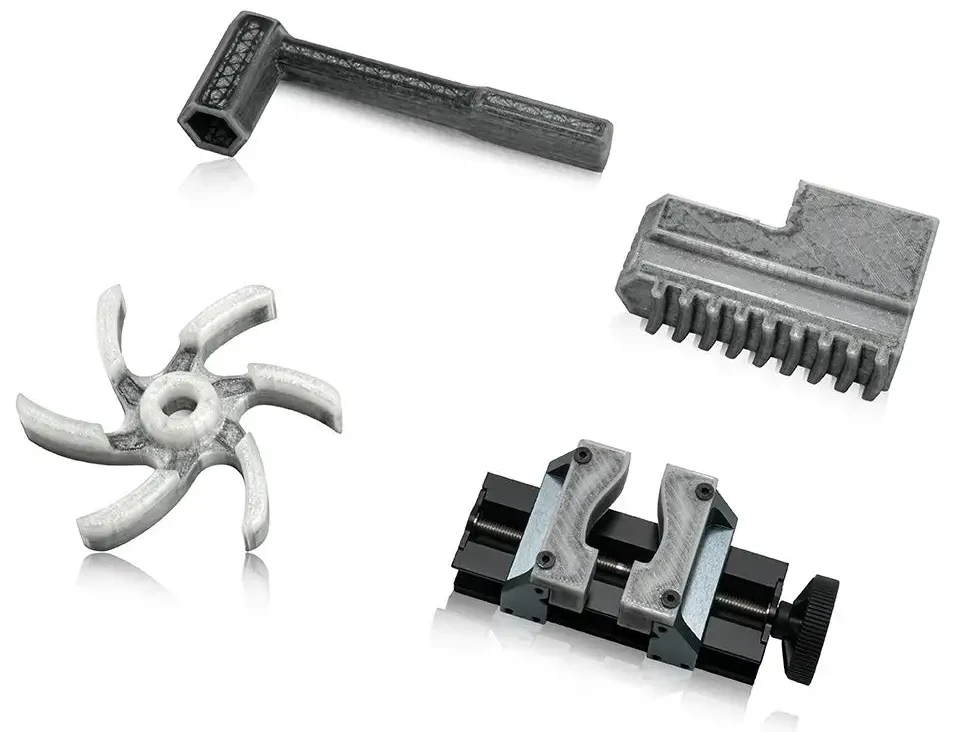
Search for a carbon fiber 3D printer and you will find two very different machines sold under the same words. One prints plastic filament that contains short, chopped carbon fibers. The other lays down a continuous strand of carbon fiber inside the part. They look similar on a spec sheet and behave very differently under load. This guide explains the difference, what each one is good for, and what it costs to get started.
Two kinds of carbon fiber 3D printing
Chopped carbon fiber filament
Filaments such as PLA-CF, PETG-CF and PA-CF (carbon-fiber nylon) carry fibers a fraction of a millimeter long, mixed into the plastic. Almost any enclosed FFF printer with a hardened-steel nozzle can print them. The fibers make parts stiffer, more dimensionally stable and more matte, but the plastic still carries most of the load, so strength rises only modestly. Our guide to carbon fiber filament grades covers which one to pick.
Continuous carbon fiber
A continuous-fiber printer feeds an unbroken carbon (or glass) fiber strand and places it along the paths you choose — around holes, along the edges of a bracket, through the load path. The fiber works like rebar in concrete. That is what moves a printed part from “stiff plastic” to a load-bearing part that can replace machined aluminum in many fixtures, brackets and drone frames. We explain the process in detail in How continuous fiber 3D printing works.
Side by side
| Chopped fiber filament | Continuous fiber | |
|---|---|---|
| What is in the part | Short fibers mixed into plastic | Unbroken fiber strands placed by the slicer |
| Main gain | Stiffness, stability, surface finish | Strength along the fiber path |
| Printer needed | Most enclosed FFF printers with a hardened nozzle | A printer built for continuous fiber |
| Typical uses | Housings, jigs, cosmetic parts, prototypes | Brackets, mounts, fixtures, drone and robot structures |
| Design work | Print as usual | Choose where the fiber goes — presets cover most parts |
When chopped fiber is enough
If the part fails because it bends or warps, rather than because it breaks, chopped carbon fiber filament is usually the cheaper answer. It is also the right choice for cosmetic parts and for printers you already own.
When you need continuous fiber
If the part carries a real load — a bracket on a machine, a mount on a vehicle, a fixture that keeps cracking — continuous fiber is the step change. The manufacturer of the FibreSeeker 3 compared the same bracket made two ways: CNC-milled 6061 aluminum at 290–310 MPa, about 260 g and about $130 with a 3–7 day lead time, versus printed with X-CCF continuous carbon fiber at up to 900 MPa, about 150 g and about $9 in 6–9 hours. These are manufacturer figures; real results depend on geometry, fiber routing and print settings.
What a continuous carbon fiber 3D printer costs
Continuous-fiber printing was long limited to industrial machines sold at many times the price of a desktop FFF printer. Desktop continuous-fiber printers have changed that. The FibreSeeker 3 starts at $2,999, prints carbon or glass fiber together with plastic through a dual-nozzle head, and has a 300 × 300 × 245 mm build volume with a 65 °C heated chamber.
Running cost is mostly fiber and plastic: a 500 m spool of X-CCF continuous carbon fiber or X-CGF continuous glass fiber, plus standard 1.75 mm filament.
Questions to ask before you buy
- Which parts will you print first? Pick two or three real parts and check whether they need strength or only stiffness.
- Who supports the printer? A printer bought from overseas is supported remotely. Buying in the US with local service means onboarding, warranty handling and spare parts here.
- Where will fiber and spare hotends come from? Continuous fiber is a consumable; check it ships from US stock.
- Can you see it print first? A live demo on your own geometry answers most questions in 30 minutes.
See it print
Additive Plus sells and services the FibreSeeker 3 in the US, with fiber and spares in US stock. You can book a 30-minute live demo with our engineers, or compare the bundles and order online.
Weighing a desktop machine against an industrial system? Read our honest comparison of desktop and industrial continuous-fiber printers.
Browse all carbon fiber 3D printers we sell, or see how teams use continuous fiber for 3D printed brackets and fixtures.
Have a question or a project? Let’s talk.
Tell us what you need — a real applications engineer replies within 24 hours. NDA on request, no sales script.