
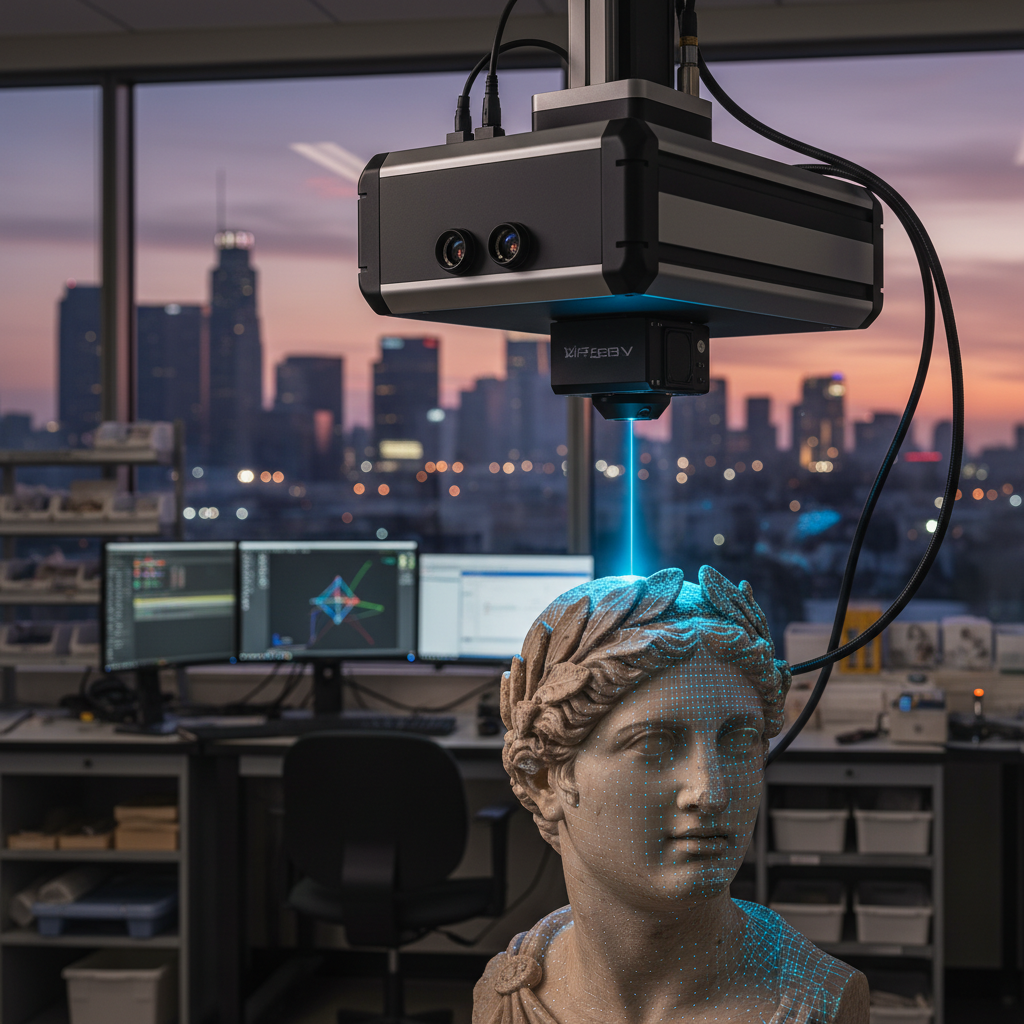
In an era where digital precision defines innovation, the ability to accurately bridge the physical and virtual worlds is paramount. Imagine transforming complex physical objects—from intricate industrial components to irreplaceable historical artifacts—into highly detailed digital models. This revolutionary capability is at the heart of 3D scanning technology, a process that captures not merely the visual appearance but the exact geometry, texture, and dimensions of an object with astonishing fidelity.
For businesses, creators, and researchers in the Southern California region, access to state-of-the-art 3D Scanning service LA is crucial. Whether your needs involve Industrial 3D scanning Los Angeles for quality control and design iteration, High-accuracy 3D scanning LA for intricate reverse engineering projects, or the delicate capture required for cultural heritage preservation, the demand for specialized expertise is clear.
This introductory guide delves into the transformative power of professional 3D scanning, exploring its diverse applications and highlighting why choosing an expert provider in Los Angeles can be the strategic advantage your project needs.
How 3D Scanning Works: The Digital Duplication Process
Ever wondered how a physical object, from a tiny, intricate gear to a massive airplane wing, can be perfectly transformed into a digital file? The magic behind this transformation lies in 3D Scanning service LA, a sophisticated process that essentially creates a digital copy machine for shapes. It’s more than just taking a picture; it’s about capturing every dimension and detail to build an exact virtual replica. Understanding this core technology is fundamental to appreciating its widespread applications, particularly in a hub of innovation like Los Angeles.
The Core Principle: Capturing Reality in Three Dimensions
At its heart, 3D scanning involves a specialized device that meticulously analyzes a real-world object or environment to collect data on its shape and often its appearance (like color). This is achieved through various methods, but the most common involve emitting and receiving signals. Imagine a smart robot equipped with a high-tech “eye” that doesn’t just see but also measures. This “eye” can send out special light, such as a precise laser beam or a projected pattern of stripes, or even utilize sound waves, similar to how bats navigate through echolocation.
The scanner then precisely measures how these signals interact with the object’s surface. For instance, with structured light, the way the projected pattern deforms when it hits the object provides depth and contour information. With laser scanning, the time it takes for a laser beam to bounce back, or the distortion of a projected line, provides accurate distance measurements. This continuous measurement across the entire surface allows the scanner to build an incredibly detailed map of the object’s geometry.
From Physical Object to ‘Point Cloud’: The First Digital Footprint
As the 3D scanner sweeps across an object, it doesn’t immediately create a smooth, solid model. Instead, it gathers millions upon millions of individual data points, each representing a precise coordinate (X, Y, Z) on the object’s surface in three-dimensional space. These tiny, discrete measurements are then compiled into what experts call a “point cloud.” Visually, a point cloud can appear like a shimmering, three-dimensional constellation – a starry night sky where each star is a tiny fragment of the object’s surface, mapped with remarkable fidelity.
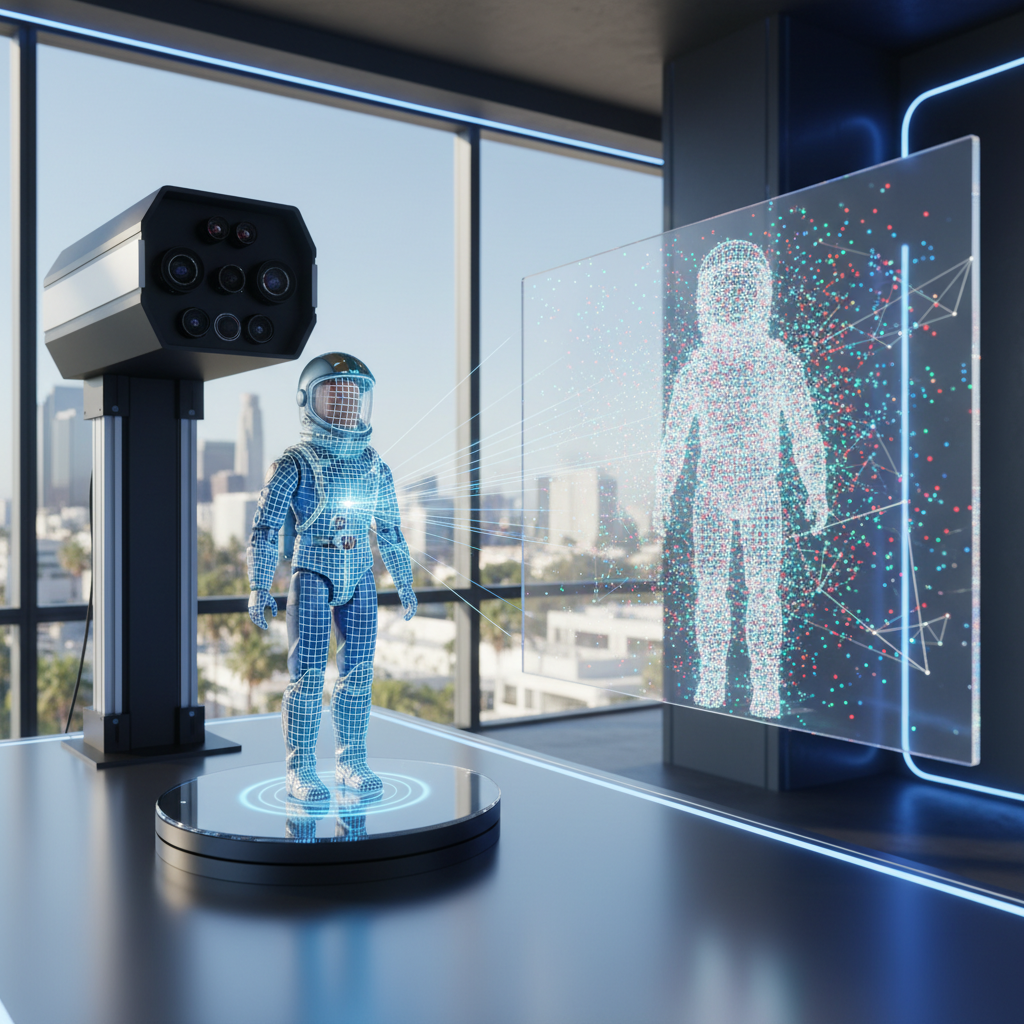
Each point in this cloud contains crucial information about its position, and often, its color. This raw data is the foundational layer for any subsequent digital manipulation or analysis. The density and accuracy of this point cloud directly determine the quality and detail of the final 3D model, making it a critical stage in the digital duplication process.
Connecting the Digital Dots: Crafting a Usable 3D Model
Once the point cloud is generated, the next step involves sophisticated computer software that acts like a digital connect-the-dots game, but on a grand scale. This software processes the raw point cloud data, intelligently connecting adjacent points to form a series of interconnected polygons, usually triangles, that approximate the object’s surface. This process, known as meshing or surface reconstruction, transforms a disparate collection of points into a coherent, solid 3D digital model.
The Crucial Role of High-Accuracy 3D Scanning in Los Angeles
While all 3D scanning aims for precision, some applications demand an unparalleled level of detail and dimensional exactness. This is where high-accuracy 3D scanning truly distinguishes itself. When dealing with components where even a fraction of a millimeter can significantly impact performance or fit, standard scanning simply won’t suffice. Think of the intricate internal mechanisms of a vintage watch, the aerodynamic contours of a racing drone component, or the precise calibration required for medical devices. In these scenarios, High-accuracy 3D scanning ensures that every minute bump, groove, and curvature is faithfully reproduced in the digital model.
This level of precision is indispensable for sectors that demand stringent quality control and exact specifications. Industries relying on Industrial 3D scanning Los Angeles, such as aerospace, automotive, and advanced manufacturing, frequently utilize high-accuracy scanners to verify dimensions, inspect parts for defects, or ensure assemblies meet design intent. Without this capability, engineering teams would face significant challenges in prototyping, quality assurance, and reverse engineering critical components. The ability to capture such fine detail means fewer errors, faster iterations, and ultimately, superior final products, reinforcing Los Angeles’s position as a hub for advanced manufacturing and design.
Now that we’ve demystified how these digital copies are made with incredible precision, you might be wondering: what exactly do professionals and innovators across Los Angeles do with these sophisticated 3D scans? Prepare to be amazed as we explore the real-world applications of this technology in our vibrant city.
Beyond the Basics: Delving Deeper into Advanced 3D Scanning Methodologies in Los Angeles
Understanding the core mechanism of 3D scanning—how light or sound translates into a digital point cloud—is merely the first step. The true power and precision of the 3D Scanning service LA emerge from the advanced methodologies employed by expert technicians and the sophisticated equipment they wield. Professionals don’t just “scan”; they strategically select from a diverse arsenal of scanning technologies, each optimized for different materials, geometries, and desired outcomes. For instance, high-resolution laser scanners are often preferred for capturing complex industrial components or precise reverse engineering with 3D scanning LA projects, offering micron-level accuracy crucial for fitting critical parts. Structured light scanners, on the other hand, excel at capturing organic shapes, textures, and colors, making them invaluable for detailed product design where aesthetics are paramount. Even photogrammetry, which uses a series of photographs to create 3D models, finds its niche in large-scale architectural projects or site surveys, complementing the direct measurement techniques with broad contextual data. The choice of technology directly impacts the ultimate fidelity and utility of the digital asset, moving beyond a simple “copy” to a highly functional, measurable, and analyzable digital twin.
The Critical Post-Processing Phase: Transforming Raw Data into Usable Models
Capturing raw scan data is only half the battle; the true artistry and technical skill of a 3D Scanning service provider shine during the post-processing phase. The initial “point cloud” generated by a scanner, while rich in data, is often raw, noisy, and incomplete due to occlusions (areas the scanner couldn’t “see”). Expert technicians meticulously clean this data, removing extraneous points, filling small gaps, and aligning multiple scan passes to create a complete, cohesive dataset. This labor-intensive process is crucial for achieving truly high-accuracy 3D scanning results.
Once cleaned, the point cloud is converted into a polygonal mesh—a network of connected triangles that forms the surface of the object. This mesh then undergoes further optimization, reducing file size while maintaining critical detail, and is often prepared for specific applications. For engineering or manufacturing, the mesh might be used as a reference to generate a precise CAD (Computer-Aided Design) model, often referred to as surface reconstruction or solid modeling. This transition from raw scan data to a parametric CAD model is essential for industrial 3D scanning applications, enabling precise measurements, simulations, and direct integration into manufacturing workflows. Different industries demand different outputs; a film studio might require a high-fidelity mesh with intricate texture maps for visual effects, while an aerospace company needs a watertight, mathematically precise CAD model for fit and function analysis. This complex workflow ensures that the digital model is not just a visual representation but a fully functional engineering asset.
Precision and Efficiency: Advanced Industrial Applications
In the demanding environment of Los Angeles’s diverse industrial sectors, industrial 3D scanning serves as a cornerstone for quality control, design validation, and metrology. Beyond simply checking if a part is “perfect,” advanced applications involve sophisticated deviation analysis. This means comparing the “as-built” physical part (scanned data) against its original “as-designed” CAD model. Specialized software highlights even minute discrepancies, showing precisely where a manufactured component deviates from its intended design. This level of detail is invaluable in industries where tolerances are tight, such as medical device manufacturing, automotive prototyping, or aerospace component production. Identifying these deviations early in the production cycle can prevent costly rework, reduce material waste, and ensure product reliability and safety.
Furthermore, the 3D Scanning service facilitates critical assembly analysis. By scanning multiple components simultaneously or individually and then digitally assembling them, engineers can foresee potential fitment issues before physical prototypes are even created. This predictive capability dramatically shortens development cycles and improves the efficiency of complex assemblies. From ensuring proper alignment in large machinery to verifying the intricate mating surfaces of precision instruments, these services provide an indispensable layer of quality assurance that transcends traditional measurement methods.
The scanning technologies, and what each one is for
Five approaches cover most work in Los Angeles shops and studios. The right one follows from the size of the subject and the accuracy the job needs.
- Structured-light scanning — projects a grid or stripe pattern and reads how it deforms across the surface. It resolves fine features, textures and subtle curves, which makes it the workhorse for small and mid-size parts in product design and component manufacturing.
- Blue-light scanning — the same principle with a blue LED source. The narrower wavelength raises accuracy and resists ambient light, so it holds up on a shop floor instead of only in a darkened room.
- Handheld scanning — the operator moves around the object while the unit captures geometry in real time. It trades some accuracy for reach, and it is the practical choice for awkward geometry and on-site work.
- Laser scanning (LiDAR) — emits laser pulses and times their return, calculating distance to millimetre accuracy. It covers what the others cannot: whole buildings, infrastructure and industrial facilities. AEC teams use it for as-built records and site verification.
- Photogrammetry — reconstructs geometry from overlapping photographs taken around the subject. It scales to very large objects and is standard in VFX, games and cultural-heritage archiving, where colour and texture matter as much as form.
What drives the cost
Five factors move the quote:
- Size and complexity — larger or more intricate objects take longer to capture and longer to process.
- Required accuracy — a tighter tolerance means better equipment and a slower, more careful capture.
- On-site or in-lab — scanning a structure where it stands adds travel and setup that a lab job does not carry.
- Deliverable — a raw point cloud is the cheapest output, a cleaned mesh costs more, and a surfaced parametric CAD model more again.
- Deadline — expedited work carries a premium.
To scope a quote, name the object, its size, the tolerance you need and the file you expect at the end. For what happens after capture, see scan to CAD.
Choosing the Right 3D Scanning Service in Los Angeles: Key Considerations
Selecting the appropriate 3D Scanning service in Los Angeles involves more than just finding someone with a scanner; it requires a provider whose expertise aligns with your project’s specific needs and desired outcomes. Key considerations include the provider’s experience with your industry – whether it’s aerospace, entertainment, or cultural preservation – as each has distinct requirements for accuracy, data formats, and project timelines. Inquire about their range of scanning technologies; a versatile service provider can select the optimal scanner for your object’s size, material, and required precision.
Crucially, assess their post-processing capabilities. A raw scan is just data; the true value comes from how that data is cleaned, refined, and converted into usable formats like precise CAD models or textured meshes. When selecting a 3D Scanning service in Los Angeles, consider their proficiency in delivering outputs compatible with advanced design platforms, including those reviewed as AI-powered 3D design software tools for printing detailed models. This ensures a seamless transition from scan data to a refined, printable design. Furthermore, discuss data security and turnaround times, especially for sensitive or time-critical projects. A reputable service will offer clear communication, transparent pricing, and a proven track record of delivering high-quality, actionable 3D data.
Frequently asked questions
What exactly is a 3D Scanning service in LA, and who typically uses it?
A 3D Scanning service LA provides specialized equipment and expertise to convert physical objects into precise digital 3D models. These services are utilized by a wide range of professionals, including engineers, product designers, architects, artists, historians, and even individuals needing custom parts for restoration or reproduction.
How long does a typical 3D scanning project take?
The duration of a 3D scanning project can vary significantly based on the size, complexity, and desired accuracy of the object. Simple, small objects might be scanned in minutes, while large, intricate industrial components or historical artifacts requiring high-accuracy 3D scanning LA could take several hours or even days for scanning and post-processing to create the final model.
What types of objects can be 3D scanned, and are there any limitations?
A vast array of objects can be 3D scanned, from tiny jewelry pieces to large vehicles and even entire rooms or buildings. However, objects with highly reflective, transparent, or very dark surfaces can be challenging and often require special preparation like temporary dulling sprays. Extremely intricate details or deep, narrow cavities might also present limitations depending on the scanner technology used.
Why is "high-accuracy 3D scanning LA" crucial for industrial applications?
High-accuracy 3D scanning LA is absolutely critical in industrial settings because even tiny deviations can lead to significant problems in manufacturing or assembly. For Industrial 3D scanning Los Angeles, precise data ensures quality control, accurate measurements, proper fit-up of components, and allows engineers to detect flaws or inefficiencies in existing designs with unparalleled precision, saving time and money.
Can reverse engineering with 3D scanning, LA truly help me replace a broken or missing part?
Absolutely! Reverse engineering with 3D scanning LA is an ideal solution for replacing broken or obsolete parts. By creating a highly accurate digital model of an existing component (even if it's damaged or only partially available), engineers can analyze its design, recreate blueprints, and then manufacture a new, functional replacement using techniques like 3D printing or CNC machining. This is particularly valuable for classic cars, antique machinery, or custom fixtures.
How do cultural institutions benefit from Cultural heritage 3D scanning LA?
Cultural heritage 3D scanning LA offers immense benefits to museums, archives, and historical sites. It allows them to create non-invasive, permanent digital records of precious artifacts, sculptures, and historical sites, safeguarding them against damage or decay. These digital models can be used for restoration planning, academic research, virtual exhibitions, and even for creating exact replicas for public interaction without risking the original object.
What information do I need to provide when requesting a 3D scanning service?
To get the most accurate quote and efficient service, you should provide details about the object's size, material, surface characteristics (e.g., shiny, dark, transparent), and its current location. Crucially, you'll need to specify the purpose of the scan (e.g., reverse engineering, inspection, archival) and the desired accuracy and output file format (e.g., STL, OBJ, STEP) to ensure the service selects the appropriate scanner and delivers the results you need.
Have a question or a project? Let’s talk.
Tell us what you need — a real applications engineer replies within 24 hours. NDA standard, no sales script.