
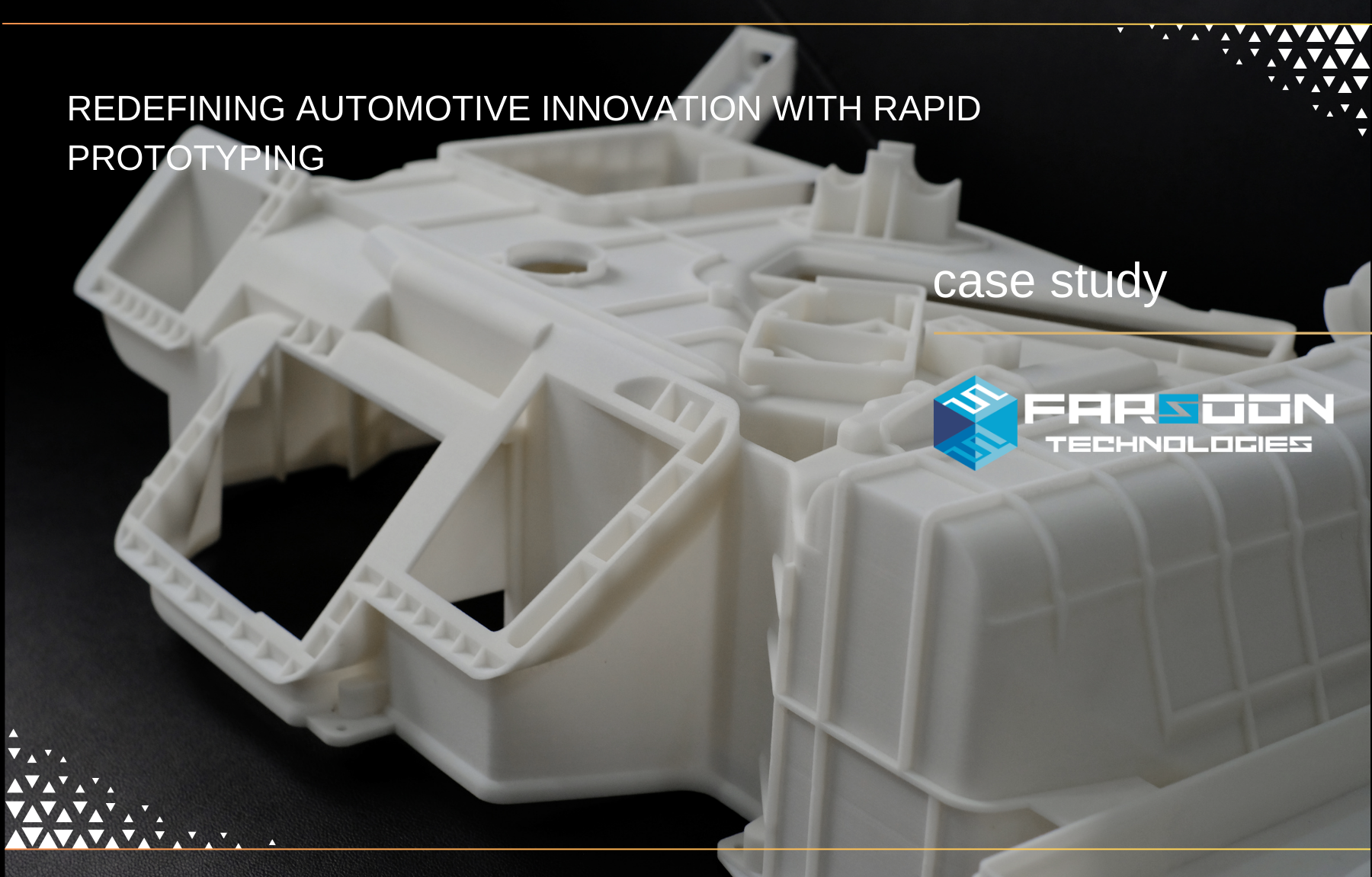
Automotive development runs on tight deadlines, rising material costs, and increasingly complex part requirements. Those pressures make traditional manufacturing hard to justify early in the design process, which is why more engineering teams reach for rapid prototyping. In practical terms, rapid prototyping is a faster, more flexible way to test part designs using tools like 3D printing. It lets automotive teams produce parts in hours instead of weeks, which cuts cost, speeds up testing, and lowers program risk. Whether the work is early R&D or late-stage design validation, rapid prototyping surfaces problems before they turn into expensive tooling mistakes.
At Additive Plus, we work with manufacturers to put proven methods like 3D printing for automotive parts into production workflows. This case study looks at how Farsoon Technologies, one of our technology partners, helps automotive suppliers simplify development through 3D printing.
Where traditional prototyping falls short in automotive
Before adopting rapid prototyping, most automotive teams rely on CNC machining or silicone molding for early parts. Both are familiar, and both carry real drawbacks when time and precision matter.
CNC machining
Producing large, detailed parts on a CNC machine often means splitting the geometry into smaller pieces, machining each one separately, and assembling them by hand. That adds delay, labor cost, and error potential at every joint. Tight design features such as undercuts are hard to reach without multiple tool changes.
Silicone molding
Silicone molding needs a long, multi-step process to build a single mold. It is slow and costly, and it struggles to hold the accuracy that high-tolerance parts demand. Shrinkage, warping, and dimensional variation are common, which is a problem in automotive work where every millimeter counts.
Limited design freedom
Both methods constrain part complexity. Organic shapes, internal channels, and curved cavities often have to be redesigned to fit the manufacturing method rather than the function. That slows development and raises production risk on components like HVAC housings, intake systems, and dashboard assemblies.
3D printing offers a different path. Because parts build up layer by layer, you can skip tool changes, consolidate assemblies, and produce the exact geometry you need from the first iteration, cutting days or weeks off a timeline.
Case study: Farsoon HT1001P and an automotive HVAC housing
A clear example comes from Farsoon Technologies in collaboration with SAPW Automotive Technology Co. The task was to produce a large, highly detailed HVAC (heating, ventilation, and air conditioning) housing, normally built from multiple CNC-machined or molded parts, as a single functional prototype.
The traditional process
- CNC machining: required segmenting the design, more than 50 hours of machining, and additional time for manual assembly.
- Silicone molding: took over 120 hours from start to finish, with accuracy limits and a labor-intensive workflow.
Both routes added complexity, drove up labor cost, and left open fitment questions. Neither was efficient or reliable enough for a part that needed smooth surfaces, tight tolerances, and internal structures.
What changed with 3D printing
Using the Farsoon HT1001P, the same HVAC housing was printed as a single part in roughly 10 hours. The result:
- No cutting or re-assembly.
- No added tooling or custom fixturing.
- Stronger part quality with no joint weak points.
- Smoother internal channels for airflow.
- Lower material and labor cost.
This is a working application of 3D printed automotive parts, delivering speed, strength, and functional geometry that the traditional methods could not reach in the same window.
About the HT1001P
Farsoon’s HT1001P is built for industrial-scale prototyping and low-volume production. With a build size of 1000 x 500 x 450 mm, it handles large-format polymer parts with complex internal features, which fits the demands of automotive development.
Why rapid prototyping shortens automotive development
The HVAC housing is one part, but the pattern repeats across a vehicle program. Design teams use 3D printing to move from CAD to a physical part in a day, test fit and function, then iterate again the next morning. That loop compresses the number of calendar weeks spent waiting on external tooling.
Rapid prototyping also earns its place beyond visual mockups. Depending on the process and material, printed parts can serve as:
- Form and fit checks that confirm a component seats correctly against surrounding hardware before tooling is committed.
- Functional prototypes that hold up to airflow, mechanical load, or under-hood conditions during validation.
- Jigs, fixtures, and assembly aids printed on demand to support the production line, often cheaper and faster than machining them.
- Low-volume and bridge production for parts needed in small quantities, such as motorsport, specialty vehicles, or pre-series runs, where hard tooling never pays off.
Material choice drives the result. Polymer processes cover most housings, ducts, brackets, and cosmetic parts, where dimensional accuracy and surface finish matter more than load. Powder-bed processes like the one behind the HT1001P produce durable, functional polymer parts, while resin 3D printers handle fine-detail visual models, master patterns, and jig work where a smooth surface is the priority.
Metal additive manufacturing takes over when a part must carry structural load or survive high temperatures, such as brackets, mounts, and under-hood components. If your program needs metal, our guide to additive metal printing with powder walks through how the process works and where it fits, and our metal powders range covers the feedstock behind it.
Bring rapid prototyping into your workflow with Additive Plus
Rapid prototyping is a practical way to cut development time, control cost, and validate designs before they reach tooling. The Farsoon HT1001P case shows what that looks like on a real automotive part: a multi-piece assembly consolidated into a single printed housing, produced in hours rather than days.
With more than 10 years of experience, Additive Plus helps clients integrate and optimize 3D printing across their operations. Our portfolio includes brands such as Farsoon Technologies and Kings3D, backed by a range of materials and services. From design support to consulting, and from polymer systems to metal powders, we help teams move from idea to functional part. If you are ready to build faster, reach out and tell us what you are trying to prototype.
Frequently asked questions
What is rapid prototyping in the automotive industry?
Rapid prototyping is the fast production of physical car parts directly from a CAD model, most often with 3D printing. It lets engineering teams test a design's form, fit, and function in hours or days instead of waiting weeks for machined or molded prototypes, so problems are caught before expensive tooling is committed.
Which 3D printing technologies are best suited to automotive prototypes?
Polymer powder-bed fusion (SLS and similar) suits durable functional prototypes like housings and ducts; FDM is economical for larger jigs, fixtures, and concept parts; resin processes (SLA/DLP) give the finest surface detail for visual models and master patterns; and metal powder-bed fusion is used for structural or heat-exposed parts. The right choice depends on the part's load, temperature, size, and finish requirements.
What materials are used for functional automotive prototypes?
Common polymers include nylon (PA11/PA12), glass- or carbon-filled nylons for added stiffness, ABS-like and PC-like materials for impact resistance, and high-temperature polymers for under-hood use. For metal parts, aluminum, stainless and tool steels, and titanium are typical. Material selection follows the part's mechanical, thermal, and surface needs.
How does 3D printing shorten the automotive development cycle?
3D printing removes the tooling step, so a design can go from CAD to a physical part overnight and be revised the next day. Teams can iterate a part several times in the span a single machined prototype would take, run fit and function tests earlier, and consolidate multi-piece assemblies into one printed component, which trims weeks from a program.
Can 3D printing produce tooling, jigs, and fixtures for the production line?
Yes. Printing jigs, fixtures, gauges, and assembly aids on demand is often faster and cheaper than machining them. These parts can be tailored to a specific operation, revised quickly when the process changes, and replaced without a long lead time, which helps keep assembly lines moving.
Is 3D printing suitable for low-volume automotive production parts?
For small quantities, such as motorsport, specialty and classic vehicles, or pre-series and bridge runs, 3D printing is often more economical than hard tooling, which only pays off at high volume. It supports end-use parts with complex geometry and short lead times, though production-grade parts still require process validation and material qualification.
When should I choose metal 3D printing over polymer for an automotive part?
Choose metal when the part must carry significant structural load, resist high temperatures, or meet wear and durability requirements, such as brackets, mounts, and under-hood components. Polymer printing is the better fit for housings, ducts, interior trim, and cosmetic or airflow parts where dimensional accuracy and finish matter more than mechanical strength.
Have a question or a project? Let’s talk.
Tell us what you need — a real applications engineer replies within 24 hours. NDA standard, no sales script.