
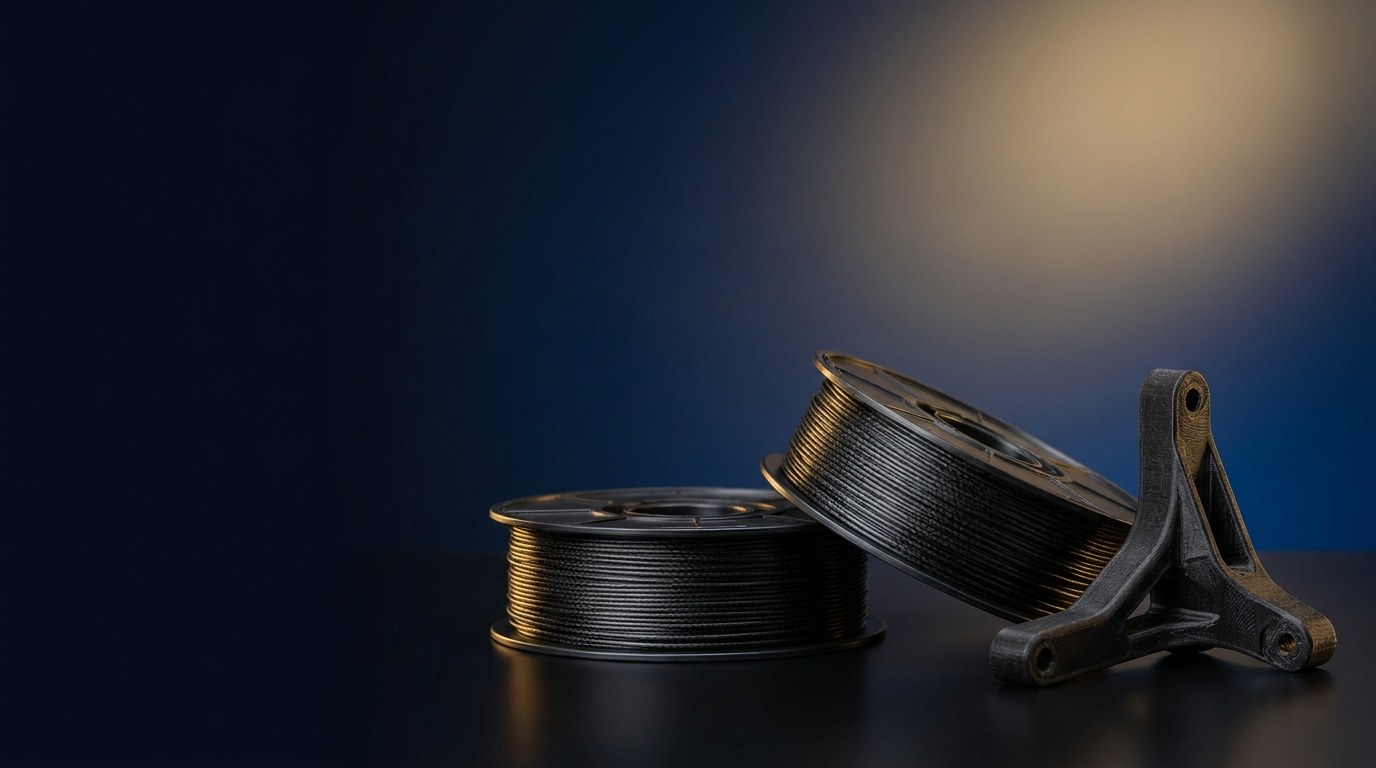
Carbon fiber filament is a thermoplastic loaded with chopped carbon fibres — usually 10–20% by weight. Those fibres do one job well: they stiffen the plastic and hold it dimensionally stable, so a printed bracket flexes less, warps less, and looks and feels like an engineered part rather than a print. It is one of the most useful upgrades on a filament shelf, and one of the easiest to misuse. This guide covers the grades, what carbon fibre actually changes, how to print it, and where it belongs.
What carbon fibre does to a filament
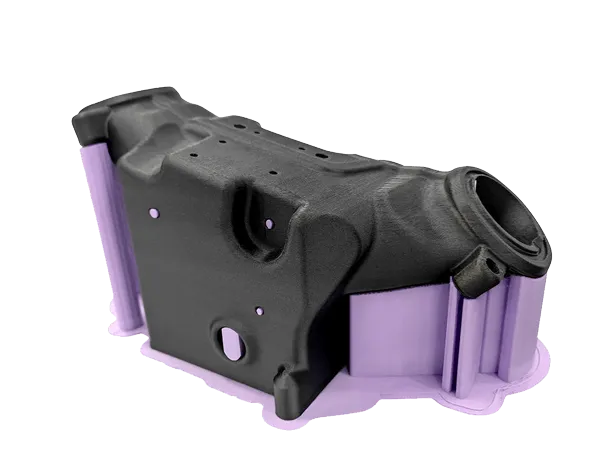
Adding chopped carbon fibre changes four things, and it is worth being precise about which:
- Stiffness rises sharply. The fibres raise the modulus — the part resists bending far more than the base plastic. This is the main reason to use it.
- Dimensional stability improves. Carbon fibre lowers thermal expansion, so parts warp less on the bed and hold tolerance better once printed.
- Weight drops slightly versus the same part in a denser engineering plastic, at similar stiffness.
- Toughness falls. This is the trade-off: the fibres make the part more rigid but more brittle, with lower impact resistance and elongation than the unfilled polymer.
The grades
The fibre is only half the material; the base polymer sets the temperature ceiling and toughness. Choose the base first, then add carbon fibre for rigidity.
| Filament | Base polymer | Heat resistance | Best for |
|---|---|---|---|
| PLA-CF | PLA | Low (~55 °C) | Stiff, matte aesthetic prototypes and low-stress parts |
| PETG-CF | PETG | ~70–80 °C | Functional brackets, chemically resistant parts |
| ABS-CF / ASA-CF | ABS / ASA | ~90–100 °C | Enclosures, automotive interior, UV-stable outdoor (ASA) |
| Nylon-CF (PA-CF) | Nylon (PA6/PA12) | ~120–180 °C | Engineering workhorse — jigs, fixtures, end-use parts |
| PC-CF | Polycarbonate | ~110–130 °C | The stiffest, highest-temperature structural parts |
For most engineering work, PA-CF (carbon-fibre nylon) is the default: the nylon base gives toughness and heat resistance, the carbon fibre adds the rigidity nylon lacks on its own.
How to print it — the hardware matters
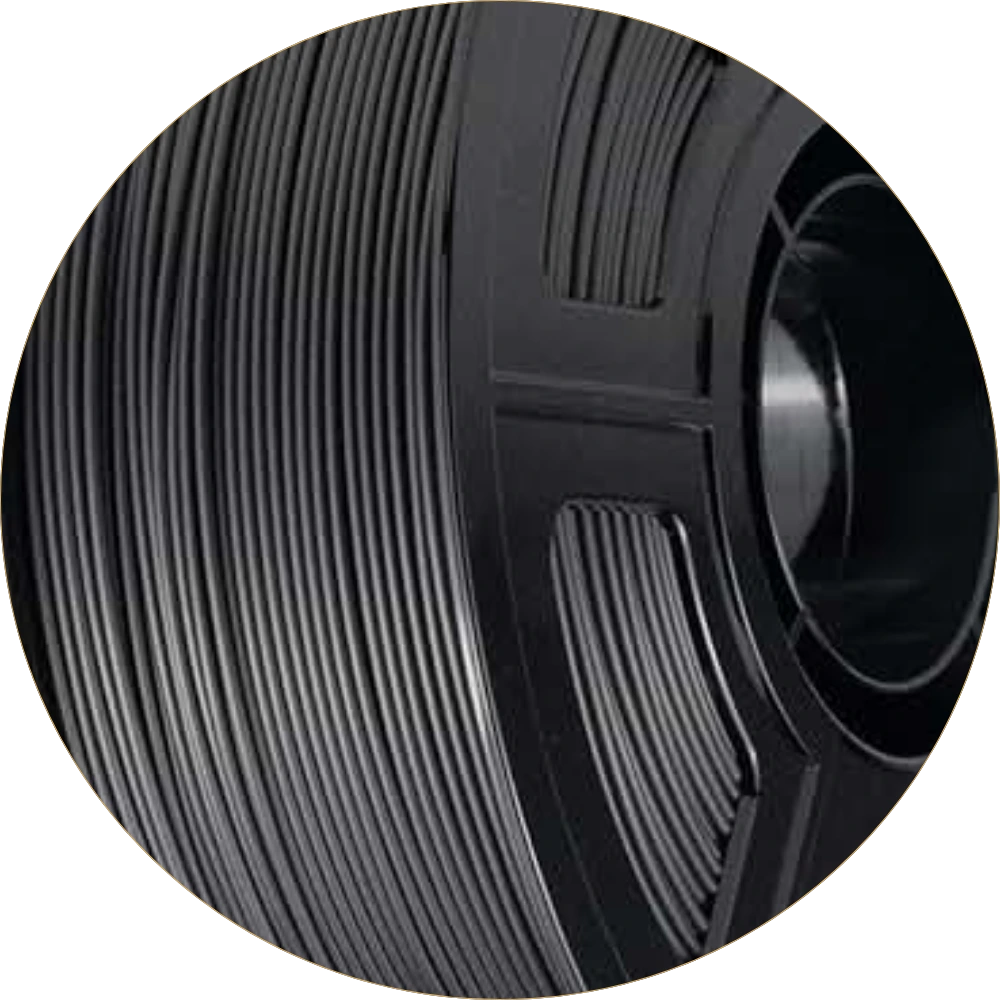
Carbon fibre is abrasive, and that dictates the setup:
- Hardened nozzle, always. Carbon fibre grinds through a standard brass nozzle in hours. Use a hardened steel or ruby nozzle, typically 0.4 mm or larger.
- Dry the filament. Nylon- and PC-based grades absorb moisture fast; a wet spool prints rough, weak and stringy. Dry it in a filament dryer and print from a dry box.
- Run the base polymer’s temperatures. Carbon fibre does not change the melt point — a PA-CF still needs nylon temperatures and often an enclosure.
- Do not expect fine detail. The fibres and larger nozzles give a matte, slightly textured surface; carbon fibre is for function, not filigree.
Any capable FFF printer with a hardened hot end can run chopped carbon-fibre filament.
Chopped fibre vs continuous fibre
One distinction matters more than any grade choice. Chopped carbon fibre — everything above — stiffens the plastic but the part is still fundamentally a plastic part. Continuous carbon fibre lays unbroken strands along the load path, and that changes the category entirely: parts can approach the strength-to-weight of aluminium, not just a stiffer plastic. If a part needs real structural load capacity rather than added rigidity, that is the route — see the FibreSeeker continuous-fibre printer.
Where carbon fibre filament belongs
- Jigs, fixtures and tooling — stiff, stable, and light enough to handle all shift.
- Drones and UAVs — rigid frames and mounts where every gram counts.
- Automotive and motorsport — brackets, ducting and interior parts that must hold shape under heat.
- Robotics — end-effectors and arms where stiffness improves precision.
Where to avoid it: parts that take impact or need to flex, anything requiring fine surface detail, and food-contact use. There, an unfilled tough nylon or a standard resin is the better call.
Choosing a carbon fiber filament
Start from the environment, not the fibre. Pick the base polymer for the temperature and toughness the part needs — PETG-CF for a warm functional bracket, PA-CF for an engineering part, PC-CF for the hottest and stiffest — then let the carbon fibre add rigidity. Match it to a printer with a hardened nozzle, and dry the spool. Browse the range in our filament catalogue, or tell us the part and the load and we will point you to the right grade.
Related: Glass-fibre nylon (PA-GF) · What is additive manufacturing · FFF printers
Frequently asked questions
What is carbon fiber filament?
A thermoplastic such as PLA, PETG, ABS, nylon or PC loaded with roughly 10-20% chopped carbon fibre, which stiffens the plastic and improves dimensional stability.
Is carbon fiber filament stronger?
It is stiffer, not necessarily stronger. Carbon fibre raises rigidity and reduces warping but lowers impact toughness and elongation, so for impact-loaded parts an unfilled tough nylon can perform better.
Do I need a special nozzle for carbon fiber filament?
Yes. Carbon fibre is abrasive and wears through a brass nozzle quickly, so use a hardened steel or ruby nozzle.
What is the difference between chopped and continuous carbon fiber?
Chopped fibre stiffens a plastic part; continuous carbon fibre lays unbroken strands along the load path and can approach the strength-to-weight of aluminium.
Have a question or a project? Let’s talk.
Tell us what you need — a real applications engineer replies within 24 hours. NDA standard, no sales script.