
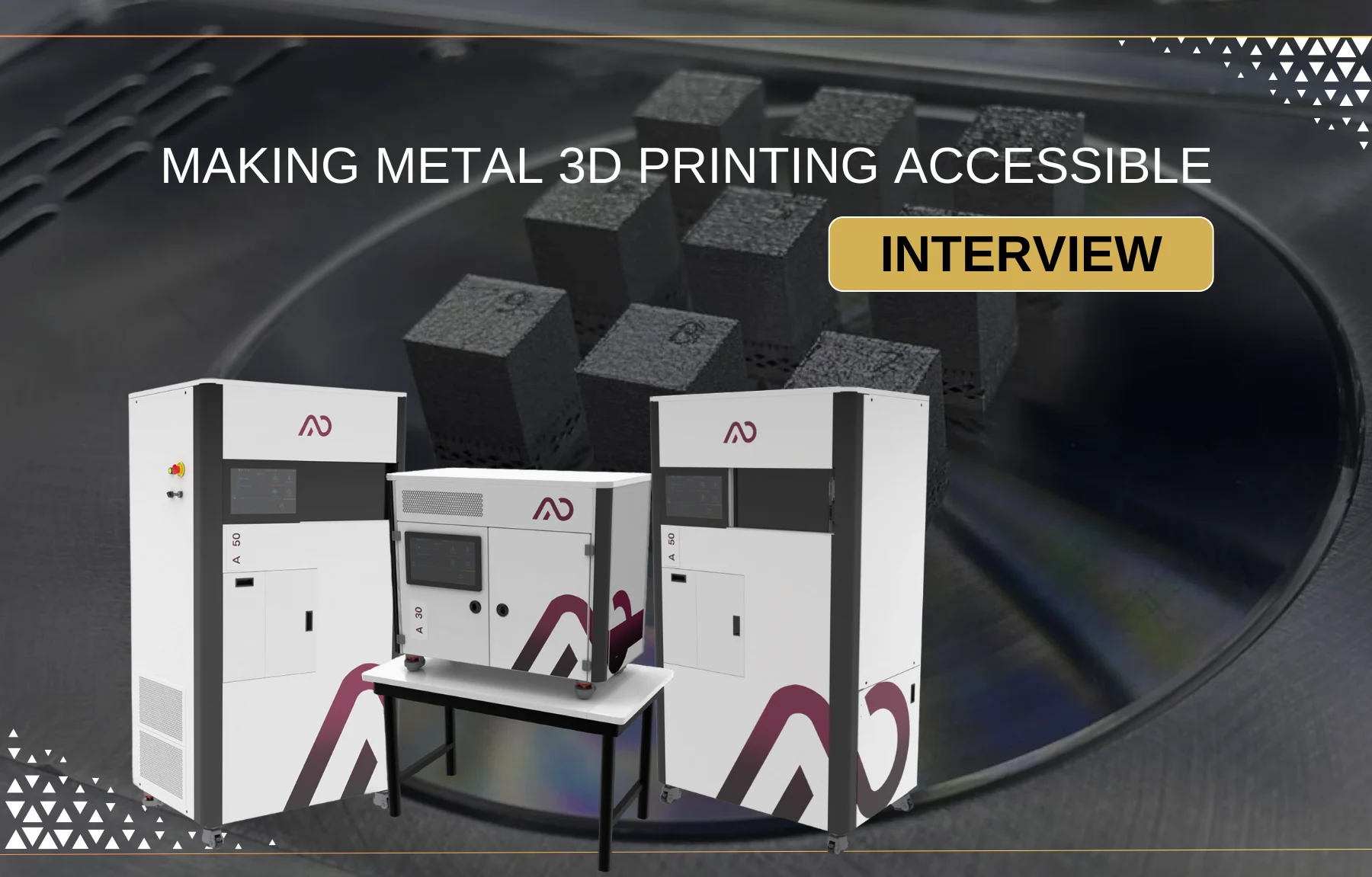
Metal 3D printing has long been locked behind six-figure machines and closed, proprietary systems. Additive Plus set out to change that. From its lab in Torrance, California, the company built AO Metal — its first in-house line of compact laser powder bed fusion (LPBF) printers — to put real metal additive manufacturing within reach of universities, research labs, and small production teams. The line debuted at RAPID + TCT 2025, with systems starting at $59,000.
Behind AO Metal is founder and CEO Ashkhen Ovsepyan, a laser physicist who developed the platform on Additive Plus’s decade of additive-manufacturing experience. Her goal is direct: remove cost as the reason a lab can’t touch metal 3D printing.
“Hands-on access to metal 3D printing shouldn’t require a six-figure investment. We built AO Metal to support researchers, universities, and small-scale innovators who are pushing material boundaries but need tools that fit their space and budget.” — Ashkhen Ovsepyan, Founder & CEO, Additive Plus
Why metal 3D printing stayed out of reach
Laser powder bed fusion produces dense, functional metal parts, but the machines that make them have traditionally been large, expensive, and parameter-locked. For a university lab or a startup, a single industrial system can cost several hundred thousand dollars and still restrict which materials and settings you are allowed to use. That combination — high capital cost plus closed parameters — kept metal additive manufacturing away from the people doing early-stage research and material development.
AO Metal attacks both problems at once: a compact footprint that fits a lab bench, a price that starts at $59,000, and fully open process control. Additive Plus reports a 60–80% cost reduction versus traditional metal AM systems.
The AO Metal lineup: A30, A50, and A100
AO Metal is a modular family of three LPBF printers, each aimed at a different stage of research and small-scale production:
| Model | Build size | Highlights | Best for |
| A30 | 30 mm diameter | Entry LPBF, from $59,000 | Material screening, micro-components |
| A50 | 50 mm + 900°C chamber | High-temperature builds | Refractory alloys, jewelry prototyping |
| A100 | 100 mm + dual lasers | Larger, faster builds | Aerospace fixtures, thermal-management R&D |
Every system runs the same metal powder workflow and open toolchain, so a lab can start on an A30 and scale up without relearning the platform.
Blue and infrared lasers for reflective metals
AO Metal’s defining feature is its laser system. Alongside a standard infrared source, the printers offer a blue laser option — a patented infrared-plus-blue combination. Blue light is absorbed far more efficiently by reflective metals, so AO Metal can process materials that are difficult or impossible on infrared-only systems: copper, gold, titanium, and high-entropy alloys. For labs developing conductive, thermal, or experimental alloys, that material range is the point.
Open parameters for real research
Each AO Metal machine runs on open process parameters — full user control over laser power, scan strategy, and thermal management. There are no vendor locks on materials or settings, so teams can qualify their own powders, develop new alloys, and treat a failed print as an R&D data point rather than an expensive, wasted run. That openness is what makes the systems suitable for material science programs and applied research, not only fixed production.
US-built, with support that keeps labs running
AO Metal is developed and manufactured in California. Additive Plus backs the hardware with a sub-48-hour technician response and a closed-loop workflow that runs from raw material to validated powder to certified part — useful when a program needs traceability from feedstock to finished component. Mid-size systems in the 200–250 mm range are in development.
Who AO Metal is for
- Universities and material science programs — hands-on LPBF for teaching and alloy research; systems are already in use at top U.S. engineering schools.
- Research labs, including NASA-supplied R&D groups, that need open parameters for experimentation.
- Medical device and hardware startups prototyping in metal without a six-figure outlay.
- Agile manufacturers running short-run or specialty metal parts.
Making metal additive manufacturing accessible
The through-line of Ovsepyan’s approach is accessibility: shrink the machine, lower the price, and open the parameters, so the barrier to metal 3D printing becomes curiosity rather than capital. For labs and universities that have watched metal AM from the sidelines, AO Metal is a way in.
Explore the AO Metal A30, A50, and A100 printers, or talk to the Additive Plus engineering team about which system fits your lab.
Frequently asked questions
How much does an AO Metal 3D printer cost?
AO Metal LPBF printers start at $59,000 for the A30 - a fraction of traditional metal AM systems. Additive Plus reports a 60-80% cost reduction versus conventional metal 3D printers, with pricing scaling up through the A50 and A100 as build size and capability increase.
What is AO Metal?
AO Metal is a line of compact metal laser powder bed fusion (LPBF) 3D printers from Additive Plus, launched at RAPID + TCT 2025. The A30, A50, and A100 bring dense metal printing to labs, universities, and small production teams in a bench-sized, affordable, open-parameter package.
What metals can AO Metal printers print?
With their infrared-plus-blue laser system, AO Metal printers handle standard metals plus reflective and difficult alloys that infrared-only machines struggle with - including copper, gold, titanium, and high-entropy alloys. Open parameters also let users qualify their own experimental powders.
Why does AO Metal use a blue laser?
Blue laser light is absorbed far more efficiently by reflective metals like copper and gold, so AO Metal's patented infrared-plus-blue setup can melt materials that infrared-only lasers reflect and waste. This gives labs a much wider material range at compact scale.
Is AO Metal suitable for universities and research labs?
Yes. AO Metal is designed for universities, material science programs, and research labs. It fits on a bench, starts at $59,000, and runs fully open process parameters - laser power, scan strategy, and thermal control - so teams can develop alloys and treat failed prints as research data. Systems are already used at top U.S. engineering schools.
Where are AO Metal printers made and supported?
AO Metal printers are developed and manufactured in California by Additive Plus, backed by a sub-48-hour technician response and a closed-loop workflow that runs from raw material to validated powder to certified part.
Have a question or a project? Let’s talk.
Tell us what you need — a real applications engineer replies within 24 hours. NDA on request, no sales script.