
Second in our monthly series on additive manufacturing by industry. Each month we take one sector and pull documented cases from across the equipment and material lines we supply.
Medical and dental 3D printing reached real production early, and for a simple reason: the parts are one-offs. Every implant fits one patient, every crown one tooth, every surgical guide one anatomy. That is the exact profile additive manufacturing was built for — a batch size of one, made to a scan. This roundup covers documented medical and dental cases from the vendors we carry, and the standards that decide whether a printed part can touch a patient.
Medical and dental 3D printing, already in patients
3D-printed titanium is routine in spine surgery. Multiple Ti-6Al-4V interbody fusion cages — from makers including EIT, Osseus and K2M — are FDA-cleared and in clinical use, built by laser powder bed fusion with a bone-like lattice core that encourages tissue to grow through the implant (3D Printing Industry). Dentistry has moved even faster: the dental 3D printing market is estimated in the tens of billions of dollars, with resins — crowns, dentures, aligner models and surgical guides — the largest and fastest-growing segment (Grand View Research). The technology is not emerging here; it is in the operating room and the dental lab.
1. Titanium and tantalum implants — metal LPBF
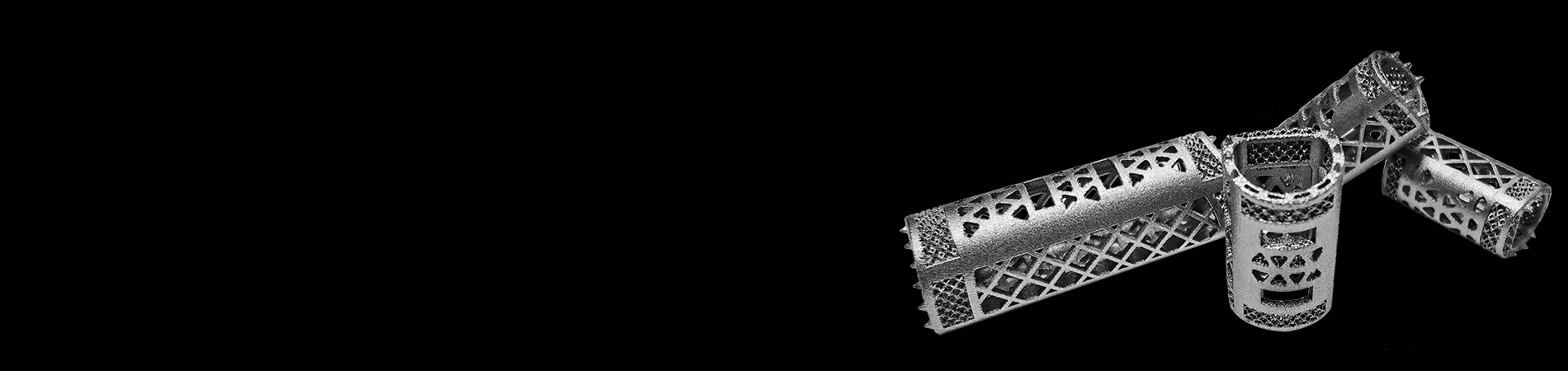
The strongest metal-implant record among our lines is Farsoon. A porous titanium spinal fusion cage printed by metal LPBF on a Farsoon FS121M became one of the first metal powder-bed-fusion orthopedic implants cleared by China’s NMPA — a Category 3 approval, the highest-risk implant class, reached only after 108 clinical cases across five top-tier (Tertiary-A) hospitals. Per Farsoon’s case study, the cage’s lattice is tuned for pore size, porosity and an elastic modulus close to that of human bone, which reduces the stress-shielding that stiff solid implants cause and encourages bone to grow into the structure.
Farsoon followed it with a pure-tantalum interspinal fusion cage — a harder feat, since tantalum’s high melting point and density make it difficult to process. Built with a trabecular microstructure at 68–78% porosity and an elastic modulus comparable to cancellous bone, it was, per Farsoon, the first NMPA-approved tantalum orthopedic implant made by metal powder bed fusion. A separate porous-titanium interspinal cage developed with the Huaxiang Group reached the same Category 3 clearance, each design fully patient-customisable and produced on demand.
All are built from medical-grade titanium — the Ti-6Al-4V Grade 23 ELI (extra-low interstitial) variant the industry uses for implants, the same feedstock we atomize and stock as A-Powder Grade 23 ELI.
2. Bioceramic bone implants — ceramic stereolithography
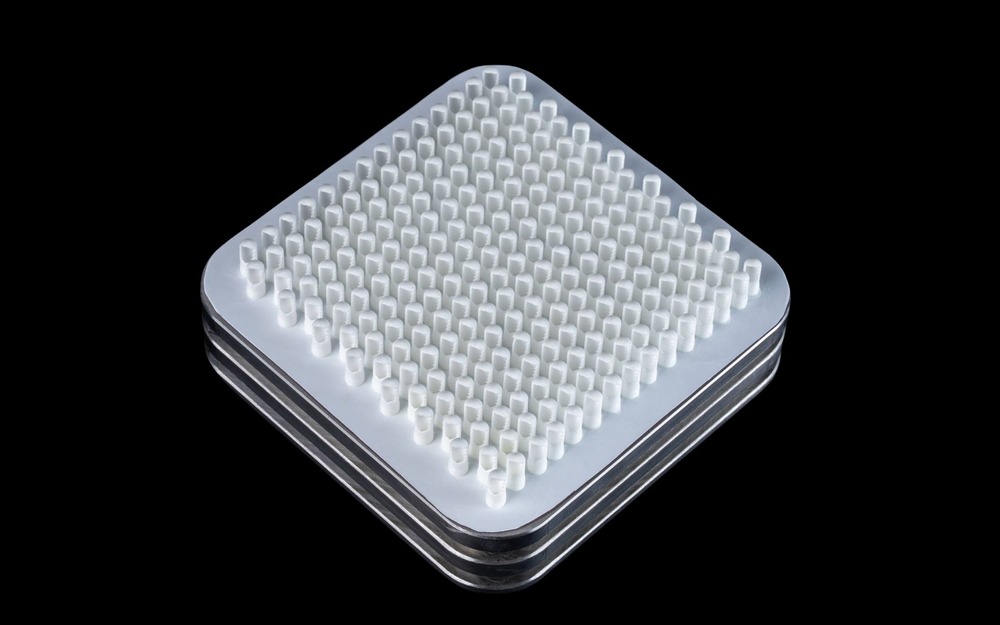
Where an implant has to bond with bone rather than just sit against it, ceramics take over. 3DCeram has printed custom cranial and jawbone implants in hydroxyapatite by ceramic stereolithography, in a collaboration with maxillofacial surgeon Joël Brie at CHU Limoges that dates back to 2005 — long enough for the ceramic-implant process to reach the maturity a biomedical device demands.
The material choice is the point. Hydroxyapatite and tricalcium phosphate are osteoconductive — bone grows onto and through them, and they can resorb as new bone forms. Alumina-toughened zirconia (roughly 80% zirconia, 20% alumina) is chosen instead where the part must be permanent and load-bearing, for its biocompatibility, wear resistance and thermal-shock tolerance. The same ceramic route produces intervertebral cages, tibial osteotomy wedges and cranial and jawbone substitutes — each patient-specific, each impossible to press or machine in a fired ceramic.
Related: Ceramic 3D printers · 3DCeram
3. Biocompatible surgical guides — polymer SLS
Not every medical part is an implant. Farsoon‘s FS3300PA nylon (PA12), run on its polymer SLS systems, is evaluated to ISO 10993 for biocompatibility — intracutaneous reactivity, irritation and skin sensitization — which qualifies it for short-term skin and mucosal contact. Farsoon uses it to print patient-specific surgical guides for procedures including developmental dysplasia of the hip (DDH) and spinal surgery: a guide that clips onto the patient’s bone and steers the drill exactly where the pre-operative plan put it. For the low volumes medical work runs in, SLS is cost-competitive with injection moulding while giving every guide a one-patient fit and needing no tooling.
4. Dental models, guides and crowns — SLA
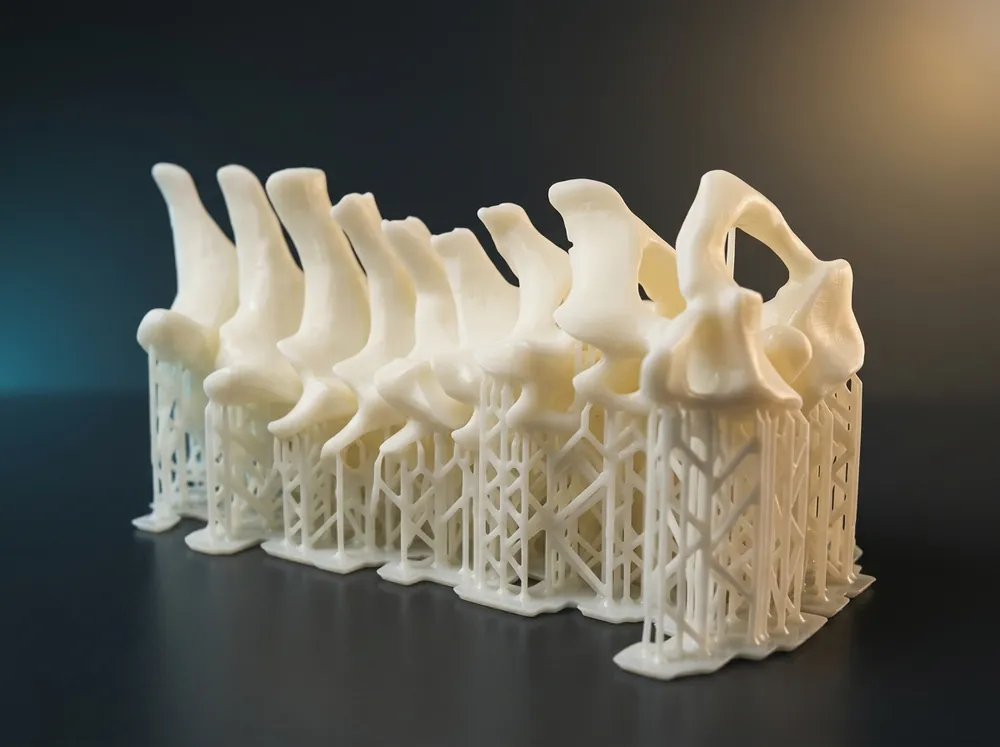
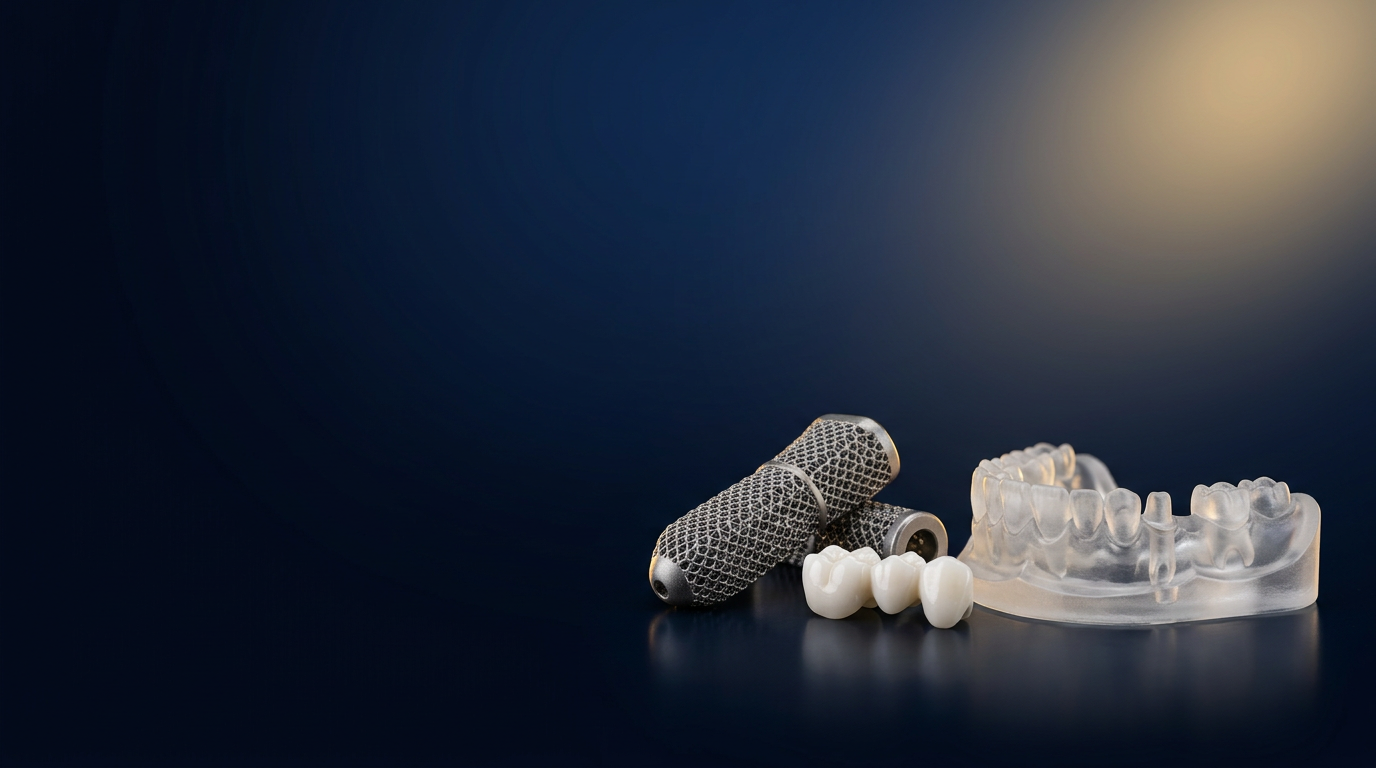
The dental lab runs on stereolithography. Kings 3D SLA systems cover the full digital-dentistry set: implant surgical guides that transfer the planned implant position into the patient’s mouth, castable crowns and bridges that burn out cleanly for casting, orthodontic and working models, veneers, and clear-aligner models. Their workflow targets guides accurate to about 0.05 mm, and the payoff is consistent across the lab — fewer manual errors, shorter production time, and a surgical guide precise enough to lower risk in the chair. The same SLA and SLS lines also print 1:1 anatomical models from CT or MRI data, so a surgeon can rehearse a complex case on a replica of the patient’s own bone before the first incision.
Related: SLA / resin printers
What this means for a medical or dental program
The pattern across every case is the same: additive wins where the part is patient-specific, the volume is one, and the geometry — a bone lattice, a scan-matched fit — is impossible any other way. Getting a printed part cleared to touch a patient is a qualification exercise as much as a printing one, and the elements are consistent:
- ISO 13485 quality management for medical device manufacture.
- ISO 10993 biocompatibility evaluation of the material and the finished part.
- FDA, NMPA or CE / EU MDR clearance for the specific device and claim — not the printer or the powder alone.
- Traceable, medical-grade feedstock — the right titanium, ceramic or resin, with a certificate of analysis and lot control.
Additive Plus supplies the printers, the biocompatible powder and resin, and the metal printing service behind these processes. If you are scoping an implant, an instrument or a dental workflow, start with the material and the standard it has to meet.
Next in the series: additive manufacturing in automotive and EV.
What we run for clinics and labs — technologies, materials and turnaround — is covered on our dental 3D printing page.
Related guides: Ceramic 3D printing · Metal 3D printing service
Frequently asked questions
What is 3D printing used for in medical and dental?
Patient-specific titanium and tantalum implants (spinal and orthopedic), bioceramic bone grafts, surgical instruments and guides, dental crowns, dentures and aligner models, and 1:1 anatomical models for surgical planning.
Are 3D-printed medical implants safe and approved?
The device, not the printer, is what gets cleared. Many 3D-printed titanium spinal cages are FDA- or NMPA-cleared and in clinical use. Any implant must be qualified under ISO 13485, with ISO 10993 biocompatibility and FDA, NMPA or CE / EU MDR clearance for its specific claim.
Which materials are used in medical and dental 3D printing?
Ti-6Al-4V Grade 23 ELI titanium and tantalum for implants, bioceramics such as hydroxyapatite and zirconia, biocompatible SLA resins for dental appliances and guides, and medical-grade PA12 nylon for SLS.
Why 3D print medical and dental parts instead of machining them?
The parts are patient-specific, made in a batch of one, and often need a porous bone-mimicking lattice or a scan-matched fit that machining cannot produce.
Have a question or a project? Let’s talk.
Tell us what you need — a real applications engineer replies within 24 hours. NDA on request, no sales script.