
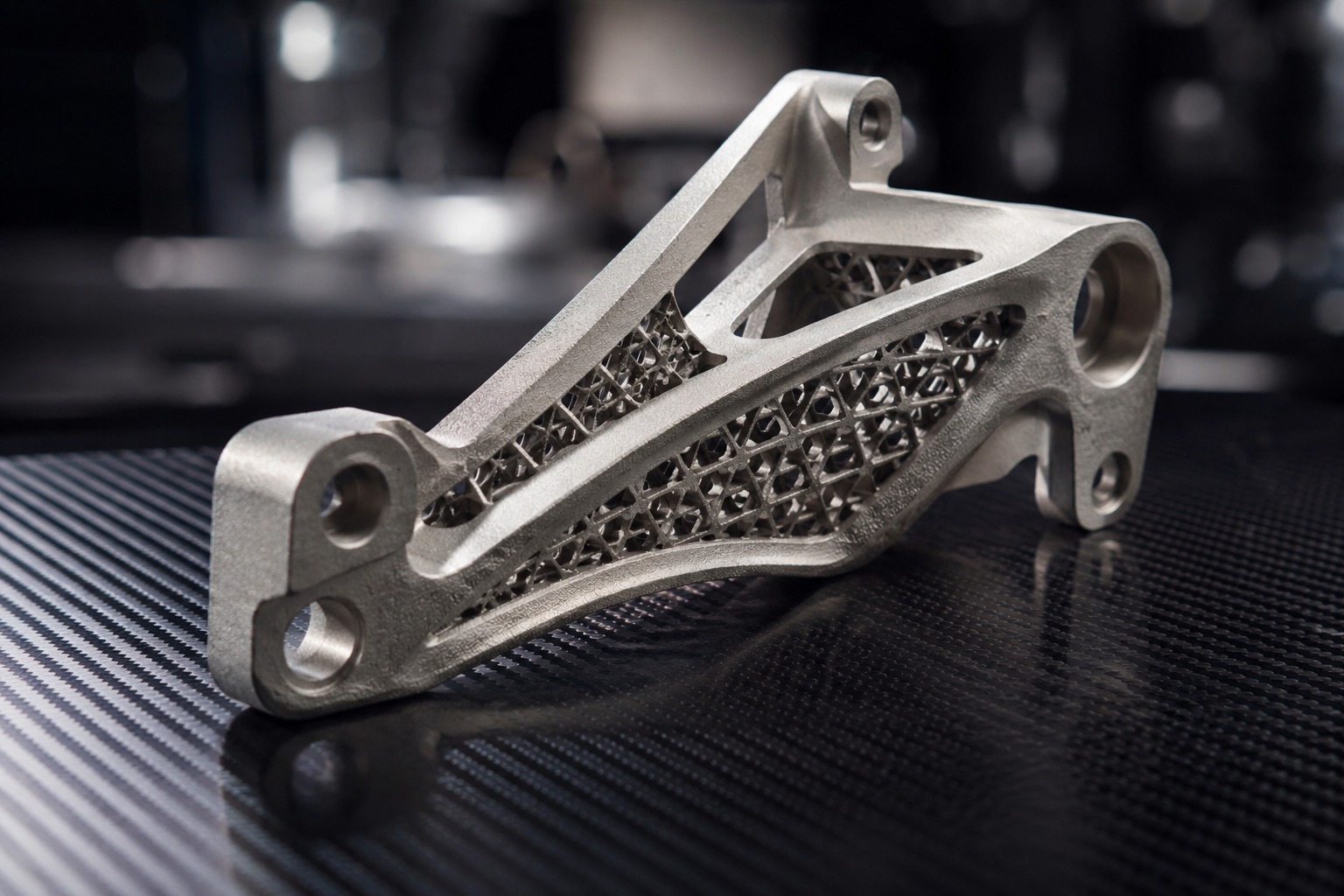
First in our monthly series on additive manufacturing by industry, where we pull one documented case from each equipment and material line we supply.
Additive manufacturing in aerospace is no longer experimental: aerospace was the first industry to move it from the prototype bench into flying hardware, and it remains the sector where the technology earns its keep. The reason is structural: aerospace programs run in low volumes, carry high part costs, and pay a direct fuel penalty for every gram of weight. That is the exact profile where additive manufacturing pays back fastest.
Individual vendor case studies rarely tell the whole story. So each month we take one industry and pull one documented case from across the equipment and material lines we supply. This first roundup covers aerospace and defense: titanium and superalloy structures, ceramic satellite hardware, large-format composite tooling, and the post-processing that qualifies any of it for flight.
The bar: what flying additive parts already look like
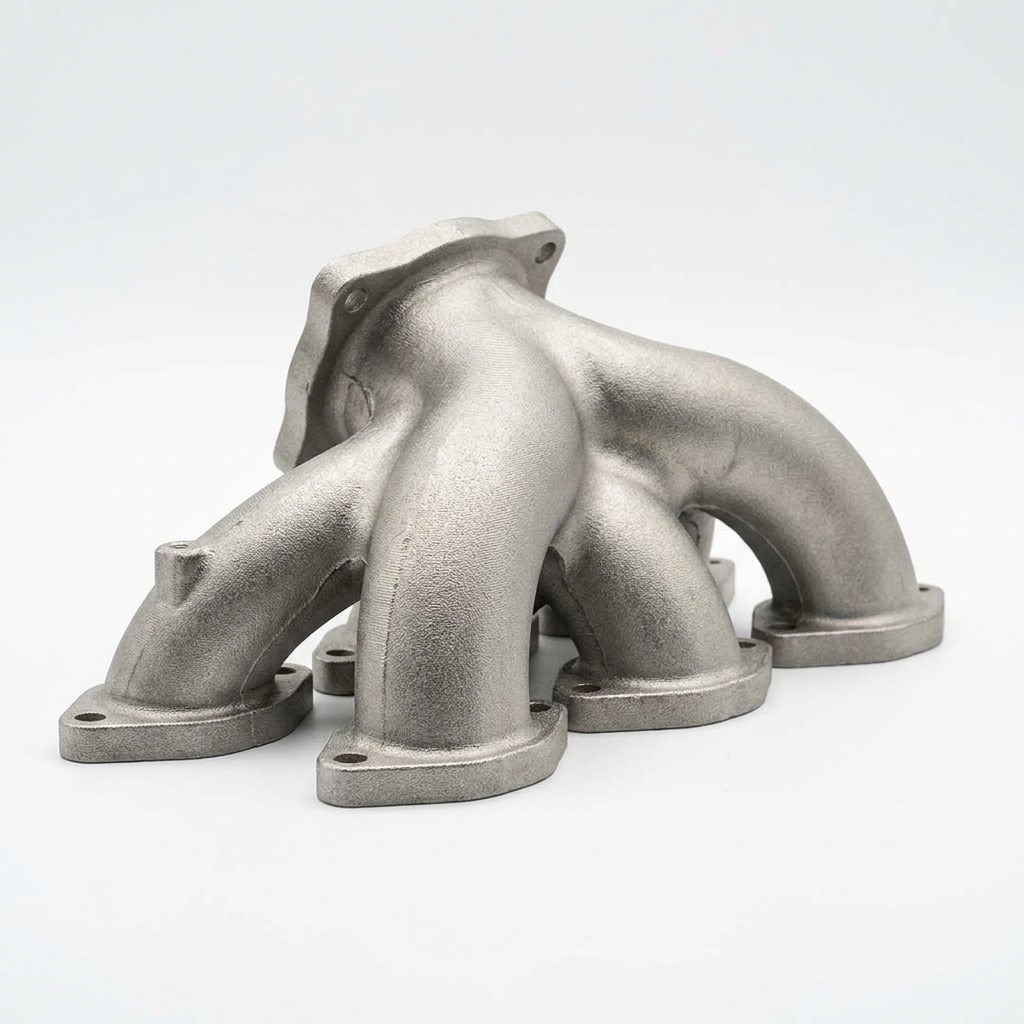
Two reference points frame the discussion. GE Aerospace consolidated the LEAP engine fuel nozzle from 20 separate components into a single printed part that is roughly 25% lighter and around five times more durable; it now flies on the Boeing 737 MAX and Airbus A320neo families, with more than 100,000 units produced (GE Aerospace). On the structural side, Materialise printed a titanium aerospace bracket that reached a 63% weight reduction while retaining only 37% of the original part volume (Materialise).
Those numbers set the expectation: part consolidation, weight reduction in the 25–60% range, and durability that meets or exceeds the machined baseline. The cases below show where the vendors we work with have delivered against that bar.
1. Titanium and superalloy structures — metal LPBF
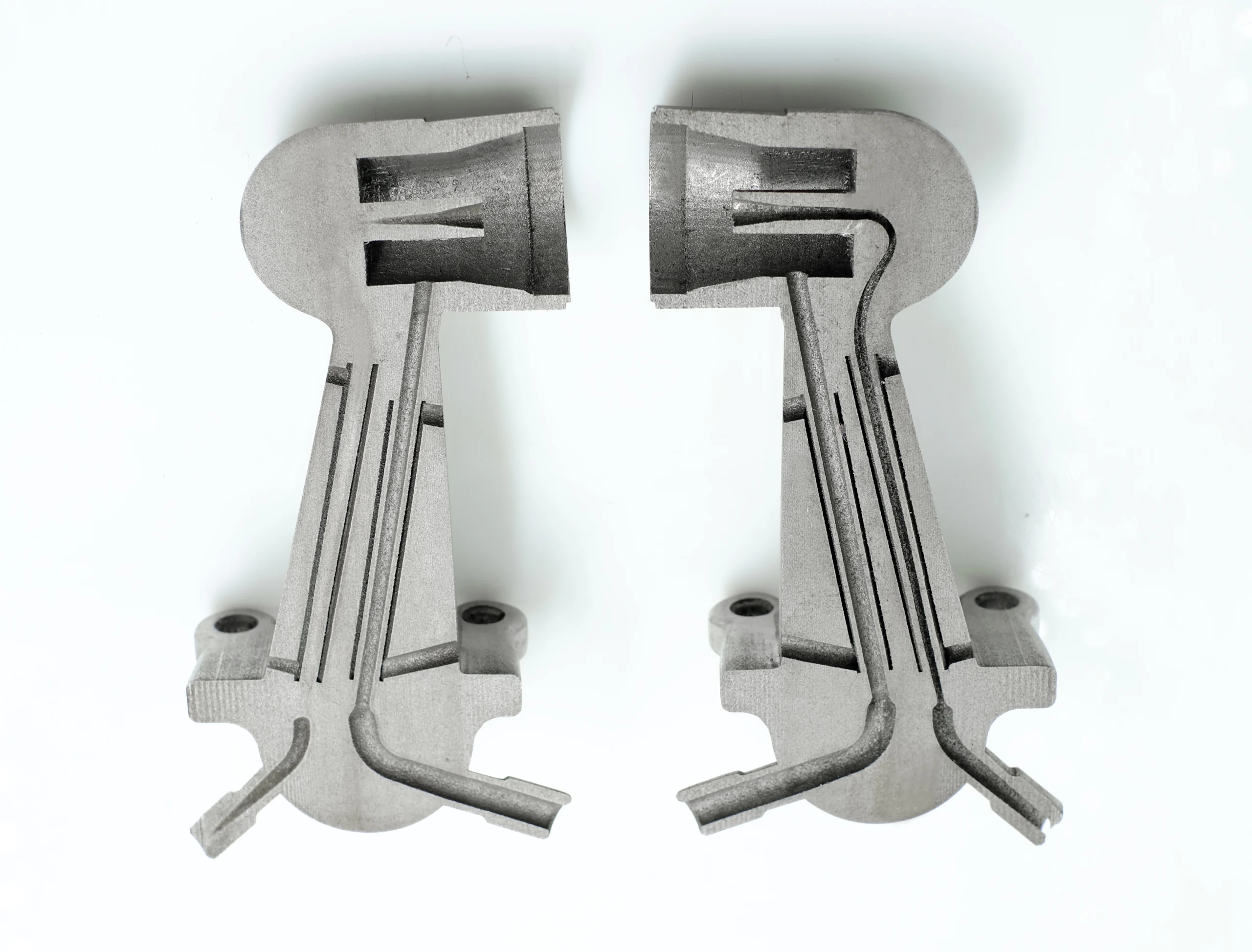
The workhorse of aerospace additive is laser powder bed fusion (LPBF) in titanium Ti-6Al-4V and nickel superalloy Inconel 718. Ti-6Al-4V gives the strength-to-weight ratio that justifies the switch from aluminium; Inconel 718 holds its properties in the hot section of an engine.
Farsoon systems are already producing certified aerospace hardware. Falcontech, an AS9100-certified supplier running a Farsoon metal fleet, produced 28 titanium-alloy structural parts that were approved and installed on the COMAC C919 commercial airliner (3D Printing Industry; background at Metal AM). It is one of the first documented cases of metal additive parts flying on a civil airliner.
This is the same process our AO Metal LPBF systems run in-house, and the same alloys we atomize and stock as A-Powder. If you are scoping titanium or Inconel structures, start with the alloy properties before the geometry.
Related: Metal powders (A-Powder) · LPBF metal printers · Farsoon systems
2. Ceramic satellite hardware — stereolithography
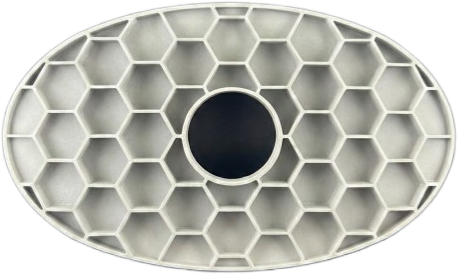
Not every aerospace part is metal. Zirconia and alumina ceramics carry radiofrequency and high-temperature roles that metals cannot fill. Working with CNES spin-out Anywaves, 3DCeram printed a zirconia GNSS antenna for small satellites using stereolithography, with a lattice structure that improved its radiofrequency performance and reached readiness for serial production (3D Printing Industry, TCT Magazine). The European Space Agency has confirmed that these 3D-printed ceramic antennas have since flown (ESA).
Related: Ceramic 3D printers · 3DCeram · Alumina
3. Large-format composite tooling — LFAM
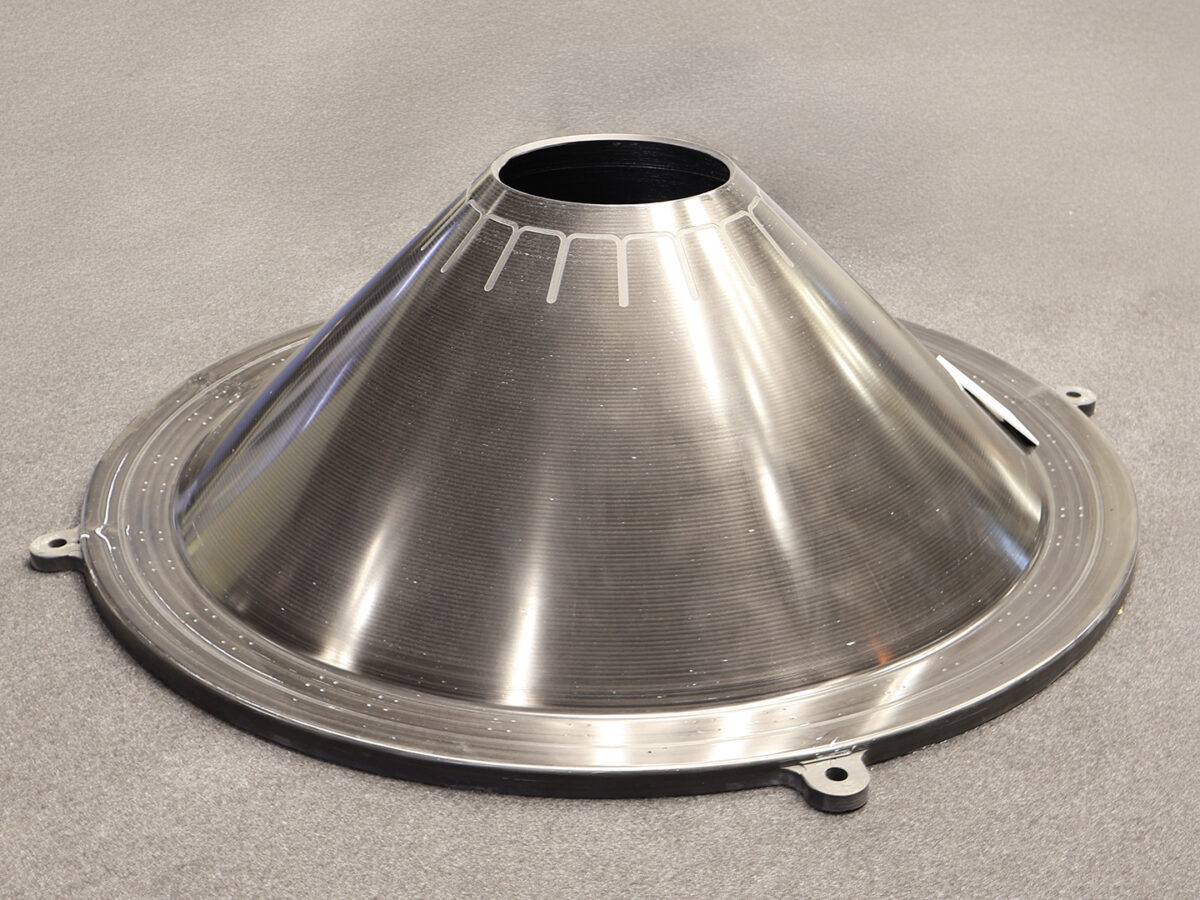
A large share of aerospace additive value is not the flying part at all; it is the tooling that makes the part. Large-format additive manufacturing (LFAM) prints autoclave moulds, layup tools, and mandrels in days instead of weeks.
Caracol has several documented aerospace tooling cases. With Formes et Volumes, a monolithic composite lamination tool measuring 2,200 × 2,200 × 600 mm was printed in about 19 hours, cutting lead time by 50% and production cost by 30% versus conventional tooling (3D Printing Industry). In a separate project, an autoclave mould for a carbon-fibre drone nose was printed as two 130 kg monolithic parts in 15 hours each, then CNC-finished to 0.8 µm surface roughness and 0.1 mm tolerance while withstanding roughly 135°C and 6 bar in the autoclave (CompositesWorld).
Related: Large-format 3D printers · Caracol systems
4. Post-processing — the step that qualifies the part
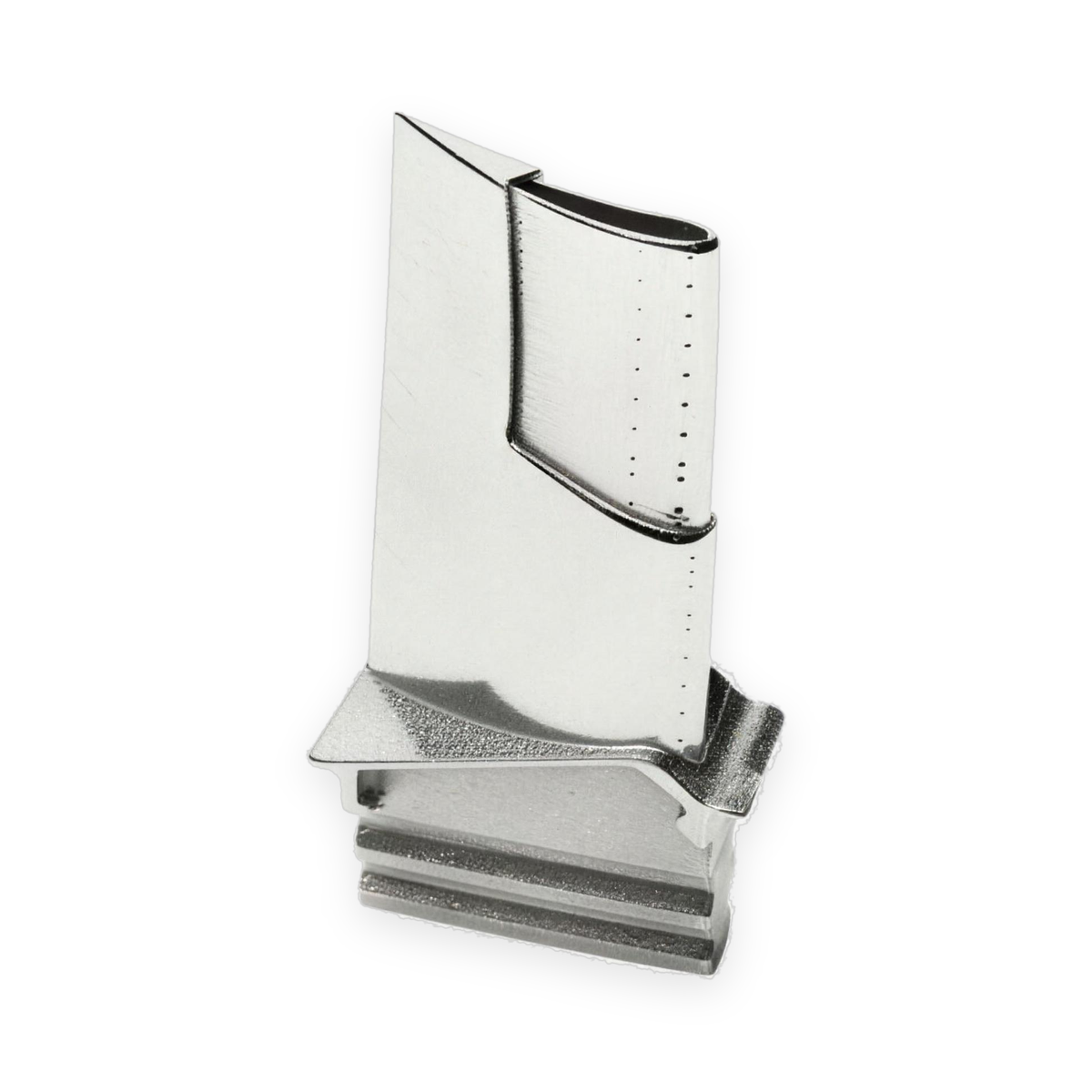
An as-built metal part is not a finished part. Support removal, layer-line reduction, and controlled surface finishing stand between the printer and a qualified component. AM Solutions, the additive brand of Rösler, builds automated post-processing for exactly this, and serves aerospace and medical parts directly. Its wet-blasting approach removes the ATEX dust-explosion risk that dry finishing of reactive titanium and aluminium powders carries (Metal AM).
For structural aerospace metal, hot isostatic pressing (HIP) and heat treatment usually sit in the same chain, closing internal porosity and setting final mechanical properties.
Related: Post-processing equipment · AM Solutions
5. Investment-casting master patterns — large-format SLA
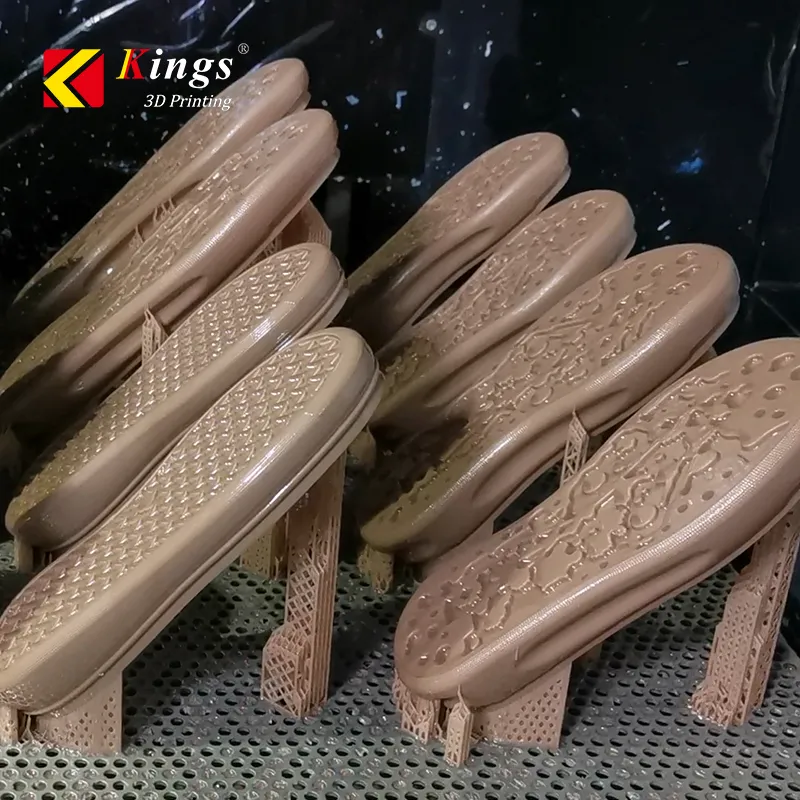
Stereolithography reaches aerospace indirectly but at scale, through investment casting. Large-format SLA prints master patterns that replace hand-carved wax, so a foundry can move from CAD to a cast turbine or structural part without cutting a hard tool. Kings3D builds industrial SLA systems with build volumes up to 2,700 mm and castable resins formulated to burn out cleanly, cutting pattern lead time from weeks to days (Kings3D). For low-volume aerospace castings, that is often the fastest route to a metal part.
Related: Kings 3035Pro industrial SLA printer · SLA / resin printers
What additive manufacturing in aerospace means for your program
The cases above share a pattern. Additive wins where the part is complex, the volume is low, and weight or lead time carries a direct cost. It does not replace machining or casting across the board; it takes the parts where those methods are slow or heavy.
Getting a printed part onto an aircraft is a qualification exercise as much as a printing one. The elements that decide it are consistent:
- AS9100 quality management across the build and inspection chain.
- ITAR handling for defense and dual-use programs, which for many teams weighs heavier than price.
- Traceable powder — known chemistry, particle size distribution, and lot control, since the feedstock sets the part.
- A defined post-processing chain — HIP, heat treatment, and surface finishing specified up front, not bolted on later.
Additive Plus supplies the printers, the atomized powder, and the metal printing service behind these processes. If you are scoping an aerospace part or standing up an in-house capability, the fastest starting point is a conversation about the part, the alloy, and the standard it has to meet.
Next in the series: additive manufacturing in medical and dental.
The equipment and process choices behind these cases are set out on our aerospace 3D printing page.
Related guides: Inconel 3D printing · metal powders
Frequently asked questions
Is 3D printing used for flight-critical aerospace parts?
Yes. GE Aerospace's LEAP fuel nozzle consolidates 20 components into one printed part that is roughly 25% lighter and flies on the Boeing 737 MAX and Airbus A320neo. Titanium and Inconel LPBF parts are in service today.
Which metals are used for aerospace additive manufacturing?
Titanium Ti-6Al-4V for strength-to-weight structures, nickel superalloy Inconel 718 for hot-section and engine parts, and aluminium AlSi10Mg for lightweight housings. Ceramics such as zirconia and alumina cover radiofrequency and high-temperature roles.
What standards does an aerospace additive part need?
AS9100 quality management across the build and inspection chain, ITAR handling for defense and dual-use programs, traceable powder with known chemistry and particle size distribution, and a defined post-processing chain of HIP, heat treatment and surface finishing.
Can additive manufacturing replace machining for aerospace parts?
No. It complements machining and casting. Additive wins on complex, low-volume and weight-sensitive parts and on tooling; conventional methods still win where the part is simple or high-volume.
Have a question or a project? Let’s talk.
Tell us what you need — a real applications engineer replies within 24 hours. NDA on request, no sales script.