
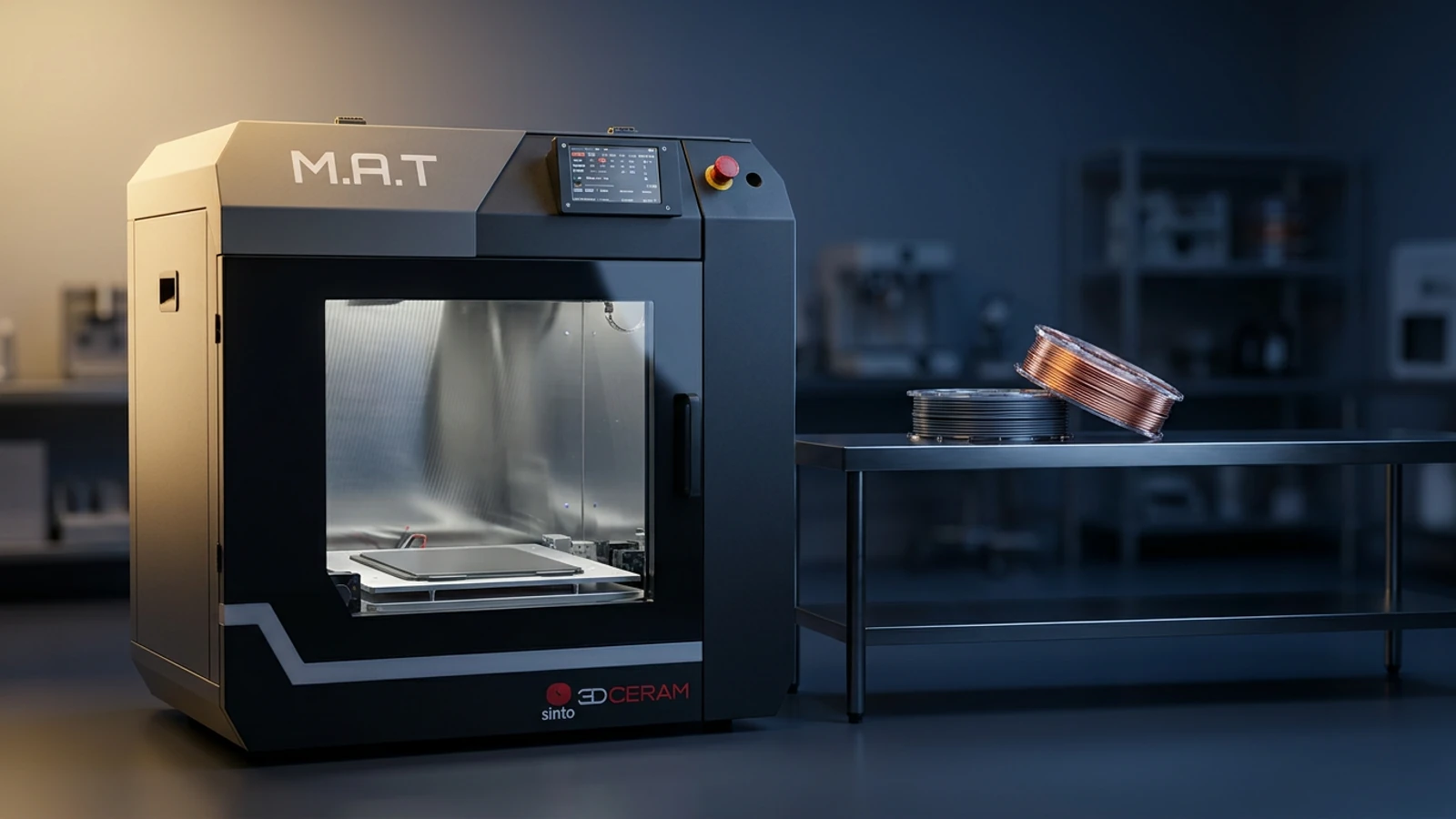
Silicon carbide 3D printing answers a problem that has frustrated engineers for decades: silicon carbide (SiC) is one of the hardest and most chemically inert technical ceramics made, which is precisely why cutting a finished part from a solid block is so slow and expensive. 3DCeram takes the opposite route — print the geometry first on a filament head, then convert it to a dense ceramic in a furnace. This guide covers how that route works on the 3DCeram M.A.T. platform, the properties you actually get, and where a printed SiC part earns its place.
The short version: extrude a silicon-carbide-loaded filament on a standard fused-filament (FFF) head, remove the polymer binder, and solid-state sinter to a dense ceramic — no powder bed, no diamond tooling on a solid billet. What follows is the process, the numbers, and the alternatives.
Why silicon carbide is worth the trouble
Silicon carbide sits near the top of the technical-ceramic table. It keeps its strength above 1400 C, is chemically inert against most acids and molten media, resists abrasion at a hardness around 2500 HV, and conducts heat far better than oxide ceramics like alumina or zirconia. Those same properties make it brutal to shape by grinding or EDM once it is fully dense, so complex geometry has historically been the exception, not the rule.
3D printing changes the order of operations. The part is built and shaped while it is a soft, machinable “green” body, and only becomes hard SiC in the final firing. That lets a small shop produce channels, lattices, and thin walls that would be uneconomic to grind — the reason silicon carbide 3D printing is drawing interest in semiconductor, space, and high-temperature hardware.
How 3DCeram 3D-prints silicon carbide
The 3DCeram M.A.T. (Multi Additive Technology) is a multi-head platform: an FFF head for ceramic and metal filaments, a direct pellet-extrusion head, a direct-ink-writing (robocasting) head, and a 3-axis CNC spindle for green machining before firing (VoxelMatters, 3D ADEPT). For silicon carbide, the filament route runs in three steps.
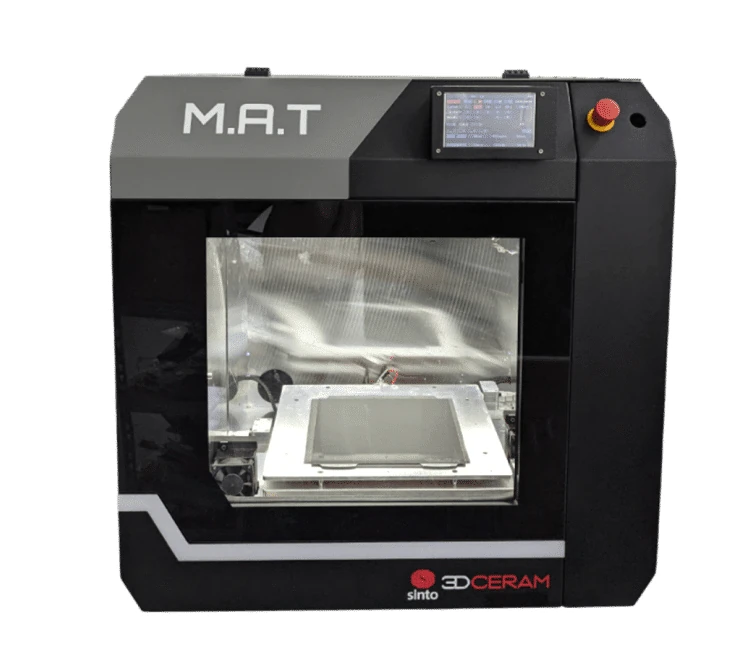
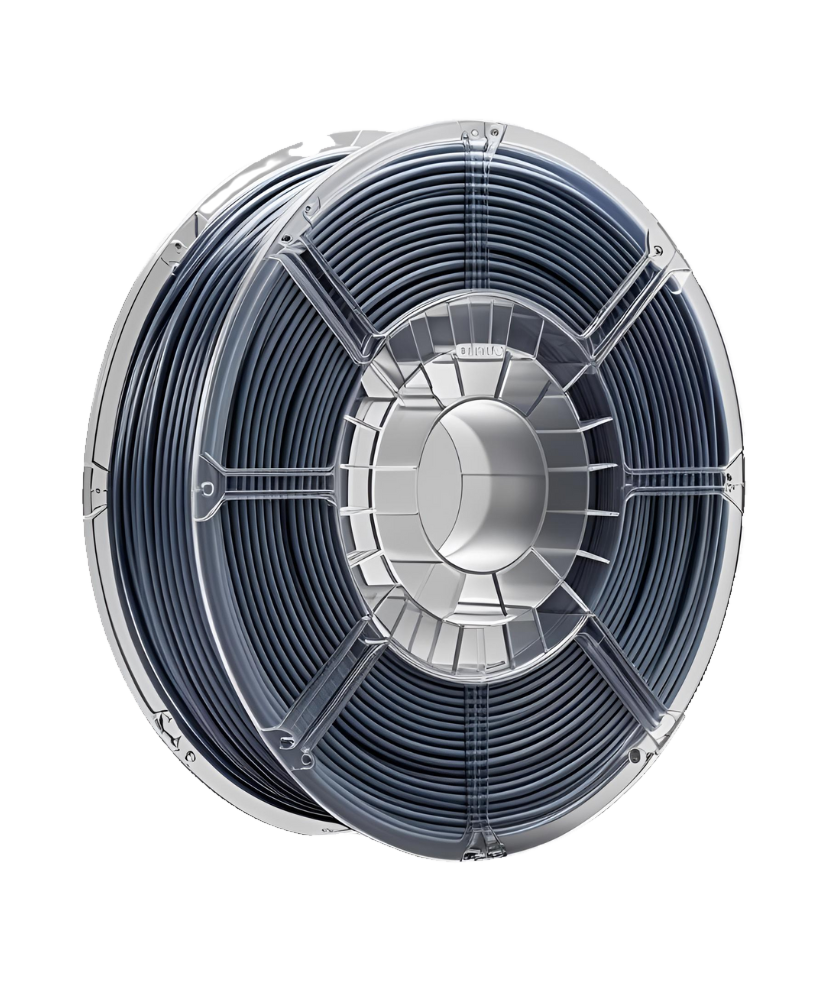
- Print. A 1.75 mm filament — silicon carbide powder loaded at 50-60% by volume in a thermoplastic binder — extrudes on the M.A.T.’s FFF head at standard desktop print temperatures. No loose powder, no laser.
- Debind. The printed green part is debound to remove the polymer binder – the exact solvent and thermal schedule ships with the feedstock – leaving a fragile SiC preform held together by particle contact.
- Sinter. Solid-state sintering at 2100 C densifies the preform into pure, chemically inert silicon carbide at 3.11 g/cc — no melt phase and no infiltrant.
The furnace sets the properties, not the printer. Print parameters decide the shape; density, strength, and dimensional accuracy are set by the debind-and-sinter schedule. That is why 3DCeram ships process parameters with the feedstock and why every SiC order is quote-based rather than off-the-shelf.
What you get: 3DCeram SiC properties
The numbers below are measured on sintered 3DCeram SiC, with mechanical and thermal-diffusivity data taken on calibrated equipment at the European Space Agency’s technology centre (ESTEC) in the Netherlands. Alumina is shown alongside because it prints on the same platform and is the usual first alternative.
| Property | Fila-MAT Silicon Carbide | Fila-MAT Alumina |
|---|---|---|
| Density (sintered) | 3.11 g/cc | 3.9 g/cc |
| Flexural strength (3-point) | 423 MPa (±67, n=14) | 295 MPa |
| Elastic modulus | 248 GPa | 213 GPa |
| Thermal conductivity (20 C) | 82 W/m‑K | — |
| CTE | 2.9 ppm/°C | — |
| Sintering | Solid-state, 2100 C | Solid-state, 1650 C |
The combination that matters for SiC is high stiffness (248 GPa) at low density (3.11 g/cc) with a low thermal-expansion coefficient (2.9 ppm/°C) — a part that stays dimensionally stable across a wide temperature swing while carrying load. The reported flexural strength includes its full spread across 14 samples, not a best case.
FFF vs the other silicon carbide 3D printing routes
Filament extrusion is one of several ways to 3D print SiC, and they differ mainly in the feedstock and the final densification:
- Bound-filament FFF (the M.A.T. route). SiC powder in a polymer binder, printed, debound, then solid-state sintered to pure SiC. Best for accessible geometry and small series without a powder bed.
- Direct ink writing / robocasting. A SiC paste extruded through a syringe — also available on the M.A.T.’s DIW head, useful for larger or paste-based builds.
- Vat photopolymerization. SiC dispersed in a photopolymer and cured layer by layer, then debound and sintered — high resolution, smaller build volume.
- Reaction-bonded silicon carbide (RBSC). A printed carbon or SiC preform infiltrated with molten silicon; it densifies fast and near-net-shape, but leaves some free silicon in the matrix rather than the pure SiC a solid-state sinter yields.
The practical split: solid-state sintered SiC, like the 3DCeram route, gives a chemically pure part for the harshest thermal and chemical service; reaction-bonded routes trade a little purity for speed and size (see the process comparison in this SiC FFF study).
Where 3D-printed silicon carbide earns its place
- Semiconductor equipment — wafer chucks, susceptors, and handling fixtures where SiC’s purity, stiffness, and thermal stability beat metals and oxide ceramics.
- Space optics and structures — low CTE and high specific stiffness make SiC a mirror and bench material; the ESA/ESTEC characterization behind these numbers reflects that heritage.
- Aerospace and defense thermal hardware — components that cycle between cryogenic and high-heat states, where the 2.9 ppm/°C expansion keeps tolerances.
- High-temperature process parts — burner nozzles, heat-exchanger elements, and kiln furniture that must resist both heat and chemical attack.
- Wear and corrosion components — seals, guides, and pump parts exposed to abrasive or aggressive media.
Sourcing silicon carbide 3D printing through Additive Plus
Additive Plus supplies both sides of the workflow: the SiC feedstock and the 3DCeram platform that runs it, with a materials engineer to confirm the debind-and-sinter schedule for your geometry before you order. SiC is quote-based because the firing cycle, not a catalog price, decides whether a part reaches target density. If you already run a standard FFF printer and only need the material, the same chemistry is available as an in-stock spool; if you are building a ceramic capability from scratch, the M.A.T. is the platform these feedstocks were qualified for.
Materials: Fila-MAT Silicon Carbide · Zetamix Silicon Carbide · Fila-MAT Alumina · Printer: 3DCeram M.A.T. · All ceramic filaments · 3DCeram
Frequently asked questions
Can you 3D print silicon carbide?
Yes. Silicon carbide is 3D printed by fused-filament fabrication: a SiC-loaded filament is extruded on an FFF head, the binder is thermally removed, and the part is solid-state sintered to dense ceramic. On the 3DCeram M.A.T. this print-debind-sinter route reaches 3.11 g/cc without a powder bed.
How strong is 3D-printed silicon carbide?
Sintered 3DCeram SiC measures 423 MPa flexural strength (three-point, plus or minus 67 across 14 samples), a 248 GPa elastic modulus, and 3.11 g/cc density, with 82 W/m-K thermal conductivity - values taken on calibrated equipment at ESA's ESTEC centre.
What is the difference between solid-state sintered and reaction-bonded silicon carbide?
Solid-state sintering fires a SiC preform to about 2100 C into chemically pure silicon carbide with no infiltrant. Reaction-bonded SiC infiltrates a preform with molten silicon, which densifies faster and near-net-shape but leaves some free silicon in the matrix.
Which printer prints silicon carbide filament?
The 3DCeram M.A.T. prints SiC on its FFF head and can also run pellet extrusion and robocasting. The same SiC filament chemistry runs on a standard FFF printer too, but a debind-and-sinter furnace is required either way to reach a dense ceramic part.
Have a question or a project? Let’s talk.
Tell us what you need — a real applications engineer replies within 24 hours. NDA on request, no sales script.