
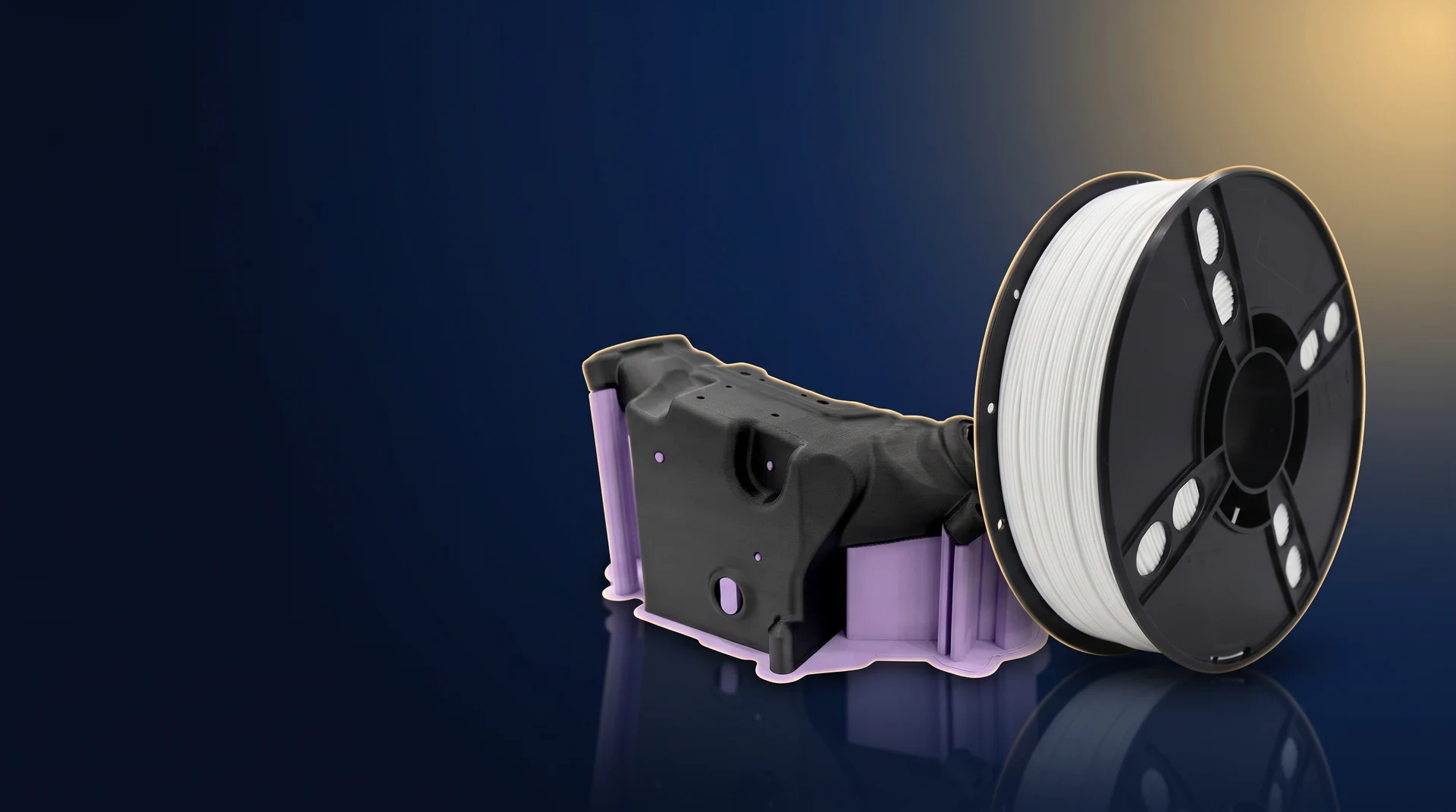
Nylon filament is what engineers reach for when a printed part has to survive real mechanical work — repeated flexing, sliding contact, impact, and heat that would leave PLA soft and brittle. It is tough, fatigue-resistant, and naturally slippery, which is why it dominates functional 3D printing: living hinges, gears, snap-fits, brackets and jigs. It is also the filament most likely to fight you, because nylon absorbs water out of the air faster than almost any other polymer on the filament shelf.
This guide covers what nylon is good for, how the common grades differ, and how to print nylon filament — the drying and printing setup that decides whether a part comes out strong or stringy — and where printed nylon earns its place.
Why print with nylon filament
Nylon (polyamide, PA) trades the easy printing of PLA for engineering-grade properties. The reasons to choose it are specific:
- Toughness and fatigue life. Nylon bends instead of snapping, and survives thousands of flex cycles — the reason it is the default for living hinges and clips.
- Low friction and wear resistance. Its natural lubricity makes it a strong choice for gears, bushings and moving parts that rub.
- Heat and chemical resistance. A good nylon holds its shape well above where PLA sags, and shrugs off oils and fuels — useful under a car hood or on a shop floor.
The catch is moisture. Nylon is strongly hygroscopic: left in open air it pulls in water within hours, and wet nylon prints with steam bubbles, popping, stringing, a hairy surface and weak layer bonding. Manage that one variable and nylon becomes predictable. Ignore it and no temperature setting will save the print.
Nylon grades: PA, PA-CF and PA-GF
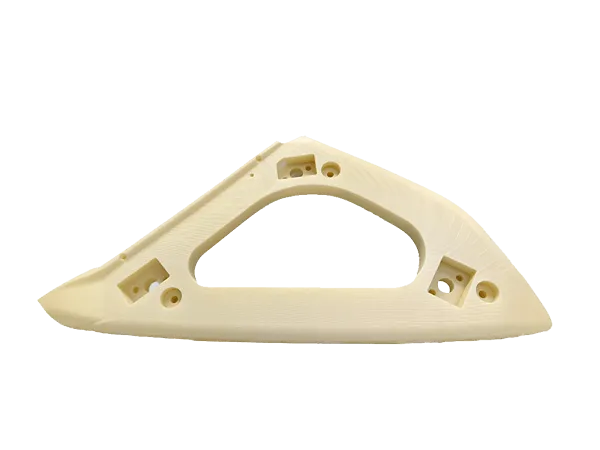
“Nylon” covers a family. Two things vary: the base polyamide (PA6, PA12 and blends differ in stiffness and water uptake) and what is mixed into it. For most engineering work the choice comes down to three options.
| Grade | What it adds | Trade-off | Best for |
|---|---|---|---|
| Unfilled nylon (PA) | Maximum toughness and flexibility | Warps more; absorbs the most water | Living hinges, clips, flexible functional parts |
| Carbon-fiber nylon (PA-CF) | Stiffness and dimensional stability; less warp | Abrasive — needs a hardened nozzle; more rigid, less flexible | Structural brackets, drone frames, jigs and fixtures |
| Glass-fiber nylon (PA-GF) | Impact strength and stiffness at lower cost than CF | Abrasive; heavier than CF for the same part | Tough tooling, housings, parts that take knocks |
The rule of thumb: reach for unfilled nylon when the part must flex, and a fiber-filled grade when it must hold its shape under load. Both carbon- and glass-filled grades are abrasive, so print them through a hardened steel or ruby nozzle — a brass nozzle wears out in a few spools.
Chopped-fiber grades across other base polymers, and how they compare on stiffness and abrasion: carbon fiber filament.
Drying nylon filament: the step that decides everything
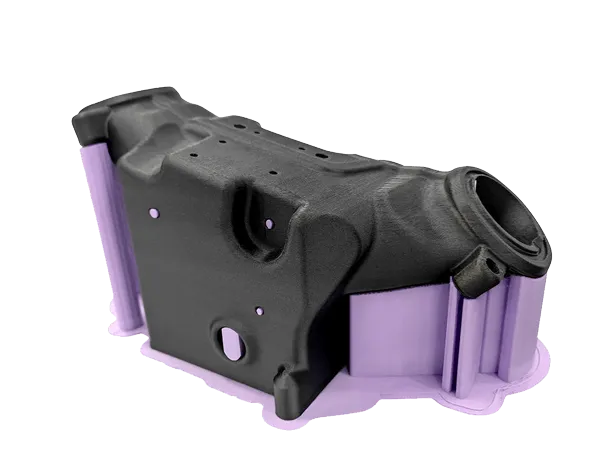
Dry the filament first — every time. Nylon should be dried at roughly 70–80 °C for 6–12 hours before printing, and kept dry while it prints. This single step separates a clean, strong nylon part from a bubbly, weak one. It is not optional the way it is with PLA.
A fresh, sealed spool can still be damp, and any spool that has sat in open air for a day needs drying. The practical setup is a heated filament dryer that also feeds the printer during the job, so the filament never re-absorbs moisture between drying and printing. Store spools with desiccant in a sealed box; treat an open spool on the bench as wet.
How to print nylon filament
Once the filament is dry, nylon prints reliably with the right hardware and settings. Targets vary by grade — always start from the spool’s datasheet — but the ranges are consistent:
- Nozzle temperature: typically 250–280 °C for standard nylon; high-temperature and fiber-filled grades often run hotter.
- Bed temperature: around 60–90 °C, with a nylon-friendly adhesive or surface — nylon does not stick to bare glass.
- Enclosure: strongly recommended. Nylon warps as it cools, and a stable, warm chamber keeps large parts flat. An enclosed FDM printer handles nylon far better than an open frame.
- Nozzle material: hardened steel or ruby for any carbon- or glass-filled grade.
- Cooling: little to none — part cooling that helps PLA hurts nylon layer adhesion.
Warping and first-layer adhesion are the two problems people hit first, and both are usually a cold or drafty environment rather than a temperature setting. Enclose the build, slow the first layer, and keep the filament dry, and most nylon problems disappear.
Where nylon earns its place
- Functional prototypes and end-use parts — brackets, housings and clips that must survive handling, not just look right.
- Moving mechanical parts — gears, bushings, cams and living hinges, where nylon’s low friction and fatigue life pay off.
- Jigs, fixtures and tooling — shop-floor parts that take impact and heat; fiber-filled grades add the stiffness a fixture needs.
- Automotive and industrial — under-hood components and parts exposed to oils, fuels and vibration.
For large functional parts, the same polymer is available as nylon pellets for pellet-fed printing, where feedstock cost drops sharply against spooled filament.
Sourcing nylon filament through Additive Plus
Nylon rewards a small amount of discipline — dry it, enclose it, match the grade to the job — with parts that do real mechanical work. Start from what the part has to survive: flex points want unfilled nylon, load-bearing parts want a fiber-filled grade, and anything abrasive-filled wants a hardened nozzle. Get those three calls right and nylon is one of the most useful materials on the printer.
Filaments: CreatBot Ultra PA (nylon) · PA-CF carbon-fiber nylon · PA-GF glass-fiber nylon · All filaments
Frequently asked questions
How do you print nylon filament?
Dry the filament first at roughly 70-80 C for 6-12 hours and keep it dry while printing, then print at about 250-280 C with a heated bed and an enclosure. Drying is the step that decides whether the part comes out strong or stringy.
Why does nylon filament need drying?
Nylon is strongly hygroscopic and pulls water from the air within hours; wet nylon prints with steam bubbles, stringing, a hairy surface and weak layer bonding. Unlike PLA, drying nylon is not optional.
What is the difference between PA, PA-CF and PA-GF nylon?
Unfilled PA is the toughest and most flexible; carbon-fibre PA-CF adds stiffness and dimensional stability with less warp; glass-fibre PA-GF adds impact strength at a lower cost than carbon. Both filled grades are abrasive and need a hardened nozzle.
What is nylon filament used for?
Functional and end-use parts that do mechanical work: gears, bushings, living hinges, snap-fits, brackets, jigs and fixtures, and under-hood automotive parts exposed to heat, oils and vibration.
Have a question or a project? Let’s talk.
Tell us what you need — a real applications engineer replies within 24 hours. NDA standard, no sales script.