
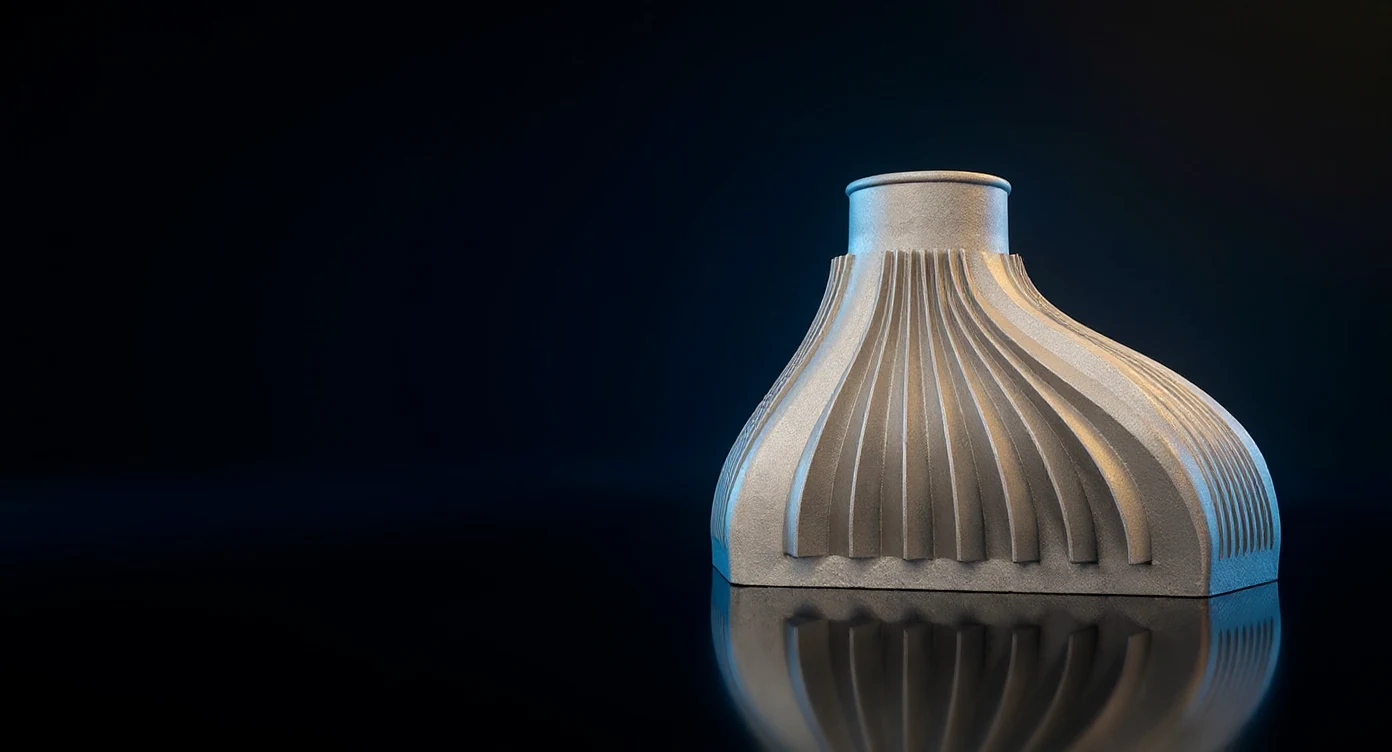
AlSi10Mg, Ti-6Al-4V and Inconel 718 cover most of what leaves a laser powder bed fusion machine, and picking between them is rarely a question of which alloy is strongest. It is a question of how hot the part runs, how much mass you are allowed to carry, and what the powder and the build hours cost you. Get that order wrong and you pay for a superalloy to do a job an aluminium casting replacement would have done for a third of the price. All three ship from stock as lot-controlled LPBF metal powders.
This guide sets the three side by side on the numbers that decide the job: mechanical properties after the heat treatment each one actually needs, specific strength, service temperature, build economics, and the design rules that differ between them.
AlSi10Mg, Ti-6Al-4V and Inconel 718 at a glance
Each alloy solves a different constraint. AlSi10Mg is the light, thermally conductive, inexpensive option that stops being useful somewhere around 150–200 °C. Ti-6Al-4V carries the highest strength per kilogram of the three and is the only one of them routinely used in implants. Inconel 718 gives up specific strength but holds its properties to roughly 650–700 °C, which is where the other two are long gone.
The values below are typical of LPBF material in the condition named. Real numbers move with orientation, layer thickness, parameter set and heat treatment, so treat them as the shape of the decision rather than as acceptance criteria — those come from the qualified datasheet for the machine and parameter set you are actually running.
| Property | AlSi10Mg | Ti-6Al-4V (Ti64) | Inconel 718 |
|---|---|---|---|
| Density | 2.67 g/cm³ | 4.43 g/cm³ | 8.19 g/cm³ |
| UTS, as-built | 430–460 MPa | 1,150–1,250 MPa | 900–1,000 MPa |
| UTS, standard heat treatment | 300–350 MPa (T6 or stress relief) | 930–1,050 MPa (annealed / HIP) | 1,300–1,400 MPa (solution + double age) |
| Elongation, heat treated | 8–12% | 12–18% | 12–20% |
| Practical service temperature | up to ~150–200 °C | up to ~350–400 °C | up to ~650–700 °C |
| Thermal conductivity | 120–150 W/m·K | 6.7–7.5 W/m·K | 11–12 W/m·K |
| PBF-LB part specification | ASTM F3318 | ASTM F2924 (Gr 5), ASTM F3001 (Gr 23 ELI) | ASTM F3055 |
| Typical role | Heat exchangers, housings, light structure | Load-bearing structure, implants | Hot-section and high-pressure hardware |
Read the table this way. AlSi10Mg is chosen for conductivity and cost, Ti-6Al-4V for strength per kilogram, Inconel 718 for strength that survives heat. Almost every correct alloy decision is one of those three sentences.
AlSi10Mg — the conductivity and cost choice
AlSi10Mg is a casting alloy that happens to suit laser powder bed fusion well. The near-eutectic silicon content gives it a narrow solidification range, so it welds to itself cleanly layer after layer, and the fine cellular silicon network the process produces is the reason as-built strength sits well above the same alloy cast.
That last point catches people out. A T6 solution and age, which strengthens cast AlSi10Mg, coarsens the fine LPBF microstructure and lowers ultimate tensile strength — typically from around 450 MPa as-built to 300–350 MPa — while buying back ductility and removing residual stress. If the part is stiffness-driven or thermally driven rather than strength-driven, a 300 °C stress relief is often the right stopping point.
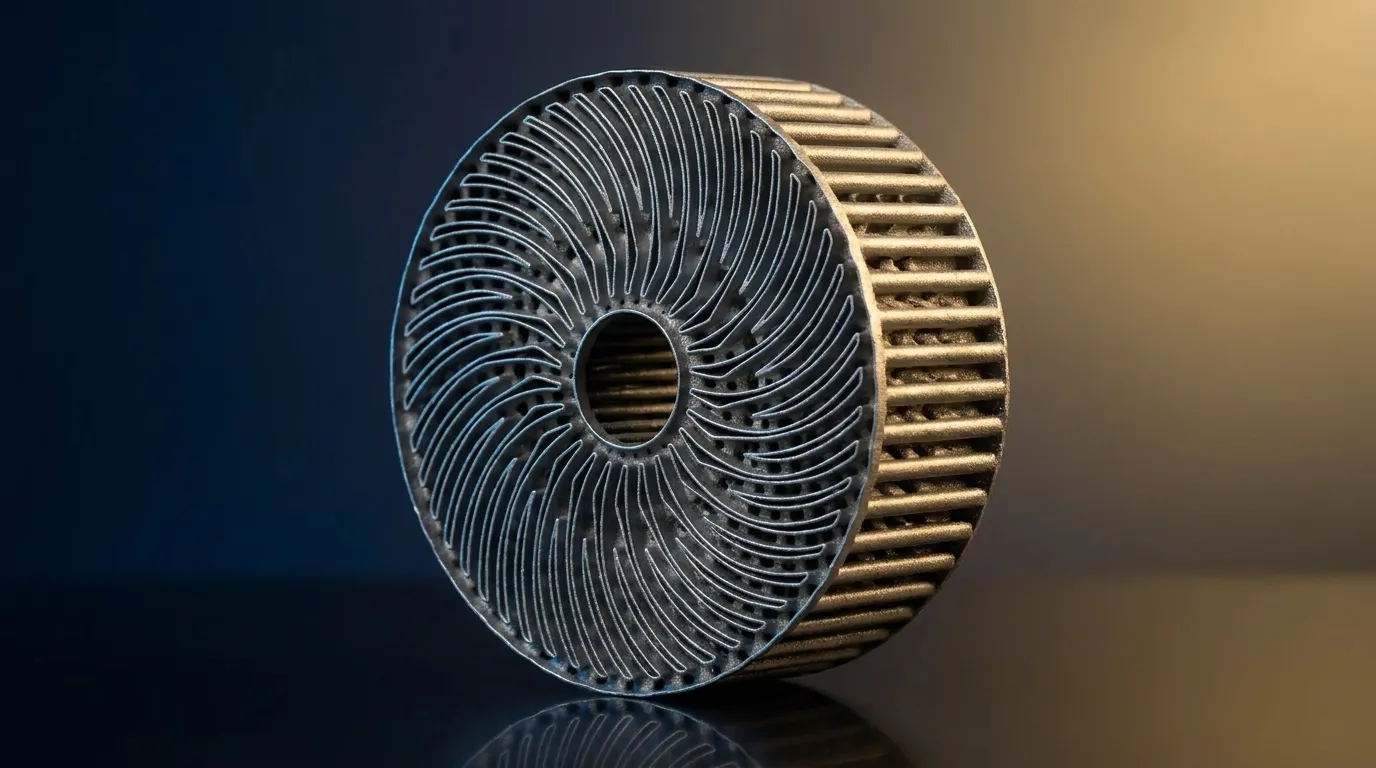
The property that has no substitute here is thermal conductivity. At 120–150 W/m·K, AlSi10Mg moves roughly twelve times the heat of Inconel 718 and twenty times that of Ti-6Al-4V. Any part whose job is to take heat somewhere — cold plates, manifolds, conformally cooled inserts, electronics housings — starts in aluminium and only moves away from it if temperature or corrosion forces the issue.
Ti-6Al-4V — the strength-per-kilogram choice
Ti-6Al-4V is the alloy to reach for when the part has to be strong and the mass budget is real. Annealed LPBF Ti64 lands around 950–1,050 MPa UTS at 4.43 g/cm³, which is the best strength-to-weight ratio of the three by a clear margin.
It comes in two grades that are not interchangeable. Grade 5 is the general engineering grade, specified for powder bed fusion under ASTM F2924. Grade 23, or ELI (extra low interstitial), holds oxygen and iron down and is the grade written into implant work under ASTM F3001 — if the part is going into a body, the grade is decided for you. Both are stocked: Ti-6Al-4V Grade 5 and Ti64 Grade 23 ELI.
Titanium’s cost is not only in the powder. It is reactive, so oxygen pickup accumulates across reuse cycles and has to be tracked against the grade limit; handling is inert, and the fines are a fire risk that dictates how the machine is serviced. Its thermal conductivity of under 8 W/m·K also means heat does not leave the melt pool quickly, which drives residual stress and makes support strategy and orientation matter more than they do in aluminium.
Inconel 718 — the choice when the part runs hot
Inconel 718 is a precipitation-hardened nickel superalloy, and after the full solution and double-age route it reaches 1,300–1,400 MPa UTS — higher than either of the others in absolute terms. It keeps useful strength to roughly 650–700 °C, above which the strengthening γ″ phase coarsens and the alloy gives way to 625 or Hastelloy X for static hot hardware.
The catch is 8.19 g/cm³. On specific strength Inconel 718 is no better than aluminium, so it earns its place on temperature, oxidation resistance and pressure capability, never on lightweighting. A deeper treatment of the nickel family, including when to move off 718, is in our guide to Inconel 3D printing.
Specific strength — the number that settles most arguments
Divide heat-treated ultimate tensile strength by density and the ranking changes shape:
- Ti-6Al-4V — roughly 1,000 MPa at 4.43 g/cm³, about 225 kN·m/kg.
- AlSi10Mg — roughly 450 MPa as-built at 2.67 g/cm³, about 169 kN·m/kg.
- Inconel 718 — roughly 1,375 MPa at 8.19 g/cm³, about 168 kN·m/kg.
Titanium wins by a third. Aluminium and nickel are level — which means that for a room-temperature bracket, Inconel 718 buys you nothing over AlSi10Mg except cost, build time and mass. That comparison is the single most common alloy mistake we see on incoming quotes.
Heat treatment is not optional, and it differs for each
Every LPBF part is stress-relieved on the build plate before it is cut free; releasing a tall part from the plate before relief is how you get a banana. After that the routes diverge.
- AlSi10Mg. Stress relief around 300 °C for two hours covers most parts. T6 is used where ductility and dimensional stability over time matter more than peak strength.
- Ti-6Al-4V. Stress relief or anneal in vacuum or argon converts the as-built martensitic α′ into a tougher α+β structure. Fatigue-critical parts add hot isostatic pressing at roughly 920 °C and 100 MPa to close internal porosity.
- Inconel 718. Solution treatment followed by the double age per the AMS 5662/5663 route is what produces the headline numbers. Aerospace hardware is usually HIP’d first. Skipping or reordering that chain is the most common reason a printed 718 part fails qualification.
Budget for it. Heat treatment, and HIP where it applies, is a real line on the part cost and a real block of lead time. An alloy comparison that stops at as-built properties is comparing parts nobody ships.
Machining, surface finishing and inspection follow — see the post-processing equipment range for what that step looks like in-house.
What each alloy costs you in build time and powder
Powder price per kilogram is the number buyers compare, and it is the least useful one. What determines part cost is how many kilograms the part needs, how many hours the build takes, and how much of the scrap comes back.
Density does most of the work: the same geometry printed in Inconel 718 carries roughly three times the powder mass of the AlSi10Mg version, before the higher price per kilogram is applied. Aluminium also tolerates thicker layers and faster scanning, so it clears the plate sooner. Titanium sits between them on mass but demands the most careful powder management, which shows up as handling cost rather than powder cost.
The full cost breakdown — machine hour, powder, heat treatment, machining, inspection — is in our guide to real cost per part in metal 3D printing.
Designing for each alloy
- Wall thickness. AlSi10Mg holds thin walls well and is the alloy of choice for fine internal channels. Inconel 718 tolerates thin sections but the residual stress in tall thin walls is unforgiving.
- Overhangs and supports. Low-conductivity alloys — Ti64 above all — need conservative overhang angles and more support contact, because heat leaves the melt pool through the solid, not the powder.
- Orientation. All three are anisotropic as-built, with the Z direction weakest and least ductile. Orient the principal load in-plane where the part allows it.
- Machining allowance. Leave stock on any sealing, bearing or datum surface. As-built roughness of Ra 8–15 µm is normal and is not a finished surface.
The general rule set, independent of alloy, is collected in our design for additive manufacturing guide, and the process itself is covered in LPBF explained.
Where each one earns its place
- Thermal management — AlSi10Mg. Cold plates, liquid-cooled housings, conformally cooled tooling inserts. Conductivity is the requirement and nothing else comes close.
- Aerospace structure — Ti-6Al-4V. Brackets, fittings and mounts where every gram is costed over the life of the airframe.
- Medical implants — Ti-6Al-4V Grade 23 ELI. Biocompatibility and the ASTM F3001 route decide the grade before anything else does.
- Hot-section and energy hardware — Inconel 718. Nozzles, seals, turbine and combustor-adjacent parts, downhole and high-pressure components.
- Motorsport and drivetrain — split. Uprights and suspension in Ti64, coolers and intake housings in AlSi10Mg, turbo and exhaust-side parts in 718.
Sourcing LPBF powder through Additive Plus
All three alloys are stocked as lot-controlled powder sized for laser powder bed fusion, and every lot ships with its certificate of analysis, so the chemistry and particle size distribution behind a qualification are traceable. The AO Metal A-Powder line is produced in the United States, which matters for programmes with domestic sourcing requirements. Trial quantities are available before a volume commitment, and quotes come back within 24 hours. If the part matters more than the powder, we also run the build: LPBF 3D printing services covers printing, heat treatment and finishing from our Californian facility.
If you are still between two alloys, send the part and the operating conditions. Temperature and mass budget usually settle it in one conversation.
Materials: A-Powder AlSi10Mg ·
A-Powder Ti-6Al-4V ·
Ti64 Grade 23 ELI ·
A-Powder Inconel 718 ·
All metal powders
Frequently asked questions
Which is stronger: Ti-6Al-4V, Inconel 718 or AlSi10Mg?
In absolute terms Inconel 718 is strongest after solution and double ageing, at roughly 1,300 to 1,400 MPa, against 930 to 1,050 MPa for annealed Ti-6Al-4V and 300 to 460 MPa for AlSi10Mg. Per kilogram the order reverses: Ti-6Al-4V reaches about 225 kN·m/kg of specific strength, while Inconel 718 and AlSi10Mg are level at roughly 168 to 169 kN·m/kg because nickel is three times denser than aluminium.
What service temperature can each LPBF alloy handle?
AlSi10Mg is useful to roughly 150 to 200 °C, Ti-6Al-4V to roughly 350 to 400 °C, and Inconel 718 to roughly 650 to 700 °C. Above 700 °C the strengthening phase in 718 coarsens and static hot hardware moves to Inconel 625 or Hastelloy X.
Why does T6 heat treatment lower the strength of printed AlSi10Mg?
Laser powder bed fusion solidifies AlSi10Mg fast enough to form a very fine cellular silicon network, which is why as-built strength reaches 430 to 460 MPa. A T6 solution and age coarsens that network, so ultimate tensile strength drops to roughly 300 to 350 MPa while ductility and dimensional stability improve. Parts that are stiffness or thermally driven often stop at a 300 °C stress relief instead.
Can I order a trial quantity of LPBF metal powder?
Yes. AlSi10Mg, Ti-6Al-4V in Grade 5 and Grade 23 ELI, and Inconel 718 are stocked as lot-controlled powder and ship with a certificate of analysis, and a trial quantity is available before a volume commitment. Quotes come back within 24 hours.
Have a question or a project? Let’s talk.
Tell us what you need — a real applications engineer replies within 24 hours. NDA standard, no sales script.