
Steel tooling is the reason short-run injection molding is slow and expensive. A water-breakable, 3D-printed mold removes that bottleneck — and, unlike most printed resin molds, it can handle PEEK, PPS and glass-filled engineering plastics. Here is how it works and where it makes sense.
For anywhere from ten to a few hundred parts, cutting a steel or aluminium mold is hard to justify: it costs thousands and takes weeks before the first part exists. 3D printing the mold instead collapses that timeline. For short runs, printed tooling can cut mold cost and lead time by up to 85–90%, with a working mold ready in 1–2 days rather than weeks.
The usual objection is that a printed resin mold cannot survive the temperature and pressure of real engineering plastics. That is true for a mold you intend to reuse. It is not true for a water-breakable One-Shot Mold — a sacrificial tool you print, fill once, and dissolve in water to release the part.
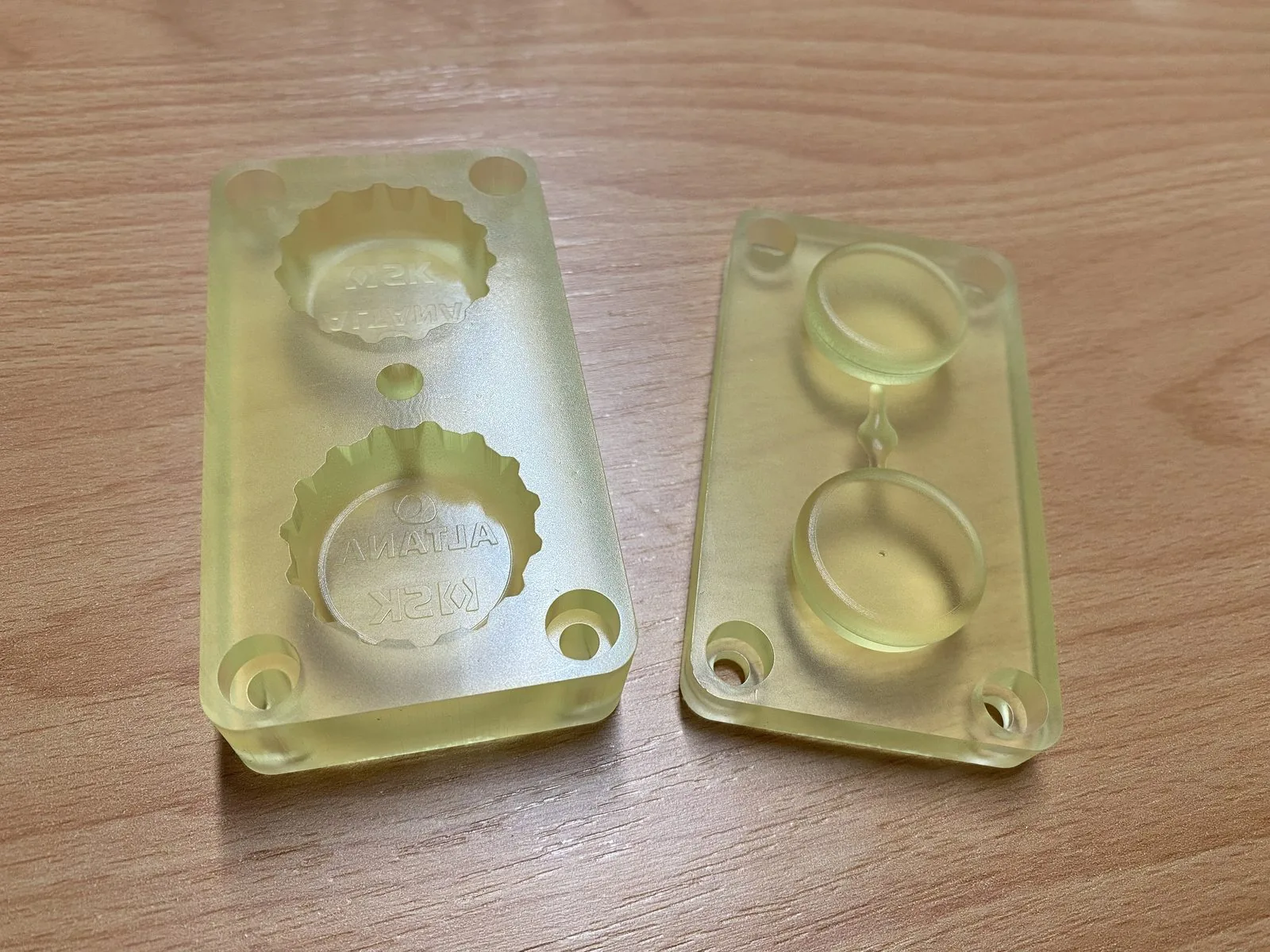
What is a water-breakable (One-Shot) mold?
A water-breakable mold is a 3D-printed cavity that tolerates the temperature and pressure of a real filling material for a single shot, then breaks apart in plain water to release the finished part. ALTANA calls the approach One-Shot Mold (OSM) technology. Because the mold is consumed rather than reused, it does not have to survive hundreds of thermal cycles — it only has to hold geometry through one fill. That single design choice is what lets a photopolymer mold process materials that would destroy a durable resin tool.
The cured mold disintegrates with minimal swelling, so the part comes out clean without mechanical breakout or solvent baths. That makes the release step repeatable and easy to automate — print, fill, dissolve, repeat.
Why print the mold instead of cutting steel?
The economics only work in a specific window — low volumes and fast iterations — but in that window they are decisive:
- Cost. No machining, no mold-maker queue. For short runs the tooling bill drops by up to 85–90%.
- Speed. A CAD change becomes a new mold overnight. First good part in days, not weeks.
- Geometry. Undercuts, internal channels and features that would need side-actions or a multi-plate steel tool print in one piece. Metal inserts and 2K/multi-component parts are straightforward.
Where it pays off. Printed injection tooling is a short-run and bridge-production tool — roughly 10 to 1,000 parts, prototype validation in the real production material, and geometries that a conventional tool cannot make economically. For high-volume production, steel still wins; for everything before that, a printed mold gets you molded parts weeks earlier.
The catch everyone hits — and how One-Shot Mold gets around it
Search “3D printed injection mold” and you will find the same warning everywhere: resin molds degrade under sustained pressure or above their thermal limit, so they are not suitable for high-performance polymers like PEEK. For a reusable resin mold, that is correct.
A one-shot, water-breakable mold changes the rules. It has to endure a single fill, and the Cubic Ink Mold 400 VP formulation is built for exactly that: process temperatures up to 380 °C at the nozzle and injection pressures up to 1,200 bar, with 200 µm minimum wall thickness and 30/50 µm xy/z accuracy. Filling-material compatibility depends on part geometry, but customers have successfully molded and cast a wide range:
| Injection molding | Casting |
|---|---|
| Polyethylene · Polypropylene (up to 36% GF) | 2K silicones (RTV & LSR) |
| PBT (up to 40% GF) · PA6 (up to 40% GF) · PA12 | 2K epoxides (incl. glass-filled) |
| PVC · Polycarbonate (up to 20% GF) | 2K polyurethanes · 2K polyesters |
| PEEK (up to 30% CF) · PPS (up to 80% CF) | Metal alloys (melting point < 200 °C) |
In other words: the plastics normally reserved for hard tooling — glass- and carbon-filled PA, PBT, PEEK, PPS — are on the menu, because the mold only has to make one part before it dissolves.
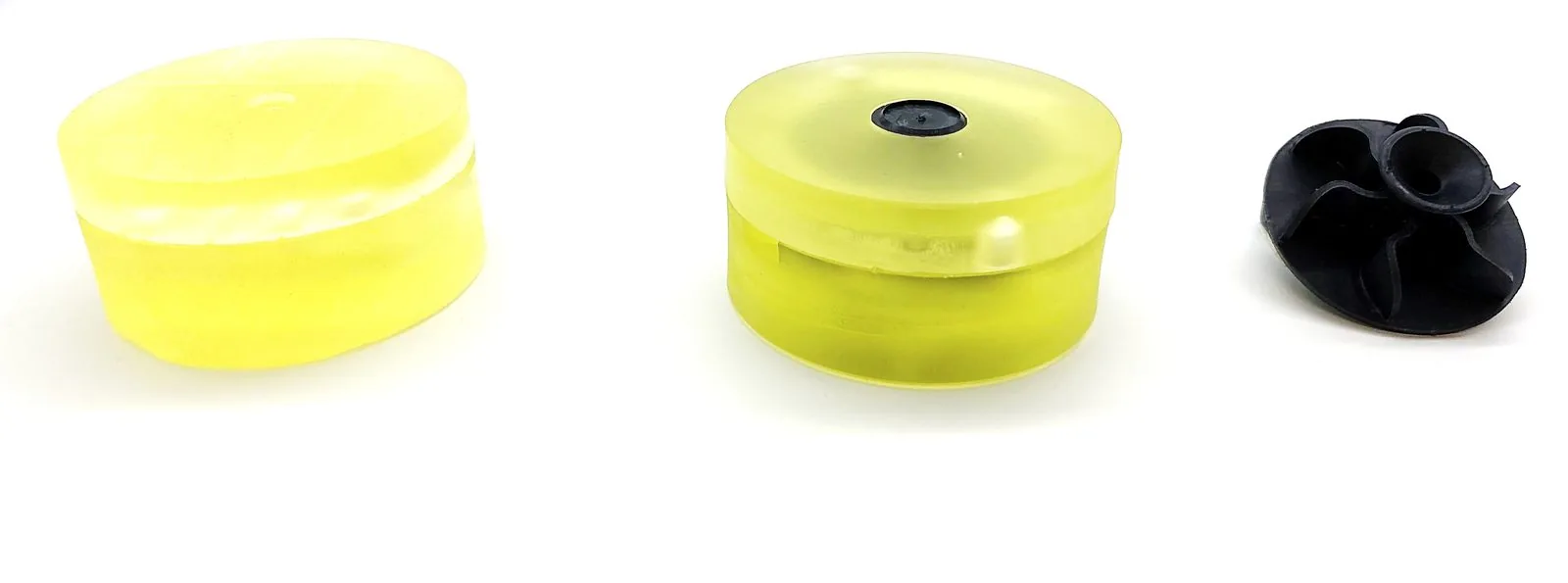
How the process works
- Print the mold. On any open LCD, DLP or mSLA printer at 385 or 405 nm. Design guidance favours cylindrical, two-piece cavities with an injection plate for controllable, crack-resistant filling.
- Wash & UV-cure. Clean in Cubic Ink Cleaner 400 or IPA, then UV post-cure to reach full properties.
- Inject or cast. Place the printed cavity in a stainless or aluminium holder and run your process. Because a photopolymer conducts heat differently than metal, material feed can run slower — which actually reduces the risk of cracking.
- Release in water. Submerge the filled mold; it breaks down in water (faster with warm, stirred, or alkaline media such as Mold Remover 100) and frees the part with minimal swelling.
Where water-breakable molds make sense
- Functional prototypes in the real material — validate a PA-GF or PEEK part in the production polymer before committing to steel.
- Complex geometry & undercuts — internal channels and features that a conventional tool cannot release.
- Hybrid and 2K parts — over-mold metal inserts or combine materials in one shot.
- Bridge and small-series production — parts in hand while hard tooling is still being cut, or for series small enough that steel never pays back. ALTANA is already running large-volume medical batches with this approach through its ACTEGA division.
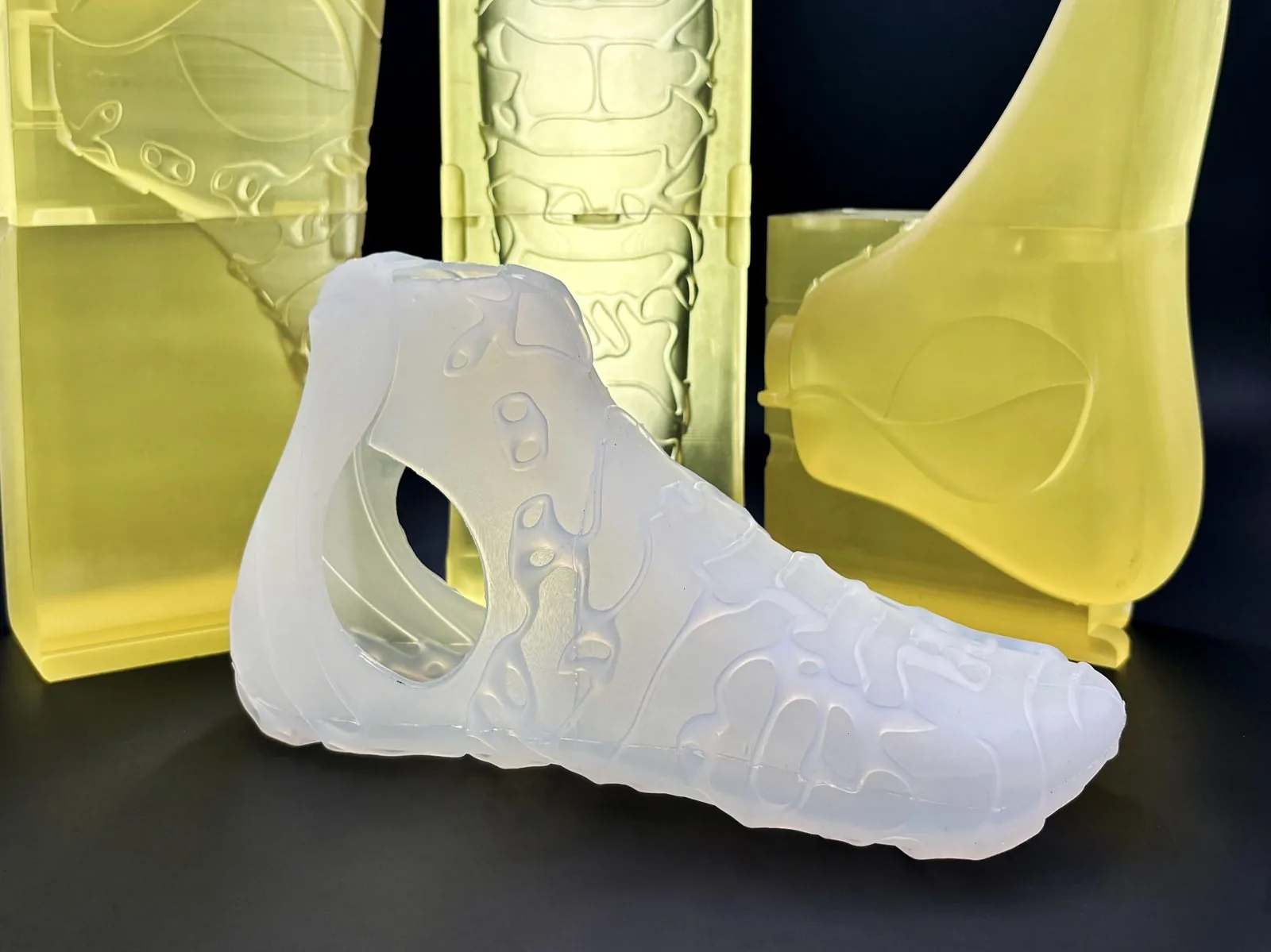
Design: Franziska Valerie Hagenauer | FVH Creative · fvhlab.com
The resin behind it: Cubic Ink Mold 400 VP
The material doing the work is ALTANA Cubic Ink Mold 400 VP, a water-breakable casting and injection-molding resin for DLP/LCD/mSLA. It prints rigid, dimensionally stable cavities (42 MPa tensile, 80 Shore D), tolerates 380 °C and 1,200 bar at the process, and dissolves cleanly in water afterwards. It is stocked and ships fast, so a mold can be printing the day you decide to try it.
Beyond molds: the Cubic Ink resin line
One-Shot Mold is one part of ALTANA’s Cubic Ink range of industrial DLP/LCD resins. If your parts are the end product rather than the tool, the same line covers demanding applications — for example High Temperature 1901 VP for high-heat tooling (HDT-B 272 °C), Rigid 2000 VP for stiff industrial parts, and High Performance 4-2800 VP-ESD for static-safe electronics parts.
Print your next mold instead of cutting it
Tell us your part, your target material and your run size, and a materials engineer will tell you whether a water-breakable mold beats steel for the job — and help you dial in the print and fill. Sub-24h reply, NDA on request. Start with ALTANA Cubic Ink Mold 400 VP.
Frequently asked questions
Can you injection mold PEEK with a 3D-printed mold?
Yes, with a sacrificial one-shot mold such as Cubic Ink Mold 400 VP, which tolerates process temperatures up to about 380 °C and injection pressures up to 1,200 bar. Because the mold is dissolved in water after a single fill, it does not need to survive the repeated high-temperature cycles that would destroy a reusable resin mold.
How much cheaper is a 3D-printed injection mold than steel tooling?
For short runs of roughly 10 to 1,000 parts, 3D-printed tooling can cut mold cost and lead time by about 85–90% versus machined steel, with a working mold ready in 1–2 days instead of weeks.
What is a water-breakable (One-Shot) mold?
A 3D-printed sacrificial mold that you print, fill once with your target material, then dissolve in plain water to release the part. It enables undercuts, complex internal geometry, metal inserts and 2K parts without a multi-plate steel tool.
What materials can you injection mold or cast with Cubic Ink Mold 400 VP?
Injection molding: PE, PP (up to 36% GF), PBT and PA6 (up to 40% GF), PA12, PVC, PC, PEEK (up to 30% CF) and PPS (up to 80% CF). Casting: 2K silicones, epoxides, polyurethanes, polyesters and metal alloys melting below 200 °C. Compatibility also depends on part geometry.
Is a printed water-breakable mold reusable?
No — water-breakable molds are single-use, which is exactly what lets them handle aggressive materials like PEEK and glass-filled plastics. For durable multi-shot tooling, ask about the reusable Cubic Ink Mold options.
Have a question or a project? Let’s talk.
Tell us what you need — a real applications engineer replies within 24 hours. NDA on request, no sales script.