
Made to order
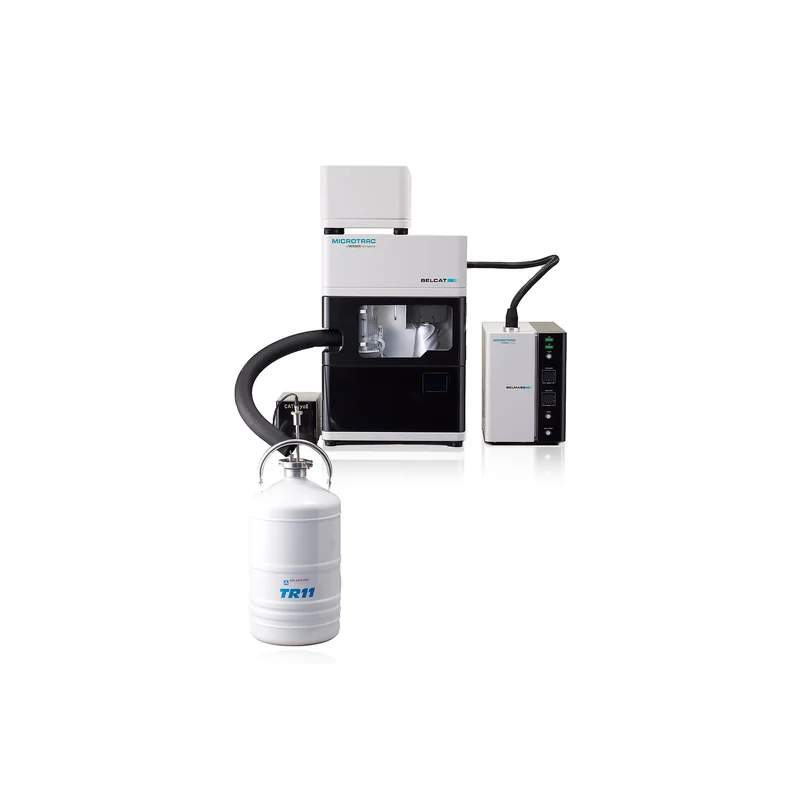
- Installation & coupling transfer-line setup and coupling to your BELCAT II
- a TPD-MS measurement on your own catalyst
Microtrac BELMASS II Mass Spectrometer for the BELCAT II
An add-on mass spectrometer for the BELCAT II that tells you which gases evolve in TPD, TPR and breakthrough runs — m/z 1 to 200, up to 16 mass numbers followed at once.
- Faraday cup or SEM detector, resolution M/ΔM ≥ 2M
- Heated hose up to 200 °C for vapors, including ammonia
- Installation and on-site training included · free test analysis of your sample
- Configured to order · lead time from 4 weeks
What your catalysis lab actually checks
Identify, don't just quantify
Coupled to the BELCAT II, the BELMASS II resolves each TPD or TPR peak into specific gases across m/z 1–200 — the species information a thermal conductivity detector alone cannot give.
An applications engineer on the line
Coupling, selected-ion monitoring and evolved-gas method support from engineers who run catalyst analysis in-house at Additive Plus.
- BELMASS II benchtop quadrupole mass spectrometer with built-in turbo molecular pump and dry diaphragm pump
- Sniffer probe and capillary — stainless steel as standard, PEEK as an option
- Heated hose, 1 m — up to 200 °C with stainless steel, 120 °C with PEEK
- BELMASS II link software for the BELCAT II; ChemMaster II for spectrum analysis
- Installation and on-site operator training — included in every quotation
What the BELMASS II is
The BELMASS II is a benchtop quadrupole mass spectrometer from Microtrac with its vacuum pumps built in. A sniffer probe draws 0.6 cc/min of gas at atmospheric pressure through a capillary and a heated hose; the gas is ionized, four parallel rods separate the ions by their mass-to-charge ratio, and the detector records the spectrum. It is an add-on, not a stand-alone analyzer: it identifies the gas that leaves another instrument, above all the BELCAT II catalyst analyzer, whose thermal conductivity detector tells you how much gas evolved but not which one. Linked to the BELCAT II software, the BELMASS II turns each peak of a TPD, TPR or reaction run into identified species.
Specifications
| Type | Quadrupole mass spectrometer, benchtop |
| Mass range | m/z 1–200 |
| Resolution | M/ΔM ≥ 2M |
| Detector | Faraday cup / SEM |
| Filament | yttria-coated iridium |
| Gas introduction | differential exhaust · 0.6 cc/min at 1 atm · inlet at atmospheric pressure |
| Capillary | SUS as standard, PEEK as an option · OD 1/16 in, ID 0.1 mm, length 1.5 m |
| Heated hose | 1 m · up to 200 °C (SUS) / 120 °C (PEEK) |
| Selected ion monitor | max. 16 channels |
| Analog signal input | DC 0–10 V, 10 bit, 1 channel |
| Interface | RS-232C |
| Exhaust port | 1/4 in one-touch joint |
| Power supply | single-phase 100–120 V or 200–240 V AC · 50/60 Hz · 600 VA |
| Dimensions (W × H × D) | 280 × 400 × 600 mm (11.0 × 15.7 × 23.6 in), without capillary |
| Weight | 36 kg (79 lb) |
| Installation environment | 10–35 °C · 20–80 % RH, no condensation · up to 2000 m |
| Standards | CE, UKCA |
| Installation and training | on site, included in every quotation |
| Lead time | from 4 weeks, depending on configuration |
Download: BELMASS II datasheet (PDF)
What it tells you about an evolved gas
Coupled to the BELCAT II, a temperature-programmed run shows which gases appear, and when:
| TPR on CuO | hydrogen consumption and water production observed at the same time |
| Thermal decomposition | calcium oxalate: m/z 18, 28 and 44 detected as the sample is heated |
| Breakthrough curves | several gas components followed in one breakthrough run |
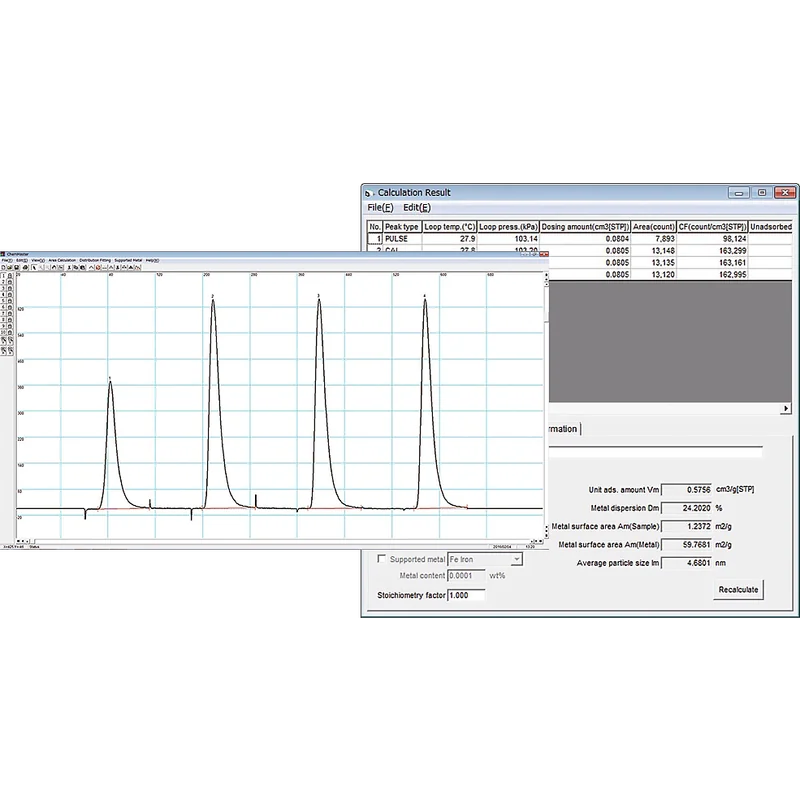
| Pulse measurements | pulse spectra analyzed; chemisorption amount and metal dispersion calculated automatically |
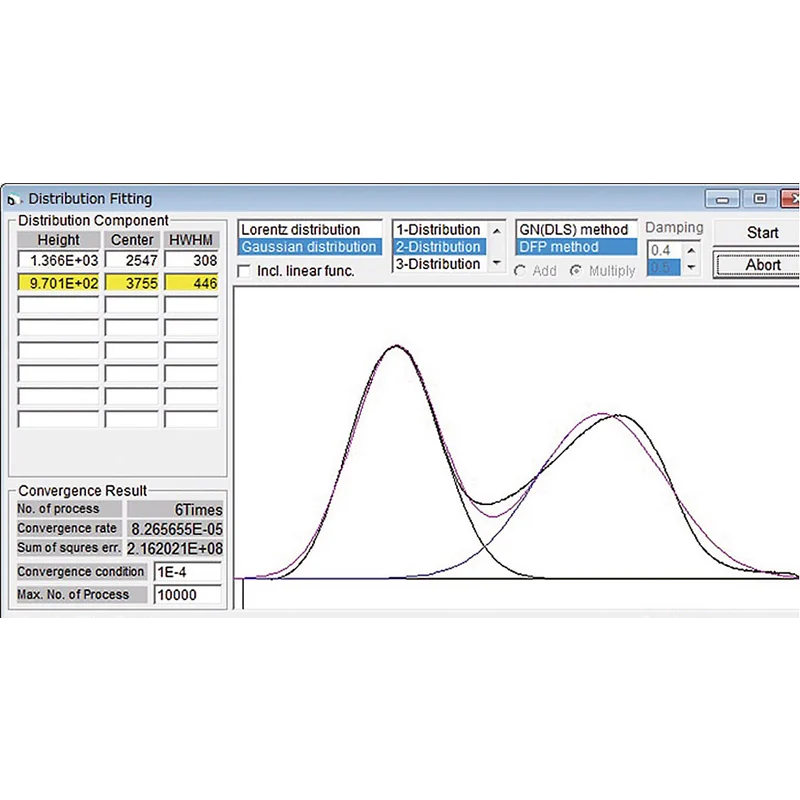
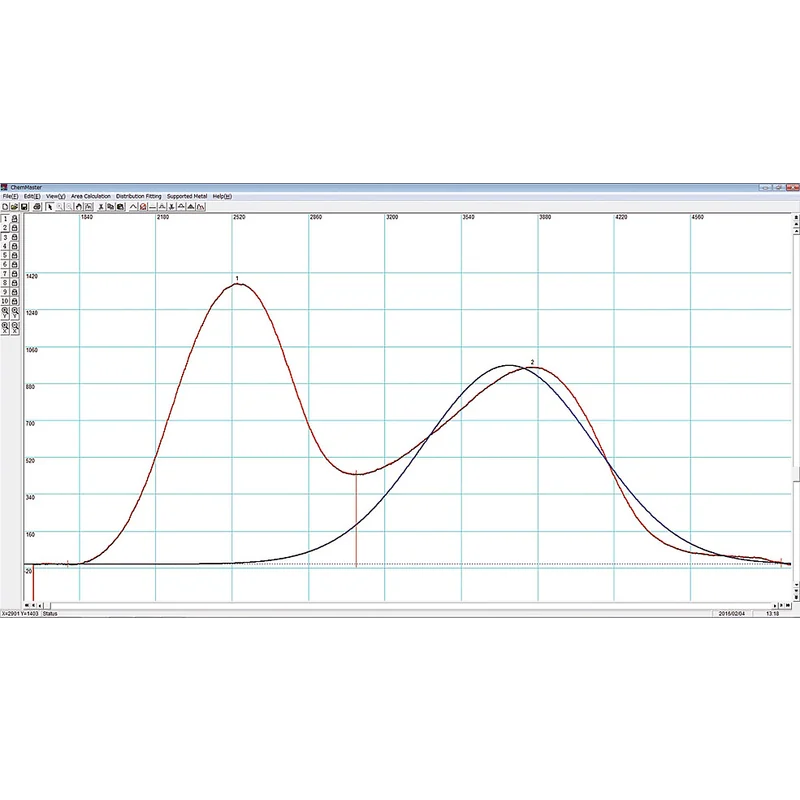
| Overlapping peaks | Distribution Fitting splits a spectrum into peaks, so the number of active sites on the catalyst surface can be determined |
Two monitoring modes cover both situations. Selected Ion Monitor follows up to 16 mass numbers over time when you know which reaction gases to expect; Mass Peak Monitoring scans the set mass range continuously when you do not.
The sample temperature can be brought in through the analog input, so the BELMASS II is also suited to thermal analysis. Baseline correction and a spike noise filter in ChemMaster II support an accurate chemisorption amount.
Where the BELMASS II stops — and what to take instead
The BELMASS II does not heat, pretreat or dose a sample: it identifies the gas another instrument releases. For catalysts and adsorbents that instrument is the BELCAT II, which runs the temperature program and quantifies with its thermal conductivity detector. The mass range ends at m/z 200, and the gas reaches the analyzer through a hose heated to 200 °C at most, or 120 °C with the PEEK capillary. If your question is the surface area or pore structure of a material rather than what it releases, the BELSORP MAX X gas adsorption analyzer is the instrument to look at.
In pictures
Availability, payment and delivery
Why buy it through Additive Plus
What usually stops people — and the honest answer
Ready when you are
| Brand | Microtrac |
| Technology | Quadrupole mass spectrometry (evolved gas analysis) |
| Certification | CE |
| Weight | 79 lb / 36 kg |
Product videos
Send us a representative sample. The test measurement in Microtrac's US application lab is free, and we go through the results with you.
Other products teams run alongside Microtrac BELMASS II Mass Spectrometer for the BELCAT II
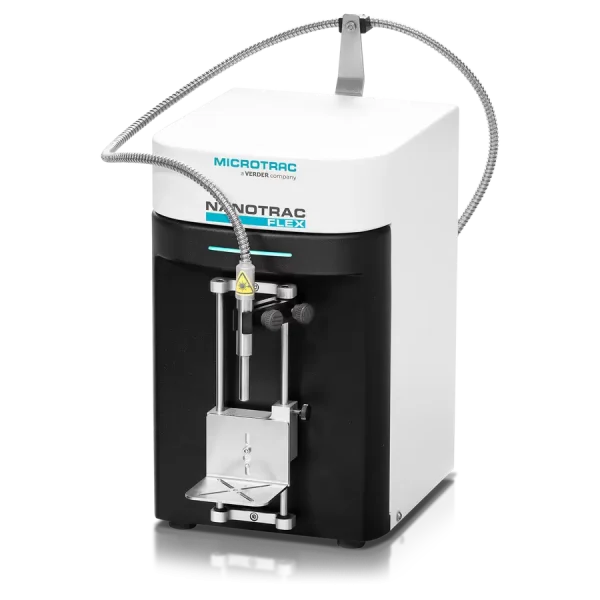
Nanoparticle size from 0.3 nm to 10 µm with a dip-in DLS probe — any vessel, from one drop, up to 40 % concentration, at line or in line.
- Size, concentration and molecular weight in one measurement
- FlowGuard for stirred and flowing liquids · no cuvettes
- Installation and on-site training included · free test measurement
- Configured to order · lead time from 4 weeks
Made to order
· Lead time from 4 weeks · installation included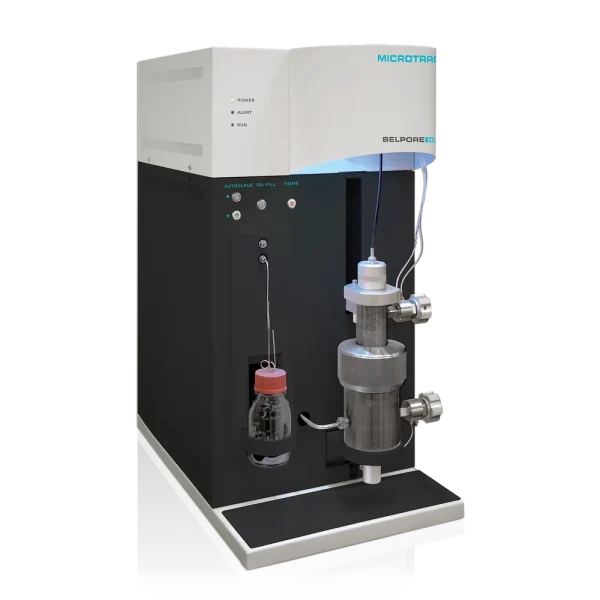
Pore size distribution and pore volume by mercury intrusion — 3.6 nm to 180 µm, to 1 mm with the Ultra-Macropore Set, up to 414 MPa and 20,000 measuring points.
- LP plus MP or HP · PoreInspect runs up to four from one PC
- No gas connection or liquid nitrogen · moist samples on the LP
- Installation and on-site training included · free test analysis of your sample
- Configured to order · lead time from 4 weeks
Made to order
· Lead time from 4 weeks · installation included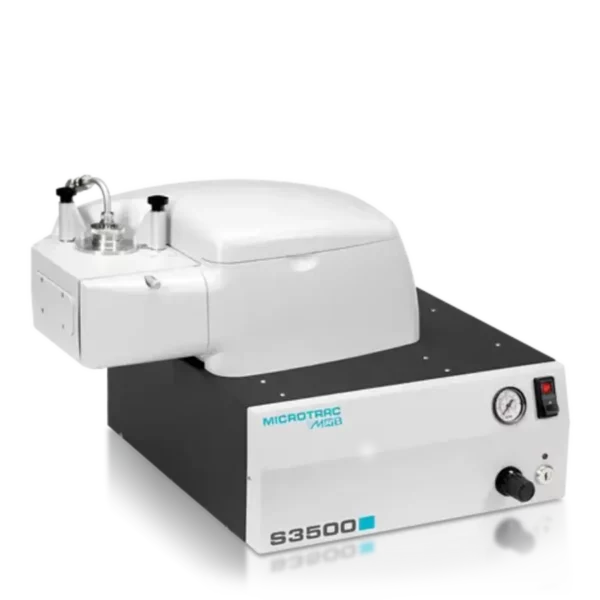
Laser diffraction particle size from 0.02 to 2800 µm, wet or dry, in about 10 to 30 seconds — three red lasers, 151 detector segments and Modified Mie for irregular particles.
- Volume, number and area distributions with d10, d50, d90 for metal powders and other materials
- SDC wet, TURBOTRAC dry and MS30 autosampler options; FDA 21 CFR Part 11 data security
- Installation and on-site training included · free test measurement
- Configured to order · lead time from 4 weeks
Made to order
· Lead time from 4 weeks · installation included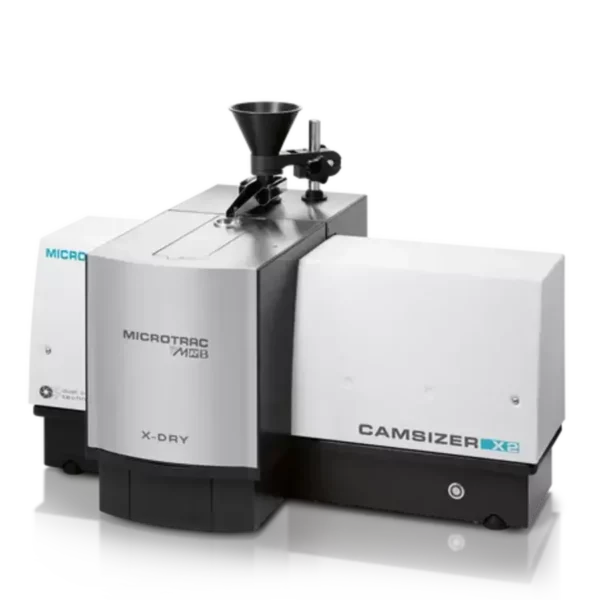
Particle size and shape of your powder in one to three minutes — two cameras, 0.9 µm to 8 mm dry, results comparable with sieving and laser diffraction.
- Sphericity, aspect ratio and irregular particles for metal AM feedstock
- X-Jet air, X-Fall gravity and X-Flow wet dispersion
- Installation and on-site training included · free test measurement
- Configured to order · lead time from 4 weeks
Made to order
· Lead time from 4 weeks · installation included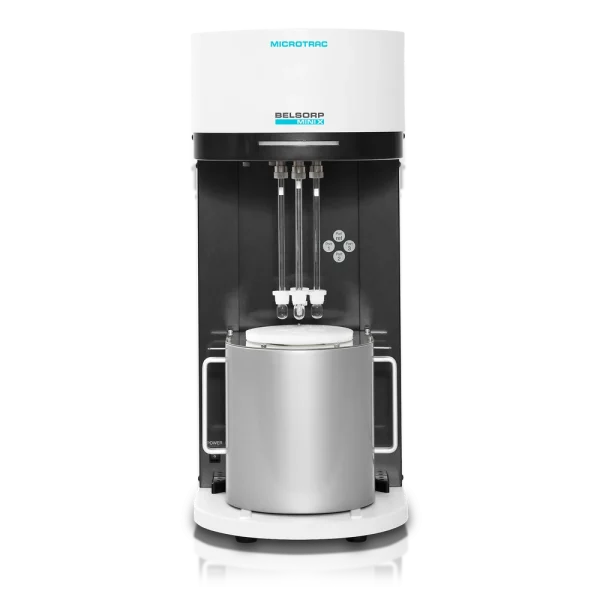
Compact BET surface area and pore size analyzer — up to four samples at once, from 0.01 m²/g with nitrogen, pores 0.7 to 500 nm.
- Each port with its own transducer, helium-free AFSM™2 measurement
- Quick BET: three-point BET of several samples in about 15 minutes
- Installation and on-site training included · free test analysis of your sample
- Configured to order · lead time from 4 weeks
Made to order
· Lead time from 4 weeks · installation included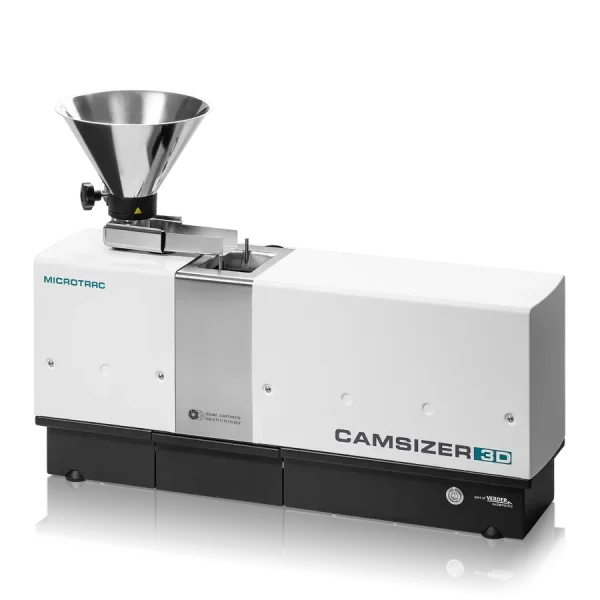
True three-dimensional particle size and shape from 20 µm to 30 mm — up to 30 images of every particle give its length, width and thickness in two to five minutes.
- Patented particle tracking with 9 MP ZOOM and 5 MP BASIC cameras, up to 250 images per second
- 2D mode with results compatible with sieve analysis; Autosampler for unattended runs
- Installation and on-site training included · free test measurement
- Configured to order · lead time from 4 weeks
Made to order
· Lead time from 4 weeks · installation included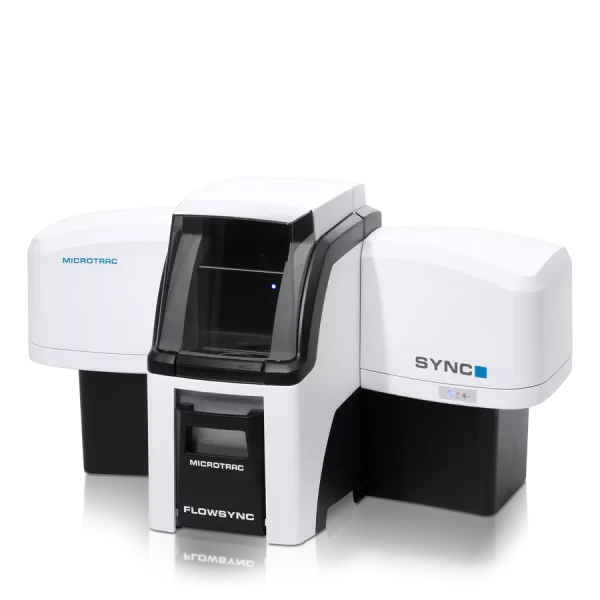
Laser diffraction and dynamic image analysis on the same sample, in the same cell, at the same time — size from 0.01 to 4000 µm and more than 30 shape parameters in a typical 10 to 30 seconds.
- Oversize, sphericity and satellites in metal AM powder, alongside the ISO 13320 size distribution
- FLOWSYNC wet and TURBOSYNC dry modules, changed in less than 15 seconds
- Installation and on-site training included · free test measurement
- Configured to order · lead time from 4 weeks
Made to order
· Lead time from 4 weeks · installation included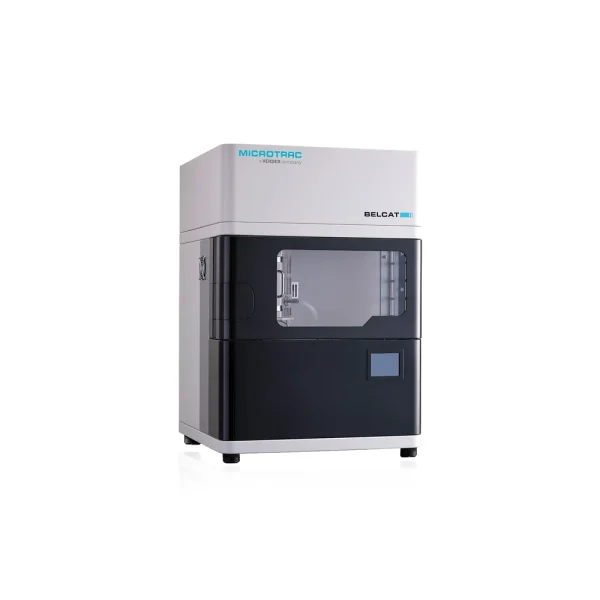
Acid sites, reducibility, coke and metal dispersion of a solid catalyst on one automatic instrument — TPD, TPR, TPO and pulse chemisorption from −120 to 1200 °C.
- Eight gas ports, mixtures blended inside the instrument
- Breakthrough curves and BET; BELMASS II option to identify the gases
- Installation and on-site training included · free test analysis of your catalyst
- Configured to order · lead time from 4 weeks
Made to order
· Lead time from 4 weeks · installation includedWhat our customers say
“Harry and team were professional, effective communicators as we set up the order, then they executed quickly and produced an amazing product for us at a very competitive price. Am looking forward to our next print w Additive Plus!”
“Great 3D printing service and the resin parts look super smooth and clean. Really happy with how everything turned out!”
“Harry was very professional and helped me out with my 3D printing needs and explained what options I have in terms of filaments such as PEEK. Highly recommended.”
“I needed a 3D enclosure printed urgently in a specific time period, they did great!”
Common questions
Don't see yours? Email [email protected] — NDA on request, typical reply within 4 hours.
What does the BELMASS II add to a BELCAT II?
What mass range and resolution does it offer?
Can it monitor several species at once?
Does it need a BELCAT II, or can it stand alone?
Can it analyze water vapor and ammonia?
How much does a BELMASS II cost?
Can I test my sample before buying?
What is the lead time, and what comes with the BELMASS II?
Place your order, or talk to an engineer first
Order Microtrac BELMASS II Mass Spectrometer for the BELCAT II direct, or talk to materials engineer