
Made to order
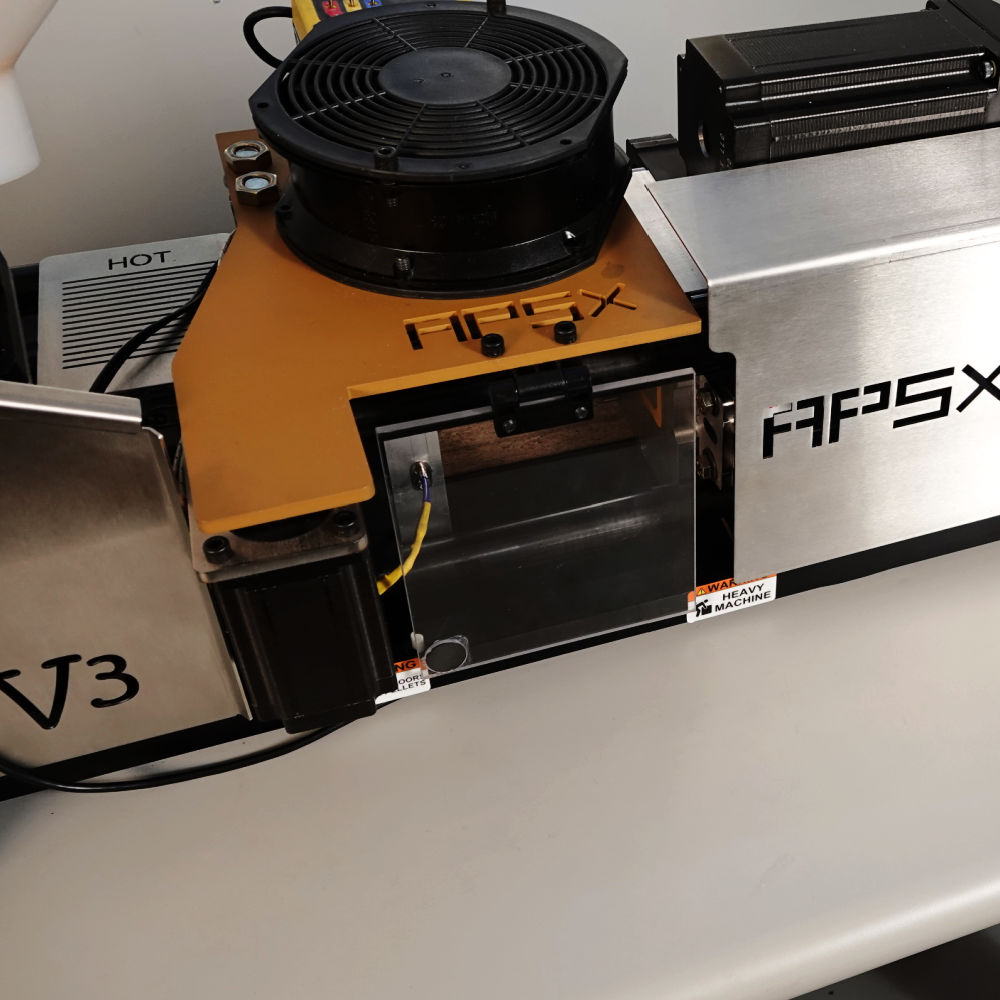
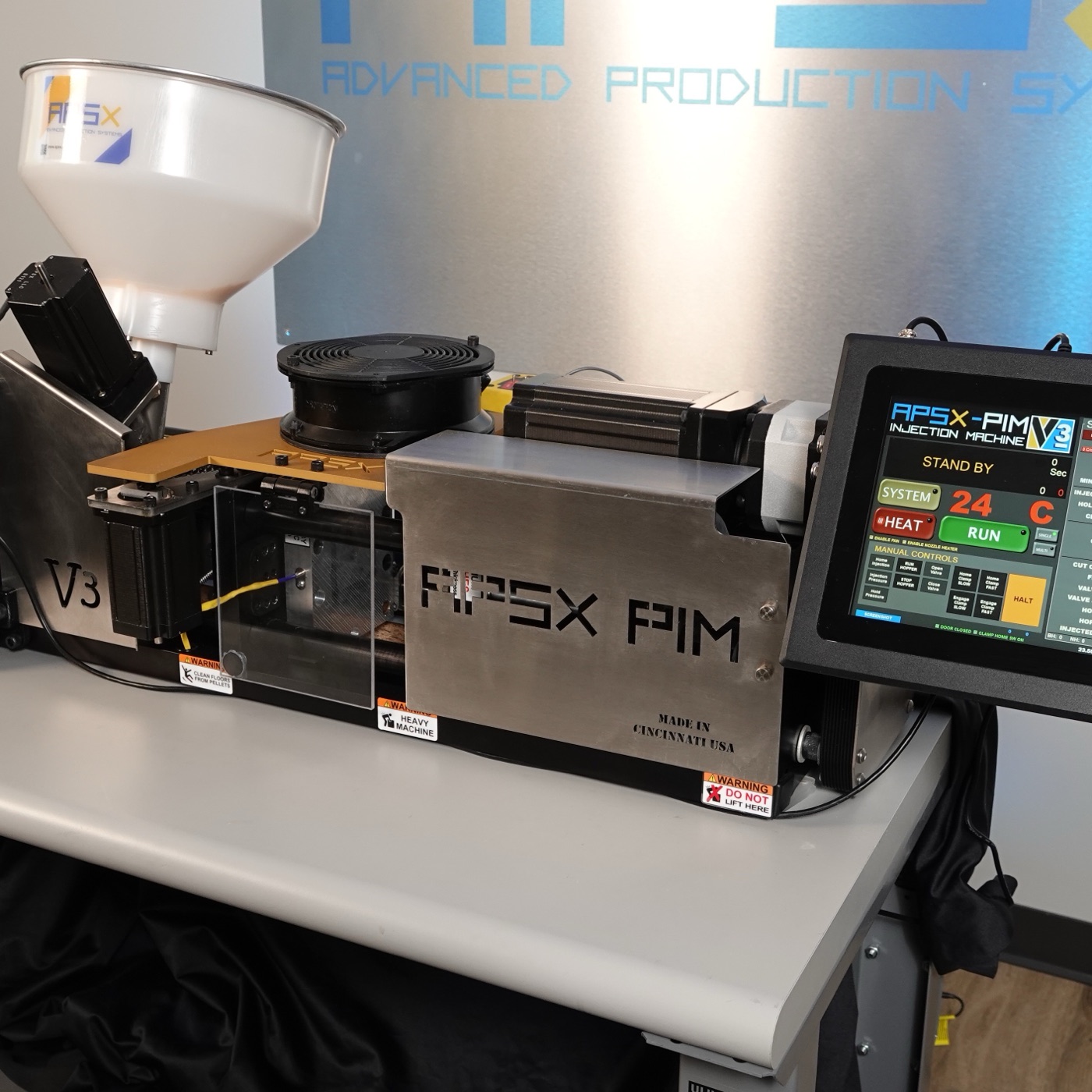
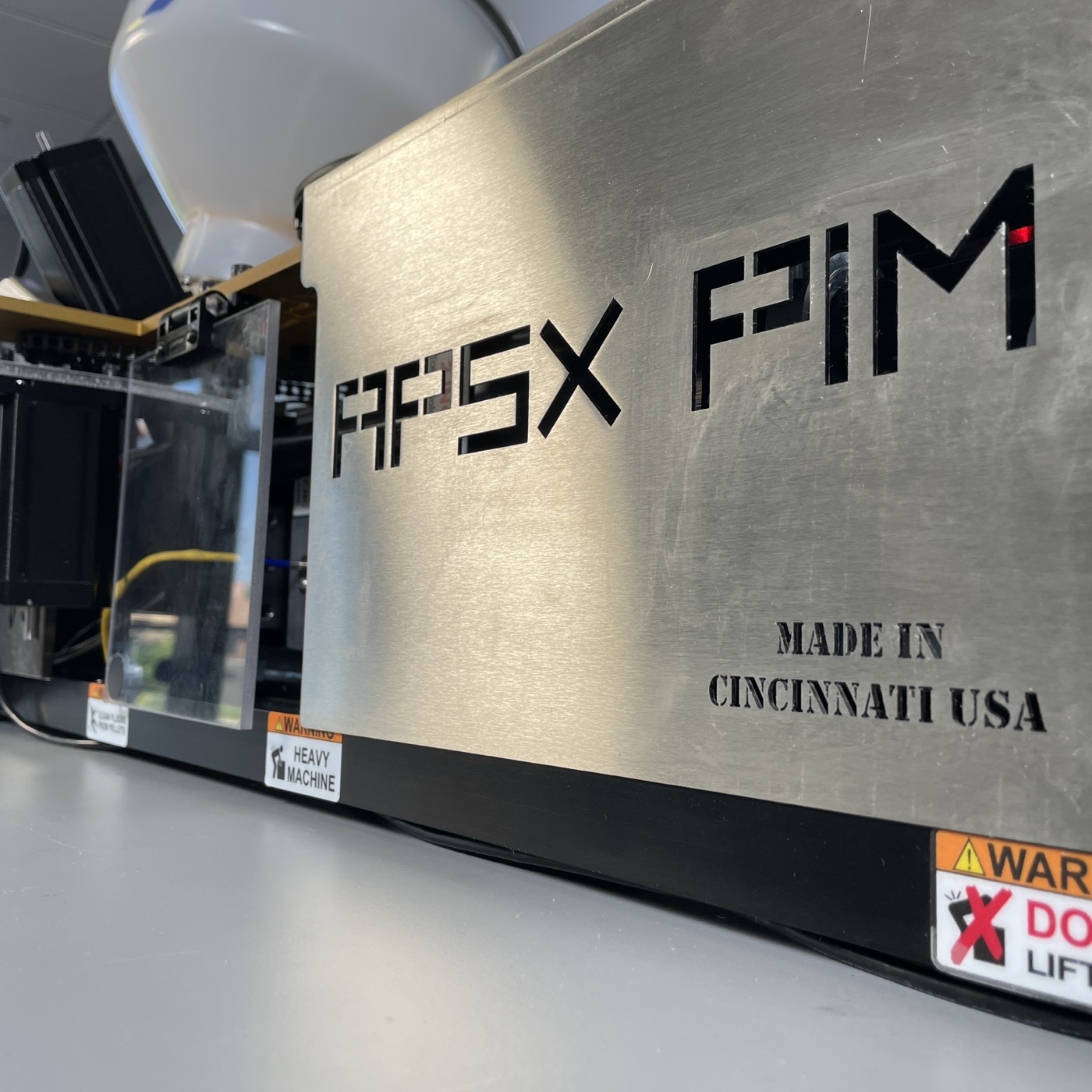
- A test mold and purge kit so you can run your first shots the day it arrives
- US-based phone and email support from the team that molds parts on these machines
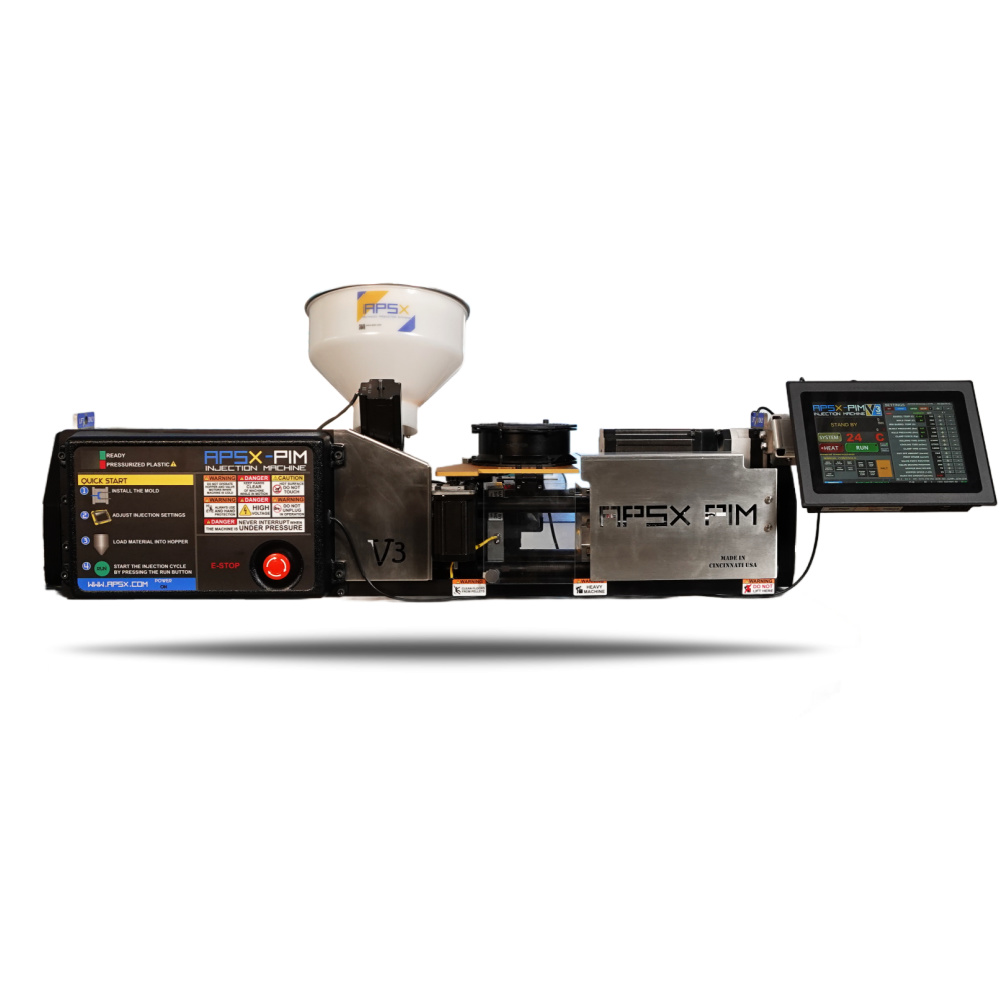
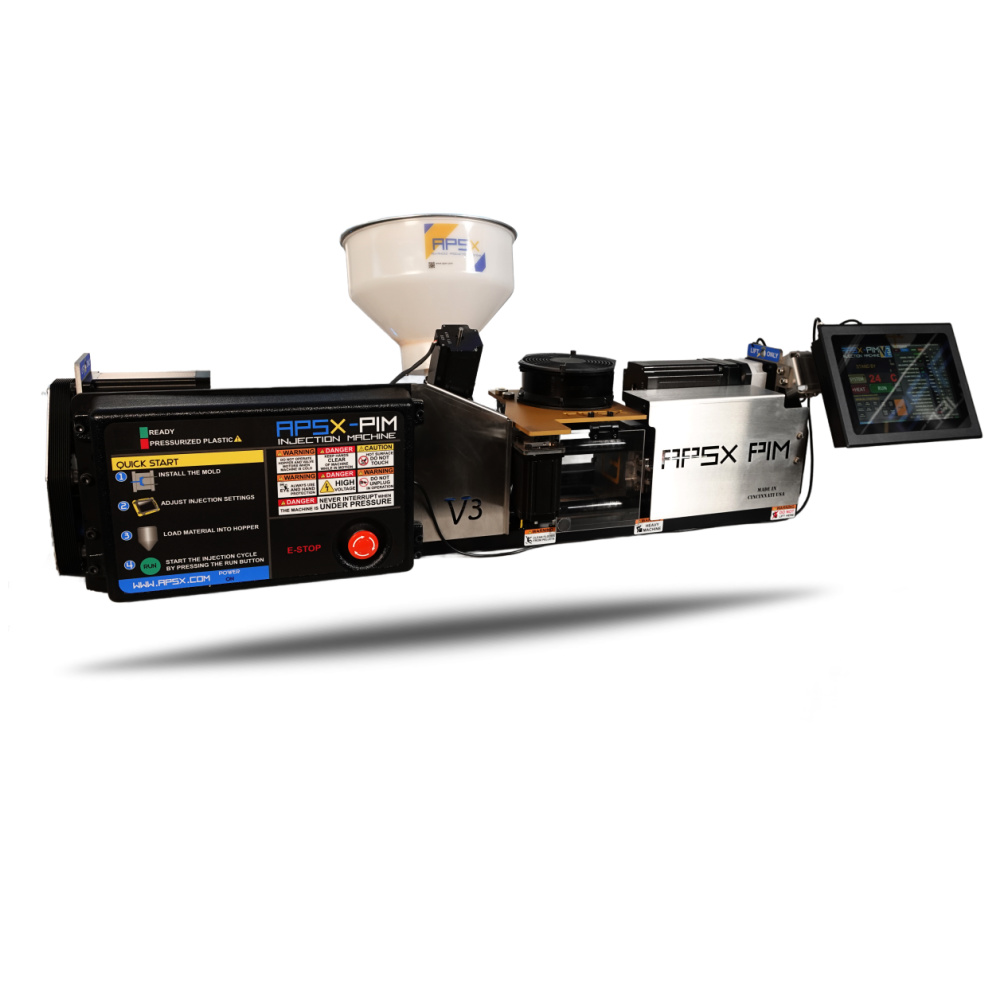
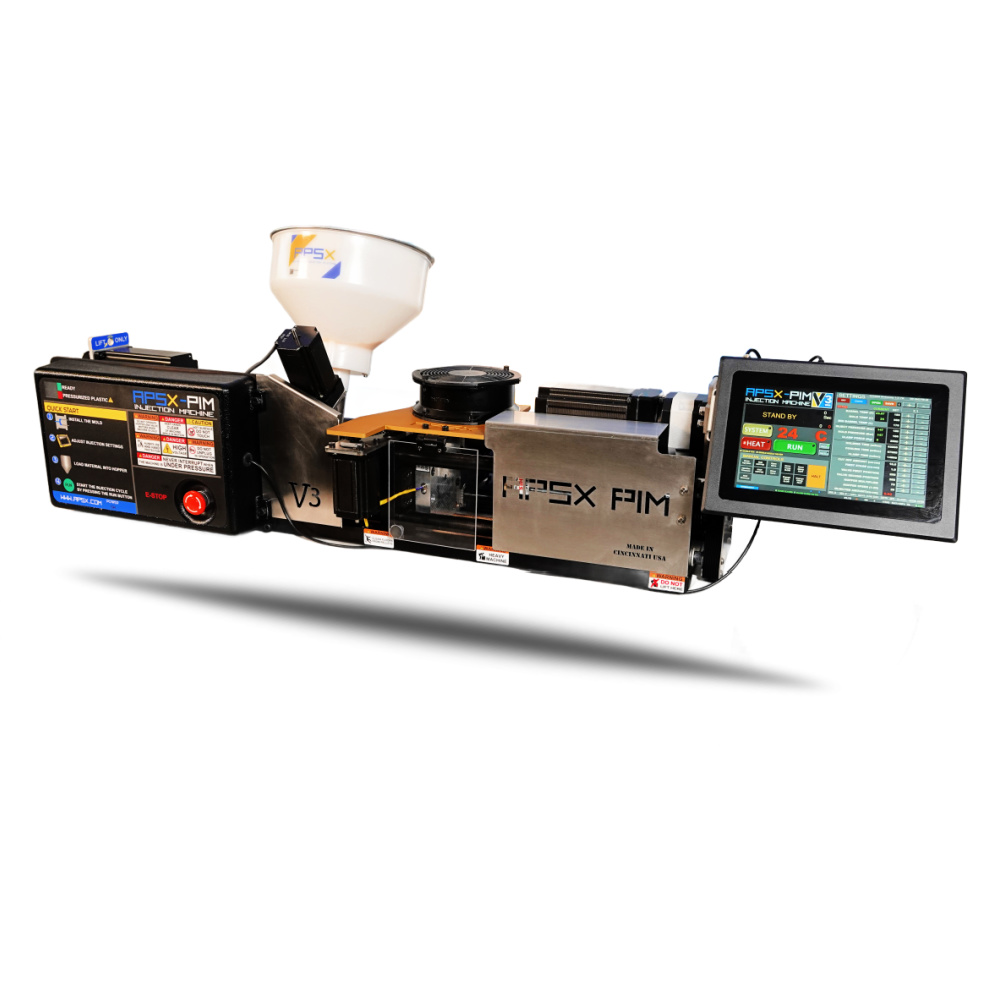
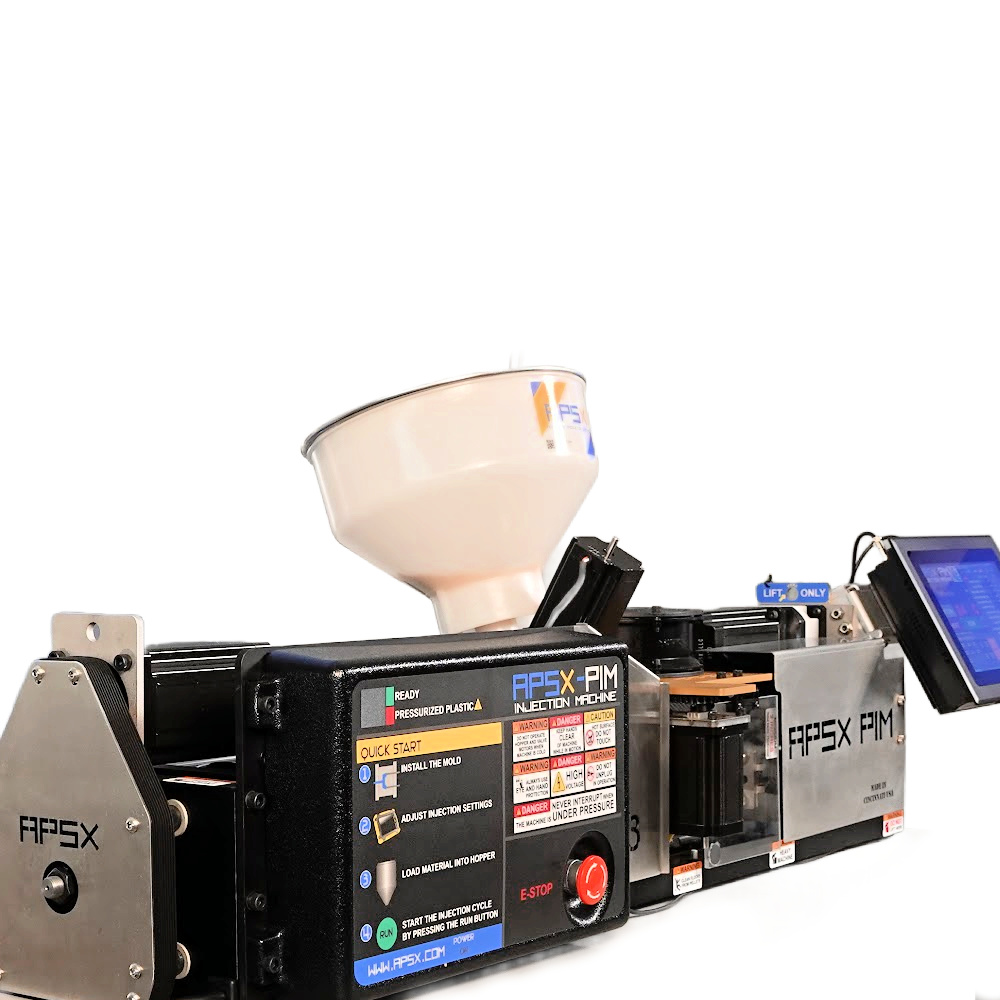
APSX-PIM V3 Desktop Injection Molding Machine – 5-Ton Clamp | 30 cc Shot | Engineering Resins
- ✓ Fully automatic multi-mode with ejector molds — ~60 s cycle; manual single-mode with the included test mold
- ✓ Runs on a standard 115 V (US) or 230 V (EU) outlet — 250 lb benchtop footprint, mold swap in ~15 min
- ✓ Lead time: confirmed on your quote — made in Cincinnati, OH, with US-based support
What a product engineer actually checks
From printed prototype to molded short run
The APSX-PIM V3 bridges a 3D-printed prototype and injection-molded production. Print the concept, then mold the same geometry in PC, nylon, or PP — real thermoplastic parts with production surface finish and material properties, at 5 tons of clamp force.
Repeatability benchtop presses skip
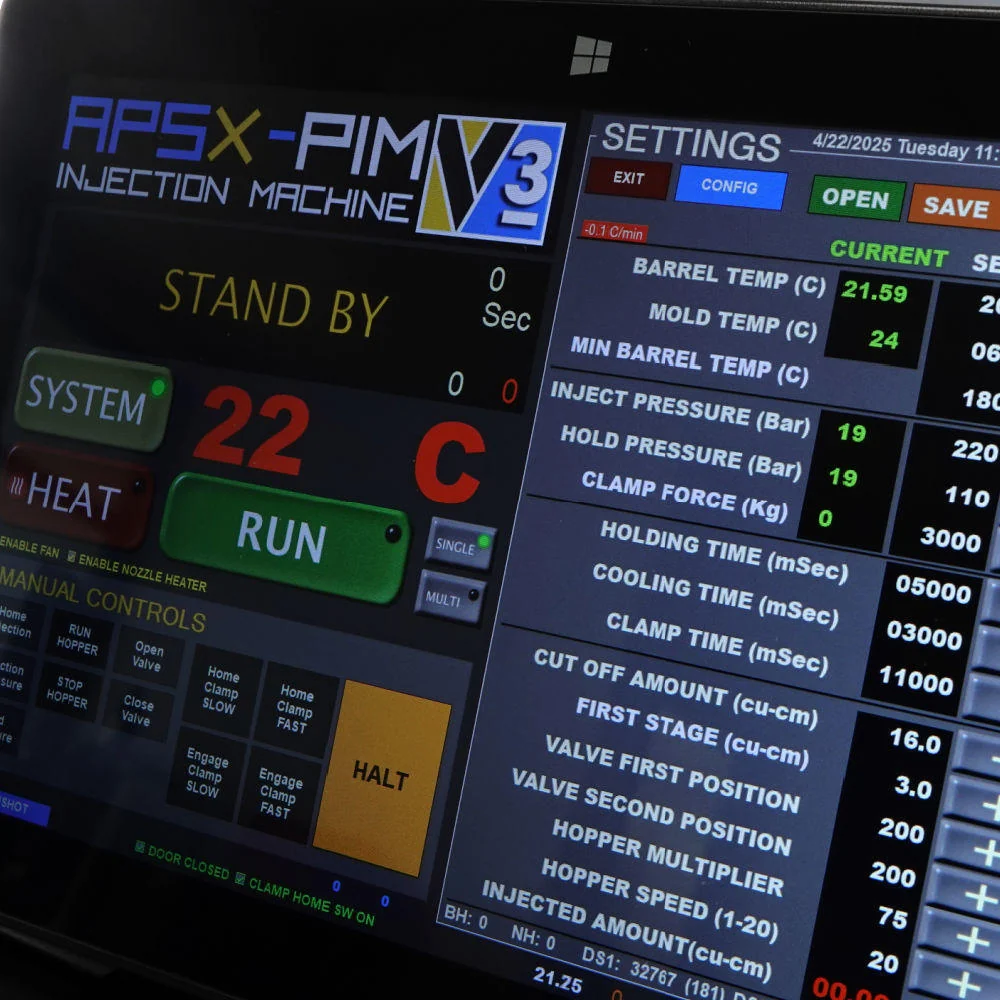
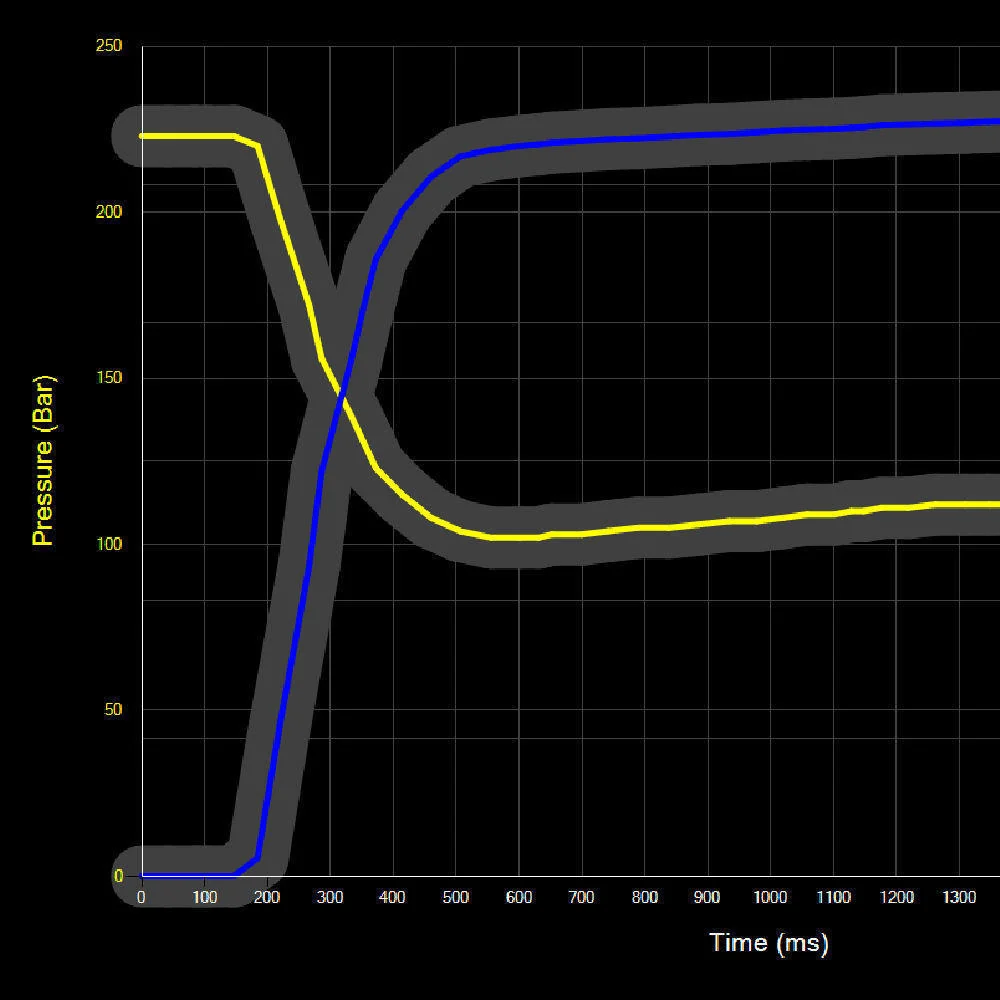
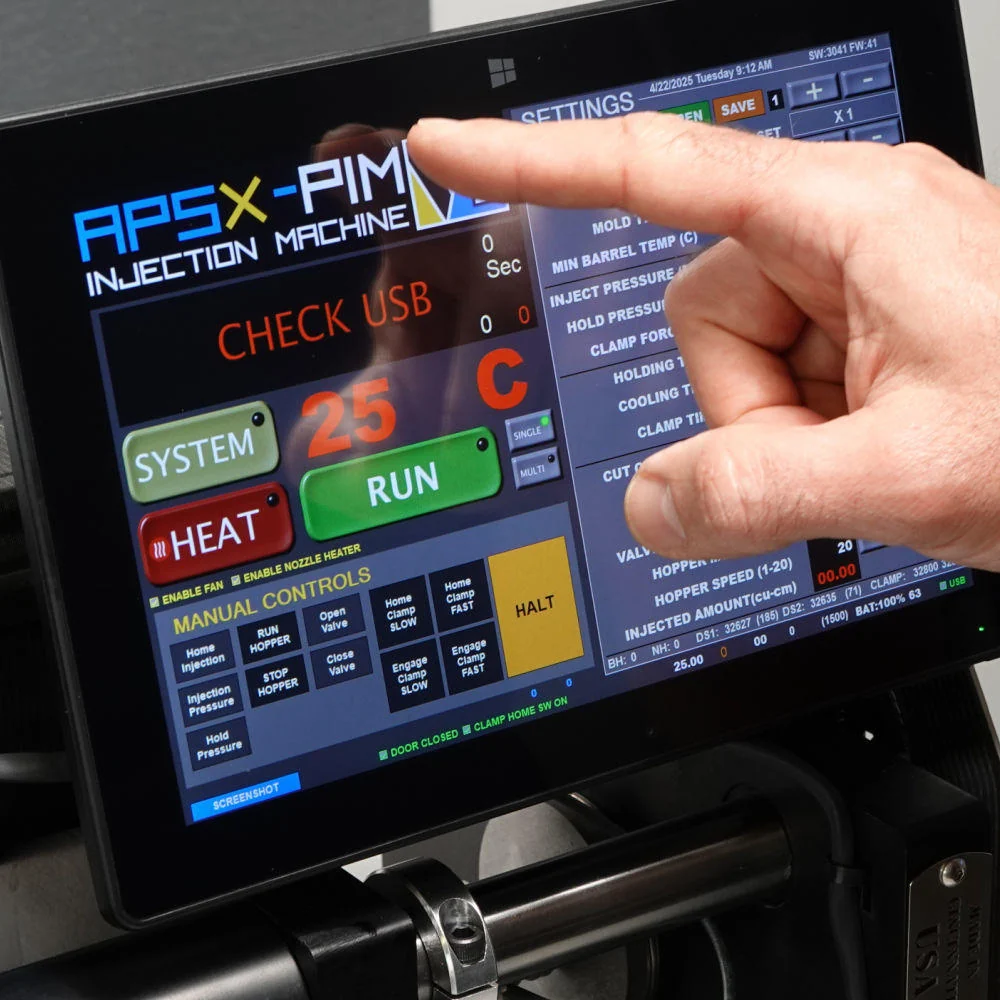
A closed-loop screen sets injection pressure to 5000 psi / 345 bar, melt temp to 330°C, and timing per shot. That process control gives shot-to-shot consistency — the parameter most desktop injectors can't offer. Multi-mode molds with ejector pins run automatically at roughly a 60-second cycle.
An applications engineer on the line
Questions on mold design, material selection, or dialing in cycle parameters? Our applications engineers help with part fit, material selection and mold approach before you order. Fast replies, NDA on request. Use the Talk to an applications engineer button above.
APSX-PIM V3 is a fully automatic desktop injection molding machine that presses real thermoplastic parts at 5 tons of clamp force and a 1.83 cu-in / 30 cc shot. It runs engineering resins — PC, nylon, ABS, PP, Delrin and more — up to 626°F / 330°C on standard or custom aluminum molds, from a normal 115 V (US) or 230 V (EU) wall outlet. It bridges the gap between a 3D-printed prototype and injection-molded short-run production, without the cost, footprint or facility requirements of a full-size press.
Why engineers choose the APSX-PIM V3
Four things design and production teams verify before buying a desktop injection press.
Prototype → molded production
Print the concept, then mold the same geometry in real thermoplastic — production surface finish and material properties, not a rough draft part.
Repeatability, not a toy press
A closed-loop screen sets injection pressure to 5000 psi / 345 bar, melt temp to 330°C and timing per shot — shot-to-shot consistency most benchtop injectors skip.
Open, low-cost material
Runs off-the-shelf pellets — PC, nylon (PA6), ABS, PC/ABS, PP, PS, PE, Delrin, TPO. No proprietary cartridges, no vendor lock-in.
Plugs into a wall outlet
No hydraulics, no compressed-air plant, no facility retrofit. 250 lb footprint fits on a workbench; swap a mold in about 15 minutes.
How Additive Plus delivers it
The APSX-PIM V3 arrives as a working process, not a puzzle — specced, shipped and supported.
Specced to your parts
Tell us your part, material and volume — we confirm the APSX-PIM V3 is the right fit and recommend a mold approach before you order.
Ships ready to run
Arrives with a test mold and purge kit; the lead time is confirmed on your quote. Plug into a 115 V or 230 V outlet and run your first shots the day it lands.
Backed by the maker
US-based machine support from APSX in Cincinnati, plus our applications engineer for part-fit and material questions before and after the sale.
Materials
- Engineering thermoplastics (up to 626°F / 330°C): Polycarbonate (PC), Acetal (Delrin), ABS, PC/ABS, Nylon (PA6), Polypropylene (PP), Polystyrene (PS), Polyethylene (PE), Thermoplastic Polyolefin (TPO)
- Feedstock: standard plastic pellets — dry hygroscopic resins (PC, nylon) before molding for best results
- Same-resin workflow: prototype and mold in the same material family, so validated parts behave like production parts
Bridge tooling economics, in numbers
Where in-house molding beats outsourcing — shown on one short run instead of adjectives.
| 500-part short run (PC) | In-house on APSX-PIM V3 | Outsourced molding |
|---|---|---|
| Tooling | Aluminum mold, reused across runs | Setup + tooling per vendor quote |
| Lead time to first parts | Same day once the mold is on the machine | Typically 2–6 weeks |
| Iteration cost | Re-run in minutes, in-house | New PO and lead time per change |
| Where it wins | Low-to-mid volumes, frequent design changes, and parts you want to keep in-house | |
Representative comparison for prototyping and short-run production; exact economics depend on part size, material and mold. Ask us for a cost-per-part estimate on your geometry.
Technical specifications
- Clamping force: 11,023 lbf / 5 tons
- Injection volume: 1.83 cu-in / 30 cc per shot
- Injection pressure: 5000 psi / 345 bar
- Piston diameter: 1 in / 2.54 cm
- Max processing temp: 626°F / 330°C (1400 W heater)
- Standard mold size (W×H): 4.8×6.0 in / 12.19×15.24 cm
- Opening stroke (w/ & w/o ejector plate): 5.5–7.0 in / 13.97–17.78 cm
- Power supply: 115 V (US) or 230 V (EU), single phase
- Machine dimensions (L×W×H): 43×10×15 in / 109×25.4×38.1 cm; weight 250 lb / 113 kg
See the Specifications tab for the full table.
Typical applications
Where teams run the APSX-PIM V3 today.
A design team replaced outsourced prototype molding by running a 300-part PC bracket run in-house on the APSX-PIM V3: an aluminum mold, a ~60-second multi-mode cycle and same-day iteration when the design changed — cutting a multi-week vendor loop down to an afternoon. Send us your part and we’ll run the same math on your geometry.
Not sure the APSX-PIM V3 is the right fit?
Match your job to the closest option.
Why source through Additive Plus
- One quote, one PO — a formal quote, invoicing and delivery coordination for university, lab and company purchasing teams.
- Made in Cincinnati, OH — US-built machine with US-based parts and support; no overseas service loop.
- Lead time confirmed on your quote — fast replies from our applications engineer before and after the sale.
| Brand | APSX |
| Technology | PIM (Plastic Injection Molding) |
| Country of origin | USA |
| Piston Diameter | 1in / 2.54cm |
| Injection Volume | 1.83cu-in / 30cu-cm |
| Injection Pressure | 5000psi / 345bar |
| Clamping Force | 11023lbs / 5tons |
| Opening Stroke w/ & w/o Ejector Plate | 5.5-7.0in / 13.97-17.78cm |
| Plastic Materials for Injection | Polycarbonate (PC), Acetal (Delrin), ABS, PC/ABS, Nylon (PA6), Polypropylene (PP), Polystyrene (PS), Polyethylene (PE), Thermoplastic Polyolefin (TPO) |
| Max. Processing temp. | 626°F / 330°C |
| Standard Mold Size (W×H) | 4.8×6.0in / 12.19×15.24cm |
| Steel Bar Frame Diameter | 1in / 2.54cm |
| Tie Bar Top Clearance | 5 in/ 12.7cm |
| Heating Power | 1400 W |
| Shipping Crate Dimensions | 48×16×19in / 122×40.6×48.3cm |
| Machine Dimensions (L×W×H) | 43×10×15in / 109×25.4×38mm |
| Weight | 250lbs / 113kg |
| Printing Materials | Plastic Pellets |
| Platform | FIM |
| Power supply | 115V, 220V |
Product videos
Send us your STL or part drawing and our applications engineer will check it against the APSX-PIM V3 — shot size, clamp area, wall thickness and material — before you order.
Other products teams run alongside APSX-PIM V3 Desktop Injection Molding Machine – 5-Ton Clamp | 30 cc Shot | Engineering Resins
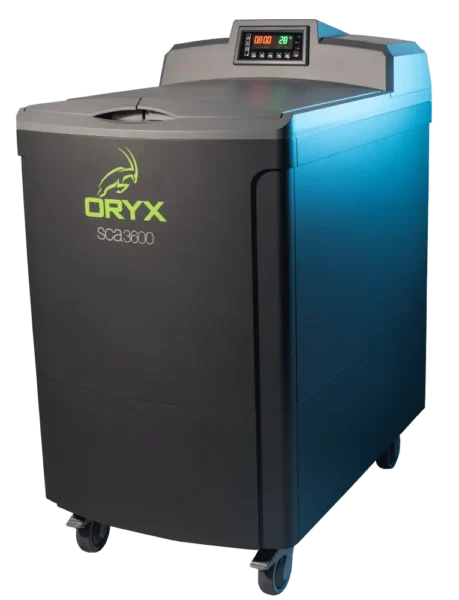
Industrial, high-throughput station that removes dissolvable support material from large or many FDM and PolyJet 3D-printed parts in a heated, agitated water-detergent bath — no IPA, no hand-picking.
- ✓ 102 L heated tank · 16×16×14 in basket · No-Heat mode for PolyJet
- ✓ Automated soluble-support removal for FDM & PolyJet, on a rolling cart
- ✓ US-built · CE / cTÜVus · 1-year warranty · quote for pricing
In stock
· US-built — ships from Additive Plus; lead time confirmed at quote. 1-year warranty, install guidance included.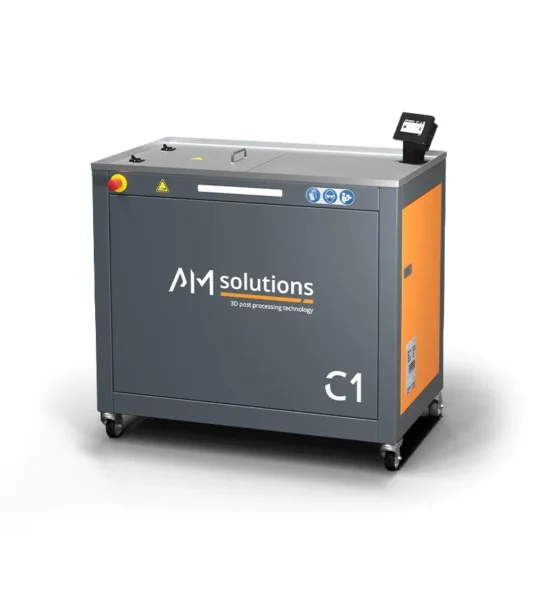
Benchtop automated system that removes support structures and cleans uncured resin from delicate photopolymer 3D-printed parts — a compound dip process with no IPA or critical solvents.
- ✓ Automated support removal + cleaning for SLA / DLP / PolyJet parts
- ✓ IPA-free compound · 230 V plug-and-play benchtop
- ✓ Lead time: 4–8 weeks — built to order · install + training included
Made to order
· Ships in 4–8 weeks — built to order. Install and operator training included.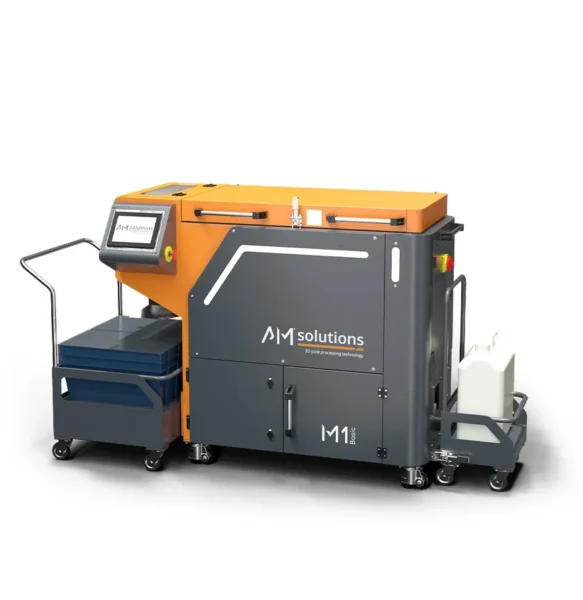
Entry-level automated vibratory finishing system that deburrs, smooths and cleans 3D-printed parts with a high-frequency processing bowl — a cost-effective way to bring finishing in-house.
- ✓ Automated deburr, smooth and clean for metal and plastic parts
- ✓ High-frequency 3,600 RPM bowl · quiet ≤78 dB(A)
- ✓ Lead time: 4–8 weeks — built to order · install + training included
- ✓ Starter consumable included — 25 L of finishing media, ready to run out of the box
Made to order
· Ships in 4–8 weeks — built to order. Install and operator training included.
Automated cleaning system for large SLA 3D-printed parts and build platforms — a compound immersion process that cleans and loosens supports without IPA or critical solvents.
- ✓ IPA-free cleaning of large SLA parts up to 750 × 750 × 550 mm
- ✓ Auto-cleans the build platform · loosens supports for easy removal
- ✓ Lead time: 4–8 weeks — built & configured to order
Made to order
· Ships in 4–8 weeks — built to order. Install and operator training included.
Entry-level automated vibratory (mass) finishing system for small 3D-printed metal and plastic parts up to 70×70×25 mm — 20 L work container, integrated 25 L closed-loop process-water tank, plug-and-play 230 V. Smoothing, deburring, polishing, and matt finishing for SLA, SLS, MJF, HSS, SAF, and SLM parts.
- ✓ Automated vibratory finishing — smoothing, deburring, polishing, and matt finish in one cycle
- ✓ Closed-loop 25 L process water — separates solids, no drain or fresh-water hookup, low running cost
- ✓ Lead time: 4–8 weeks — configured to order, installed and supported from California
Made to order
· Ships in 4–8 weeks — built to order.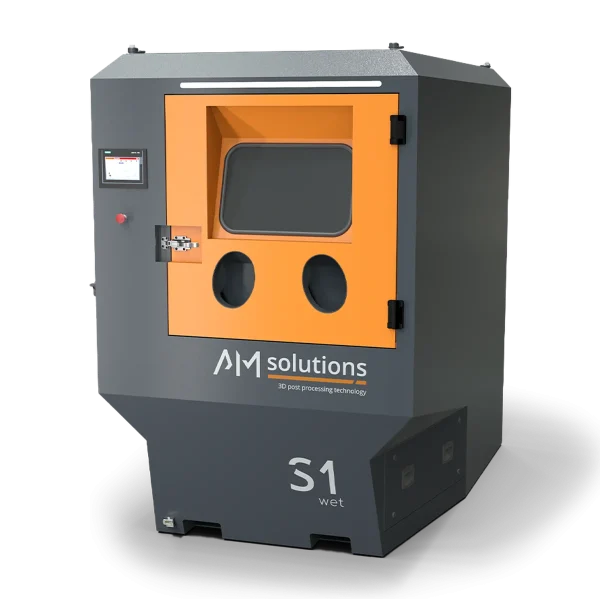
Automated wet-blasting cell that cleans and surface-finishes metal and polymer 3D-printed parts with a water-media slurry — dust-free, spark-free, no ATEX compliance needed.
- ✓ Wet blasting for metal LPBF parts + polymers — no dust, no ATEX
- ✓ PLC recipes, closed-loop water + media recycling
- ✓ Lead time: 4–8 weeks — built & configured to order
Made to order
· Ships in 4–8 weeks — built to order. Install and operator training included.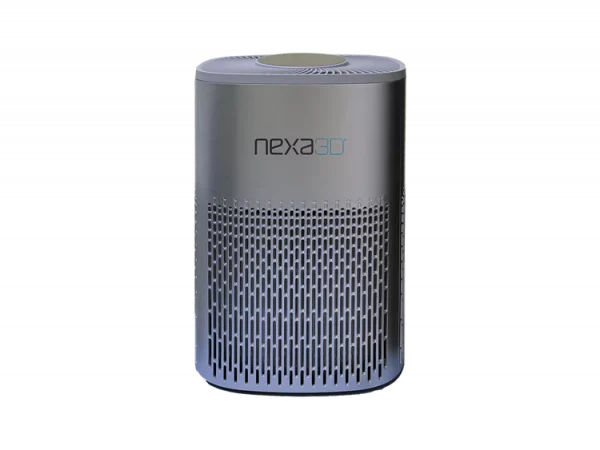
Bluetooth-enabled desktop air purifier built for resin 3D printing - a HEPA stage plus a carbon stage carrying roughly 5× the activated carbon of a comparable unit, to pull resin odour and VOCs out of the room.
- ✓ Two-stage HEPA + activated-carbon filtration
- ✓ Sits on the bench - no ducting or extraction hookup
- ✓ In US stock - ships in 2 business days
Available in the United States and Canada only.
In stock
· 2 Business Days
Enclosed pressurized-waterjet spray booth for fast, targeted support-material removal on 3D-printed parts — manual dual-pressure wands, no heat and no detergent, cleaning in minutes.
- ✓ Dual-pressure waterjet wands up to 1700 psi — bulk and fine detail
- ✓ No heat, no detergent, no plumbing required — mobile or direct-plumb
- ✓ US-built · CE / cTÜVus · 1-year warranty · quote for pricing
In stock
· US-built — ships from Additive Plus; lead time confirmed at quote. 1-year warranty, setup guidance included.What our customers say
“Harry and team were professional, effective communicators as we set up the order, then they executed quickly and produced an amazing product for us at a very competitive price. Am looking forward to our next print w Additive Plus!”
“Great 3D printing service and the resin parts look super smooth and clean. Really happy with how everything turned out!”
“Harry was very professional and helped me out with my 3D printing needs and explained what options I have in terms of filaments such as PEEK. Highly recommended.”
“I needed a 3D enclosure printed urgently in a specific time period, they did great!”
Common questions
Don't see yours? Email [email protected] — NDA on request, typical reply within 4 hours.
What is the APSX-PIM V3 Desktop Injection Molding Machine?
What materials can the APSX-PIM V3 process?
What is the maximum clamping force?
What is the injection capacity?
Is the APSX-PIM V3 fully automatic?
What types of molds are compatible with the APSX-PIM V3?
Can I use standard plastic pellets?
Does the machine require special electrical service?
How long does it take to change molds?
Who should use the APSX-PIM V3?
What applications is the APSX-PIM V3 best suited for?
Can I produce end-use parts with this machine?
How does the APSX-PIM V3 compare to industrial injection molding machines?
Is this machine suitable for educational programs?
Can Additive Plus help with mold design?
Place your order, or talk to an engineer first
Order APSX-PIM V3 Desktop Injection Molding Machine – 5-Ton Clamp | 30 cc Shot | Engineering Resins direct, or talk to materials engineer