
Pellet extrusion 3D printing feeds a machine the same raw granulate an injection moulder buys, and that single change to the feedstock is what makes printing a two-metre part economically sensible. The process is also called fused granulate fabrication, or FGF, and at the top end of the size range it is the basis of large format additive manufacturing. The machines that run it are collected under pellet plastic 3D printers and LFAM 3D printers.
This guide covers what the process actually does differently from filament printing, the four machine classes you can buy, the material side, and the honest limits — because the finish is not the reason anyone chooses it.
What pellet extrusion 3D printing changes
A filament printer melts a precision-ground 1.75 or 2.85 mm strand. A pellet machine runs a proper single-screw extruder: granulate falls from a hopper into a heated barrel, a screw plasticises and meters it, and the melt leaves through a nozzle that is typically 2 to 8 mm rather than 0.4 mm. Everything downstream follows from that.
Two numbers explain why anyone bothers:
- Feedstock cost. Engineering-grade pellets commonly cost five to ten times less per kilogram than the same polymer drawn into filament, because filament carries an extra extrusion, spooling and tolerance-control step. On a 40 kg part that difference decides the project.
- Deposition rate. An industrial pellet head puts down roughly 2 to 20 kg per hour depending on screw size, against roughly 50 to 150 grams per hour from a conventional filament nozzle. Parts that would take weeks on filament finish in a shift.
The trade you are making. You buy throughput and feedstock economics, and you pay in surface finish and resolution. A 4 mm bead leaves visible layers and a wall you cannot hold to a tight tolerance as-printed. Plan on machining the surfaces that matter.
The four machine classes
Pellet machines split cleanly by build envelope and by whether the machine can also cut.
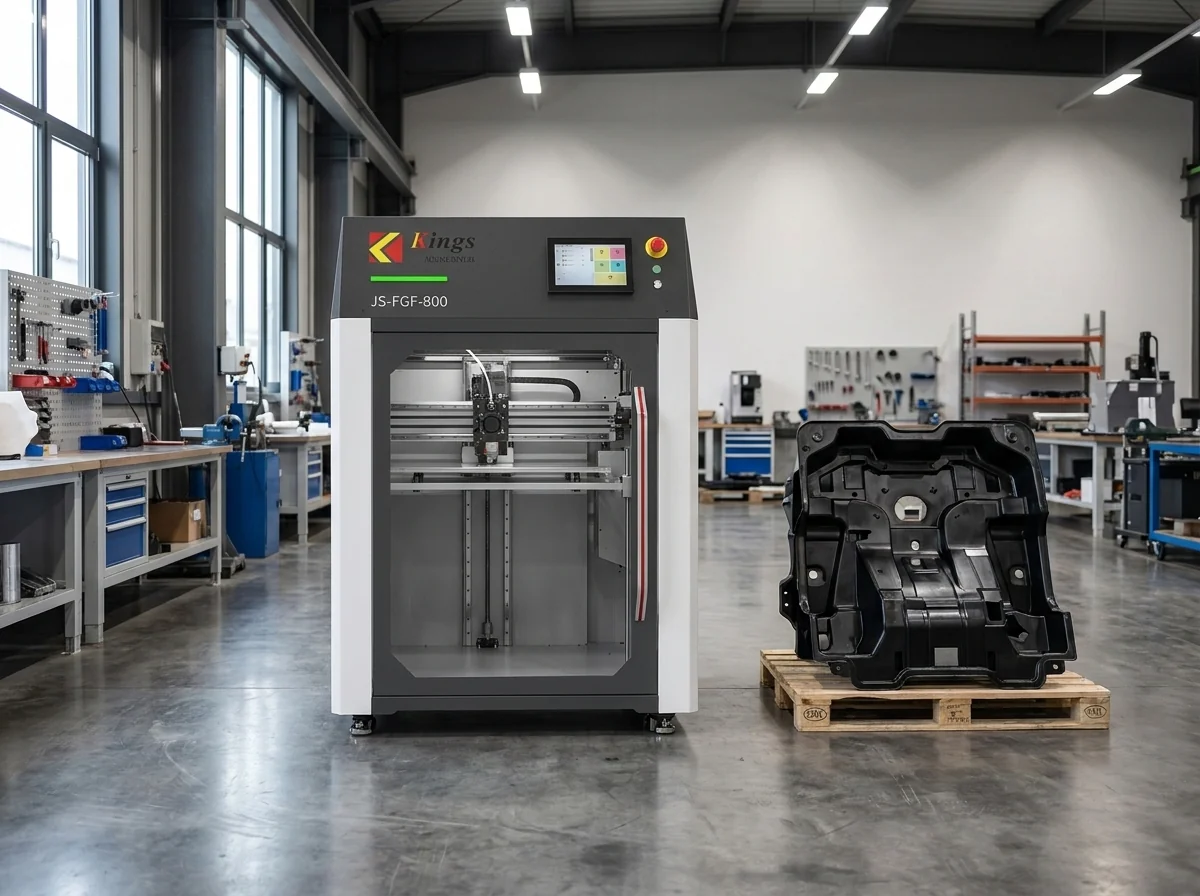
| Class | Typical envelope | What it is for | Example |
|---|---|---|---|
| Enclosed gantry, compact | ~800 × 600 × 800 mm | Jigs, fixtures, short-run parts, learning the process | Kings FGF800 |
| Enclosed gantry, large | ~1800 × 1200 × 1100 mm | Tooling, patterns, architectural and display work | Kings FGF1800 |
| Hybrid additive + subtractive | ~2400 × 2000 × 1350 mm and up | Print and machine in one setup, no re-fixturing | Kings FGF2400, Kings FGF-2435 5-axis |
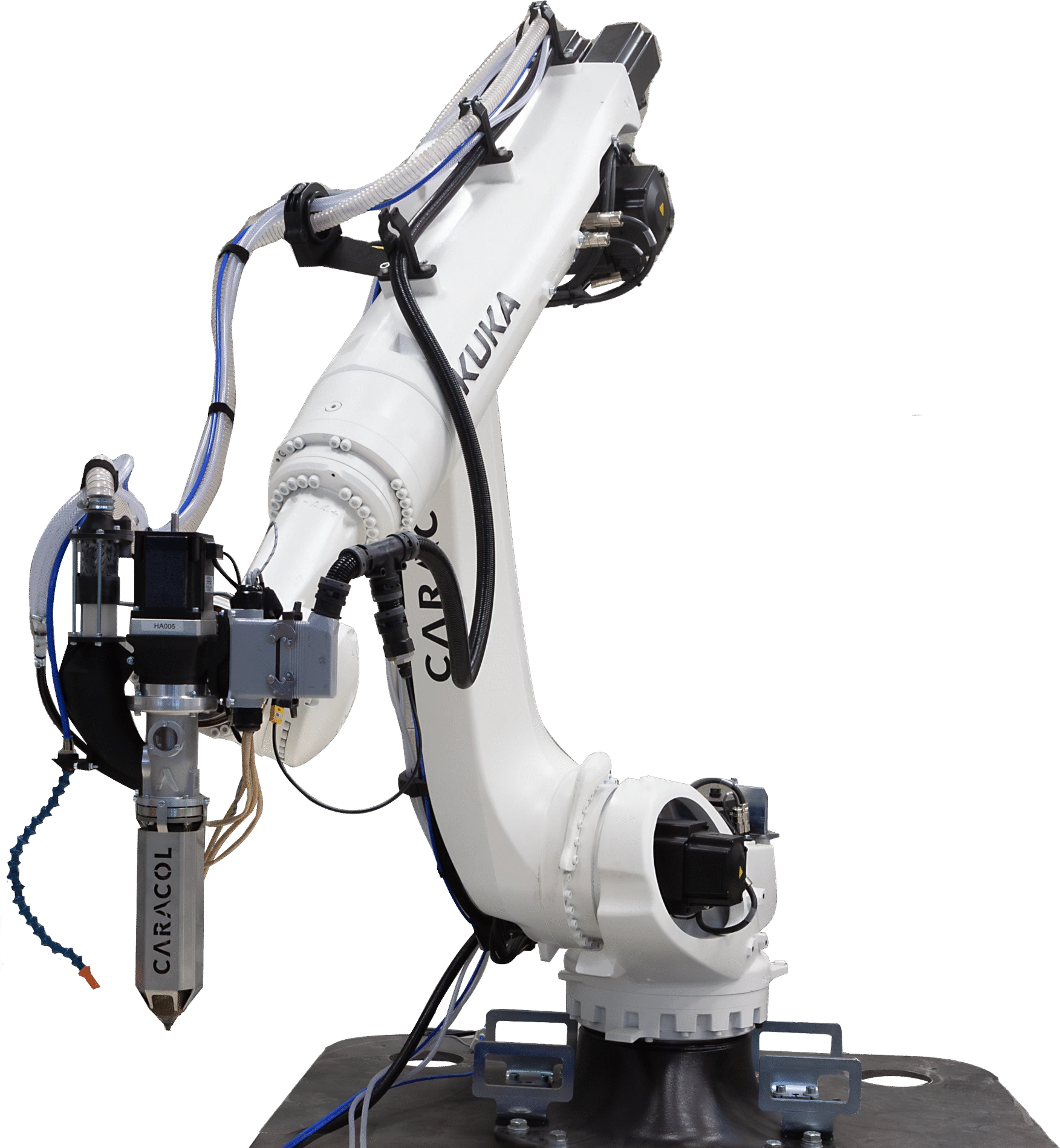
| Robotic arm LFAM | Defined by the robot cell, not a box | Very large parts, non-planar and multi-axis deposition | Heron AM HF, HA, HV |
The hybrid class deserves a note. Because almost every LFAM part gets machined anyway, a machine that prints and then mills without releasing the part removes a fixturing operation and the error that comes with it. That is the practical argument for the additive-plus-subtractive layout rather than a separate CNC downstream.
Materials: what goes in the hopper
Pellet machines run standard thermoplastic granulate, which opens the materials list well beyond what is sold as filament. The grades that matter in practice are the fibre-reinforced ones.
- ABS and ASA — the workhorses. ASA holds up outdoors where ABS yellows and embrittles. Both are usually bought glass-filled for LFAM: Caracol ABS, Caracol ASA.
- PA6 with glass fibre — structural parts and tooling that sees load. Hygroscopic, so drying is not optional: Caracol PA6.
- PC — higher service temperature, used for tooling that goes near a cure cycle: Caracol PC.
- PP, PET-G, PLA, TPE — chemical resistance, easy printing, display work and flexible parts respectively. The full range sits under LFAM materials and FGF materials.
Short glass or carbon fibre at 20 to 30 percent by weight is close to standard in large-format work, and not mainly for stiffness. Fibre cuts the coefficient of thermal expansion, and on a part measured in metres thermal contraction is what pulls a build off the bed and opens layer cracks. The reinforcement is there to keep the part dimensionally honest while it cools.
Drying carries over from filament printing and gets stricter, because a pellet machine consumes kilograms per hour. Wet granulate gives you steam in the melt, porosity in the bead and weak layer bonds. PA6 and PC need a dryer sized for the throughput, not a small desiccant box.
Designing for the bead
The bead, not the nozzle, is the design unit. A 6 mm nozzle laying a 2 mm layer produces a bead roughly 8 to 10 mm wide, and that sets the rules.
- Wall thickness in whole beads. Design walls as one, two or three bead widths. A wall that lands at 1.5 beads prints badly.
- Machining stock. Leave 3 to 5 mm on any surface that will be sealed, bolted or referenced. As-printed LFAM surfaces are not finished surfaces.
- Avoid unsupported overhangs. Large beads sag. Keep overhangs conservative or re-orient; on a robotic cell, use the extra axes instead of support material.
- Watch the cooling gradient. Large flat areas laid straight onto the bed are where warping starts. Break them up or add ribs.
Where pellet extrusion earns its place
- Tooling and moulds — layup tools, trim fixtures and vacuum-forming tools, printed in days from granulate instead of milled from billet or board stock.
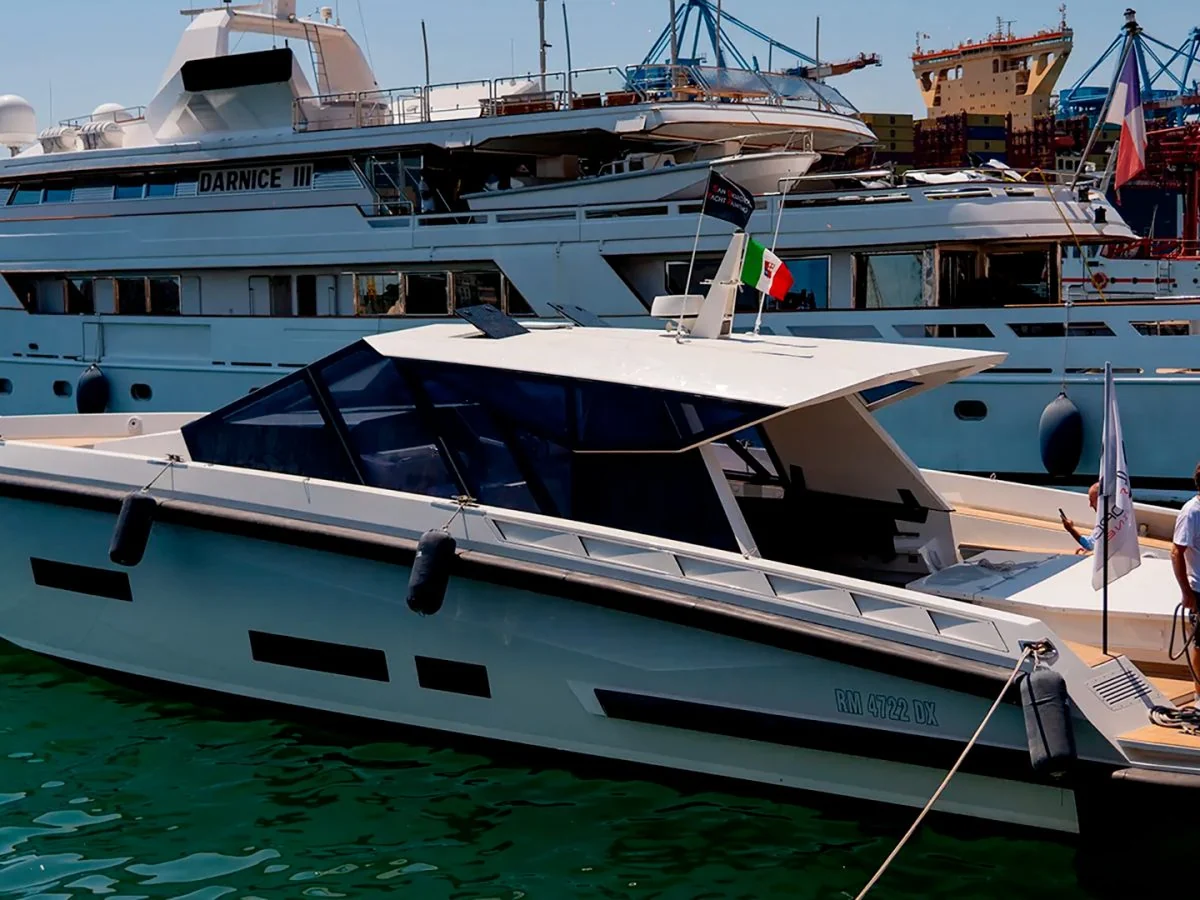
- Marine — hulls, plugs and deck hardware at a scale no filament machine reaches.
- Automotive and industrial — jigs, checking fixtures, assembly aids, and low-volume body and interior parts.
- Architecture, retail and furniture — facade elements, installations and one-off pieces where the bead texture is the aesthetic rather than a defect.
- Foundry patterns — large patterns and core boxes, printed and then machined to the tolerance the foundry needs.
When it is the wrong process
Pellet extrusion is not a finer FDM. If the part is smaller than a shoebox, needs tolerances tighter than a millimetre as-printed, or has fine detail and thin features, a filament or resin machine will do it better and cheaper. The process starts making sense somewhere around the point where a filament build would run past a day, and it becomes obvious past a metre.
It is also a shop-floor process rather than an office one. The machines are large, they need dried feedstock in bulk, they generate swarf once you start machining, and the parts need handling equipment. Budget for the cell, not only the machine. The wider context of the size class is covered in our guide to LFAM 3D printing.
Sourcing pellet and FGF systems through Additive Plus
We supply the enclosed gantry Kings FGF range, the hybrid additive-and-subtractive machines, and the Caracol Heron AM robotic cells, along with the granulate to run them. Configuration matters more here than on a desktop machine — screw size, nozzle set, chamber and cell layout all follow from the parts you intend to make, so machine quotes are built per application rather than from a price list. If you want the parts without the capital spend, FGF 3D printing services runs the builds for you from our Californian facility.
Send the largest part you expect to print and the material you have in mind, and we will come back with the machine class that fits and the throughput it gives you.
Printers: Kings FGF800 ·
Kings FGF1800 ·
Kings FGF2400 ·
Heron AM HF ·
All LFAM printers
Materials: LFAM pellets ·
FGF materials
Frequently asked questions
What is pellet extrusion 3D printing?
Pellet extrusion 3D printing, also called fused granulate fabrication or FGF, feeds thermoplastic granulate into a heated single-screw extruder instead of melting a filament. The nozzle is typically 2 to 8 mm rather than 0.4 mm, so an industrial head deposits roughly 2 to 20 kg per hour against roughly 50 to 150 grams per hour from a filament nozzle.
How much cheaper are pellets than filament?
Engineering-grade pellets commonly cost five to ten times less per kilogram than the same polymer sold as filament, because filament carries an additional extrusion, spooling and tolerance-control step. On parts measured in tens of kilograms that difference usually decides whether the project is viable.
What is the difference between FGF and LFAM?
FGF, or fused granulate fabrication, names the process — extruding thermoplastic pellets. LFAM, large format additive manufacturing, names the size class of machine that usually runs it, from enclosed gantries of about 1.8 metres up to robotic arm cells with no fixed build box. Every LFAM machine is an FGF machine, but a compact 800 mm pellet printer is FGF without being large format.
Why is glass or carbon fibre added to LFAM pellets?
Short fibre at 20 to 30 percent by weight lowers the coefficient of thermal expansion, which is the main cause of warping and layer cracking on parts measured in metres. The stiffness increase is useful, but dimensional stability during cooling is the reason the reinforcement is close to standard in large-format work.
Have a question or a project? Let’s talk.
Tell us what you need — a real applications engineer replies within 24 hours. NDA standard, no sales script.