
In stock
- Installation & training on-site setup, gas connection and operator onboarding
- Method + calibration a hydrogen SOP set up on your alloys
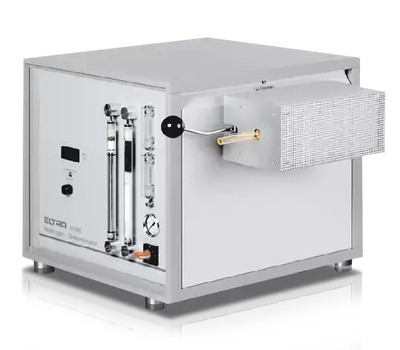
ELTRA H-500 Hydrogen Analyzer – Hot Extraction + TCD | Steel, Copper & Alloys
Analyzer for hydrogen in metals by hot extraction — the solid sample drops into a tilting furnace at 900–1,000 °C, and a nitrogen carrier sweeps the diffused hydrogen into a high-capacity thermal conductivity cell in 3–15 minutes.
- ✔ Residual / diffusible hydrogen · hot extraction · precise at low levels
- ✔ Tilting furnace 900–1,000 °C · high-capacity thermal conductivity cell
- ✔ Solid samples up to ø13×60 mm / 10 g · minimal prep
- ✔ Lead time: configured to order — request current timeline
What your QC lab actually checks
Residual hydrogen in metals
Hot extraction below the melting point releases residual and diffusible hydrogen from steel, copper and alloys, and a high-capacity thermal conductivity cell measures it precisely even at low concentrations. This is the hydrogen number that governs embrittlement, cracking and porosity — a routine 3–15 minute determination on solid samples up to 10 g, with minimal preparation.
An applications engineer on the line
Extraction temperature, calibration and blank control from engineers who run metal additive manufacturing in-house (AO Metal). Sub-4h reply, NDA on request.
The ELTRA H-500 determines hydrogen in metals by hot extraction. The solid sample is placed in the cold zone of a horizontal, tilting furnace; when the analysis starts, the furnace rotates so the sample falls into the hot zone (operating 900–1,000 °C), and a nitrogen carrier sweeps the diffused hydrogen into a high-capacity thermal conductivity cell. It handles samples up to ø13×60 mm (up to 10 g), resolves low hydrogen concentrations precisely, and runs an analysis in about 3–15 minutes.
Why metallurgy and QC labs choose the H-500
Residual and diffusible hydrogen in metals — precise, low-maintenance, production-ready.
Hydrogen by hot extraction
The heat-extraction technique determines residual and diffusible hydrogen below the melting point — the number that governs embrittlement and cracking in steel, copper and alloys.
High-capacity TCD
A sensitive, high-capacity thermal conductivity cell gives precise measurements even at low hydrogen concentrations, where embrittlement risk is decided.
Large solid samples
Analyze solid parts up to ø13×60 mm and up to 10 g directly — representative pieces, minimal preparation, no dissolving or fusing.
Low maintenance, easy calibration
Easy calibration with standard materials or a gas dose, multilingual software and easily accessible filters and chemicals — robust for lab and production control.
How Additive Plus supports it
A configured, installed analyzer with a hydrogen method dialed in on your alloys.
Configure to your samples
We set the furnace temperature, extraction time and calibration standards to your alloy and hydrogen range before it ships.
Install & train
Factory-trained engineers install the analyzer, connect the nitrogen and PC/balance, and train your team on extraction and analysis.
Method & QC support
We help build the SOP — calibration with standards or gas dose, blank control and a repeatable hydrogen baseline.
What the H-500 measures
Full technical specifications are in the Specifications tab. Key measurement capability:
| Parameter | H-500 |
|---|---|
| Measured element | Hydrogen (residual / diffusible, hot extraction) |
| Principle | Hot extraction in a tilting resistance furnace (900–1,000 °C) + thermal conductivity detection |
| Carrier gas | Nitrogen 99.995 % (2–4 bar) |
| Sample size | Solid samples up to ø13×60 mm · up to 10 g |
| Analysis time | ~3–15 minutes |
| Requirements | PC, monitor, 0.0001 g balance · 230 V, max 450 W |
Typical sample materials
Where residual hydrogen in metals has to be controlled.
Not sure the H-500 is the right analyzer?
Compare with ELTRA fusion analyzers for total O/N/H in our catalog.
O + N + HELEMENTRAC ONH-p 2View analyzer →
O + N by fusionELEMENTRAC ON-p 2View analyzer →
Why source the H-500 through Additive Plus
- Authorized channel for ELTRA / Verder Scientific lab equipment — sales, installation, training and service in one place.
- Configured to your samples — furnace temperature, extraction time and calibration specified before shipping.
- Method development on your alloys — calibration, blank control and a repeatable hydrogen SOP; relevant to metal AM QC.
- <24h response from engineers who run metal additive manufacturing in-house (AO Metal). NDA on request.
| Brand | ELTRA |
| Model | H-500 |
| Measured elements | hydrogen |
| Furnace alignment | horizontal / tilting function |
| Sample carrier | - |
| Field of application | engineering / electronics, glass / ceramics, steel / metallurgy |
| Furnace | resistance furnace with quartz tube, adjustable up to 1000 °C (operating temperature 900 - 1000 °C) |
| Detection method | thermal conductivity |
| Maximum sample size | ø 13 x 60 mm |
| Typical analysis time | 3 - 15 min |
| Chemicals required | Schuetze reagents, magnesium perchlorate, sodium hydroxide |
| Gas required | nitrogen 99.995 % pure (2 - 4 bar / 30 - 60 psi) |
| Power requirements | 230 V, 50/60 Hz, 2 A, max. 450 W |
| Dimensions (W x H x D) | 750 x 520 x 600 mm / 29.53 x 20.47 x 23.62 in |
| Weight | ~ 40 kg |
| Required equipment | PC, monitor, balance (resolution 0.0001g) |
| Optional accessories | voltage stabilizer 5 KVA |
Product videos
Other products teams run alongside ELTRA H-500 Hydrogen Analyzer – Hot Extraction + TCD | Steel, Copper & Alloys
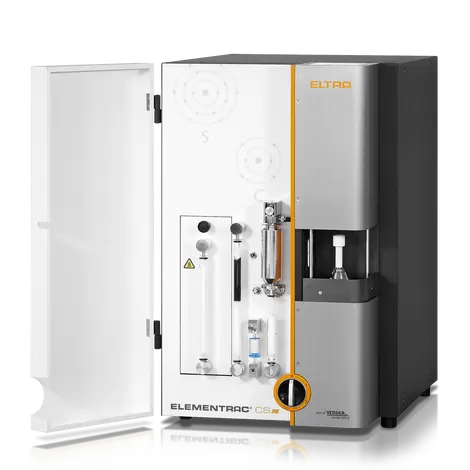
Induction-furnace analyzer for carbon and sulfur in inorganic samples and metals — combustion above 2,000 °C with up to four infrared cells covering 0.6 ppm to more than 6 % at 1,000 mg, in about 40 seconds.
- ✔ Induction furnace > 2,000 °C · single or simultaneous C/S · metals & inorganics
- ✔ 0.6 ppm to 6 %+ · up to 4 IR cells · heated dust trap · Pt catalyst
- ✔ ~40 s analysis · optional 36/130-position autoloader · TIC module
- ✔ Lead time: configured to order — request current timeline
In stock
· Lead time: configured to order — request current timeline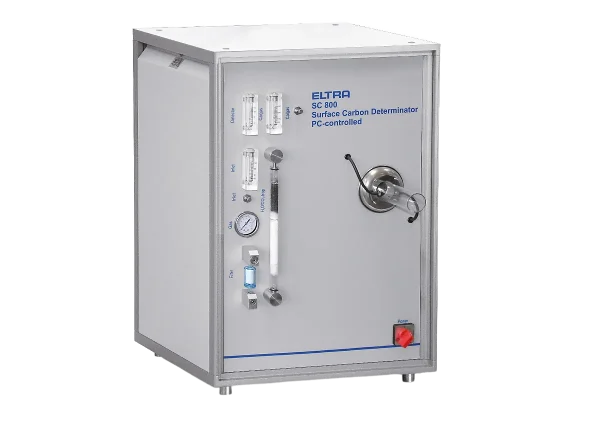
Dedicated surface-carbon analyzer for solid samples — combustion in a resistance furnace up to 1,000 °C with infrared CO₂ detection, from trace level to 1,000 µg/cm² in 60–90 seconds.
- ✔ Surface carbon: trace–1,000 µg/cm² · 60–90 s per analysis
- ✔ Resistance furnace to 1,000 °C · solid-state IR cells (1–2)
- ✔ Large samples up to 32×145 mm · minimal prep · gold IR path option
- ✔ Lead time: configured to order — request current timeline
Made to order
· Lead time: configured to order — request current timeline
Multi-ramp version of the CW-800 for simultaneous carbon dioxide and water — up to five programmable temperature steps release and resolve TOC/TIC and water fractions without adding acids, measured by infrared cells.
- ✔ CO₂ + water · TOC / TIC without acids · fraction "chromatogram"
- ✔ Up to 5 programmable ramps · resistance furnace to 1,000 °C · 1–2 IR cells
- ✔ Nitrogen & oxygen carrier · gold IR path · no halogen trap
- ✔ Lead time: configured to order — request current timeline
In stock
· Lead time: configured to order — request current timeline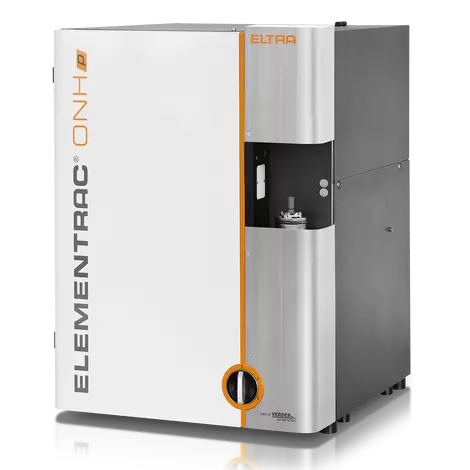
Inert-gas-fusion analyzer for oxygen, nitrogen and hydrogen in metals — the sample melts in a graphite crucible in an 8.5 kW impulse furnace above 3,000 °C, with IR detection of oxygen and thermal conductivity for nitrogen and hydrogen.
- ✔ O / N / H by fusion · single or ON / OH / NH / ONH · inorganic samples
- ✔ 8.5 kW impulse furnace > 3,000 °C · closed gas system · low detection limits
- ✔ Up to 2000 mg · 32-position autoloader · Autocleaner · argon possible
- ✔ Lead time: configured to order — request current timeline
In stock
· Lead time: configured to order — request current timeline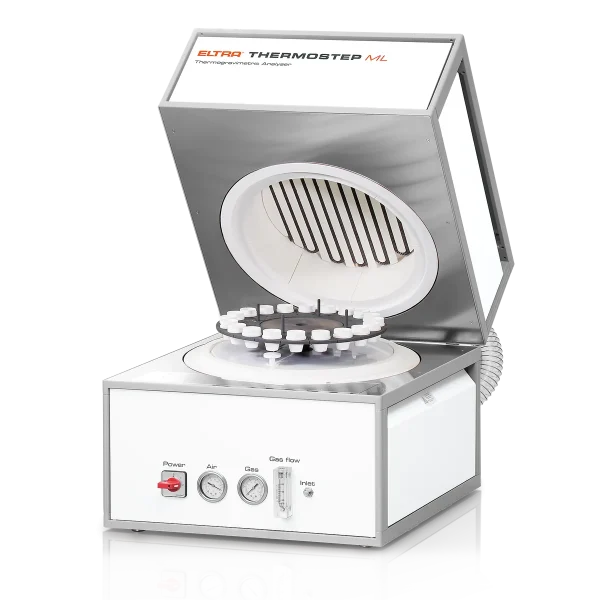
Manual-lid thermogravimetric analyzer — programmable furnace plus integrated balance measures moisture, ash and volatiles in up to 19 samples per run, 50–1,000 °C. A more economical route to standard-compliant TGA.
- ✔ 19 samples + 1 reference · 500 mg–5 g · moisture/ash/volatiles in one run
- ✔ Ceramic furnace 50–1,000 °C · N₂/O₂/air per stage · manual crucible lids
- ✔ Encapsulated balance 0.1 mg · ASTM D 7582 compliant
- ✔ Lead time: configured to order — request current timeline
Made to order
· Lead time: configured to order — request current timeline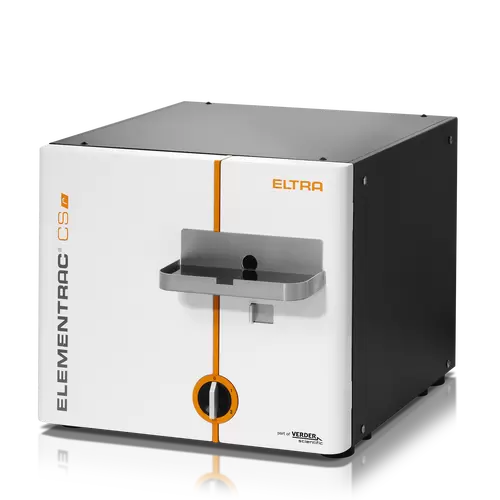
Resistance-furnace analyzer for fast, simultaneous carbon and sulfur in organic matrices — combustion up to 1,550 °C with up to four solid-gold infrared cells over 20 ppm to 100 %, and an optimized low-blank sample port for reliable low-carbon analysis.
- ✔ Simultaneous C/S · 20 ppm–100 % · high sample weights
- ✔ Resistance furnace to 1,550 °C (1 °C steps) · up to 4 solid-gold IR cells
- ✔ Low-blank sample port · dual-furnace option · TIC module (DIN EN 15936)
- ✔ Lead time: configured to order — request current timeline
In stock
· Lead time: configured to order — request current timeline
Inert-gas-fusion analyzer for oxygen and nitrogen in metals — the sample melts in a graphite crucible in an 8.5 kW impulse furnace above 3,000 °C, with IR detection of oxygen and thermal conductivity for nitrogen.
- ✔ O / N by fusion · single or combined ON · inorganic samples
- ✔ 8.5 kW impulse furnace > 3,000 °C · closed gas system · low detection limits
- ✔ Up to 2000 mg · argon carrier possible · Autocleaner option
- ✔ Lead time: configured to order — request current timeline
In stock
· Lead time: configured to order — request current timeline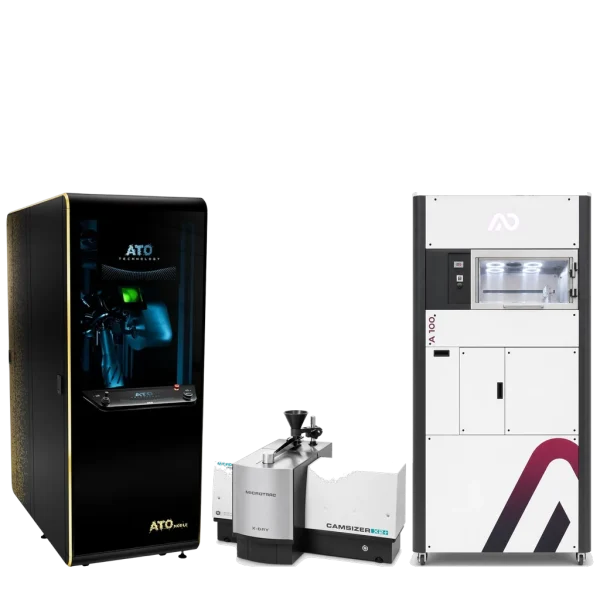
Make your own gold, silver and platinum powder, measure it and print it — the ATO Noble, the Microtrac CAMSIZER X2+ and the AO Metal A100 as one precious-metal cell from one supplier.
- ATO Noble: Au 9 ct to 99.99%, Ag, Pt, Pd, Ir with Zero Loss recovery
- CAMSIZER X2+: size and shape from 0.9 µm to 8 mm in 1–3 minutes
- A100: Ø100 × 100 mm LPBF, optional blue laser for gold and silver
- Installation and training included · 8–14 weeks · 12-month warranty
Made to order
· Lead time 8–14 weeks · installation includedWhat our customers say
“Harry and team were professional, effective communicators as we set up the order, then they executed quickly and produced an amazing product for us at a very competitive price. Am looking forward to our next print w Additive Plus!”
“Great 3D printing service and the resin parts look super smooth and clean. Really happy with how everything turned out!”
“Harry was very professional and helped me out with my 3D printing needs and explained what options I have in terms of filaments such as PEEK. Highly recommended.”
“I needed a 3D enclosure printed urgently in a specific time period, they did great!”
Common questions
Don't see yours? Email [email protected] — NDA on request, typical reply within 4 hours.
What does the ELTRA H-500 measure?
How does the measurement work?
How is hot extraction different from fusion analysis?
What sample sizes can the H-500 handle?
How is the H-500 calibrated and maintained?
Is the H-500 useful for metal additive manufacturing QC?
What is the lead time, and can Additive Plus set it up?
Place your order, or talk to an engineer first
Order ELTRA H-500 Hydrogen Analyzer – Hot Extraction + TCD | Steel, Copper & Alloys direct, or talk to materials engineer