
Industrial DLP and LCD resins are not interchangeable — the right one depends on what the part has to survive. Here is how to choose between high-temperature, tough, rigid, ESD, high-resolution and dental grades, with a straight requirement-to-resin map.
Photopolymer 3D printing has moved well past prototyping. On DLP and LCD systems you can now print tooling that injection-molds PEEK, functional parts that take impact, and static-safe fixtures for electronics. The catch is that no single resin does all of it well. Choosing an industrial resin starts with the requirement, not the datasheet.
Start with the requirement, not the resin
Decide what the part must do first, then pick the material that hits it. The four questions that settle most decisions are: How hot? How hard a knock? How stiff? Any special property (static-safe, fine detail, dental, or a dissolvable mold)? The table below maps each requirement to a grade in the ALTANA Cubic Ink line.
| Your requirement | Reach for | Why |
|---|---|---|
| High heat (tooling, under-hood, steam) | High Temperature 1901 VP | HDT-B 272 °C, Tg > 300 °C, tough not brittle |
| Impact & handling (functional parts) | Tough 2100 VP | 36 J/m notched Izod, 12% elongation, fast print |
| Durable, scratch-resistant end-use parts | High Performance 4-4800 VP | HDT-B 90 °C, scratch-resistant, cytotoxicity passed |
| Stiff, heat- & chemical-resistant industrial parts | Rigid 2000 VP | 92 MPa, 3600 MPa modulus, HDT-B 122 °C |
| Affordable everyday prototyping | Rigid 1600 VP | Rigid, precise, lower cost per kg |
| Fine detail / high resolution | Rigid 300 VP High Resolution | Ultra-thin layers, crisp XY detail |
| Static-safe electronics parts | High Performance 4-2800 VP-ESD | Dissipative 5.5×10⁷ Ω·cm, tough |
| Dental models (aligner thermoforming) | Dental 3000 VP | High detail, thermoform-ready, made in USA |
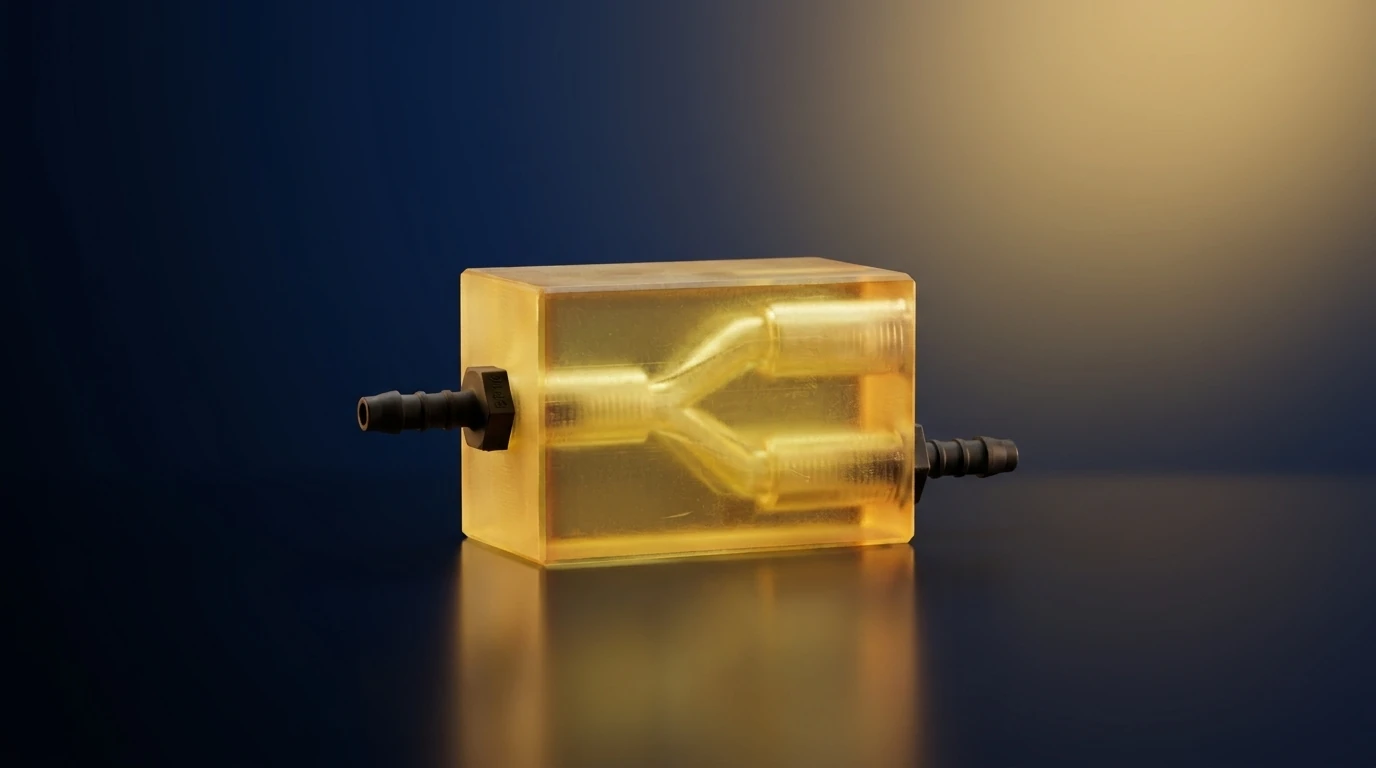
| Injection or casting mould (short run) | Mold 400 VP | Water-breakable, handles PEEK/PPS/GF for one shot |
Heat resistance
Heat is where cheap resins fail first. If parts see molten-material contact, steam or sustained high temperature, High Temperature 1901 VP (HDT-B 272 °C) is the pick, and it stays tough enough to drill and machine. For long-term use around 120 °C with high stiffness, Rigid 2000 VP is the all-rounder.
Toughness and impact
Many rigid resins are strong but brittle. If a part gets handled, dropped or flexed, prioritise impact resistance: Tough 2100 VP for fast functional parts, or High Performance 4-4800 VP for durable, scratch-resistant, good-looking end-use parts.
Stiffness and detail
For dimensional stability under load, Rigid 2000 VP leads on modulus and HDT; Rigid 1600 VP is the affordable everyday choice; and when the geometry is fine and intricate, Rigid 300 VP High Resolution resolves the smallest features.
Special properties: ESD, dental, tooling
Some jobs need a specific property, not just good mechanics. For electronics handling, High Performance 4-2800 VP-ESD keeps parts in the static-dissipative range. For dental labs, Dental 3000 VP prints accurate, thermoform-ready models. And to make a part rather than buy a mould, Mold 400 VP prints a water-breakable injection or casting tool.
Switching from another brand? Several of these grades sit in the same application class as industrial resins you may already run, so the decision is a short technical comparison — heat, toughness, stiffness and price side by side — not a redesign.
Do not forget processing
The resin is half the result; the process is the other half. Match wash and post-cure to the grade — high-temperature materials, for example, reach full heat resistance only after a thermal post-cure — and confirm your printer’s wavelength (385 or 405 nm) and intensity. Every Cubic Ink grade ships with a processing guide, and validated settings exist for common Formlabs, Asiga, Prusa, Phrozen and Nexa systems.
Still not sure?
Tell us the part and the load case — temperature, impact, stiffness, ESD, detail, dental or tooling — and a materials engineer will point you to the right grade and help you dial in the print and post-cure. Sub-24h reply, NDA on request. A good place to start comparing specs and pricing is Rigid 2000 VP or the tooling-focused Mold 400 VP.
Frequently asked questions
How do I choose an industrial 3D printing resin?
Start from the load case — temperature, impact, stiffness and any special property such as ESD, fine detail, dental or a dissolvable mould — then pick the grade that meets it. Use the requirement-to-resin table in the article.
What is the most heat-resistant Cubic Ink resin?
High Temperature 1901 VP, with an HDT-B of 272 °C and a Tg above 300 °C, while staying tough enough to drill and machine.
Which resin is best for tough, impact-resistant parts?
Tough 2100 VP for fast functional parts (36 J/m notched Izod, 12% elongation), or High Performance 4-4800 VP for durable, scratch-resistant end-use parts.
Is there an ESD (static-safe) DLP resin?
Yes — High Performance 4-2800 VP-ESD is a tough, static-dissipative resin (volume resistivity 5.5×10^7 Ω·cm) for electronics fixtures and trays.
Have a question or a project? Let’s talk.
Tell us what you need — a real applications engineer replies within 24 hours. NDA on request, no sales script.