
Made to order
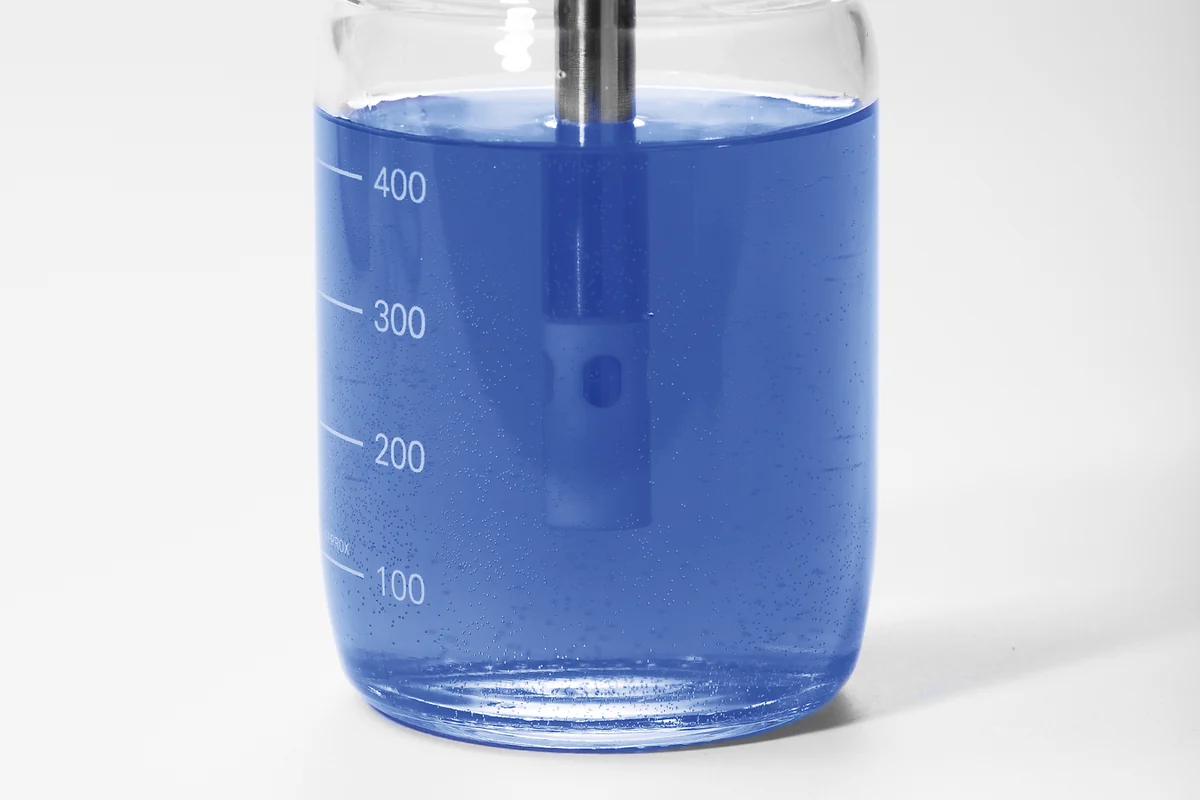
- Installation & training on-site setup and DIMENSIONS LS onboarding
- Method + sample run a nanoparticle size measurement on your own sample
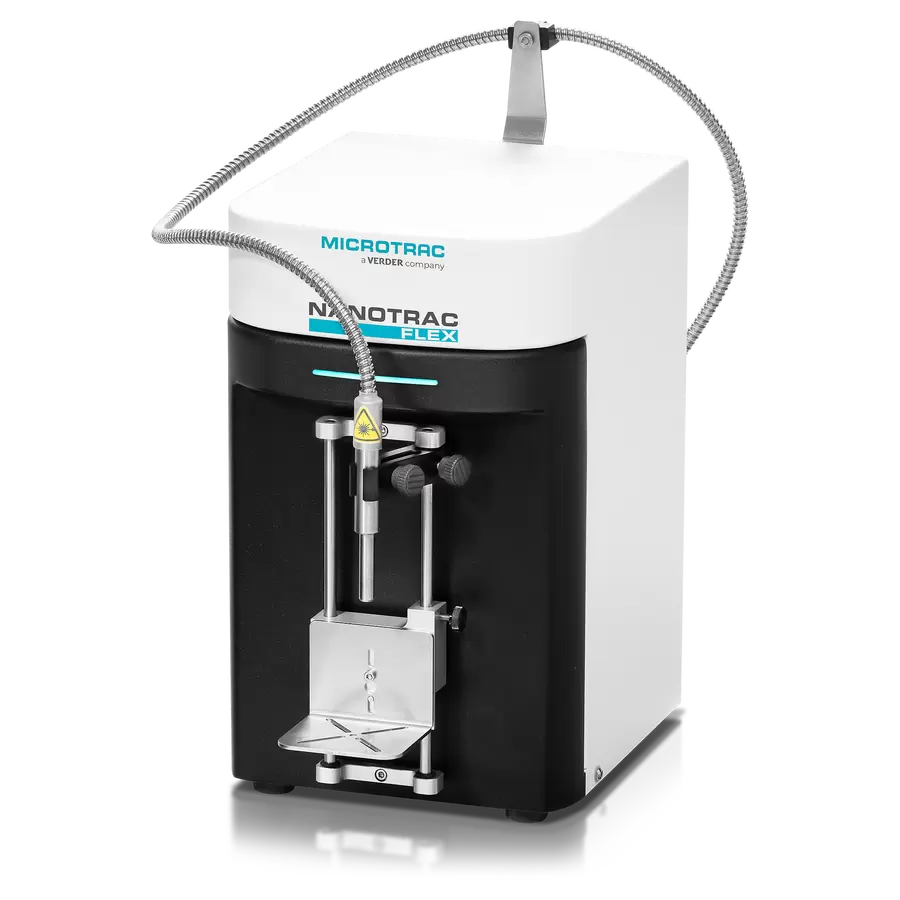
Microtrac NANOTRAC FLEX Dip-Probe DLS Nanoparticle Size Analyzer
Nanoparticle size from 0.3 nm to 10 µm with a dip-in DLS probe — any vessel, from one drop, up to 40 % concentration, at line or in line.
- Size, concentration and molecular weight in one measurement
- FlowGuard for stirred and flowing liquids · no cuvettes
- Installation and on-site training included · free test measurement
- Configured to order · lead time from 4 weeks
What your nano lab actually checks
Dip-and-measure DLS
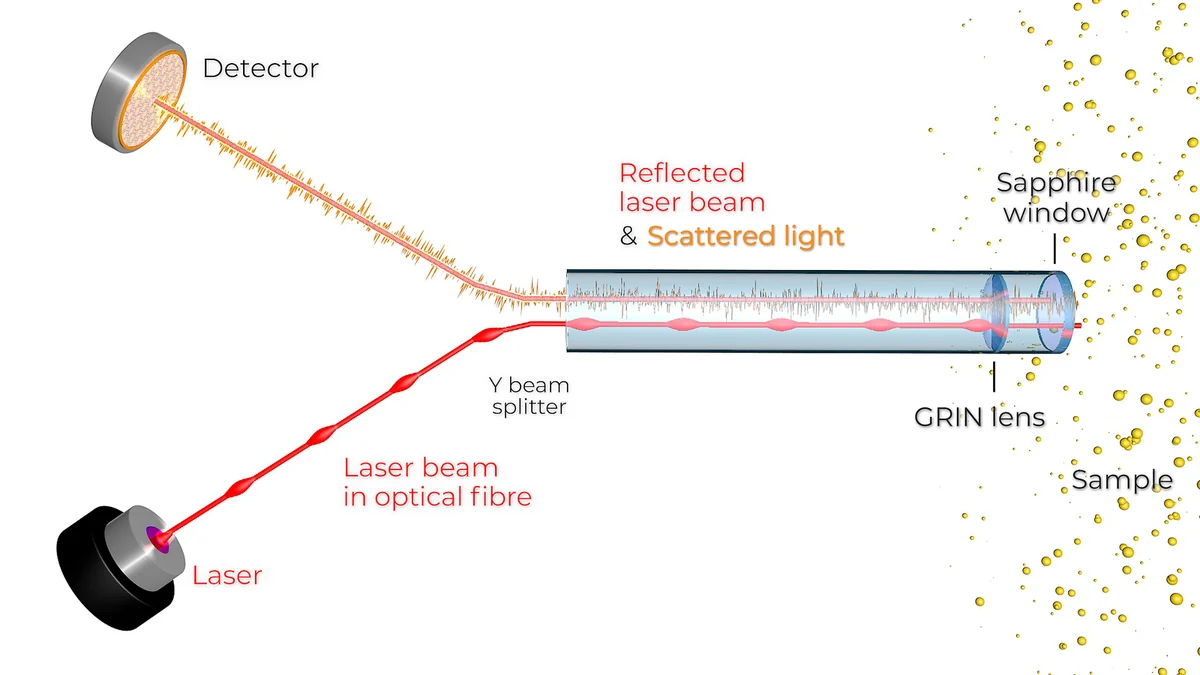
An external probe turns any vessel — down to one droplet — into a cell, with no cuvettes or consumables. Laser Amplified Detection and a Frequency Power Spectrum model size concentrated (up to 40%), multimodal and reacting samples with no a-priori assumptions and no dilution.
An applications engineer on the line
- NANOTRAC FLEX base unit with fixed external probe — 180° backscatter, 780 nm, 3 mW laser
- FlowGuard cap for measurements in stirred or flowing liquids, in reaction vessels or pipes
- DIMENSIONS LS software — five workspaces, multi-user, extensive data export
- Combination with the STABINO ZETA: the FLEX probe fits into its measuring cell
- Installation and on-site operator training — included in every quotation
What the NANOTRAC FLEX is
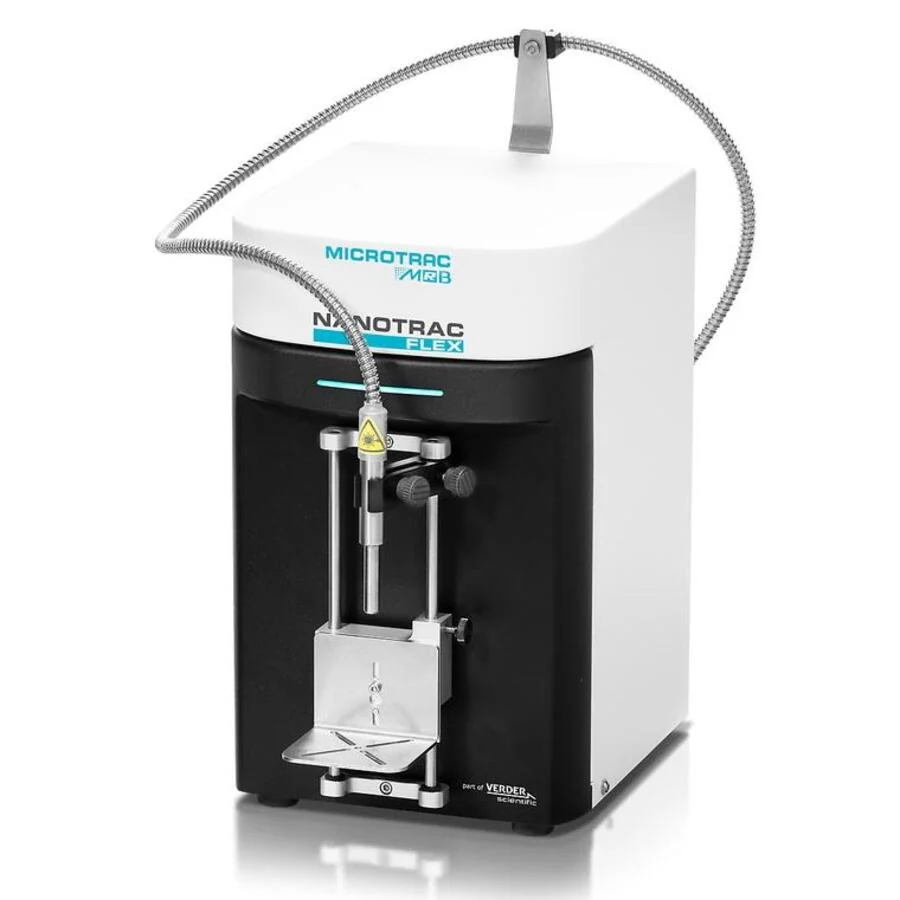
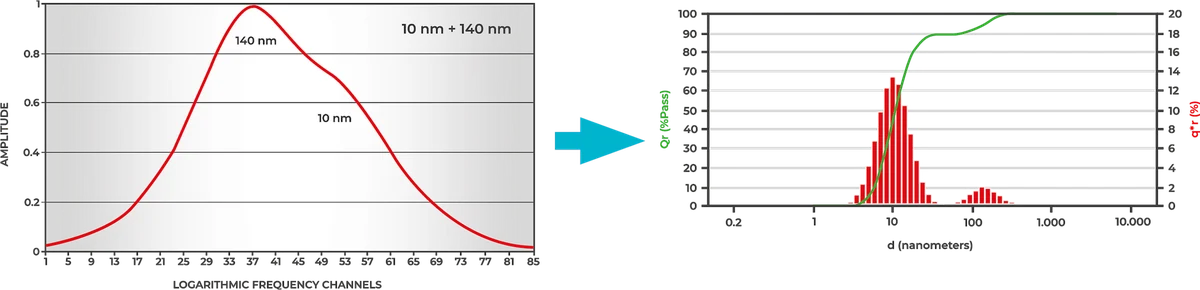
The NANOTRAC FLEX is a dynamic light scattering analyzer from Microtrac whose complete optical bench sits in an external probe. You bring the probe to the sample — a drop on its tip, a 1.5 mL Eppendorf tube, a beaker or a reaction vessel — so there are no cuvettes and no consumables. Laser light reflected at the probe’s sapphire window mixes with the light the particles scatter back at 180°. This Laser Amplified Detection gives up to 106 times the signal-to-noise ratio of photon correlation spectroscopy, and a frequency power spectrum calculation returns narrow, broad, mono- and multimodal distributions without prior knowledge of the sample. Besides particle size it reports concentration and molecular weight.
Specifications
| Method | backscattered laser-amplified scattering reference method |
| Calculation model | FFT power spectrum |
| Measurement angle | 180° |
| Measuring range | 0.3 nm – 10 µm |
| Sample cell | external probe (in situ) |
| Sample volume | one drop to any volume |
| Sample concentration | up to 40 % (sample dependent) |
| Concentration measurement | yes |
| Molecular weight range | <300 Da to 20 × 106 Da |
| Zeta potential | no — in combination with the STABINO ZETA |
| At line / in line measurement | yes |
| Temperature range | +4 to +90 °C, accuracy ±0.1 °C |
| Reproducibility (size) | ≤ 1 % |
| Carrier fluids | water, polar and non-polar organic solvents, acid and base |
| Laser | 780 nm, 3 mW |
| Humidity | 90 % non-condensing |
| Dimensions (W × H × D) | 180 × 300 × 260 mm (7.1 × 11.8 × 10.2 in) |
| Installation and training | on site, included in every quotation |
| Lead time | from 4 weeks, depending on configuration |
Download: NANOTRAC FLEX datasheet (PDF) · NANOTRAC series brochure (PDF)
What it tells you about a nanoparticle sample
One measurement at one angle, and several answers from it:
| Size distribution | narrow, broad, mono- or multimodal — with no cumulants, NNLS or CONTIN to choose |
| Growth during a reaction | particle size followed at line or in line, with the FlowGuard in stirred or flowing liquid |
| Molecular weight | by Debye plot; the second virial coefficient shows whether molecules tend to aggregate |
| Concentration | measured together with size |
| Contaminated samples | Laser Amplified Detection is unaffected by signal aberrations from contaminants, so samples need not be filtered first |
In a Microtrac application note the NANOTRAC FLEX measured dextran and polyethylene oxide at four concentrations and calculated molecular weights of 33,000 Da and 80,100 Da, with the mean diameter constant across the series.
In another, a FLEX probe inside a STABINO ZETA followed a CBD nanoemulsion from 330 nm down to 168 nm over five microfluidizer passes, then showed the size rising as the zeta potential reached zero during titration.
Three ways to measure
Where the NANOTRAC FLEX stops — and what to take instead
The NANOTRAC FLEX measures size, concentration and molecular weight — not zeta potential. For size and zeta potential in one benchtop instrument, take the NANOTRAC WAVE II; for charge titration, put the FLEX probe into a STABINO ZETA, which then measures size and charge in the same sample. In a stirred or flowing liquid you need the FlowGuard, because the motion of the liquid otherwise hides the Brownian motion DLS relies on. Above 10 µm, laser diffraction is the method — see the BLUEWAVE or the SYNC. To follow how a concentrated formulation separates over days, look at the TURBISCAN LAB.
In pictures
Availability, payment and delivery
Why buy it through Additive Plus
What usually stops people — and the honest answer
Ready when you are
| Brand | Microtrac |
| Country of origin | USA |
| Measurement principle | Backscattered laser-amplified scattering reference method |
| Measuring range | 0.3 nm - 10 µm |
| Calculation Model | FFT power spectrum |
| Measurement angle | 180° |
| Sample cell | External probe (in situ) |
| Zeta potential analysis | no |
| Molecular weight measurement | yes |
| Molecular weight range | <300 Da -> 20 x 10^6 Da |
| Temperature range | +4°C - +90°C |
| Temperature accuracy | ± 0.1°C |
| At line / in line measurement | yes |
| Reproducibility (size) | =< 1% |
| Sample volume size measurement | one drop – ∞ |
| Concentration measurement | yes |
| Sample concentration | up to 40 % (sample dependent) |
| Carrier fluids | Water, polar and unpolar organic solvents, acid and base |
| Laser | 780 nm, 3 mW |
| Humidity | 90 % non-condensing |
| Dimensions (W x H x D) | 7×11.8×10.2 in / 180×300×260 mm |
Product videos
We run this lab daily. Send a sample.
Send us a powder sample and we'll run PSD and morphology on the actual instrument, then share the data and method — so you see repeatability before you buy. We can also run analysis as a service while you evaluate.
Other products teams run alongside Microtrac NANOTRAC FLEX Dip-Probe DLS Nanoparticle Size Analyzer
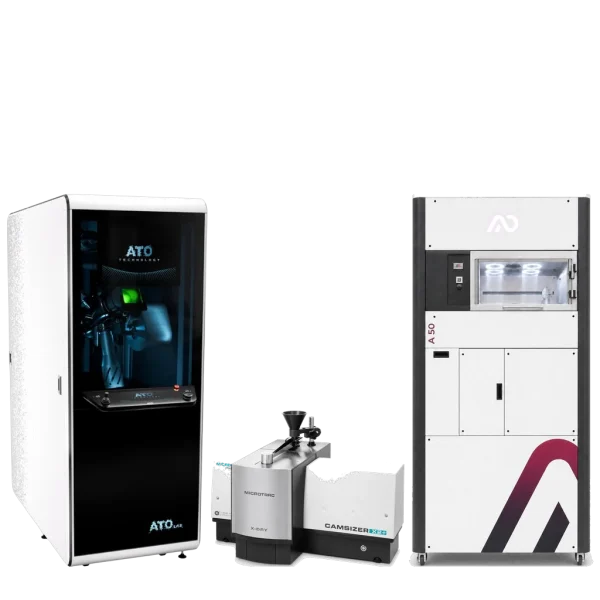
Atomize your own alloy, measure the powder and print it — the ATO Lab, the Microtrac CAMSIZER X2+ and the AO Metal A50 as one materials-development cell from one supplier.
- ATO Lab: 20–120 µm spherical powder, oxygen below 10 ppm
- CAMSIZER X2+: size and shape from 0.9 µm to 8 mm in 1–3 minutes
- A50: Ø50 × 100 mm LPBF, every laser parameter open
- Installation and training included · 8–14 weeks · 12-month warranty
Made to order
· Lead time 8–14 weeks · installation included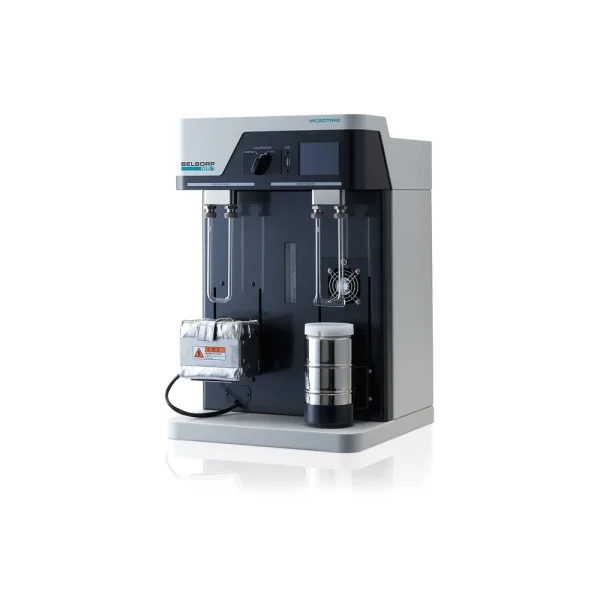
Single-point BET surface area in about 15 minutes — dynamic flow method, from 0.01 m²/g, repeatability within ±1.0 %.
- Pretreatment up to 400 °C at the same time as the measurement
- Touch panel, automatic Dewar, results to USB without manual calculation
- Installation and on-site training included · free test analysis of your sample
- Configured to order · lead time from 4 weeks
Made to order
· Lead time from 4 weeks · installation included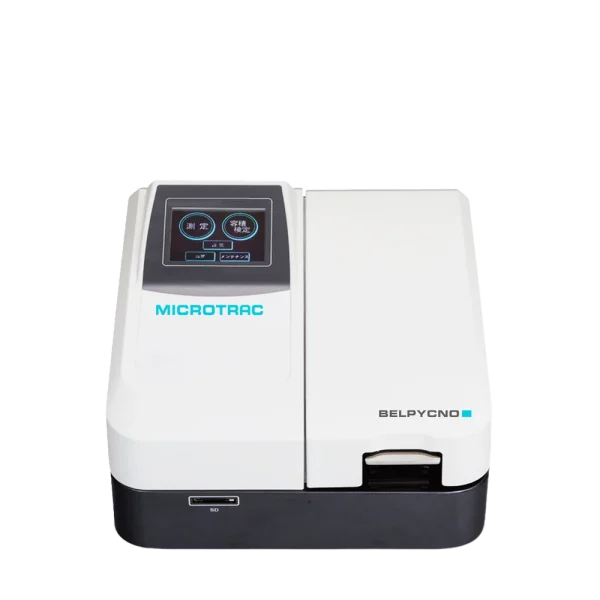
True (skeletal) density of powders and porous solids by gas displacement — helium or nitrogen, 10, 3.5 and 1 cm³ sample cells.
- Accuracy 0.03% of full scale + 0.03% of reading · repeatability 0.02%
- Benchtop, 8 kg · the reference value for porosity calculations
- Installation and on-site training included · free test analysis of your sample
- Configured to order · lead time from 4 weeks
Made to order
· Lead time from 4 weeks · installation included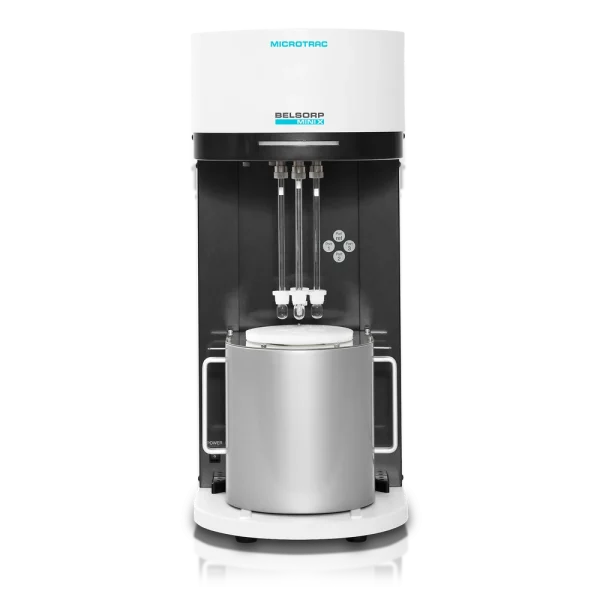
Compact BET surface area and pore size analyzer — up to four samples at once, from 0.01 m²/g with nitrogen, pores 0.7 to 500 nm.
- Each port with its own transducer, helium-free AFSM™2 measurement
- Quick BET: three-point BET of several samples in about 15 minutes
- Installation and on-site training included · free test analysis of your sample
- Configured to order · lead time from 4 weeks
Made to order
· Lead time from 4 weeks · installation included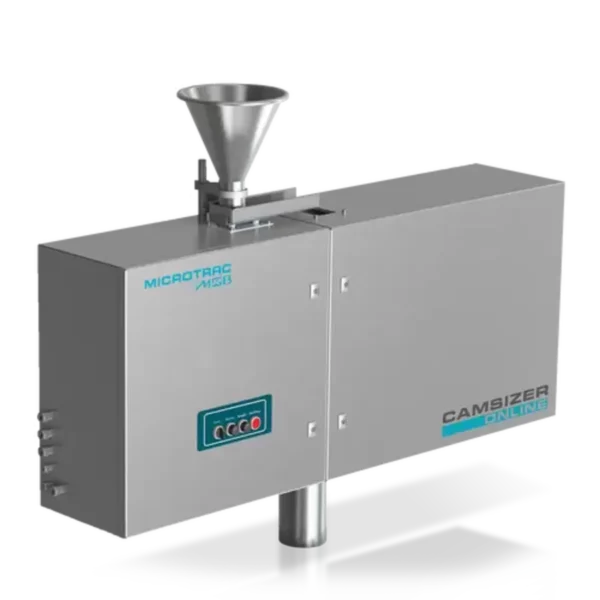
Particle size and 3D shape measured in your process line, not in the lab — 30 µm to 30 mm, with a result every 5 to 10 minutes in the control room.
- More than 35 3D size and shape parameters, built for correlation with sieving
- IP66 stainless steel enclosure, self-cleaning, unattended SOP operation
- Installation and on-site training included · free test measurement
- Configured to order · lead time from 4 weeks
Made to order
· Lead time from 4 weeks · installation included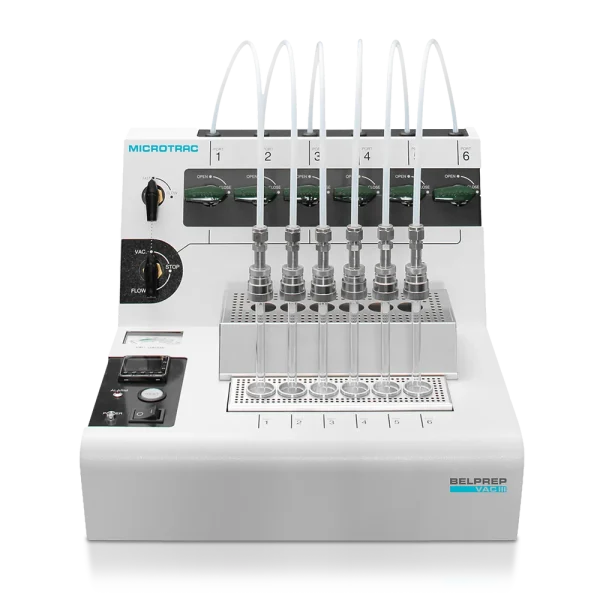
Vacuum degasser for BELSORP gas adsorption analyzers — prepares 3 or 6 samples at up to 430 or 450 °C while the analyzer measures.
- Vacuum / heat degassing, flow / heat under inert gas as an option
- Add-on for BELSORP MINI X, MAX G and MAX X analyzers
- Installation and on-site training included · free test analysis of your sample
- Configured to order · lead time from 4 weeks
Made to order
· Lead time from 4 weeks · installation included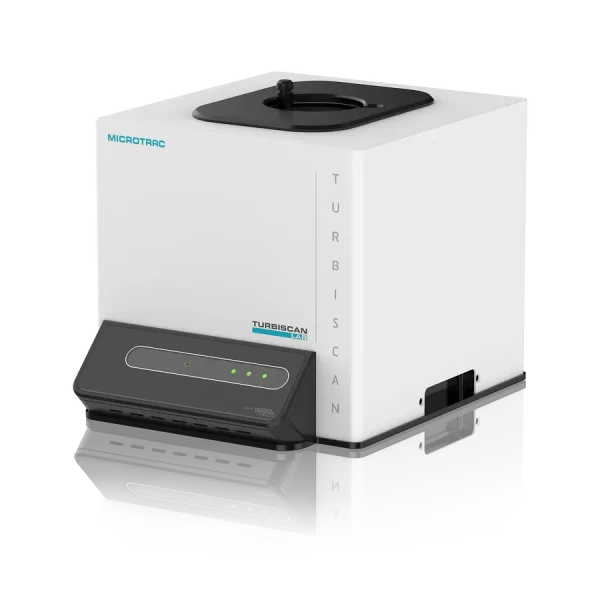
Physical stability of emulsions, suspensions and foams measured on the native sample — up to 1,000× faster than visual observation, 0.0001–95 % v/v, no dilution.
- Sedimentation, creaming, flocculation and coalescence detected and quantified
- One-click Turbiscan Stability Index · room temperature to 60 °C
- Installation and on-site training included · free test analysis of your sample
- Configured to order · lead time from 4 weeks
Made to order
· Lead time from 4 weeks · installation included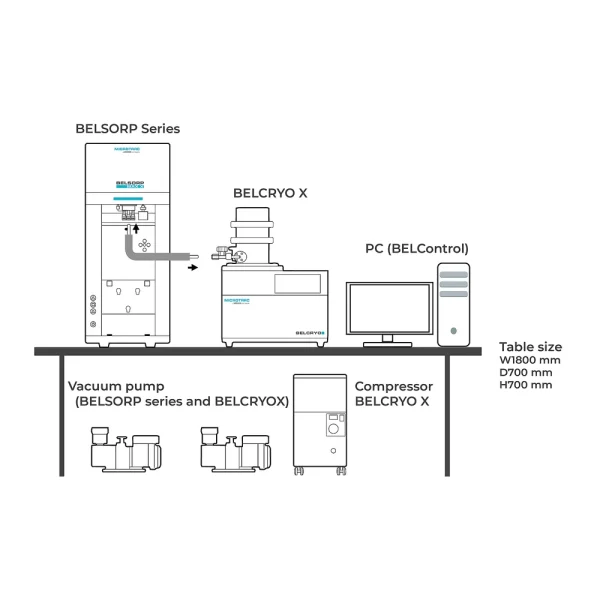
Cryogenic unit for BELSORP analyzers — adsorption isotherms at any temperature from 35 to 473 K without liquid nitrogen, stability to ±0.001 K.
- Add-on for BELSORP MAX X (incl. HP), MAX G and MINI X
- Up to 3 samples, fully automated in BELControl
- Installation and on-site training included · free test analysis of your sample
- Configured to order · lead time from 4 weeks
Made to order
· Lead time from 4 weeks · installation includedWhat our customers say
“Harry and team were professional, effective communicators as we set up the order, then they executed quickly and produced an amazing product for us at a very competitive price. Am looking forward to our next print w Additive Plus!”
“Great 3D printing service and the resin parts look super smooth and clean. Really happy with how everything turned out!”
“Harry was very professional and helped me out with my 3D printing needs and explained what options I have in terms of filaments such as PEEK. Highly recommended.”
“I needed a 3D enclosure printed urgently in a specific time period, they did great!”
Common questions
Don't see yours? Email [email protected] — NDA on request, typical reply within 4 hours.
What size range does the NANOTRAC FLEX measure?
How does the dip probe work — do I need cuvettes?
Can it measure concentrated samples?
Can the NANOTRAC FLEX monitor a reaction in situ?
How is it different from Photon Correlation Spectroscopy (PCS)?
Does the NANOTRAC FLEX measure zeta potential?
Which liquids can it measure in?
How much does a NANOTRAC FLEX cost?
Can I test my sample before buying?
What is the lead time, and what comes with the NANOTRAC FLEX?
Place your order, or talk to an engineer first
Order Microtrac NANOTRAC FLEX Dip-Probe DLS Nanoparticle Size Analyzer direct, or talk to materials engineer