
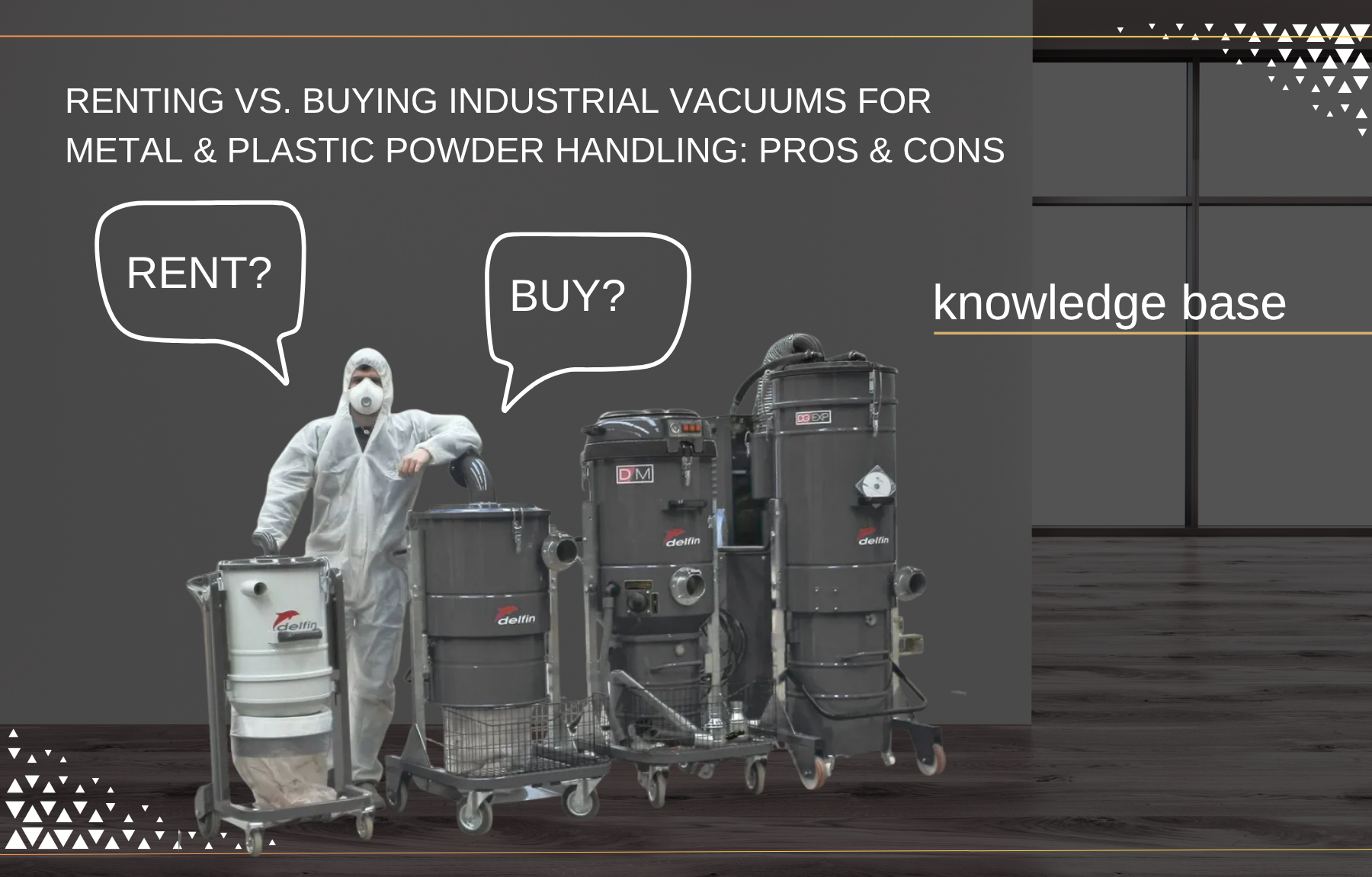
If your team handles metal or plastic powders, cleanup is a critical part of the workflow. Leftover dust can affect safety, compliance, and part quality.
But when it comes to industrial vacuums, should you rent an industrial vacuum or buy one outright?
That choice depends on how often you clean, your budget, and your operational goals. Some teams rent an industrial vacuum cleaner for short-term needs. Others decide to buy an industrial vacuum cleaner for ongoing use in powder handling or post-processing areas.
This article breaks down the pros and cons of both options, plus cost factors and real equipment examples, to help you make the right call.
See our collection of industrial vacuums
Where Industrial Vacuums Matter Most in Powder Handling
Industrial vacuums play a critical role in environments that generate metal or plastic powder. These aren’t general-purpose vacuums; they’re built for fine dust, combustible particles, and continuous use.
Here are the most common areas where industrial vacuums are not just useful, but necessary:
- Additive manufacturing and 3D printing: Powder-based technologies like LPBF, SLS, and FGF produce fine material residue after every build. Without proper collection, this buildup can damage equipment, contaminate parts, and pose safety risks.
- Research and development labs: R&D environments often handle a mix of powders for short-term projects, testing, or prototyping. These setups require precise, safe, and adaptable vacuum systems to manage varying material types and cleaning frequencies.
- Post-processing and finishing areas: During tasks like powder recovery, depowdering, blasting, or support removal, dust becomes airborne quickly. Industrial vacuums help maintain a cleaner workspace and reduce exposure to fine plastic and metal particles.
- Safety-driven or regulated workspaces: Workplaces governed by OSHA or NFPA rules, especially those dealing with combustible dust, must use vacuums that meet specific filtration and containment standards. In these environments, standard shop vacs can’t be used safely or legally.
Many teams start by looking to rent an industrial vacuum for immediate cleanup or short-term projects. But when dust control is a daily task, it may make more sense to buy an industrial vacuum cleaner built for continuous use.
When Is Buying an Industrial Vacuum a Better Choice?
If your team regularly handles metal or plastic powders, buying an industrial vacuum is often the more practical long-term decision. While the upfront cost is higher than renting, ownership gives you full control over how the equipment is used, cleaned, and maintained.
Buy the Delfin DG 70 industrial vacuum, with equipment financing available today.
Here’s when buying makes the most sense:
1. Daily or Continuous Use
If vacuuming is part of your daily operations, during every shift, after each build, or as part of standard cleanup, renting can become more expensive over time. At a certain point, the cost of repeated rentals adds up to the price of owning a high-quality vacuum outright.
2. Maintenance Control and Customization
Owning your equipment gives you control over filter changes, cleaning intervals, and accessories. This matters in labs and production areas where powder contamination and consistency are major concerns.
3. Better ROI Over Time
Buying reduces long-term expenses and downtime. You don’t have to wait for rentals to be delivered or worry about limited availability during busy seasons. Instead, you have a machine that’s always ready and tailored to your exact needs.
Buy the Delfin Mistral 451 BL Inert industrial vacuum, with equipment financing available today.
Industrial Vacuums Available at Additive Plus
Below is a breakdown of the top models available for purchase through Additive Plus. Each one is engineered for specific tasks, whether you’re dealing with hazardous dust, wet material, reactive powders, or daily powder handling.
| Model Name | Advantages | Best Used For | Key Features |
|---|---|---|---|
| DG 70 | Powerful 8.4 HP motor, 26-gal capacity, high airflow | Heavy-duty continuous powder recovery in production | 353.1 CFM, Class L filter |
| DBF 30 | Compact, 3.46 HP, antistatic filter, maintenance-free | Daily dry powder cleanup in small labs | Class M filter, space-saving design |
| DM 3 EL | 3 motors, 16-gal tank, antistatic filter | Mid-size AM labs, metal or plastic dust collection | Manual filter shaker, 283 CFM |
| MTL 802 WD | Wet/dry vacuum with 21-gal stainless steel tank | Temporary liquid or slurry removal | Submersible pump, floating shut-off |
| PRO HEPA 10 | Portable, certified HEPA filter | Hazardous dust in tight, safety-regulated spaces | Meets OSHA/EPA silica dust standards |
| PRO HEPA 20 | Rugged, 20-gal capacity, certified HEPA filter | Extended hazardous dust collection | Polyethylene tank, clean-air tech |
| ZFR EV AP 420 | Compact fan motor, manual filter cleaning | Light powder capture in pharma or electronics labs | 412 CFM, optional HEPA |
| ZFR EV AP 560 | High-CFM dust collector, compact footprint | High-volume powder extraction | 560 CFM, polyester star filter |
| Mistral 300 BL D2 | Spark-free, portable vacuum | Combustible dust zones (Class II, Div. 2) | Stainless tank, brushless motor, optional HEPA |
| Mistral 451 BL D2 | HEPA filtration, compact, and certified for hazardous dust | Safety-critical fine dust removal | 15.8-gal tank, Class II certified |
| Mistral 451 BL Inert | Inert vacuum for reactive powders | Titanium, aluminum, or explosive powder handling | AISI 304 tank, inert collection chamber |
If you’re looking to buy an industrial vacuum cleaner that fits your powder type, facility size, and safety requirements, Additive Plus offers trusted models ready for integration into your workflow.
View all industrial vacuum models or talk to our team for help choosing the best fit for your facility.
When Renting an Industrial Vacuum Makes Sense
Renting an industrial vacuum is a practical option when your team needs a quick solution without committing to a purchase. It gives you access to reliable equipment without the long-term cost of ownership, especially useful in short-term, temporary, or emergency scenarios.
Here’s when renting makes the most sense:
1. Short-Term Projects or Temporary Work
If you need a vacuum for just a few days or weeks, whether for a facility cleanup, post-project sweep, or a one-off manufacturing task, renting saves you from tying up your budget. For example, a model like the MTL 802 WD works well for wet and dry cleanup during short runs or shutdowns.
2. Unexpected Equipment Downtime
If your main unit fails or goes in for maintenance, renting helps you avoid costly delays. A compact option like the Mistral 300 BL D2 can handle sensitive environments until your regular setup is back online.
3. Trying Before You Buy
Renting gives you the chance to test a specific model in your own environment. If you’re considering a unit like the PRO HEPA 10 or DM 3 EL, renting first lets you assess its filtration, suction power, and usability before making a full investment.
4. Seasonal or Peak Demand
During high-volume periods, a rented vacuum can temporarily expand your team’s capacity. This avoids overloading your primary equipment or delaying work due to limited resources.
Rent vs. Buy: A Practical Comparison
Not sure whether to rent an industrial vacuum or purchase one? This side-by-side comparison outlines the key differences, so you can decide based on what your facility needs most: speed, flexibility, or long-term value.
| Factor | Renting | Buying |
|---|---|---|
| Upfront Cost | Low, ideal for short-term use or budget constraints | High initial cost, but it pays off over time |
| Best For | Temporary jobs, emergencies, and testing new models | Daily or frequent use, long-term savings |
| Availability | Depends on stock; good for quick fill-ins | Always available for your team |
| Maintenance | Handled by the rental provider | Your team is responsible for upkeep |
| Flexibility | Upgrade or switch models as needed | Fixed to the model you own |
| Compliance Testing | Try a model (e.g., HEPA or inert) before committing | Full control over filters and accessories |
| Long-Term Cost | Adds up quickly if used repeatedly | More cost-effective if vacuuming is routine |
If you frequently rent industrial vacuum cleaner systems, it may be time to compare costs. A one-time purchase could save you more over the next year than a dozen rentals.
Choose What Works for Your Workflow
There’s no one-size-fits-all answer when it comes to industrial vacuums. If you’re running a short-term job, testing equipment, or handling a temporary spike in powder volume, renting may be the right call. But if cleanup is part of your daily routine, owning a vacuum designed for your materials and workspace often delivers better results and better value.
At Additive Plus, we offer a full selection of industrial vacuums built for metal and plastic powder handling. Whether you need high-filtration systems, inert powder safety, or heavy-duty continuous performance, we’re here to help you choose with confidence.
Browse our available vacuum systems
Frequently asked questions
What if I'm unsure whether to rent or buy for our current project?
If you're on the fence, the best first step is to rent an industrial vacuum cleaner. This lets you test it in your environment without commitment. You can also reach out to suppliers that offer both industrial vacuum cleaners for sale and rental options, so you can easily shift from one to the other based on how your needs evolve.
Can I rent a vacuum that matches specific material handling requirements, like powders or hazardous dust?
Yes, absolutely. Whether you're dealing with metal powders, plastic dust, or combustible residues, there are industrial vacuum pumps for rent built for those exact jobs. Just be sure to communicate your application clearly, especially if you're working in a regulated setting. Teams often rent industrial vacuum models temporarily to ensure safety and compliance without purchasing upfront.
How often do teams actually rent vs. buy these vacuums?
It depends on the operation. Labs and smaller facilities often rent an industrial vacuum for short bursts, for cleanup after a few builds or trial periods. On the other hand, production teams usually decide to buy industrial vacuum cleaner units once they realize the frequency of use. Many start by renting, then invest once they've identified the right specs.
What types of vacuums can I rent if I'm not sure what we need long-term?
Look for providers that allow you to rent industrial vacuum cleaner types with features like HEPA filtration, wet/dry functionality, or spark-free motors. These cover a wide range of use cases, from daily cleanups to hazardous dust recovery, and help you test what's best before making a larger purchase.
Are there risks in choosing the wrong vacuum for powder cleanup?
Definitely. Choosing a vacuum without proper filtration or containment features could lead to safety violations, equipment damage, or failed inspections. Whether you're looking to rent an industrial vacuum or purchase one outright, make sure the unit matches your workflow, dust type, and any regulatory requirement.
Have a question or a project? Let’s talk.
Tell us what you need — a real applications engineer replies within 24 hours. NDA on request, no sales script.