Tailored Warranty And Support


ATO ultrasonic atomizer systems use high-frequency vibrations to produce high-quality atomized metal powders.
Step-by-step Process:

Our ATO Ultrasonic Atomizers are capable of processing a wide spectrum of metals, enabling high-precision atomization for research, prototyping, and full-scale production.
Materials Processed:
Technical Specifications:
Request Detailed Material Reports
We maintain a comprehensive list of successfully atomized materials, which can serve as a reference for your project planning. For more specific data, you can request a detailed report on the atomization results for your material of interest. This ensures you have full insight into particle size, distribution, and suitability for your applications.

| Feature | ATO Ultrasonic Atomizer | Traditional Methods |
| Powder Quality | High sphericity, narrow PSD | Less uniform, irregular shapes |
| Oxygen Level | <150 ppm | Higher oxygen content |
| Footprint | Compact (<10 sq. ft.) | Large industrial setup |
| Batch Size | Small to medium, no minimum | Often large batch only |
| Material Versatility | Non-reactive, reactive, precious metals | Limited range |
| Operating Costs | Low | Higher energy and material costs |
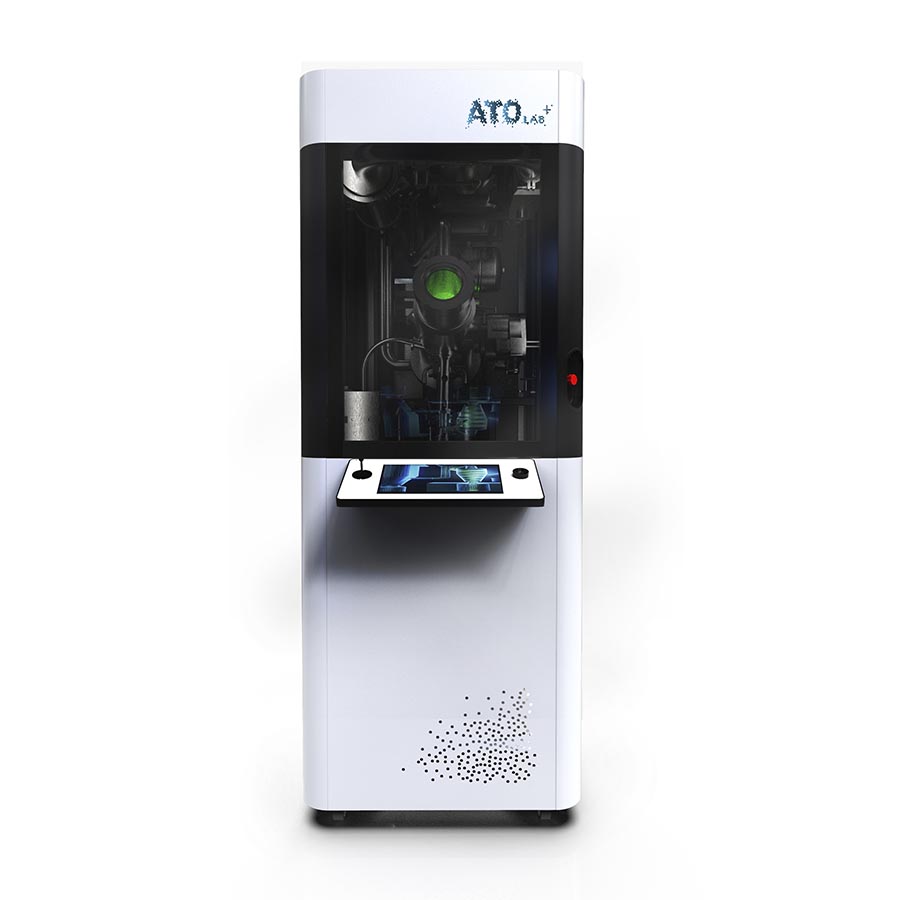
General Specification: ATO Lab Plus
| Feature | Details |
| Technology | Ultrasonic atomization |
| Protective atmosphere prep | < 10 min |
| Processable materials | Non-reactive & reactive metal alloys |
| Particle Size Distribution (PSD) | 20–120 µm |
| Input material | Wire: 0.5–2.2 mm Ø
Rod (upgrade): Ø up to 10 mm, length up to 120 mm, up to 10 rods per process |
| System throughput | Up to 0.3 L/h |
| Oxygen Level (delta) | < 150 ppm |
| Ultrasonic frequency | 35 kHz (upgradeable to 60 kHz) |
Particle Size Distribution for Common Metals
| Material | D10 | D50 | D90 |
| Inconel 718 | 46.5 µm | 54.3 µm | 63 µm |
| Stainless Steel 316L | 49.6 µm | 56.8 µm | 65.3 µm |
| Titanium Gr.5 | 45.5 µm | 50.8 µm | 57.5 µm |
Q: What metals can be used in ultrasonic atomization?
A: Metals from aluminum to molybdenum, including precious metals and reactive alloys.
Q: What is the minimum powder quantity?
A: No minimum requirement, even small batches are possible.
Q: How quickly can I switch materials?
A: Swapping materials is fast and hassle-free, keeping downtime to a minimum—typically just 1 to 2 hours when using ATO Clean.
Q: How does the ATO atomizer compare to traditional atomization methods?
A: ATO atomizers provide higher powder quality, narrow particle size distribution, low oxygen content, compact footprint, and versatile material options.
Q: What industries benefit from ultrasonic atomization?
A: Aerospace, University, R&D labs, metalurgist, automotive, medical, dental, jewelry.
Q: How is maintenance handled?
A: Minimal downtime, easy cleaning, expert support, and replacement parts available in the USA.
Q: What particle size distribution can I expect?
A: Typically 20–120 µm with narrow distribution and high sphericity. The particle size distribution depends on the frequency of work; the higher the frequency, the smaller the particle size.
Unlock faster R&D, higher-quality powders, and unmatched flexibility with ATO ultrasonic atomizer systems.
Take the next step:
Engineer-reviewed · Confidential · Fast response
Engineer-reviewed · Confidential · Fast response
Engineer-reviewed · Confidential · Fast response
Engineer-reviewed · Confidential · Fast response
Engineer-reviewed · Confidential · Fast response
Please describe your part and scanning needs. Include details like size, material, and how you plan to use the 3D model. Let us know if you require additional services like digital sculpting. Upload images of your part(s) if you have them.
Engineer-reviewed · Confidential · Fast response
Upload your CAD file or describe your project — our engineers will follow up shortly.
Engineer-reviewed · Confidential · Fast response
Engineer-reviewed · Confidential · Fast response