
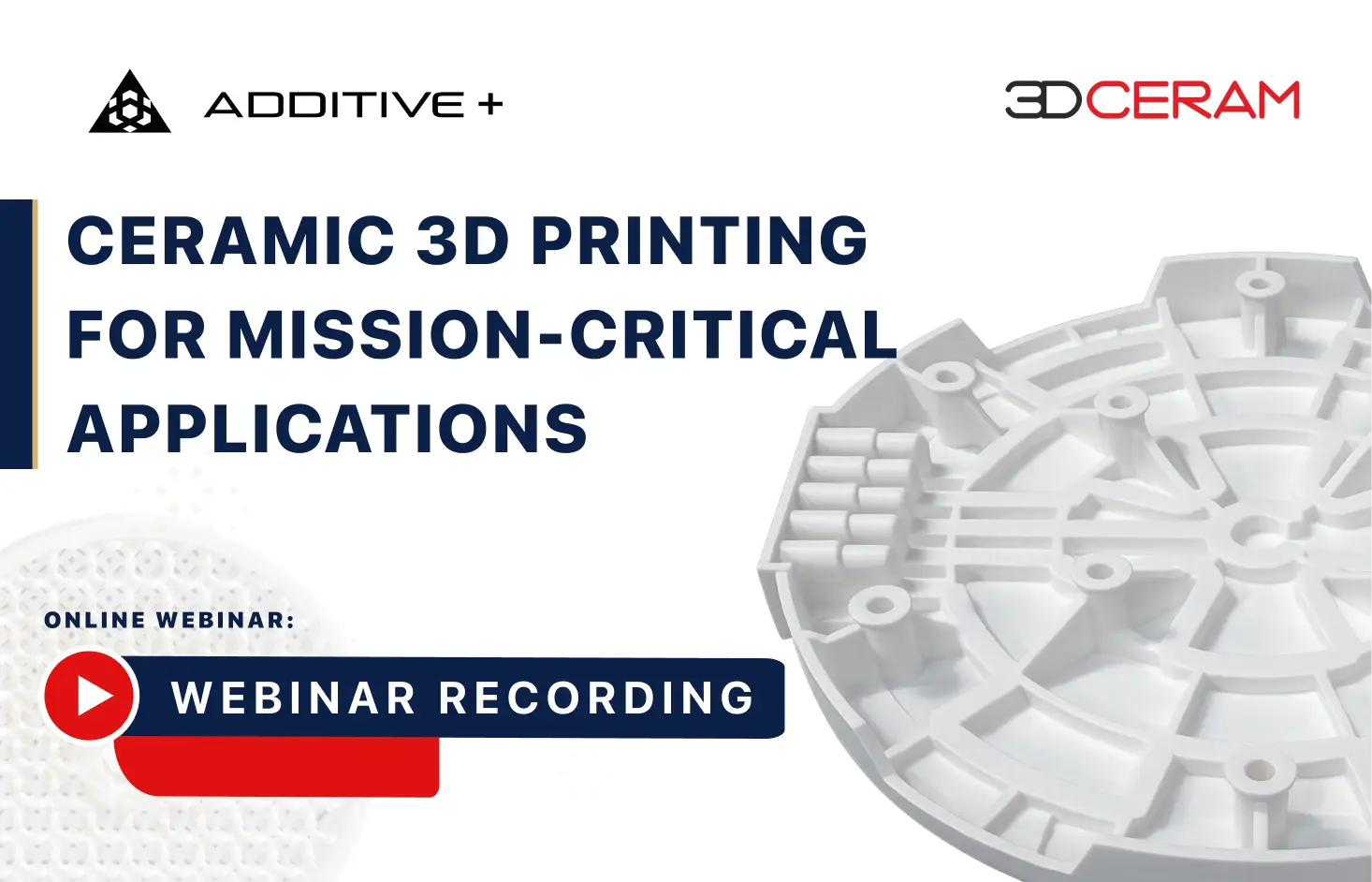
Additive Plus: Building a Complete Engineering Ecosystem for Ceramic Additive Manufacturing
The February 17, 2026 webinar on ceramic SLA technology for mission-critical applications opened with an overview of Additive Plus and its role in advancing industrial additive manufacturing in the United States.
Engineering-Driven Approach to Additive Manufacturing
Additive Plus serves as the U.S. representative and long-term partner of 3DCeram, supporting the deployment of ceramic SLA systems across research and industrial sectors. Headquartered on the West Coast, with warehouse and operational capabilities throughout the United States, the company brings more than 15 years of experience in additive manufacturing.
Rather than focusing solely on machine distribution, Additive Plus operates with a systems-level philosophy. The objective is not simply to deliver equipment, but to implement complete production environments that include:
- Process development
- Engineering validation
- Application-specific optimization
- Stability and repeatability assurance
- Scalability for production
This integrated approach ensures that customers can transition from feasibility studies and prototyping to stable industrial production with predictable performance outcomes.
One-Stop Engineering Solutions
Additive Plus positions itself as a one-stop engineering solutions provider. Organizations working with advanced and technically demanding materials can access:
- Equipment selection and configuration
- Process development support
- Engineering consulting
- Material testing and validation
- Implementation guidance
This model is particularly critical when working with technical ceramics and other advanced materials, where machine capability alone is insufficient without deep process knowledge and material expertise.
OEM Capabilities and Proprietary System Development
Through years of industrial collaboration, Additive Plus has also evolved into an OEM supplier, developing proprietary systems tailored to high-performance applications.
One example is the AO Metal product line — a series of high-powered metal additive manufacturing systems developed in the United States. These platforms were designed to address applications requiring:
- Open processing parameters
- Capability to process challenging materials
- Localized technical support
- High performance combined with cost efficiency
Such systems have been deployed in national laboratories and other environments where critical applications demand both technical flexibility and process reliability.
A Turnkey Additive Manufacturing Ecosystem
The broader Additive Plus ecosystem includes:
- Additive manufacturing equipment
- Metal atomization infrastructure
- In-house design and manufacturing support
- OEM-level engineering capabilities
This turnkey model is particularly relevant for mission-critical industries, where qualification, validation, and repeatability are as important as raw technical performance.
Strategic Role in Ceramic Additive Manufacturing
Within the ceramic additive manufacturing space, Additive Plus has supported leading U.S. companies in producing advanced technical ceramic components through its long-standing partnership with 3DCeram.
Its approach centers on:
- Deep understanding of ceramic processing fundamentals
- Material-to-application alignment
- Validation testing across different ceramic systems
- Full implementation support from R&D to production
Because ceramic components are often required to operate in extreme temperatures, under high mechanical stress, or within aggressive chemical environments, successful adoption requires more than hardware — it demands an integrated engineering strategy.
3DCeram: Industrializing Ceramic SLA for Mission-Critical Applications
The technical foundation of the webinar centered on ceramic 3D printing for mission-critical environments — including aerospace, defense, space, and other high-performance sectors where advanced ceramics are essential.
Industrial Background and Strategic Positioning
With more than three decades of experience in ceramics and over eight years dedicated specifically to ceramic additive manufacturing, the leadership behind 3DCeram brings deep domain expertise in both traditional ceramic processing and digital manufacturing.
Founded more than 20 years ago in France, 3DCeram initially focused on developing applications for ceramic 3D printing, starting with biomedical use cases. Over time, the company evolved toward a broader industrial model centered on advanced ceramic part production.
In 2025, a major strategic consolidation led to the creation of Sinto Advanced Ceramics, bringing together several key European players in advanced ceramics. This integration positioned the group to become a significant global actor in advanced ceramic component manufacturing, with additive manufacturing serving as a central pillar of its industrial strategy.
A Process-Driven Manufacturer
Based in France, 3DCeram operates its own production facility where its printers are assembled. The company defines itself not merely as an equipment manufacturer, but as a process provider.
This distinction is critical. The company’s scope includes:
- Manufacturing ceramic SLA equipment
- Developing proprietary software for process control
- Integrating AI-driven tools to enhance printing optimization
- Formulating in-house ceramic slurries
- Delivering installation, training, and technical services
- Supporting application and part development prior to system acquisition
By controlling hardware, software, and material formulation, 3DCeram ensures tight process integration — a requirement for producing dense, high-performance ceramic components for demanding industries.
Ceramic Additive Manufacturing in Context
Compared to metals and polymers, ceramic additive manufacturing is a relatively younger segment. However, it encompasses a range of technologies, including:
- Digital Light Processing (DLP)
- Stereolithography (SLA)
- Sheet lamination
- Binder jetting
The core technology deployed by 3DCeram is stereolithography (SLA), specifically within the category of vat photopolymerization.
How Ceramic SLA Works
Ceramic SLA relies on a highly engineered slurry composed of:
- Fine ceramic powder (the structural material)
- A photosensitive organic binder
The slurry has a viscosity comparable to drinkable yogurt, enabling controlled spreading in thin layers.
The process follows these steps:
- A recoater distributes a thin layer of ceramic slurry across the build platform.
- A 405 nm UV laser selectively polymerizes the layer, curing the photoreactive binder.
- The platform adjusts, and the next layer is deposited.
- The sequence repeats, building the part layer by layer.
After printing, additional post-processing steps such as debinding and sintering convert the “green part” into a dense, high-performance ceramic component.
This approach enables extremely high resolution and dimensional precision, making it suitable for complex geometries required in aerospace, defense, electronics, and advanced industrial systems.
Machine Portfolio and Large-Format Capability
The 3DCeram printer portfolio is structured primarily by build size.
- Entry-level systems: approximately 100 × 100 × 150 mm
- Large-format systems: up to 600 × 600 × 300 mm
The largest configuration represents the biggest available platform on the market for producing large, dense ceramic components using SLA technology. This large-format capability is particularly relevant for structural aerospace parts, satellite components, and industrial assemblies where scale and material integrity must coexist.
Material Qualification and Application Strategy in Ceramic AM
A critical step in adopting ceramic additive manufacturing for mission-critical applications is material and process qualification. Every component operates under specific environmental conditions, so selecting the right ceramic and tailoring the printing process is central to successful implementation.
Understanding Part Requirements
The process begins with a detailed assessment of the intended application:
- Mechanical properties – strength, toughness, wear resistance
- Thermal performance – operating temperature, thermal shocks, expansion
- Electrical and dielectric characteristics – for electronic or insulating components
- Chemical resistance – exposure to aggressive or corrosive environments
Advanced ceramics are often used in harsh conditions, but even within this category, material choice varies based on the precise combination of stresses and environmental factors.
Equally important is understanding the customer’s objective with additive manufacturing:
- Prototype development for R&D validation
- Small-series production
- Installation of in-house printing capabilities
This informs whether the focus should be on proof-of-concept parts, co-development of new materials, or economic feasibility for production scaling.
Co-Engineering and Customer Collaboration
3DCeram emphasizes co-development with customers, integrating their application requirements with the company’s deep expertise in ceramic shaping and additive manufacturing. This collaborative approach ensures that the selected material and process align with both performance expectations and practical feasibility.
It is also acknowledged that additive manufacturing is not always the optimal solution. While it provides unique capabilities — such as producing complex geometries not achievable with conventional methods — for some applications, traditional processes may remain more cost-effective or efficient.
Evolution of Industry Understanding
Over the past eight years, the perception of ceramic AM has shifted significantly. Initially, customers were primarily curious about the potential of ceramics and their reuse. Today, engineers increasingly explore advanced materials to understand the tangible benefits — such as weight reduction, design freedom, or integration of multifunctional properties — that ceramic additive manufacturing can deliver.
This growing interest underscores the importance of material expertise combined with application-driven engineering, which forms the foundation for successful mission-critical ceramic components.
Material Portfolio and Key Properties for Advanced Ceramic AM
A key advantage of ceramic additive manufacturing is the ability to tailor material selection and properties to match the requirements of mission-critical applications. Ceramic materials offer a range of characteristics that can be optimized beyond what metals or polymers can achieve.
Comparing Ceramics to Other Materials
Advanced ceramics are frequently evaluated against metals and other engineering materials across multiple dimensions:
-
Mechanical properties: Young’s modulus, hardness, wear resistance
-
Density: significantly lower than many metals, beneficial for weight-sensitive applications
-
Thermal properties: thermal conductivity, thermal shock resistance, operating temperature limits
-
Electrical and dielectric properties: insulating or semiconducting behavior
-
Specialized properties: optical transparency (visible or electromagnetic), chemical resistance
These property combinations enable ceramics to serve in niche or extreme environments — such as high-temperature aerospace components, dielectric substrates for electronics, or optically transparent structural parts.
Standard Ceramic Material Families
The 3DCeram portfolio focuses on advanced ceramics, divided broadly into oxides and non-oxides:
-
Oxides:
- Alumina (Al₂O₃) – standard and translucent grades
- Zirconia (ZrO₂) – including ATZ and AP variants
-
Non-oxides:
- Aluminum nitride (AlN)
- Silicon nitride (Si₃N₄)
While oxide ceramics are widely accessible, non-oxides are more specialized. Equipment for sintering non-oxide ceramics typically comes with very high cost and complexity, often requiring collaboration with specialized kiln providers rather than in-house capabilities.
Process Integration: Printing to Final Part
Ceramic 3D printing is just the shaping stage. Post-processing is essential to achieve final part performance:
- Debinding – removal of the organic binder
- Sintering – densification to achieve mechanical strength and thermal/electrical performance
3DCeram provides full-spectrum equipment and support for oxide ceramics, including furnaces and automated systems for post-processing. Non-oxide ceramics generally require external specialized sintering systems.
Open Material System
A distinguishing feature of 3DCeram printers is the flexibility of material usage:
- Machines are compatible with 3DCeram’s proprietary ceramic slurries
- Customers can develop custom material formulations for unique powders or proprietary compositions
- Open process parameters allow experimentation with new materials without locking the user to a single supplier
This flexibility supports R&D, prototyping, and small-scale production for highly specialized applications, ensuring that additive manufacturing can deliver unique material properties not achievable with conventional shaping methods.
Mission-Critical Applications of Ceramic 3D Printing
The final section of the webinar focused on real-world applications of advanced ceramic additive manufacturing in mission-critical environments, emphasizing defense, aerospace, and dual-use technologies. These examples illustrate how 3D printing enables performance and design flexibility that conventional manufacturing cannot achieve.
Defense and Aerospace Applications
3D-Printed Ceramic Radomes
Radomes — protective covers for antennas — require precise electromagnetic properties alongside mechanical durability. Different ceramic materials, such as alumina, silicon nitride, and custom formulations, offer varied permittivity and mechanical strength, influencing the part’s suitability for specific frequencies and environments.
Advanced additive manufacturing allows:
- Tailoring material properties: density, purity, and composition can be optimized for electromagnetic performance.
- Complex internal structures: lattice or gyroid architectures can selectively tune permittivity and weight.
- Optical transparency: 3D printing combined with post-processing techniques (e.g., HIP) can produce translucent or even transparent alumina parts — capabilities not achievable with traditional methods.
Ballistic and Protective Components
Ceramics such as zirconia, combined with structured 3D-printed geometries, provide localized ballistic protection. While ultra-hard materials like B₄C are expensive and specialized, additive manufacturing enables new configurations that leverage ceramic hardness and internal lattice designs to achieve protective performance for targeted applications.
Dual-Use Energy Applications
Advanced ceramics are also being explored for dual-use energy systems, applicable in both civil and defense contexts:
- Solid oxide fuel cells (SOFCs) and power-to-gas or gas-to-power devices: enable energy generation in remote environments.
- Materials such as 3Y- and 8Y-stabilized zirconia with high ionic conductivity are combined with 3D-printed honeycomb or gyroid structures to optimize ion transport and mechanical stability.
- These systems can, for example, convert sunlight into hydrogen during the day, and then generate electrical power at night — providing autonomous energy solutions in the field.
Several European collaborative projects, including partnerships with the Institute of Energy in Barcelona and DTU, demonstrate the high TRL (technology readiness level) of 3D-printed zirconia-based solid electrolyte cells for green hydrogen production.
Key Takeaways
The applications highlighted reveal the synergy between material science and additive manufacturing:
- 3D printing enables geometries, lattice structures, and tailored internal architectures impossible with traditional ceramic shaping.
- Material selection and post-processing are integral to achieving mechanical, thermal, electrical, and optical performance.
- Co-development with customers ensures that additive solutions meet specific mission-critical requirements, whether for aerospace, defense, energy, or advanced industrial applications.
Advanced ceramic additive manufacturing is no longer limited to prototyping; it now offers a scalable, high-performance solution for components operating in extreme and complex environments.
Additive manufacturing for ceramics is not limited to prototypes or lab-scale experiments — it enables full industrial-scale production, customized design, and performance optimization across mission-critical industries.
Advantages in Energy and Industrial Components
One compelling example is 3D-printed solid oxide fuel cells (SOFCs) and hydrogen generation systems. Using SLA, corrugated or honeycomb structures can be printed instead of flat, tap-cast cells. This provides multiple benefits:
- Improved efficiency in hydrogen production
- Enhanced mechanical resilience, allowing cells to operate under pressure without failure
- Integrated features, such as gas evacuation channels, reducing the need for additional metal interconnects
- Compact form factor, achieving up to 35% reduction in stack size compared to traditional designs
Such advances demonstrate how additive manufacturing enables functionally optimized geometries that cannot be achieved by conventional methods.
Scaling and Continuous Production
The SLA technology supports scalability from R&D to industrial production. Printers range from small-format (100 × 100 × 150 mm) for development work to large-format machines (600 × 600 × 300 mm) capable of producing big parts or increasing throughput.
Advanced systems allow continuous 24/7 operation with minimal downtime, integrating:
- Automated process preparation
- AI-assisted printing for optimization of build time and material consumption
- Production of geometrically complex parts previously considered unprintable
This ensures that additive manufacturing is not a “lab toy” but a fully industrial tool for high-volume or high-value production.
Aerospace and Space Applications
Space applications share many characteristics with defense: extreme environments, material performance criticality, and small or customized production runs. Ceramic AM enables:
- Small-series or customized satellite components with rapid design iteration
- Materials with extreme thermal stability, such as zirconia, alumina, and dense ceramic optical materials (e.g., low-CTE cardite)
- Fast time-to-market: components can go from initial drawing to industrial production in as little as 18 months, including R&D and process validation
Examples include:
- S-band antennas for European satellites, developed from scratch and already operational in orbit
- Alumina components for propulsion systems, used in European space programs
Large-format SLA also allows printing of big structural parts, such as telescope mirrors and satellite supports, enabling in-house manufacturing for strategic independence. This reduces reliance on external suppliers, addresses geopolitical risks, and mitigates supply chain disruptions.
Key Takeaways
Ceramic SLA additive manufacturing enables mission-critical industries to:
- Produce customized, high-performance components with complex geometries
- Scale from R&D to continuous industrial production
- Integrate AI and process optimization for material efficiency and precision
- Achieve sovereign manufacturing capability for strategic components
The combination of material science, process control, and 3D printing geometry opens new possibilities across defense, aerospace, energy, and advanced industrial applications.
Multi-Additive Technologies for R&D and Functional Prototyping
Beyond SLA, 3DCeram has developed versatile multi-additive platforms designed for R&D, academia, and functional prototyping, enabling exploration of challenging materials and custom part development. These systems complement the industrial SLA printers, offering flexibility for materials and geometries that SLA cannot handle.
Case Studies in Aerospace and Thermal Protection
- Talis Selenia Space: Silicon nitride support structures were 3D-printed with complex geometries that can be quickly modified in software, dramatically reducing lead time compared to traditional tooling methods such as injection molding or pressing.
- Thermal Protection Systems: Silicon carbide demonstrator parts for high-temperature applications (e.g., NASA) were produced with rapid iteration cycles, highlighting the speed and adaptability of additive processes.
These examples showcase how 3D printing accelerates design iterations and allows rapid testing and modification of complex ceramic components for extreme environments.
Multi-Additive Platform Capabilities
The multi-additive platform integrates multiple technologies:
- Extrusion-Based Printing: Direct ink writing (paste extrusion), fused filament fabrication, and pellet extrusion allow dense ceramic parts to be produced.
- CNC Green Machining: After printing, parts can be machined on the build plate to enhance dimensional accuracy, surface finish, and density. This step is crucial for ceramics due to shrinkage and tight tolerances.
- Multi-Material Printing: Supports ceramics, metals (e.g., stainless steel, titanium, copper), and thermoplastics up to 250°C nozzle temperature.
Advantages Over SLA for Certain Materials
Some ceramics, particularly carbides (“dark ceramics”), are not reactive to UV polymerization, making them difficult or impossible to print with SLA. The multi-additive approach allows processing of these materials using thermoplastic matrices and extrusion-based methods.
- Pellet-based printing simplifies debinding: water-soluble organics reduce the need for chemical debinding, lowering cost and cycle time.
- Layer-by-layer machining allows correction for shrinkage and ensures high dimensional accuracy for functional prototypes.
- Users can experiment with proprietary or niche powders that are not available in standard formulations.
Role in R&D and Material Development
While not intended for high-volume industrial production, multi-additive systems provide:
- Rapid prototyping and functional testing
- Material experimentation for new formulations or composites
- Cost-effective entry into ceramic additive manufacturing before investing in larger SLA systems
By combining multiple deposition technologies with green machining, these platforms give researchers and engineers full control over material behavior, geometry, and functional properties, bridging the gap between laboratory experimentation and industrial-scale manufacturing.
Additive Plus is the official provider of 3DCeram systems and solutions in the USA. The company offers a complete range of services for implementing ceramic 3D printing, including equipment, materials, and engineering support, giving clients access to advanced additive manufacturing technologies. For consultations or project implementation, Additive Plus can be approached as a reliable 3DCeram solutions provider.
Have a question or a project? Let’s talk.
Tell us what you need — a real applications engineer replies within 24 hours. NDA on request, no sales script.