
3D printing often leaves behind fine dust, powder, and airborne particles. These aren’t just messy; they can damage equipment, affect print quality, and put your team’s health at risk.
That’s why general-purpose vacuums aren’t enough. You need an industrial vacuum with a HEPA filter, or in some cases, a ULPA filter, to safely collect fine and hazardous particles at the source.
At Additive Plus, we support teams working with metal, resin, and polymer-based printing by offering vacuum systems designed specifically for additive manufacturing environments. Clean workspaces mean fewer failures, longer machine life, and safer conditions for everyone involved.
In this article, we’ll explain what HEPA and ULPA filters do, when to use each, and which vacuums are best for additive manufacturing. If you’re working with powders, resins, or sensitive parts, this guide is for you.
Looking for a solution now? Talk to our team or view our industrial vacuum lineup.
What Is A HEPA Filter And How Does It Work?
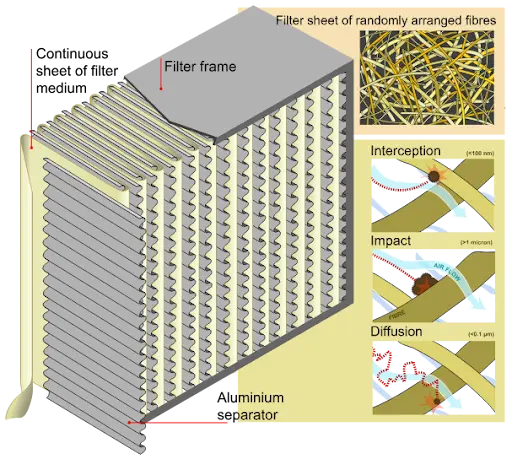
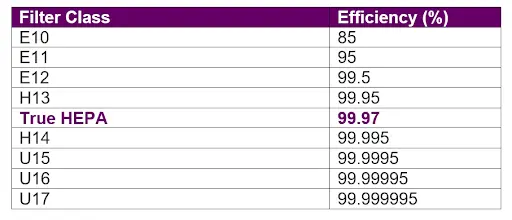
A HEPA filter (High-Efficiency Particulate Air) is a certified filter that removes 99.97% of particles that are 0.3 microns in size or larger. That includes common materials in 3D printing like metal powder, polymer dust, and resin particles.
Source: Wikipedia
But how does it actually work?
Unlike standard filters, HEPA filters use a dense, pleated fiber mesh to trap particles. As air passes through, contaminants are caught through three physical processes:
- Interception – particles stick to the fibers as they follow the airflow
- Impaction – larger particles can’t avoid the fibers and embed directly
- Diffusion – tiny particles (like fumes or nanoparticles) move randomly and get caught as they bounce around
This makes HEPA filters especially effective in capturing both large debris and fine, invisible particles that could otherwise harm your equipment or be inhaled.
Source: Winix
Many industrial vacuums also use pre-filters to trap larger debris first. This helps extend the life of the HEPA filter and reduce maintenance costs.
What Is A ULPA Filter And How Does It Work?
A ULPA filter (Ultra-Low Penetration Air) is a high-efficiency air filter that removes 99.999% of airborne particles down to 0.1 microns. That includes ultrafine dust, aerosols, bacteria, and other contaminants that standard or even HEPA filters may miss.
ULPA filters work the same way HEPA filters do, using a dense, pleated fiber structure. As air passes through the filter, particles are trapped by three physical processes:
- Interception – particles moving through the airflow brush up against and stick to fibers
- Impaction – larger particles can’t follow the air path and collide directly into the filter media
- Diffusion – very small particles move erratically (Brownian motion) and get caught in the fiber maze
Because ULPA filters are denser, they allow less airflow and create more resistance, which can lead to faster clogging and higher energy use.
That’s why they’re mainly used in cleanrooms, pharmaceutical labs, medical device manufacturing, and other settings where maximum particle control is critical.
https://www.youtube.com/watch?v=YoIxEGf63CE
What Is The Difference Between HEPA And ULPA Filters?
Both HEPA and ULPA filters are designed to trap very small particles from the air. The difference comes down to filtration efficiency, particle size, and how demanding your application is.
Here’s a quick comparison:
HEPA vs. ULPA Filters in 3D Printing
|
Category |
HEPA Filter |
ULPA Filter |
|
Filtration Efficiency |
99.97% @ 0.3 microns |
99.999% @ 0.1–0.3 microns |
|
Particle Size Captured |
Fine dust, metal powders, polymer/resin debris |
Ultrafine particles, biological and chemical contaminants |
|
Airflow Resistance |
Lower – allows for better suction and airflow |
Higher – requires more powerful fans, may reduce suction efficiency |
|
Filter Lifespan |
Longer – less prone to clogging |
Shorter – denser media clogs faster |
|
Operating Cost |
Lower–affordable filters, lower energy use |
Higher – costlier filters, increased power demand |
|
Use Case Examples |
Standard AM labs, polymer/metal 3D printing, post-processing cleanup |
ISO 3–5 cleanrooms, aerospace, pharma, medical AM applications |
|
Best For |
General-purpose additive manufacturing |
High-sensitivity environments with strict contamination control |
In most additive manufacturing environments, a HEPA filter is more than sufficient, especially for collecting resin dust, polymer powders, and excess metal. But if you’re working in a cleanroom (ISO Class 3–5) or handling high-risk biological materials, a ULPA filter may be required.
Still not sure which one fits your setup? Get in touch with us. We’ll help you decide based on your process and materials.
Why HEPA/ULPA Filtration Matters In Additive Manufacturing?
Additive manufacturing isn’t just about precision printing—it’s also about safe, controlled environments. Fine dust, leftover powder, and airborne particles are part of the process, but without proper filtration, they create serious risks.
Here’s where industrial vacuum cleaners with HEPA or ULPA filters come in. Let’s break it down:
1. Metal Powder Safety
Metal 3D printing (like LPBF) uses reactive powders such as titanium, aluminum, and stainless steel. These materials are:
- Toxic if inhaled
- Combustible under certain conditions
- Hard to contain with standard vacuums
A certified HEPA filter industrial vacuum helps capture fine metal powder during post-processing, powder changes, or cleaning around the build chamber. For highly sensitive setups, ULPA filters may be used with inert or explosion-proof vacuums.
2. Resin and Polymer Dust Control
SLA, FDM, and SLS processes often leave behind:
- Micron-scale plastic or resin dust
- Harmful fumes and fine particulates
- Build-up around optics or cooling fans
Using a vacuum with a HEPA filter ensures these particles are removed at the source, before they affect machine performance or operator health.
https://www.youtube.com/watch?v=do7d_yRq8wY
3. Protecting Sensitive Equipment
Dust isn’t just a health issue—it’s a mechanical one. Fine particles:
- Settle into optical systems, reducing print accuracy
- Accumulate in electronics, cooling systems, and motion rails
- Shorten the lifespan of precision equipment
HEPA/ULPA filtration keeps your machines in better shape, reducing maintenance costs and downtime.
4. Meeting Safety Standards
Many AM labs must comply with:
- OSHA and NFPA guidelines on combustible dust
- ISO Class cleanliness for specific industries (aerospace, medical, pharma)
ULPA filters help meet these stricter standards, especially in controlled cleanroom environments.
Proper filtration is part of responsible 3D printing, protecting both people and processes. Additive Plus offers industrial vacuum options built to handle all of the above.
Elevate Your 3D Printing with Additive Plus
The CAMSIZER X2 is ideal for determining the particle shape and particle size distribution of fine metal powders. Especially in modern powder metallurgical processes such as additive manufacturing, dynamic image analysis provides valuable information for the usability of both raw materials and recycled material. Particularly noteworthy are the short measuring times, the high sample throughput, the reliable detection of even the smallest amounts of oversize, and the finding of particles that deviate from the desired shape.
If you’re ready to take your 3D printing projects to the next level, Additive Plus is here to help. With over 10 years of experience, we specialize in helping clients integrate and optimize 3D printing technologies seamlessly into their operations.
Our curated portfolio features industry-leading brands like Farsoon Technologies, Kings3D, offering a wide range of materials and services to meet diverse needs. From design to consulting, we provide the expertise and tools to bring your ideas to life.
Frequently asked questions
What is the significance of particle size and shape in 3D printing of metal components?
Particle size and shape are critical parameters that influence the flow behavior of powders, the operating conditions of the printer, and the properties of the final product. Round particles in a narrow size range typically flow better and allow for more homogeneous deposition. However, if the size range is too narrow, it can lead to lower packing density and potential voids in the final component.
How does the CAMSIZER X2 improve particle analysis compared to traditional methods?
The CAMSIZER X2 utilizes Dynamic Image Analysis (DIA), which measures both the length and width of particles independently, providing a more accurate representation of particle shape and size. In contrast, traditional methods like laser diffraction only calculate one size parameter based on a spherical model, which can lead to misinterpretation of irregularly shaped particles.
What types of metal powders can be analyzed with the CAMSIZER X2?
The CAMSIZER X2 can analyze a variety of metal powders, including aluminum, cobalt, chromium, inconel, manganese, molybdenum, nickel, steel, titanium, tungsten, silver, gold, and their respective alloys.
Can CAMSIZER X2 help in maintaining consistent quality in additive manufacturing?
Yes, by providing comprehensive analysis of particle size and shape, the CAMSIZER X2 ensures that only high-quality powders are used in the printing process. This consistency is vital for producing reliable and high-performance components in additive manufacturing.
What information does the CAMSIZER X2 provide about particle dimensions?
The CAMSIZER X2 measures particle width, length, and equivalent circle diameter. This detailed analysis helps in understanding particle shape and size distribution, which is crucial for applications like additive manufacturing.
How quickly can the CAMSIZER X2 perform measurements on metal powders?
The CAMSIZER X2 can perform measurements on metal powders in less than 20 seconds per sample. This high throughput makes it suitable for rapid quality control and analysis in industrial applications.
What types of metal powders can be analyzed with the CAMSIZER X2?
The CAMSIZER X2 is capable of analyzing a variety of metal powders, including titanium and steel, among others. It is particularly effective for fine powders with a particle size down to 1 μm
How does dynamic image analysis benefit additive manufacturing processes?
Dynamic image analysis with the CAMSIZER X2 provides valuable insights into particle shape and size distribution, which are essential for optimizing raw and recycled materials in additive manufacturing. The ability to detect small amounts of oversized particles and deviations from desired shapes enhances the overall quality and performance of printed components.
Have a question or a project? Let’s talk.
Tell us what you need — a real applications engineer replies within 24 hours. NDA standard, no sales script.