
1. Introduction Metal 3D printing has evolved significantly over the past decade, shifting from a…
Camsizer: Ensuring Perfect Powder for Strong 3D Prints
Additive manufacturing (AM), particularly processes like laser powder bed fusion, has revolutionized industries from aerospace to medical devices. The ability to create complex geometries with superior material properties hinges not just on sophisticated printer technology, but crucially, on the quality of the 3D printing materials themselves. At the heart of this material quality control lies camsizer technology.
A camsizer is a dynamic image analysis system specifically designed for advanced particle characterization. Unlike traditional methods that offer limited insights, a camsizer provides comprehensive data on both particle size distribution and intricate shape descriptors. This precision in powder analysis is paramount for achieving consistent, high-performance results in additive manufacturing.
Without a thorough understanding of powder characteristics—including aspects like sphericity, aspect ratio, and the presence of fines or agglomerates—even the most advanced metal 3D printer struggles to deliver reliable, defect-free parts. This article will demystify camsizer technology, exploring how its advanced capabilities ensure superior powder quality, especially for critical materials like aluminum powder and titanium alloy, thereby unlocking the full potential of high-quality additive manufacturing.
1. Introduction: Demystifying Camsizer Technology for Superior 3D Printing
Additive manufacturing, commonly known as 3D printing, has revolutionized industries from aerospace to medical devices. Its promise of complex geometries and on-demand production hinges critically on one fundamental element: the quality of the raw material powders. Without precise control over these microscopic constituents, even the most advanced DMLS 3D printer struggles to deliver consistent, high-performance parts. This is where Camsizer technology emerges as an indispensable tool.
A Camsizer is a state-of-the-art instrument employing dynamic image analysis for comprehensive particle characterization. It serves as a cornerstone for quality control of powders used across various sectors, especially in additive manufacturing. By meticulously analyzing particle size, shape, and overall morphology, Camsizer systems provide critical insights into the physical properties that directly impact the printability and final performance of 3D printing materials. This guide will delve into the intricacies of Camsizer technology, demonstrating why it is the hidden engine driving superior results in modern additive manufacturing processes.
2. Understanding Camsizer Technology: How It Works and What It Measures
At its core, Camsizer technology operates on the principle of dynamic image analysis, a method standardized under ISO 13322-2. This sophisticated approach involves particles freely falling through a precisely defined sensing zone. As each particle traverses this zone, it is illuminated by specialized LED strobe backlighting while being simultaneously captured by two high-speed digital cameras. This allows for rapid and accurate measurement of its characteristics.
What truly sets Camsizer apart, particularly models like the CAMSIZER 3D, is its innovative “3D particle tracking” principle. Instead of just a single snapshot, the system captures up to 30 images per particle at an impressive rate of up to 250 frames per second. As particles fall in a natural tumbling motion, these multiple images capture them in different orientations. Proprietary software then processes these sequential images, reconstructing a 3D-like track of each individual particle. This advanced tracking provides access to its true morphology, offering a level of detail unattainable by simpler methods.

The scope of what a Camsizer measures is extensive. It delivers highly accurate particle size distribution across a remarkably wide range. For instance, the CAMSIZER 3D can analyze particles from 20 µm to 30 mm. Beyond size, it quantifies a comprehensive suite of particle shape descriptors. These include fundamental metrics like length, width, and thickness, alongside more complex indicators such as aspect ratio, sphericity, roundness, perimeter, and area. This detailed morphological data provides a deep understanding of the powder’s characteristics. Furthermore, Camsizer results often show excellent compatibility with traditional sieve analysis, offering a more granular and automated alternative.
The emphasis on 3D analysis is critical. Conventional 2D image analysis, by its nature, only provides a view of a particle in a single, random orientation. This can lead to misinterpretations of true particle morphology, potentially overlooking critical defects or misrepresenting actual dimensions. By contrast, the Camsizer’s ability to track and generate 3D-like profiles of particles leads to significantly more accurate volume and shape assessments, as well as superior detection of even subtle defects. This precision is absolutely crucial when dealing with high-value powders destined for sensitive applications like additive manufacturing.
3. Why Powder Characterization Matters in Additive Manufacturing – And Where Camsizer Fits
The profound impact of powder characteristics on the success of an additive manufacturing build cannot be overstated. The precise particle size and shape of a powder directly influence several critical process behaviors within a 3D printer. These include its flowability and spreadability, which dictate how uniformly the powder recoater can distribute a new layer across the build platform. It also impacts the packing density of the powder bed, a factor crucial for achieving high part density and minimizing internal defects. Furthermore, the surface characteristics and size distribution of particles affect melt pool behavior, influencing energy absorption, heat transfer, and ultimately, the complete consolidation of the material.
Conversely, powders with poor size distributions or irregular shapes can lead to a cascade of problems. These might manifest as uneven layer thickness, loosely packed zones within the powder bed, and ultimately, severe defects in the final part. Such defects can include undesirable porosity, lack-of-fusion voids, and significant surface roughness, all of which compromise the mechanical integrity and aesthetic quality of the printed component.
This is precisely where the Camsizer becomes an indispensable tool. Its ability to provide high-resolution, multi-dimensional size and shape data offers a robust, quantitative basis for comprehensive material management. Manufacturers can leverage Camsizer data to rigorously specify the quality of incoming powder lots, ensuring that only materials meeting stringent criteria enter the production workflow. It also enables meticulous monitoring of batch-to-batch consistency, a vital aspect for maintaining repeatable production. Crucially, Camsizer metrics provide a direct link for correlating powder properties with key print quality indicators (KPIs), such as final part density, tensile strength, and surface finish. This allows for proactive adjustments and optimization throughout the additive manufacturing lifecycle.
4. Material Spotlight: Aluminum Powder and Titanium Alloy Characterization with Camsizer
The unique demands of various additive manufacturing materials underscore the need for advanced particle characterization. Let us consider two prominent examples: aluminum powder and titanium alloy.
Aluminum powder, frequently utilized in lightweight components and processed via techniques like laser powder bed fusion or DMLS, demands specific characteristics for optimal performance. Key requirements include high sphericity to ensure excellent flowability and a narrow, precisely controlled particle size distribution to mitigate issues such as spatters and incomplete melting during the build process. A Camsizer proves invaluable here by quantitatively assessing fine fractions, which can significantly affect material oxidation and handling characteristics. It also effectively detects detrimental particles like satellites, agglomerates, or irregularly shaped grains that invariably harm powder flow and packing efficiency, leading to print defects.
Similarly, titanium alloy, particularly Ti-6Al-4V, is a cornerstone material for critical applications in aerospace, medical implants, and other high-performance sectors where mechanical reliability is paramount. This material demands a very consistent size range for reproducible melt pools and exceptional roundness with minimal defect content to prevent crack initiation sites within the final part. Camsizer technology supports the stringent quality control of titanium powder by reliably detecting broken or partially sintered particles and even foreign granules. This enables tight morphology control, which directly underpins the critical fatigue performance and overall density of printed titanium components.
Ultimately, the Camsizer serves as a vital tool for engineers to tailor powder specifications precisely to the unique processing windows of advanced material systems like aluminum and titanium alloy. This material-specific precision is a cornerstone of robust additive manufacturing.
5. Optimizing Selective Laser Sintering with Camsizer Data
For processes like powder-bed fusion technologies, the intricate dance between laser and powder is heavily choreographed by the particles themselves. Key parameters within the selective laser sintering 3D printer are directly influenced by the physical characteristics of the powder. These include re-coatability and layer uniformity, which are critically dependent on the powder’s flowability, size distribution, and shape. An ideal powder ensures a consistently smooth and even layer across the entire build platform.
Furthermore, powder bed density is directly controlled by the packing behavior of the particles, a property strongly tied to both size distribution and sphericity. A dense, uniform powder bed is essential for achieving high part density and minimizing voids. The particles’ surface texture and the ratio of fines to coarse particles also significantly affect melt uniformity and laser interaction, influencing how efficiently the laser energy is absorbed and distributed throughout the material.
Leveraging Camsizer measurements allows operators to precisely tune their LPBF 3D printing processes. By defining acceptable ranges for parameters such as median particle size and span, the fraction of fines or coarse particles (e.g., those greater than X µm or less than Y µm), and critical shape metrics like aspect ratio or circularity, manufacturers can proactively prevent common print issues. This proactive approach significantly reduces the occurrence of layer defects, streaking, porosity, warping, and dimensional inaccuracy. It also minimizes build interruptions that can arise from inconsistent powder flow.
For purchasers and operators of a DMLS 3D printer, integrating Camsizer-based specifications into their material qualification procedures is a strategic imperative. This not only leads to faster process development and optimization but also ensures more stable and repeatable production windows across different printers and material batches. It is a fundamental step towards achieving reliable and high-quality additive manufacturing outcomes.
6. Beyond Particle Size: How Shape and Morphology Drive 3D Printing Performance
While particle size distribution is a fundamental metric, the nuances of particle shape and morphology are equally, if not more, critical in determining the ultimate performance of 3D printing materials. Metrics such as sphericity, aspect ratio, and surface roughness profoundly influence several key aspects of the additive manufacturing process. These characteristics dictate how well powder flows within hoppers, feed systems, and, most importantly, during the recoating process on the build bed. They also affect packing density and inter-particle friction, which directly correlate to the uniformity and stability of the powder bed. Moreover, the surface texture and geometry of individual particles can impact laser absorption and scattering at the powder bed surface, influencing the energy transfer dynamics during melting.
The direct link between particle shape and the final mechanical properties of a printed part is undeniable. Irregularly shaped particles can create voids and increase porosity within the solidified material, acting as detrimental stress concentrators that compromise part strength. Conversely, more spherical, clean powders typically yield higher part density, superior surface finish, and significantly improved fatigue strength, which is vital for high-performance applications.
This is where the Camsizer’s advanced morphology capabilities truly shine. Its dynamic image analysis in 3D mode allows for the precise separation of distributions for length, width, and thickness for each particle, providing a multi-dimensional view of its true form. Beyond average metrics, the system can identify specific defects and outliers, such as deformed, fused, or hollow particles, which might otherwise go undetected. This level of detail is invaluable for specific use cases, such as screening out satellites and splats commonly found in gas-atomized metal powders. Furthermore, it enables vigilant monitoring of morphology drift after multiple powder recycling cycles, ensuring that reused powder maintains its critical performance characteristics.
7. Integrating Camsizer into an Additive Manufacturing Quality Control Workflow
Integrating Camsizer technology into an existing additive manufacturing quality control workflow provides a robust framework for ensuring consistent part quality and process stability. Its versatility allows it to fit seamlessly into multiple stages of the AM lifecycle.
Incoming material inspection is a primary application. Each new powder lot can be rigorously validated against predefined size and shape specifications, allowing for swift approval or quarantine of suppliers based on trending Camsizer data. This proactive step prevents substandard materials from entering the production line.
During in-process monitoring, routine checks on powder extracted from hoppers or after sieving can provide early detection of critical issues like contamination, agglomeration, or humidity-driven changes, which can quickly degrade print quality.
For organizations employing powder recycling strategies, Camsizer is indispensable. It enables precise characterization of blends combining virgin and used powder, allowing for meticulous tracking of the accumulation of fines, spatter, and oxidized particles across multiple reuse cycles. This data empowers manufacturers to define objective limits—for instance, maximum fine content or acceptable shape deviations—to ensure powder reusability without compromising final part quality. For example, a comprehensive R&D setup might include advanced particle characterization, such as the AO Metal ATO Lab Plus Camsizer x2 R&D Bundle, offering tools for both powder production and analysis. Similarly, for precision applications like jewelry, dedicated systems like the AO Metal ATO Lab Plus Camsizer x2 Jewelry Bundle ensure material integrity.
Finally, in the unfortunate event of troubleshooting print failures, historical Camsizer datasets become invaluable. Engineers can correlate shifts in powder size or shape distribution with observed defects such as increased porosity, delamination, or rough surfaces. This provides critical data to support root-cause analysis, complementing machine log data and advanced inspection techniques like CT scanning or metallography.
From a practical implementation standpoint, Camsizer systems offer significant advantages. Models like the CAMSIZER 3D boast high throughput, capable of analyzing hundreds of samples per day, especially when equipped with autosamplers. Measurement times are remarkably short, typically ranging from 2 to 5 minutes, facilitating rapid decision-making. The potential for online or at-line variants further extends their utility into dynamic production environments, providing real-time feedback. To maximize the effectiveness of Camsizer integration, organizations should establish clear standard operating procedures (SOPs). These SOPs should cover detailed sampling protocols, define precise acceptance criteria for key particle metrics, and standardize reporting formats for seamless communication among engineers and quality managers.
The Indispensable Role of Camsizer: Setting the Stage for Future Innovations
This deep dive into Camsizer technology underscores its paramount importance as a central quality control tool for both metal and polymer powders in additive manufacturing. By delivering high-resolution, 3D-like particle size and shape analysis, Camsizer directly influences critical factors such as powder flowability, packing density, and melt behavior, which in turn dictate defect rates, mechanical performance, and surface finish of 3D printed parts.
The strategic value of integrating Camsizer data into material qualification and process validation frameworks cannot be overstated. It enables organizations to de-risk scaling to serial production, ensures consistency across diverse material lots and different printing machines, and provides the objective data necessary for regulatory compliance and customer documentation. Manufacturers are strongly encouraged to review their current powder specifications against Camsizer-type metrics and consider piloting Camsizer analysis on critical materials, like aluminum or titanium alloy powders, to quantitatively demonstrate quality improvements.
Understanding these intricate details is crucial for professionals in the additive manufacturing sector. However, the fundamental principles—that the “secret ingredient” to great 3D prints lies in the quality of the powder, and that specialized tools exist to ensure this quality—are universally applicable. Even the youngest innovators can grasp the basic idea that perfect powder leads to perfect parts. In the next section, we will demystify these concepts further, exploring the essential role of powder quality in 3D printing in a way that is easy for everyone to understand.
Why Powder Characterization Matters in Additive Manufacturing – And Where Camsizer Fits
In the realm of additive manufacturing (AM), the quality of the final part is inextricably linked to the characteristics of the raw material: the powder. Beyond simply having the right chemical composition, the physical attributes of each powder particle dictate everything from how it behaves in the printer to the mechanical integrity of the finished component. This is where high-precision particle characterization, especially with a Camsizer, becomes not just beneficial, but critical.
Particle size and shape directly influence several critical process behaviors within a selective laser sintering 3D printer or any laser powder bed fusion system. Consider flowability and spreadability: powder must flow consistently and form an even layer during recoating to prevent defects. Irregular shapes or a wide particle size distribution can impede this, leading to uneven layer thickness and compromised part quality. Similarly, optimal packing density in the powder bed is crucial for minimizing porosity in the final part. Powders with a tighter, more spherical distribution pack more efficiently, reducing voids and enhancing overall part density.
Furthermore, the morphology of individual particles significantly impacts melt pool behavior and energy absorption. The surface texture, sphericity, and even the presence of fine particles can alter how laser energy is absorbed or scattered, affecting consolidation and potentially leading to issues like incomplete melting or spatter. Without precise control over these factors, even the most advanced metal 3D printer can produce parts riddled with defects such as porosity, lack-of-fusion zones, and excessive surface roughness.
This is precisely where the Camsizer emerges as an indispensable tool. Its ability to provide high-resolution, quantitative data on particle size distribution and a wide array of shape descriptors offers a robust, objective basis to:
- Specify incoming powder quality: Ensuring every batch meets rigorous standards.
- Monitor batch-to-batch consistency: Essential for reliable, repeatable production.
- Correlate powder metrics with print quality KPIs: Directly linking material properties to critical outcomes like part density, tensile strength, fatigue performance, and surface finish.
Material Spotlight: Aluminum Powder and Titanium Alloy Characterization with Camsizer
The demands placed on metal powders vary significantly depending on the material and its intended application. The Camsizer’s versatility makes it invaluable for characterizing diverse materials, from lightweight aluminum powder to high-performance titanium alloy.
For aluminum powder used in AM, particularly in lightweight components via laser powder bed fusion, achieving excellent flowability is paramount. This necessitates high sphericity to ensure smooth spreading across the build plate. Moreover, a narrow and controlled particle size distribution is crucial to prevent issues like excessive spatter or incomplete melting during the laser interaction. Camsizer technology precisely quantifies the presence of fine fractions, which can increase surface area and affect oxidation, and accurately detects detrimental features like satellites, agglomerates, or irregular particles that severely compromise flow and packing.

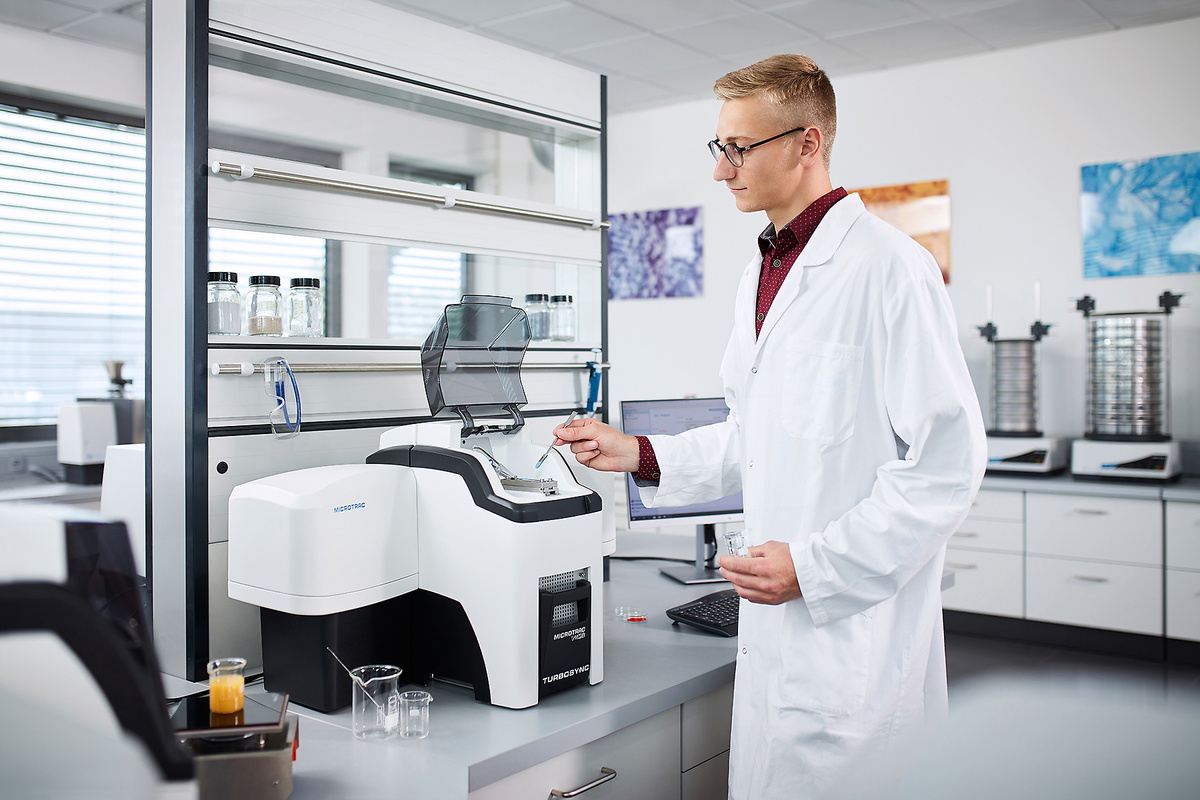
The Camsizer in action: precision characterization of fine metal powders.
Similarly, titanium alloy such as Ti-6Al-4V is critical for applications in aerospace, medical implants, and other high-performance sectors where mechanical reliability cannot be compromised. The key powder demands here include a very consistent size range for reproducible melt pools and high roundness with minimal defect content to prevent crack initiation sites. The Camsizer provides the granular data needed to detect broken or partially sintered particles and foreign granules, enabling tight morphology control that directly underpins the final part’s fatigue performance and density. By providing such detailed insights, the Camsizer becomes a strategic tool to tailor powder specifications precisely to the unique processing windows required for optimal aluminum and titanium alloy additive manufacturing systems. For laboratories focused on advanced material R&D, specialized bundles like the AO METAL + ATO Lab Plus + Camsizer x2: R&D Bundle offer comprehensive solutions for in-depth powder characterization.
Optimizing Selective Laser Sintering with Camsizer Data
The performance of a selective laser sintering 3D printer relies heavily on the quality and consistency of its powder material. Camsizer data offers actionable insights for optimizing key LPBF parameters, directly impacting the integrity and repeatability of printed parts.
Several critical process parameters are fundamentally influenced by particle characteristics:
- Re-coatability and layer uniformity: Directly dependent on powder flowability, its size distribution, and the consistency of particle shapes. Poor flow leads to streaking and uneven layers.
- Powder bed density: Controlled by how particles pack together, which is strongly tied to the distribution of sizes and overall sphericity. A denser powder bed minimizes porosity in the final part.
- Melt uniformity and laser interaction: Affected by particle surface texture and the precise ratio of fine to coarse particles, which dictates how uniformly the laser energy is absorbed and converted into melting.
By leveraging Camsizer measurements, engineers can define acceptable operational ranges for various powder metrics. This includes the median particle size and span, the precise fraction of fines and coarse particles (e.g., >X µm, <Y µm), and critical shape metrics such as aspect ratio and circularity. Adhering to these Camsizer-derived specifications directly reduces common print failures:
- Minimizing layer defects and streaking.
- Decreasing porosity, warping, and dimensional inaccuracies.
- Preventing build interruptions caused by inconsistent powder flow.
For manufacturers and operators investing in a DMLS 3D printer, integrating Camsizer-based specifications into their material qualification protocols is a strategic move. This integration not only leads to faster process development cycles but also ensures more stable production windows across different machines and powder batches, solidifying process reliability.
Beyond Particle Size: How Shape and Morphology Drive 3D Printing Performance
While particle size distribution (PSD) has long been a foundational metric, advanced additive manufacturing recognizes that particle shape and morphology are equally, if not more, critical determinants of print quality and final part performance. Metrics such as sphericity, aspect ratio, and surface roughness profoundly influence fundamental behaviors:
- Powder flow: Smooth, spherical particles exhibit lower inter-particle friction, flowing more efficiently through hoppers, feed systems, and recoaters compared to irregular or angular particles.
- Packing density: Highly spherical particles can achieve a denser packing arrangement, which directly translates to lower porosity in the consolidated part.
- Laser absorption and scattering: The surface texture and shape of particles affect how incident laser energy is absorbed or scattered at the powder bed surface, influencing melt pool formation and stability.
Crucially, particle morphology directly correlates with the mechanical properties of the 3D printed component. Irregularly shaped particles can create localized stress concentrations and contribute to increased porosity within the part, potentially acting as crack initiation sites under stress. Conversely, highly spherical and clean powders generally yield higher density parts with superior fatigue strength and better overall mechanical performance.
The Camsizer’s advanced morphology capabilities are designed to capture these intricate details. Unlike conventional 2D image analysis, which provides only a single, random orientation view, dynamic image analysis in Camsizer’s 3D mode captures up to 30 images per particle as it tumbles. This allows the software to separate distributions of length, width, and thickness for a truly three-dimensional understanding. This comprehensive data also enables the identification of defects and outliers—such as deformed, fused, or hollow particles—that would otherwise go undetected. These capabilities are vital for:
- Screening out satellites and splats: Common impurities in gas-atomized metal powders that can significantly degrade flow and print quality.
- Monitoring morphology drift: Tracking changes in particle shape and surface texture after multiple powder recycling cycles, allowing for informed decisions on powder reusability and replenishment strategies.
Integrating Camsizer into an Additive Manufacturing Quality Control Workflow
For any organization serious about scaling additive manufacturing to serial production, integrating Camsizer technology into a comprehensive quality control (QC) workflow is essential. Its precise and high-throughput capabilities allow it to fit seamlessly into multiple stages of the AM lifecycle.
1. Incoming Material Inspection: This is the first and arguably most critical point of control. Every new lot of powder can be quickly validated against pre-defined size and shape specifications using Camsizer data. This enables companies to approve or quarantine suppliers based on objective data trends, preventing substandard material from ever entering the production pipeline.
2. In-process Monitoring: Routine checks on powder taken from hoppers, feed systems, or after sieving operations can provide early detection of critical issues like contamination, agglomeration, or humidity-driven changes in flow characteristics. This proactive approach helps maintain consistent conditions throughout a build.
3. Powder Recycling Strategies: A major economic driver in AM is powder reuse. The Camsizer is indispensable for characterizing blends of virgin and used powder, tracking the accumulation of fines, spatter, and oxidized particles across multiple reuse cycles. This allows for the definition of objective limits—e.g., maximum fine content or acceptable shape deviations—to determine optimal reusability windows and ensure consistent part quality with recycled materials.
4. Troubleshooting Print Failures: When defects occur (e.g., increased porosity, delamination, rough surfaces, or dimensional inaccuracies), historical Camsizer datasets can be invaluable for root-cause analysis. Correlating shifts in size or shape distributions with specific print failures, alongside machine log data and advanced techniques like CT scanning or metallography, can rapidly pinpoint material-related issues.
From a practical implementation standpoint, the CAMSIZER 3D boasts high throughput, capable of analyzing hundreds of samples per day with autosamplers, and short measurement times (typically 2–5 minutes). This efficiency makes it suitable for both R&D and production environments. While the CAMSIZER 3D is a powerful lab tool, other variants (like the CAMSIZER ONLINE or CAMSIZER P4) offer potential for online or at-line integration, providing real-time feedback in continuous production lines. To maximize the value of this data, establishing standard operating procedures (SOPs) is crucial, covering precise sampling protocols, clear acceptance criteria for key Camsizer metrics, and standardized reporting formats for quality managers and process engineers.
Conclusion
The pursuit of excellence in additive manufacturing ultimately hinges on the quality of its foundational material: the powder. As we’ve explored, Camsizer technology stands as the indispensable guardian of this quality, delivering high-resolution, 3D-like particle size and shape analysis that directly correlates to every critical aspect of 3D printing performance. From ensuring optimal powder flowability and packing density to mitigating defect rates and enhancing the mechanical integrity and surface finish of finished parts, Camsizer data underpins reliable production.
Its strategic value cannot be overstated. By providing a quantitative basis for material qualification and in-process monitoring, Camsizer de-risks the scaling of additive manufacturing to serial production. It guarantees consistency across powder lots and machine types, supporting stringent regulatory compliance and critical customer specifications, particularly for demanding applications like aerospace and medical devices utilizing materials such as aluminum powder and titanium alloy.
For innovators pushing the boundaries of material science, incorporating advanced analytical tools like Camsizer is paramount. Solutions like the AO Metal ATO Lab Plus Camsizer X2 R&D Bundle offer comprehensive capabilities for detailed material characterization, crucial for new material development or optimizing existing ones for LPBF 3D printing. Similarly, for industries requiring impeccable precision and aesthetic quality, such as in high-value components or jewelry, specialized setups like the AO Metal ATO Lab Plus Camsizer X2 Jewelry Bundle ensure every particle meets exacting standards for your selective laser sintering 3D printer.
It’s time to elevate your understanding of powder characteristics. We encourage you to review your current powder specifications against the detailed metrics Camsizer provides. Integrate dynamic image analysis data into your material qualification and process validation frameworks to unlock unprecedented levels of print reliability and part performance, ensuring your 3D-printed creations are not just innovative, but consistently strong, safe, and ready for whatever challenges they face.
Frequently Asked Questions
What is a Camsizer, and how does it differ from traditional particle analysis methods for 3D printing powders?
A Camsizer is an advanced instrument that uses dynamic image analysis (DIA) to characterize the size and shape of particles. Unlike traditional methods like sieve analysis or static image analysis, the Camsizer captures multiple high-speed images (up to 30) of each individual particle as it falls, allowing for a 3D-like reconstruction of its true morphology. This provides a much more comprehensive understanding of particle characteristics than simple 2D measurements or bulk averages.
Why is 3D particle analysis crucial for high-quality additive manufacturing?
3D particle analysis is critical because the actual shape and dimensions of powder particles in all orientations directly influence their behavior in the powder bed. A conventional 2D analysis might miss critical defects or incorrectly estimate a particle’s volume. Camsizer’s ability to track particles in different orientations means it can accurately determine length, width, and thickness, identify irregular shapes, agglomerates, or satellites, and provide a true picture of the powder’s suitability for optimal flow, packing density, and melt pool formation in your 3D printer.
How do particle size and shape directly impact the performance of 3D printed parts?
The size and shape of powder particles fundamentally dictate how they behave in an additive manufacturing process. Good flowability (often associated with spherical particles and a controlled size distribution) ensures uniform layer spreading, preventing streaks and defects. Optimal packing density reduces porosity in the powder bed, leading to denser final parts. Irregular shapes or an uncontrolled size distribution can cause uneven melting, increased porosity, surface roughness, and ultimately compromise the mechanical properties (e.g., tensile strength, fatigue life) of the printed object.
Which metal powders benefit most from Camsizer characterization in additive manufacturing?
Materials like aluminum powder and titanium alloy (e.g., Ti-6Al-4V) are highly sensitive to particle characteristics, making them prime candidates for Camsizer analysis. For aluminum, high sphericity and a narrow size distribution are vital for flowability and preventing oxidation of fine particles. For titanium alloys, which are used in high-performance applications like aerospace and medical implants, very consistent size and morphology are crucial to ensure robust mechanical properties and minimal defect rates.
How can Camsizer data optimize DMLS 3D printing processes?
In LPBF 3D printing, Camsizer data helps optimize crucial parameters by providing precise control over powder quality. By defining acceptable ranges for median particle size, span, and shape descriptors (like aspect ratio or circularity), manufacturers can ensure ideal re-coatability, powder bed density, and laser interaction. This reduces common LPBF issues such as layer defects, warping, porosity, and dimensional inaccuracies, leading to more stable and repeatable print outcomes.
Can Camsizer help manage powder recycling strategies in additive manufacturing?
Absolutely. Camsizer is an invaluable tool for implementing effective powder recycling strategies. It can accurately characterize the changes in particle size and shape distribution of used powder, track the accumulation of fines, spatter, or oxidized particles, and monitor morphology drift across multiple reuse cycles. This data allows manufacturers to define objective limits for powder reusability and determine optimal virgin-to-recycled powder blend ratios, ensuring consistent print quality while maximizing material utilization.
What Camsizer model is recommended for additive manufacturing applications, and are there specialized bundles available?
For detailed and accurate particle characterization in additive manufacturing, the Camsizer X2 is a highly recommended model due to its precision and broad capabilities. It offers fast, reliable analysis critical for both R&D and production environments. For specific needs, specialized bundles are often available, such as an AO-Metal ATO LAB Plus & Camsizer X2 R&D Bundle for advanced research and development, or an AO-Metal ATO LAB Plus & Camsizer X2 Jewelry Bundle tailored for high-precision applications in the jewelry industry.
How does integrating Camsizer into a quality control workflow de-risk scaling up 3D printing production?
Integrating Camsizer analysis throughout the additive manufacturing lifecycle—from incoming material inspection to in-process monitoring and powder recycling—significantly de-risks scaling production. It ensures batch-to-batch consistency, helps troubleshoot print failures by correlating powder shifts with part defects, and supports material qualification and process validation. This comprehensive quality control allows manufacturers to confidently scale to serial production, meet regulatory requirements, and ensure consistent part performance across all machines and production runs.