

The landscape of additive manufacturing has evolved dramatically beyond desktop hobbyist machines, ushering in an era where unprecedented scale meets intricate design. This paradigm shift is encapsulated by large scale 3D printing, a revolutionary approach capable of producing objects significantly larger than typical builds, often starting from impressive 300 × 300 × 300 mm dimensions and extending to industrial systems capable of crafting meter-scale components. This isn’t merely about making things bigger; it’s about transforming industries by enabling the creation of complex, full-size parts that were previously unfeasible or exorbitantly expensive through traditional methods.
Large-format additive manufacturing is rapidly becoming indispensable across sectors such as aerospace, architecture, automotive, maritime, and construction. Its core advantages are profound: facilitating the production of single-piece components, which reduces assembly time and potential failure points; offering drastically faster lead times for colossal prototypes and specialized tooling; and unlocking the ability to realize highly complex, lightweight geometries at full scale. For businesses looking to innovate and streamline production, understanding the nuances of 3D printing large components is no longer optional but a strategic imperative.
This comprehensive guide delves into the intricate world of large scale 3D printing. We will explore the key technologies driving this innovation, with a particular focus on the scalable capabilities of FDM 3D printing, and examine the advanced materials, including 3D printing carbon fiber composites, that provide the necessary strength and durability. Furthermore, we’ll uncover transformative applications, from 3D printing automotive parts to intricate architectural elements, address the inherent challenges in scaling additive processes, and peer into the future trends shaping this exciting frontier.
2. Defining Large Scale Additive Manufacturing: Beyond the Desktop
When we talk about large scale 3D printing, we are fundamentally referring to additive manufacturing systems capable of producing objects significantly larger than what typical desktop or prosumer machines can handle. The primary differentiator lies in the build volume, which moves from the sub-200 mm cubes of hobbyist printers to industrial large-format systems boasting build envelopes often exceeding 0.5 cubic meters, and even reaching several meters in some advanced applications.
The distinction between a desktop unit and a truly large-format additive manufacturing system is evident in several key aspects:
- Hardware: Industrial large-scale printers feature heavier, more robust gantries, reinforced frames, and powerful, high-throughput extruders. These components are designed for stability and precision over vast print areas, often incorporating heated chambers to manage thermal conditions more effectively.
- Material Throughput: Unlike desktop printers that feed thin filaments, large-scale systems demand much higher material feed rates. This often translates to larger nozzles for rapid deposition and, crucially, the ability to utilize pellet-fed extruders for continuous, high-volume material supply.
- Process Complexity: As print size increases, so does the complexity of managing the printing process. Motion control systems must maintain extreme accuracy over long distances, thermal management becomes critical to prevent defects, and print strategies need careful optimization to ensure structural integrity across expansive layers.
These unique demands lead to specific challenges and considerations for large-format production:
- Warping and Shrinkage: Managing thermal stresses, which can cause warping and shrinkage, is paramount when printing over extended dimensions. This requires sophisticated environmental controls and material expertise.
- Print Time: While a small part might print in hours, large scale 3D printing jobs can be measured in days, or even weeks for exceptionally large or complex components. This necessitates reliable systems and continuous monitoring to mitigate failure risks.
- Risk and Cost of Failure: Given the extended print times and significant material consumption, the cost and consequence of a failed build are substantially higher compared to smaller prints. Robust quality assurance and process control are therefore critical.
These capabilities enable 3D printing large objects for use cases that are simply not viable with smaller machines. This includes full-size functional prototypes, large jigs and fixtures, foundry molds, intricate architectural elements, and even structural components for various industries.
3. Core Technologies Driving Large Scale 3D Printing
The ability to create objects of massive scale through additive manufacturing relies on several specialized technologies, each suited to different materials and applications. Among these, FDM 3D printing (Fused Deposition Modeling) or FFF (Fused Filament Fabrication) stands out as the most widespread and scalable technology for large-format polymer parts.
The principle behind FDM involves the layer-by-layer extrusion of thermoplastic materials or composites through a heated nozzle. This process, familiar to many desktop users, is engineered for industrial scale through significant enhancements:
- Larger Nozzles and Higher Flow Rates: To build large objects efficiently, industrial FDM systems employ much wider nozzles and extruders capable of significantly higher material flow rates, depositing more material per unit of time.
- Pellet-Fed Extruders: Moving beyond filament spools, many large-format FDM printers utilize pellet-fed extruders. This allows for continuous material feeding, reducing interruptions, and often leveraging more cost-effective bulk polymer pellets.
- Gantry Systems or Robotic Arms: To cover vast build volumes, these printers often employ heavy-duty gantry systems or integrate industrial robotic arms, providing the necessary reach and precision. An example of a high-precision industrial system like the Nexa3D NXE400 demonstrates the kind of advanced engineering required for industrial-scale additive manufacturing.
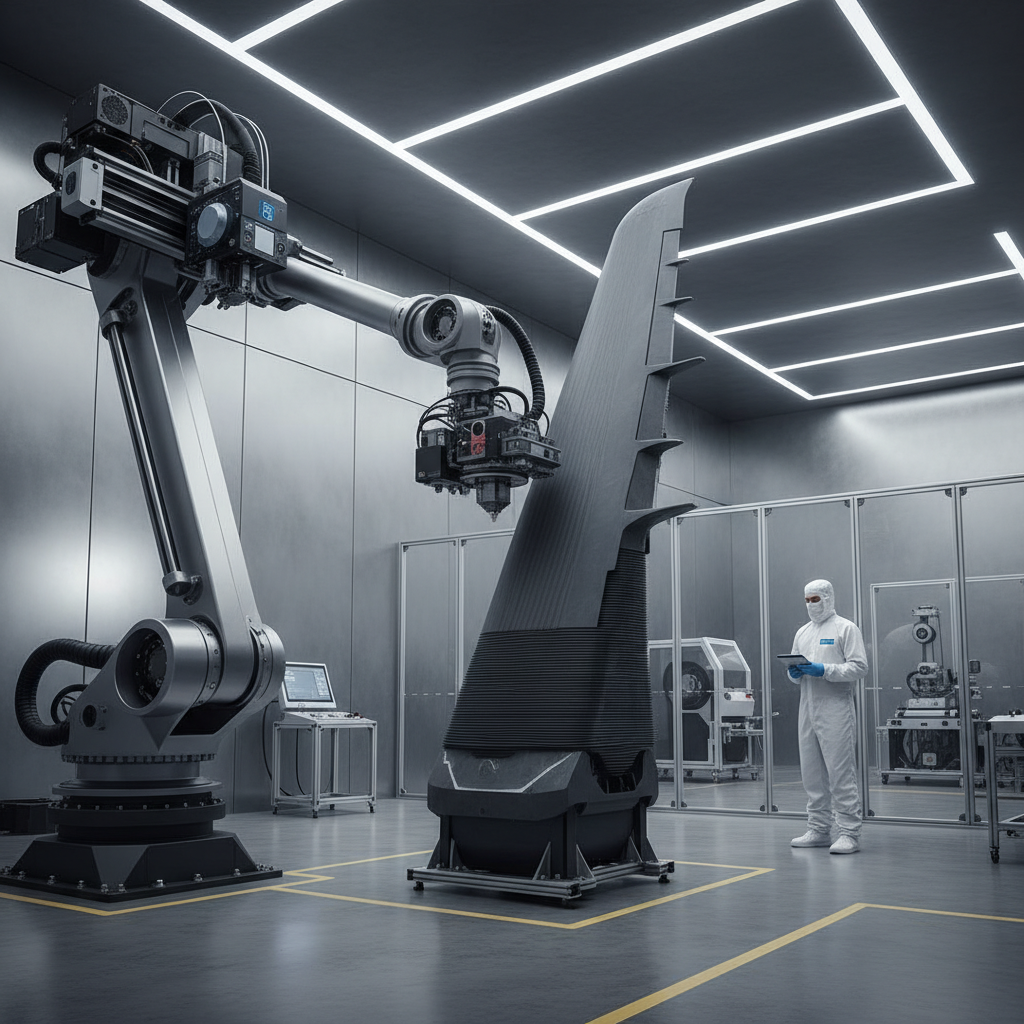
Typical large-format FDM applications include industrial prototypes, robust tooling, jigs and fixtures for manufacturing lines, patterns and molds for casting, and full-scale models for design validation.
Beyond FDM, other significant large-scale additive manufacturing methods include:
- Robotic Arm Additive Manufacturing (RAAM) / Wire-Arc Additive Manufacturing (WAAM) for Metals: WAAM systems use an arc welding process with metal wire feedstock and a robotic arm to build very large metal parts. This technology is capable of fabricating components like pressure vessels, large fuselage panels, or repairing massive turbine blades, offering a significant advantage for large structural metallic components.
- Large-Format Sand/Binder Jetting: This process involves depositing a binder onto layers of sand to create complex molds and cores for traditional metal casting. It enables faster, more cost-effective production of intricate casting tooling, crucial for industries requiring large, custom metal parts.
- Concrete / Mortar-Based Construction Printing: For the construction sector, giant robotic systems can extrude concrete or mortar to print entire building components, walls, or even full structural elements directly on site, revolutionizing construction methods.
The selection of a specific large scale 3D printing technology ultimately depends on a range of factors including the desired material, the size and precision requirements of the part, and its intended application. For instance, creating large polymer tools will likely favor FDM, while large metal structures would lean towards WAAM, and architectural molds might utilize sand binder jetting.
4. Materials for Mass and Strength: The Role of Advanced Composites
Material selection is a foundational decision in large scale 3D printing, directly impacting a part’s performance, durability, and cost-effectiveness. The requirements for 3D printing large objects necessitate materials that offer both structural integrity and processability at scale.
Broadly, materials for large-scale additive manufacturing fall into several categories:
- Polymers: Common engineering thermoplastics like ABS, PLA, PETG, PC (Polycarbonate), Nylon, and various high-temperature thermoplastics form the backbone for many large polymer prints. Materials such as KS158T Transparent , KS608A , UV Resin KS168C , and KS408A highlight the diversity and specialization available in industrial-grade polymer resins for other high-precision additive processes like SLA.
- Composite Polymers: These are crucial for enhancing the mechanical properties of prints. Carbon fiber reinforced and glass fiber reinforced filaments or pellets significantly improve a part’s stiffness, strength, and dimensional stability, making them ideal for demanding large-scale applications.
- Metals: Via processes like WAAM or large-format metal powder bed systems, materials such as aluminum, steel alloys, and high-performance superalloys like Inconel can be printed. These are critical for structural parts, high-load tooling, and components in industries like aerospace and energy.
- Sand and Binders: Specifically for large foundry molds and cores, specialized sands are combined with chemical binders to create robust and precise casting patterns.
The increasing emphasis on 3D printing carbon fiber and other advanced composites is a game-changer for large parts. These materials offer an exceptional strength-to-weight ratio and high stiffness, which are vital for manufacturing large components without excessive mass. The integrated fibers help reduce deformation and improve accuracy over long print spans, mitigating issues like warping. Consequently, these materials are widely adopted in industries requiring robust, lightweight solutions, including aerospace, automotive, marine, and industrial tooling.
When selecting materials for large-scale projects, several criteria are paramount:
- Mechanical Properties: Essential considerations include tensile strength, flexural stiffness, impact resistance, and fatigue life, especially for parts subject to high stresses.
- Thermal Resistance and Environmental Durability: The ability of a material to withstand operating temperatures, chemical exposure, and environmental factors is critical for the longevity and functionality of large parts.
- Weight vs. Stiffness Trade-offs: For applications like aerospace or transportation, achieving an optimal balance between low weight and high stiffness is crucial for operational efficiency.
- Cost and Availability: The economic viability of a large-scale project often depends on the cost and readily available forms (e.g., pellets, large spools, or bulk powders) of the chosen material.
5. Transformative Applications Across Industries
The capabilities of large scale 3D printing are translating into transformative applications across a diverse array of industries, enabling innovations previously impossible or prohibitively expensive.
- Aerospace: This sector heavily leverages large scale 3D printing for manufacturing extensive tooling, layup molds for composites, drill templates, and complex assembly jigs. These large, custom tools drastically reduce lead times and costs compared to traditional manufacturing. The technology also facilitates the production of lightweight structural or semi-structural parts using high-performance polymers and composites, contributing to fuel efficiency and performance.
- Automotive: The automotive industry is a prime beneficiary, with 3D printing automotive parts ranging from full-scale vehicle prototypes and interior/exterior panels to bumpers. This accelerates design iteration and reduces development cycles. Furthermore, large-format printers are invaluable for creating jigs, fixtures, and factory tooling directly on the assembly line, improving production efficiency and customization. For low-volume models or specialized components, 3D printing enables cost-effective production of end-use parts and spares.
- Construction & Architecture: In architecture and construction, large-scale additive manufacturing is used to produce intricate formwork, molds, and patterns for concrete and facade elements. This allows for unparalleled design freedom and customization. Directly printed large architectural elements and full-scale models serve as crucial tools for client validation and construction planning.
- Marine & Maritime: The shipbuilding and marine industries utilize large scale 3D printing for components like propellers, large hull sections, and expansive molds for composite boat hulls. It also supports the creation of large fixtures for assembly and repair within shipyards, enhancing efficiency and reducing downtime.
- Energy & Industrial Equipment: This sector benefits from large-scale printing of patterns and molds for casting massive components, such as parts for wind turbines, industrial pumps, and specialized housings. Custom tooling and replacement parts can also be fabricated rapidly for maintenance and repair operations in power plants and industrial facilities.
- Art & Sculpture: Artists and sculptors are embracing large-format 3D printing to create immense, intricate sculptures, installations, and public art pieces. The technology’s ability to realize complex geometries at scale provides unprecedented creative freedom.
Across all these sectors, the key benefits are consistent: significantly faster design iteration and time-to-market, substantial cost reduction for one-off parts, prototypes, and low-volume production compared to traditional fabrication, and the ability to achieve part consolidation and lighter, more efficient geometries.
6. Navigating the Challenges of Large Scale Additive Manufacturing
While the benefits of large scale 3D printing are immense, successful implementation requires careful consideration of several practical challenges. Understanding these hurdles is key to optimizing processes and realizing the full potential of the technology.
- Build Time and Throughput: One of the most significant challenges is the extensive time required for large prints. Jobs often span many hours or even days. Strategies to mitigate this include using larger nozzles, thicker layer heights, and advanced print path optimization to maximize material deposition without compromising part quality.
- Material and Operating Costs: Large scale 3D printing consumes considerable amounts of material, particularly when using advanced composites and engineering-grade polymers, which are often more expensive than standard plastics. Furthermore, the energy usage for operating heated build chambers and high-power extruders over extended periods contributes to higher operating costs. Accurate cost modeling against alternative manufacturing methods is essential to justify the investment.
- Quality Control for Large Parts: Maintaining dimensional accuracy over extended dimensions presents a substantial quality control challenge. Managing warping, residual stresses, and ensuring consistent layer adhesion and material density throughout a voluminous part are critical. This necessitates rigorous in-process monitoring and robust quality assurance workflows to prevent costly failures.
- Post-processing Requirements: Once a large part is printed, it often requires significant post-processing. This can include removal of extensive support structures, surface finishing (sanding, polishing), machining of critical interfaces for assembly, and application of coatings or paint for aesthetic or functional purposes. These steps add to the overall lead time and cost.
- Design Optimization: Successfully designing for large scale 3D printing requires a specialized approach known as Design for Additive Manufacturing (DFAM). This involves optimizing part geometry for the specific process, leveraging features like internal lattice structures for lightweighting, strategically placed ribbing for strength, and considering whether to print a single monolithic part or segment it for later assembly, balancing integrity with printability.
- Equipment Investment and Integration: The capital investment for large-format additive manufacturing systems can be substantial, along with the required factory footprint and infrastructure (power, ventilation). Integrating these sophisticated machines into existing production workflows demands specialized training for operators, strict safety protocols, and a comprehensive strategy for seamless integration.
Addressing these challenges systematically is paramount for organizations looking to scale their additive manufacturing capabilities.
Awesome Things Made with Giant 3D Printers!
So, what cool stuff are people actually making? You’d be surprised! The ability to 3D print large components isn’t just a novelty; it’s transforming entire sectors by enabling unprecedented speed, customization, and design freedom at scale.
Transformative Applications Across Industries
The versatility of large scale 3D printing extends far beyond simple prototypes, fundamentally changing how various industries approach design, manufacturing, and supply chains.
- Aerospace: This industry demands precision and lightweight strength. Large scale 3D printing is instrumental in producing enormous tooling, such as layup molds for composite aircraft parts, drill templates, and assembly jigs. These printed tools are significantly lighter and cheaper to produce than traditional metal counterparts, accelerating design iterations and maintenance processes. Engineers can also create large, lightweight structural or semi-structural components using high-performance polymers and advanced composites, pushing the boundaries of aircraft design.
- Automotive: The automotive sector is rapidly adopting large scale 3D printing to innovate. When it comes to 3D printing automotive parts, manufacturers can now produce full-scale vehicle prototypes, intricate interior and exterior panels, and even functional bumpers within days, drastically cutting development cycles. Beyond prototyping, it’s revolutionizing factory operations by creating large jigs, fixtures, and custom tooling for assembly lines, leading to greater efficiency and flexibility. This also enables low-volume production or custom end-use components, allowing for niche models or personalized parts much more economically.
- Construction & Architecture: Imagine constructing buildings with bespoke designs and complex geometries. Large scale 3D printing allows for the creation of massive formwork, molds, and patterns for concrete and facade elements, giving architects unparalleled design freedom while often reducing waste and labor. Beyond molds, direct printing of large architectural elements and full-scale models assists clients in visualizing and validating designs long before breaking ground.
- Marine & Maritime: From propellers to entire hull sections, the marine industry benefits immensely. 3D printing large molds for composite boat hulls significantly reduces lead times and costs compared to traditional methods. It also enables the creation of large, customized fixtures for shipbuilding, improving precision and efficiency in vessel construction and repair.
- Energy & Industrial Equipment: This sector leverages large scale 3D printing for patterns and molds used in casting massive components, such as parts for wind turbines, pumps, or industrial housings. Additionally, custom tooling can be rapidly fabricated for maintenance and repair operations in complex plants, minimizing downtime and optimizing operational efficiency.
- Art & Sculpture: For artists, large scale 3D printing unlocks the creation of truly monumental and intricate sculptures, installations, and public art pieces that would be physically or economically unfeasible through conventional methods. It empowers designers to realize complex forms at grand scales, pushing artistic boundaries.
Across all these applications, the core benefits remain consistent: faster design iteration, significantly reduced cost for one-off or low-volume parts compared to traditional fabrication, part consolidation leading to fewer assemblies, and the creation of lighter, more efficient geometries.
While large-format FDM remains a strong solution for oversized prototypes and functional tooling, manufacturers often rely on multiple additive technologies to address varying requirements for precision, surface quality, and material performance. For highly detailed prototypes and intricate tooling components where accuracy and finish are critical, resin-based SLA printing plays a key role.
Kings 3D leverages advanced SLA systems paired with a broad portfolio of engineering-grade resins to support these needs. For example, resins such as KS408A and KS608A provide ABS-like strength, dimensional stability, and moisture resistance, making them well suited for functional prototypes and low-volume production parts in automotive and industrial applications. When superior surface finish or visual clarity is required—such as for lenses, housings, or fluid-flow models—KS158T transparent resin enables the production of clear, accurate components with excellent mechanical performance.
For demanding environments that involve elevated temperatures, HeatShield1200 (KS1208H) offers high thermal resistance and dimensional stability, making it ideal for heat-exposed prototypes or quick molds. In applications requiring tough, aesthetically consistent parts with minimal post-processing, KS808-BK delivers excellent surface quality, repeatability, and durability. Additionally, for investment casting workflows, ClearCast6080 (KS168C) provides the clean burnout and precision necessary to produce high-quality casting patterns with minimal residue.
By combining these specialized resin materials with high-precision SLA processes, Kings 3D enables manufacturers to select the optimal technology and material combination for each stage of product development—balancing speed, accuracy, and performance across a wide range of industrial applications.
Navigating the Challenges of Large Scale Additive Manufacturing
Despite its immense potential, implementing large scale 3D printing comes with its own set of sophisticated challenges that demand careful consideration and expertise.
- Extended Build Times and Throughput: While offering speed for prototypes compared to traditional methods, the actual print duration for a massive object can range from many hours to several days. Optimizing throughput involves leveraging strategies like larger nozzles, thicker layers, and advanced process optimization to balance print speed with desired part quality.
- Material and Operating Costs: The sheer volume of material required for 3D printing large parts can be substantial, especially when using engineering-grade polymers or high-performance composites like 3D printing carbon fiber. Furthermore, the energy consumption of large industrial printers operating for extended periods contributes to overall costs. Businesses must engage in robust cost modeling to compare large scale 3D printing with alternative manufacturing methods to determine the most economical solution for their specific applications.
- Quality Control for Large Parts: Maintaining dimensional accuracy over meters of material is a complex task. Managing warping, shrinkage, and residual stresses across long dimensions is critical for part integrity and requires precise thermal management and environmental control within the print chamber. Issues like layer adhesion and internal defects become exponentially more critical at scale, necessitating advanced in-process monitoring and stringent quality assurance workflows to ensure reliability.
- Post-Processing Requirements: The journey from a printed object to a finished product often involves significant post-processing. This can include the removal of support structures, intricate surface finishing, precision machining of critical interfaces for assembly, and application of coatings or paints to meet functional or aesthetic requirements. These steps add to the overall time and cost, and must be factored into the production plan.
- Design Optimization (DFAM): Designing for Additive Manufacturing (DFAM) takes on new importance for large parts. Engineers must consider unique strategies like lattice structures and internal ribbing for lightweighting, optimizing material usage while maintaining structural integrity. Deciding between a single-piece print or segmenting a larger object into smaller, more manageable sections for assembly later is another critical design decision that impacts printability, quality, and logistics.
- Equipment Investment and Integration: The capital expenditure for large scale 3D printing systems can be considerable, as can the physical footprint and infrastructure requirements (power, ventilation, material storage). Beyond the hardware, integrating these advanced systems into existing production workflows demands specialized training for operators and technicians, alongside rigorous safety protocols to ensure a secure and efficient manufacturing environment.
The Future Outlook for Large Scale Additive Manufacturing
Large scale 3D printing is not just a passing trend; it’s a foundational shift that will profoundly impact manufacturing and global supply chains. The trajectory for this technology points towards increasingly sophisticated capabilities and wider adoption.
- Technological Advancements: We can anticipate continued innovation in core technologies. This includes even higher throughput extruders capable of depositing material at unprecedented rates, more precise and adaptable robotic arms, and increasingly stable large-format platforms designed for continuous industrial operation. The material science will also advance, offering more sophisticated composite materials and high-temperature polymers that push the boundaries of mechanical and thermal performance. Crucially, improved process monitoring and automation will enhance the reliability and repeatability of large builds, making them more predictable and less prone to failure.
- Impact on Supply Chains and Production Models: Large scale 3D printing is a powerful enabler of more agile and resilient supply chains. It facilitates on-demand, localized production of large tools, fixtures, and critical spare parts, reducing reliance on distant suppliers and mitigating shipping delays. For low-volume or highly customized production runs, it significantly reduces the need for expensive, dedicated tooling, offering greater flexibility and cost savings. This technology also opens the door to mass customization of large products, from personalized vehicle components to bespoke architectural elements, transforming consumer choice and production economics.
- Sustainability Aspects: Beyond economic benefits, large scale 3D printing offers significant sustainability advantages. Its additive nature intrinsically leads to greater material efficiency and less waste compared to traditional subtractive manufacturing methods. Furthermore, the ability to create lightweight designs, particularly through 3D printing carbon fiber and other advanced composites, directly translates to reduced energy consumption during the operational life of products like vehicles and aircraft, contributing to a lower carbon footprint.
- Adoption Trajectory: As systems mature, become more reliable, and costs decline through economies of scale and innovation, the role of large scale 3D printing will continue to grow exponentially across key industries. Its increasing integration into sectors like aerospace, automotive, construction, marine, and energy will redefine manufacturing capabilities, fostering a new era of large-format innovation.
Conclusion
Large scale 3D printing stands as a testament to additive manufacturing’s incredible evolution, moving far beyond desktop prototypes to become a formidable force in industrial production. We’ve seen how this paradigm shift is defined by vastly expanded build volumes, driven by robust technologies like FDM, and enabled by advanced materials, particularly powerful [3D printing carbon fiber] composites. From the intricate tooling for aerospace to full-scale [3D printing automotive parts] and massive construction molds, the applications are as diverse as they are impactful, bringing benefits like rapid iteration, cost reduction, and unprecedented design freedom.
While the journey isn’t without its challenges—demanding significant investment, careful quality control over expansive prints, and optimized design strategies—the trajectory of innovation is clear. Future advancements promise even higher throughput, more sophisticated materials, and greater automation, further solidifying large-format additive manufacturing’s role in resilient, localized supply chains and sustainable production.
The next time you consider manufacturing, remember that the limitations of scale are rapidly dissolving. Large scale 3D printing is not just for making small toys; its super-sized cousins are out there building the future, one giant, intricately detailed layer at a time. From custom components to massive tools for demanding industries, thinking big with additive manufacturing is proving to be the most innovative way forward.
Frequently asked questions
What exactly defines "large scale 3D printing"?
Large scale 3D printing, also known as large-format additive manufacturing, refers to the production of objects significantly larger than typical desktop builds. While exact definitions vary, it generally involves build volumes starting around 300 x 300 x 300 mm and extending up to several meters, allowing for the creation of single-piece components like automotive panels, industrial tooling, or architectural elements.
What are the main technologies used for large scale 3D printing?
The most widespread technology for large-scale polymer parts is FDM (Fused Deposition Modeling) or FFF (Fused Filament Fabrication), which scales up with larger nozzles, higher flow rates, and sometimes robotic arms. Other methods include Wire-Arc Additive Manufacturing (WAAM) for very large metal components, large-format binder jetting for sand molds, and even concrete printing for construction.
Why are composite materials like carbon fiber important for large prints?
3D printing carbon fiber and other reinforced composites is crucial for large-scale applications because these materials offer an excellent strength-to-weight ratio and high stiffness. For big parts, traditional plastics might deform or lack sufficient strength. Composites provide the necessary mechanical properties, dimensional stability, and reduced weight, making them ideal for demanding sectors like aerospace, automotive, and marine.
What industries benefit most from large scale 3D printing?
Large scale 3D printing offers transformative benefits across several key industries. The automotive sector uses it for full-scale prototypes, interior/exterior panels, and manufacturing tools. Aerospace benefits from large tooling, molds, and lightweight structural components. Construction utilizes it for formwork and architectural elements, while the marine industry produces boat hulls and large fixtures. It also plays a significant role in industrial equipment and even large-scale art and sculpture.
What are some common challenges in large scale 3D printing?
Key challenges include managing long build times (often days), higher material and operating costs, and ensuring quality control over large dimensions to prevent warping or shrinkage. Post-processing requirements can also be extensive. Effective Design for Additive Manufacturing (DFAM), specifically for large parts, is critical to optimize design for the process.
Can large scale 3D printing be used for functional parts, or just prototypes?
Definitely for functional parts! While widely used for large prototypes and tooling due to faster lead times and cost efficiency, large scale 3D printing increasingly produces end-use components. With advanced materials like high-performance polymers, metals, and carbon fiber reinforced composites, industries are creating functional jigs, fixtures, customized vehicle parts, and even structural elements for various applications.
How do materials like resins factor into large-scale applications?
While FDM is dominant for sheer volume in large plastic parts, specific large-format industrial resin printers can produce high-precision, larger-than-average components.
Have a question or a project? Let’s talk.
Tell us what you need — a real applications engineer replies within 24 hours. NDA on request, no sales script.