PVA Filament For 3D Printer: A Must-Have for Complex Prints and Easy Removal
-
What Is PVA 3D Printer Filament?
-
Why Choose PVA 3D Printer Filament For Complex Prints?
-
Benefits Of Using PVA Filament
-
Best Applications For PVA Filament
-
How To Print With PVA Filament
-
Common Challenges With PVA Filament
-
Comparing PVA With Other Support Materials
When working with complex 3D prints, the right support material can make or break your project. PVA 3D printer filament (Polyvinyl Alcohol) is becoming a favorite choice for creators who need clean results without the hassle of removing supports by hand. Known for being water-soluble, flexible, and biodegradable, pva filament has opened new possibilities in dual-extrusion printing.
In this article, you’ll learn what makes PVA unique, why it’s such a valuable tool for intricate designs, and how to get the best results when using it in your own projects.
What Is 3D Printer PVA Filament?
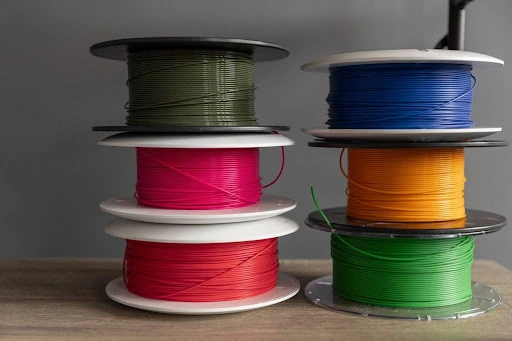
PVA filament is a support material made from polyvinyl alcohol, a synthetic polymer best known for its ability to dissolve completely in water. Unlike standard 3D printing filaments, it’s not usually used for building the final object but for creating the temporary supports that hold complex shapes in place during printing.
Its standout properties, water-solubility, flexibility, and biodegradability, make it one of the most versatile support options available today. Designers and engineers rely on PVA 3D printer filament in dual-extrusion systems, where it pairs with materials like PLA or ABS to produce detailed parts with clean finishes.
Compared to other support materials, such as HIPS (which dissolves in limonene) or standard PLA supports (which must be removed manually), PVA offers a far easier post-processing workflow. You simply submerge the model in water, and the supports disappear without tools or harsh chemicals.
Why Choose PVA 3D Printer Filament For Complex Prints?
When printing models with intricate shapes, overhangs, or hidden internal features, standard supports often create more problems than they solve. PVA filament changes that.
Because it’s water-soluble, PVA 3D printer filament allows you to print detailed designs with full confidence that the supports can be removed cleanly later. This makes it ideal for parts with delicate surfaces or structures where manual support removal would risk breaking the model.
For projects with overhangs, bridges, or curved geometries, PVA provides stable support during printing and then vanishes in a simple water bath. No cutting tools, no leftover marks, just a smooth, finished part.
This ease of use is what makes PVA a game-changer for post-processing: it saves time, reduces the chance of damage, and helps produce professional-quality results even on desktop printers.
Benefits Of Using PVA Filament
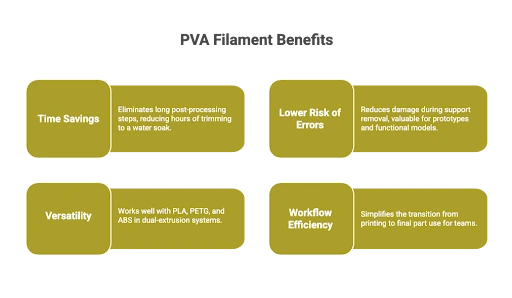
Beyond easy removal, PVA filament delivers several practical advantages that make it worth the investment:
These benefits make PVA 3D printer filament not just a convenience, but a real productivity tool for both hobbyists and professionals.
Best Applications For PVA Filament
Because it dissolves away without leaving marks, PVA filament opens the door to projects that would otherwise be difficult or impossible with traditional supports. Some of the most common uses include:
- Complex Geometries: Essential for printing lattice structures, hollow parts, or designs with hidden internal channels.
- Overhangs and Bridges: Perfect for models with steep angles or extended spans that need temporary support.
- Functional Prototypes: Allows engineers and designers to test accurate parts with smooth finishes and precise detail.
- Medical and Educational Models: Provides the clean accuracy needed for anatomical models, teaching tools, or scientific prototypes.
In these cases, PVA 3D printer filament ensures that the final print maintains its form, detail, and strength, without extra work after printing.
How To Print With PVA Filament
To get the best results with PVA filament, it’s important to follow specific printing practices and handle the material carefully.
| Category | Best Practices |
| Recommended Print Settings | – Print temp: 185–220 °C
– Bed temp: 45–60 °C – Print speed: 30–50 mm/s |
| Printer Compatibility | – Works best with dual-extrusion printers (PVA for supports, PLA/ABS/PETG for models)
– Limited results with single-extrusion printers |
| Handling & Storage | – Moisture sensitive: keep in airtight container with desiccant
– Dry filament before use if exposed to humidity |
| Post-Processing | – Submerge print in room-temp or warm water
– Agitate gently to speed up dissolution – Rinse after supports fully dissolve for a clean finish |
Common Challenges With PVA Filament
While PVA filament is incredibly useful, it does come with a few challenges that every user should keep in mind.
- Moisture Sensitivity: PVA absorbs water quickly from the air, which can cause poor extrusion and weak prints. Always store it in a sealed container with desiccant.
- Printing in Humid Conditions: If you live in a humid climate, drying the filament before use is essential for consistent results.
- Printer Settings and Calibration: Incorrect temperatures or speeds may lead to clogging or under-extrusion. Regular calibration helps avoid these issues.
- Cost Considerations: PVA 3D printer filament is more expensive than standard materials, so many users reserve it only for models that truly require soluble supports.
By addressing these challenges with proper handling and optimized printer settings, you can get the best performance from PVA filament without wasted material or failed prints.
Comparing PVA With Other Support Materials
Not all support materials perform the same, and understanding their differences helps you choose the right one for your project. Here’s a closer look at how PVA filament stacks up against the most common alternatives:
PVA vs. HIPS
- Dissolution Method: PVA dissolves in plain water, while HIPS requires limonene, a chemical solvent that can be costly, smelly, and harder to dispose of safely.
- Printer Pairing: HIPS is often used with ABS because both adhere well, but it’s less effective with PLA. PVA, on the other hand, bonds well with PLA, PETG, and other popular materials.
- Environmental Impact: PVA is biodegradable, while HIPS is petroleum-based and less eco-friendly.
PVA vs. PLA (used as support)
- Ease of Removal: PLA supports must be broken off manually, which can damage fine details. PVA dissolves away, protecting fragile surfaces and delicate features.
- Surface Quality: PLA supports often leave marks, requiring sanding or polishing. With PVA, you can achieve clean, smooth finishes without extra effort.
- Application Fit: PLA supports are fine for simple geometries. For complex, intricate models, PVA 3D printer filament is far more reliable.
PVA vs. Breakaway Supports
- Speed vs. Finish: Breakaway supports are quick to remove but rarely leave a perfect surface. PVA takes longer (soaking time in water) but delivers much cleaner results.
- Use Case: Breakaway is useful for prototypes where speed matters more than aesthetics. PVA is ideal when precision and surface quality are priorities.
- Risk of Damage: Breakaway supports can snap off small parts by accident. PVA eliminates this risk since it dissolves instead of being pulled away.
In short, PVA is not always the cheapest or fastest option, but when the goal is professional-grade results, delicate parts, and smooth finishes, PVA filament outperforms most alternatives.
FAQ
1. How long does it take to dissolve PVA filament in water?
You’ll usually see PVA soften and start peeling away within 10–15 minutes of soaking in warm water, especially with light agitation. For full dissolution, plan on a few hours, depending on the print’s size and complexity. Even a short soak, about 10 minutes, can make a big difference: you can manually remove parts with pliers, then continue soaking to clear the rest.
2. Can I use PVA filament on a single-extrusion 3D printer?
Technically, yes, but it’s far from ideal. Without a separate support extruder, the PVA and model material must share the same nozzle, which risks mixing, poor print quality, and stranded filament lines that don’t dissolve cleanly. Dual-extrusion systems, especially IDEX (independent dual extruders), offer the cleanest, most reliable results with PVA.
3. How do I prevent PVA filament from absorbing moisture during storage?
PVA is extremely hygroscopic; it can weaken or clog if exposed to humidity. Store it in an airtight container with desiccant, ideally under 20% RH (relative humidity). If the filament has already absorbed moisture, use a filament dryer or warm oven before printing to restore performance.
4. Can I use PVA with all types of 3D printing filaments?
PVA pairs best with PLA, PETG, and ABS, especially in dual-extrusion setups. Be cautious when pairing with nylon; some users report that nylon prints become soft or weakened after soaking, possibly due to water absorption. This isn’t a universal issue, but it’s wise to test small prints first.
5. Is PVA biodegradable, and what are its environmental benefits?
Yes, PVA 3D printer filament is biodegradable and water-soluble, making it significantly more eco-friendly than petroleum-based alternatives like HIPS. When disposing of the water used for dissolving PVA, it’s generally safe to run it down the drain (especially if connected to a wastewater treatment system), though you should check local regulations.
Related Posts