
1. Introduction
Additive manufacturing, commonly known as 3D printing, has fundamentally transformed modern product development, prototyping, and small-to-large scale manufacturing. Unlike traditional subtractive methods—where material is cut away from a solid block—additive manufacturing builds parts layer by layer directly from digital CAD data, enabling greater design freedom, reduced material waste, and faster production cycles.
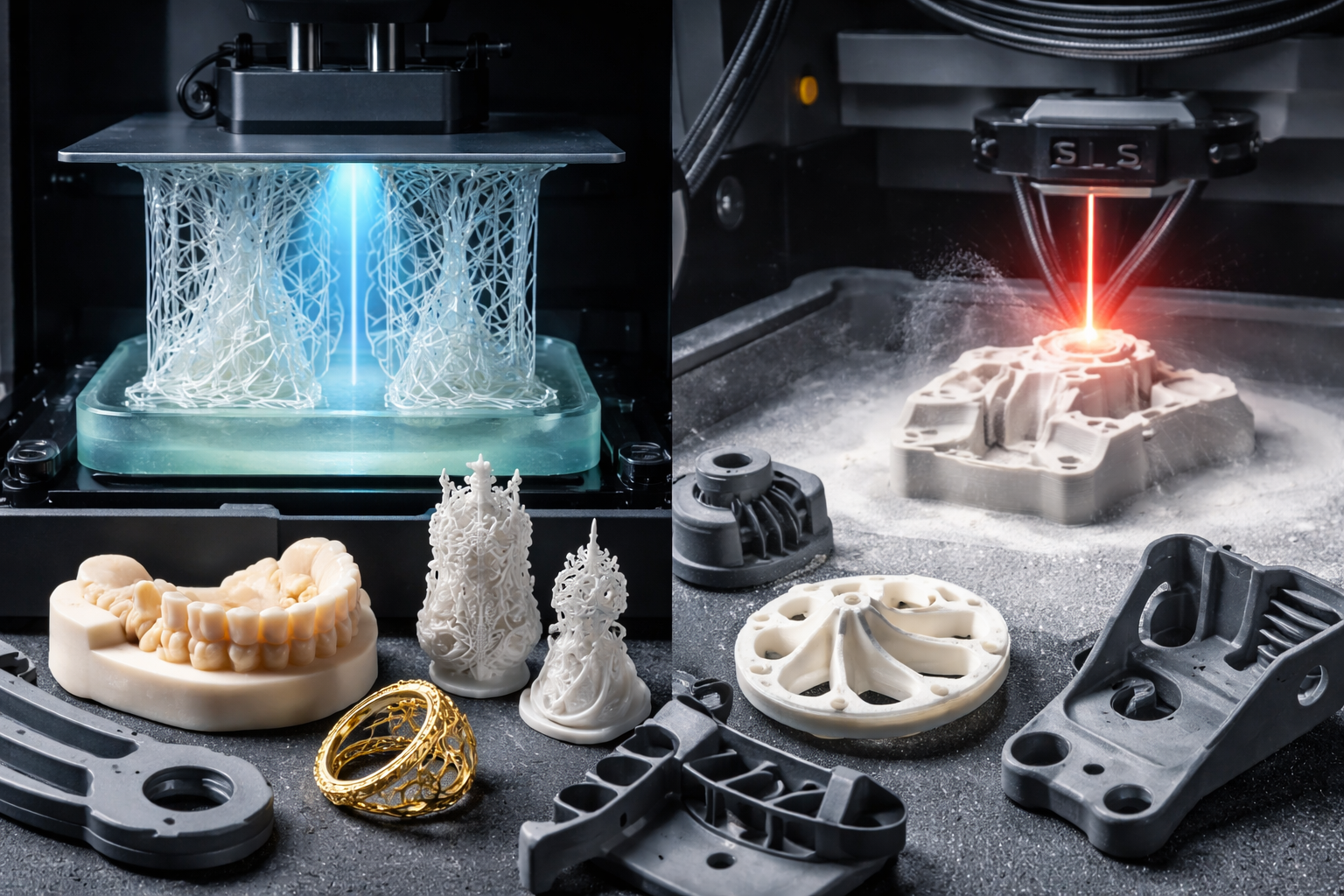
Among the many additive manufacturing technologies available today, SLA (Stereolithography) and SLS (Selective Laser Sintering) are two of the most widely used and established polymer-based processes in industrial applications. Both are laser-driven technologies, but they differ significantly in how materials are processed and what types of parts they produce.
SLA (Stereolithography) uses a UV laser to cure liquid photopolymer resin into highly detailed solid parts. It is widely recognized for producing components with exceptional surface finish, sharp details, and high visual fidelity, making it a preferred choice for prototypes, dental models, jewelry patterns, and design validation parts where aesthetics and precision are critical.
In contrast, SLS (Selective Laser Sintering) uses a high-powered laser to fuse powdered thermoplastic materials such as nylon. This process does not require support structures and produces parts that are highly durable, mechanically strong, and suitable for functional testing and end-use applications. Because of its strength and design freedom, SLS is commonly used in industries such as automotive, aerospace, and industrial manufacturing.
While both SLA and SLS play a crucial role in modern engineering workflows, they are optimized for different outcomes. SLA is typically chosen when surface quality, fine detail, and accuracy are the top priorities. On the other hand, SLS is preferred when strength, durability, and functional performance are more important than surface aesthetics.
Selecting the right technology depends on several critical factors, including cost efficiency, mechanical performance, production volume, post-processing requirements, and final application needs. Understanding these differences allows engineers, designers, and manufacturers to choose the most suitable process for each stage of product development.
For professional-grade production and reliable manufacturing support, you can explore the following services:
2. What is SLA 3D Printing?
SLA (Stereolithography) is one of the earliest and most widely adopted resin-based 3D printing technologies, known for its ability to produce parts with exceptional detail and smooth surface quality. It is primarily used in applications where visual appearance, dimensional accuracy, and fine feature resolution are critical.
SLA is especially popular in industries such as product design, dental manufacturing, jewelry prototyping, and engineering visualization, where even the smallest surface imperfections can impact the quality of the final output.
2.1 Process Overview
SLA (Stereolithography) works by using a high-precision UV laser to selectively cure and solidify liquid photopolymer resin. The process begins with a digital 3D model, which is sliced into extremely thin layers by specialized software.
During printing, the UV laser traces each cross-section of the model onto the surface of a resin vat. Wherever the laser touches, the liquid resin hardens instantly. After one layer is completed, the build platform moves slightly, allowing the next layer of resin to be cured on top of the previous one.
This layer-by-layer photopolymerization process continues until the full object is formed. Once printing is complete, parts are typically removed from the build platform, cleaned of excess resin, and post-cured under UV light to achieve maximum strength and stability.
2.2 Key Characteristics
SLA 3D printing is widely recognized for its high-resolution output and superior surface quality, making it one of the best technologies for visually critical and detail-sensitive applications.
Key characteristics include:
- Extremely high detail and precision
SLA can reproduce very fine features, sharp edges, and complex geometries with outstanding accuracy. - Smooth surface finish suitable for visual models
Parts require minimal post-processing, making them ideal for presentation models, prototypes, and aesthetic components. - Requires support structures during printing
Overhangs and complex geometries need supports, which are removed after printing and may require minor finishing. - Ideal for fine-featured components
Best suited for intricate designs where dimensional accuracy and visual clarity are more important than mechanical strength.
Because of these characteristics, SLA is often the preferred choice for design validation, concept modeling, and high-detail prototyping.
2.3 SLA Materials
SLA technology uses a variety of photopolymer resins, each engineered for specific mechanical and visual properties. These materials allow users to tailor prints based on performance requirements, flexibility, and durability.
Common SLA resin types include:
- Standard resins for prototypes
Used for general-purpose models, concept validation, and visual prototypes where high strength is not required. - Tough and durable engineering resins
Designed for functional testing and mechanical parts that require improved impact resistance and durability. - Flexible resins for rubber-like parts
Ideal for components that need bending, compression, or elasticity, such as grips, seals, and wearable prototypes. - Castable and high-temperature resins for specialized applications
Used in industries like jewelry and dental manufacturing, as well as applications requiring heat resistance or investment casting compatibility.
3. What is SLS 3D Printing?
SLS (Selective Laser Sintering) is a powerful industrial-grade 3D printing technology that uses powdered thermoplastic materials to create strong, functional parts. Unlike resin-based systems, SLS is designed primarily for durability, mechanical performance, and end-use applications, making it one of the most widely used technologies in engineering and manufacturing environments.
SLS is especially valuable for producing parts that must withstand real-world stress, mechanical load, and long-term usage, such as functional prototypes, housings, brackets, and production components.
3.1 Process Overview
SLS (Selective Laser Sintering) works by using a high-powered laser to selectively fuse powdered thermoplastic materials layer by layer. The process begins with a thin layer of polymer powder—commonly nylon—spread across the build platform inside a heated chamber.
A laser then scans the cross-section of the 3D model and fuses the powder particles together only in the designated areas. Once a layer is completed, a new layer of powder is spread over the build surface, and the process repeats.
A key advantage of SLS is that unsintered powder remains in place and acts as a natural support structure, meaning no additional support material is required. This allows for the production of highly complex geometries, including internal channels, lattice structures, and interlocking components that would be difficult or impossible with other technologies.
After printing, parts are cooled, removed from the powder bed, and cleaned before optional post-processing steps such as bead blasting or surface finishing.
3.2 Key Characteristics
SLS is widely valued in industrial manufacturing due to its combination of strength, design freedom, and production efficiency.
Key characteristics include:
- Strong, functional end-use parts
SLS parts exhibit excellent mechanical strength, impact resistance, and long-term durability, making them suitable for real-world applications. - Capable of producing complex geometries
The powder-bed process enables highly intricate designs, including internal cavities, snap-fits, and lightweight lattice structures. - No support structures required
Unfused powder naturally supports the part during printing, eliminating the need for support removal and reducing post-processing time. - Suitable for production-grade applications
SLS is commonly used not just for prototyping, but also for low- to mid-volume manufacturing and final end-use parts across multiple industries.
Because of these advantages, SLS is often chosen when mechanical performance and design flexibility are more important than surface aesthetics.
3.3 SLS Materials
SLS supports a wide range of engineering-grade thermoplastic powders, making it highly versatile for industrial applications.
Common SLS materials include:
- Nylon (PA12, PA11)
The most widely used SLS materials, offering excellent strength, flexibility, chemical resistance, and dimensional stability. - TPU flexible powders
Used for elastomer-like parts that require flexibility, impact absorption, and rubber-like behavior. - Glass-filled and carbon-filled composites
Reinforced materials designed for higher stiffness, improved thermal resistance, and enhanced structural performance.
These materials make SLS ideal for manufacturing durable industrial components, including functional prototypes, enclosures, mechanical assemblies, automotive parts, and aerospace-grade applications.
4. SLA vs SLS Key Differences
Although both SLA and SLS are laser-based additive manufacturing technologies, they differ significantly in terms of material behavior, mechanical performance, and ideal use cases. Understanding these differences is essential for selecting the right process for product development, prototyping, or production.
Material Type
The most fundamental difference between the two technologies lies in the material form used during printing.
- SLA uses liquid photopolymer resin, which is cured layer by layer using a UV laser. This allows for extremely fine detail but results in parts that are typically more brittle compared to thermoplastics.
- SLS uses powdered thermoplastics, such as nylon, which are fused together using a high-powered laser. This creates strong, durable parts suitable for functional applications.
This difference in material structure directly influences the final part properties, including strength, flexibility, and heat resistance.
Strength vs Aesthetics
SLA and SLS are often chosen based on whether the priority is visual quality or mechanical performance.
- SLA excels in visual quality and surface finish, producing parts that are smooth, highly detailed, and ideal for presentation or design validation. It is commonly used when appearance and precision are critical.
- SLS excels in mechanical strength and functionality, producing rugged parts capable of withstanding stress, impact, and long-term use.
In short, SLA is typically chosen for appearance-focused applications, while SLS is preferred for engineering-grade functionality.
Accuracy vs Durability
Both technologies offer precision, but their strengths differ depending on the intended application.
- SLA offers extremely fine detail and high dimensional accuracy, making it suitable for intricate designs, small features, and visually complex models.
- SLS provides superior durability and structural integrity, making it ideal for parts that must perform reliably under real-world mechanical loads.
This tradeoff means SLA is often used in early-stage design and visualization, while SLS is used for functional testing and end-use parts.
Support Structures
Support requirements also differ significantly between SLA and SLS.
- SLA requires support structures to hold overhangs and complex geometries during printing. These supports must be removed after printing and may require additional finishing.
- SLS does not require support structures, because the unused powder surrounding the part naturally supports the geometry during printing.
This makes SLS more efficient for complex designs and reduces post-processing time.
Scalability
Production scalability is another key differentiator between the two technologies.
- SLA is best suited for prototypes and small-batch production, especially where high detail and surface quality are required.
- SLS is better suited for batch production and end-use manufacturing, as multiple parts can be nested within the powder bed, improving throughput and efficiency.
SLS is often used in production environments where repeatability and volume are important.
Cost Efficiency
Cost considerations vary depending on project type and production scale.
- SLA is generally more cost-effective for prototyping, especially when producing highly detailed models in low volumes. However, post-processing and support removal can add time and labor costs.
- SLS becomes more cost-efficient for production runs, as multiple parts can be produced simultaneously without support structures, reducing material waste and labor.
In practice, SLA is often chosen for design iteration and validation, while SLS is preferred for functional production parts and scalable manufacturing.
5. Pros and Cons of SLA 3D Printing
SLA (Stereolithography) is widely recognized for its exceptional precision and surface quality, making it one of the most preferred technologies for visual prototyping and high-detail applications. However, like any manufacturing process, it also has certain limitations that must be considered when selecting it for production.
5.1 Pros of SLA 3D Printing
SLA offers several significant advantages, particularly in applications where detail, accuracy, and surface finish are the highest priorities.
Extremely high resolution and fine detail
SLA is capable of producing parts with micron-level precision, allowing it to reproduce extremely small features, sharp edges, and intricate geometries. This makes it ideal for complex designs that require exceptional dimensional accuracy.
Smooth surface finish requiring minimal post-processing
One of SLA’s most notable advantages is its exceptionally smooth surface quality straight off the printer. Unlike many other 3D printing technologies, SLA parts often require only light sanding or polishing, making them suitable for presentation-ready models and aesthetic applications.
Ideal for visual prototypes and presentation models
SLA is widely used for concept validation, design reviews, and client presentations, where visual appeal and detail accuracy are critical. It allows designers to produce highly realistic prototypes that closely resemble final production parts.
Excellent for molds and casting patterns
Due to its precision and smooth finish, SLA is commonly used to create master patterns for investment casting and mold-making. This is especially important in industries such as jewelry manufacturing and precision engineering.
Widely used in dental, jewelry, and product design industries
SLA has strong adoption in specialized industries where accuracy is essential. In dental applications, it is used for models, aligners, and surgical guides. In jewelry design, it is widely used for wax casting patterns and intricate prototypes. It is also commonly used in industrial product design for early-stage development and visualization.
5.2 Cons of SLA 3D Printing
Despite its advantages, SLA also has several limitations that restrict its use in certain functional and industrial applications.
More brittle compared to thermoplastics
SLA parts are generally more rigid and brittle compared to SLS or injection-molded thermoplastics. This makes them less suitable for applications that require high impact resistance or long-term mechanical stress.
Requires support structures
SLA printing requires support structures for overhangs and complex geometries. These supports must be manually removed after printing, which can add extra time and may leave minor surface marks that require post-processing.
Limited mechanical strength for functional parts
While some engineering-grade resins exist, SLA parts typically have lower mechanical strength compared to thermoplastic materials, making them less ideal for load-bearing or high-stress applications.
Resin handling requires care and post-processing
SLA involves working with liquid photopolymer resins, which require careful handling due to their chemical nature. After printing, parts must undergo cleaning and UV post-curing to achieve full material properties, adding extra steps to the workflow.
UV exposure can degrade material over time
SLA materials can be sensitive to long-term UV exposure, which may cause discoloration or material degradation over time. This makes SLA parts less suitable for outdoor or long-term functional applications without protective coatings.
6. Pros and Cons of SLS 3D Printing
SLS (Selective Laser Sintering) is a highly versatile and industrially robust 3D printing technology widely used for functional prototyping and end-use production parts. It is especially valued in engineering environments where mechanical performance, design freedom, and production efficiency are more important than surface aesthetics. However, it also comes with certain limitations that should be considered when selecting it for a project.
6.1 Pros of SLS 3D Printing
SLS offers a strong combination of durability, flexibility, and manufacturing efficiency, making it one of the most powerful additive manufacturing solutions for industrial applications.
Strong and durable functional parts
SLS produces parts with excellent mechanical strength, impact resistance, and long-term durability. Nylon-based materials used in SLS make it suitable for functional testing, mechanical assemblies, and even end-use components in demanding environments.
No support structures required
One of the biggest advantages of SLS is that it does not require support structures. The unsintered powder acts as a natural support medium, allowing complex geometries to be printed without additional material or post-processing for support removal. This significantly reduces design limitations and production time.
Excellent for complex internal geometries
SLS enables the production of highly complex and innovative designs, including internal channels, hollow structures, lattice designs, and interlocking components. These features are difficult or impossible to achieve with traditional manufacturing methods.
Suitable for batch production
SLS is highly efficient for small to medium batch production, as multiple parts can be nested within a single build chamber. This improves throughput and reduces per-part cost, making it ideal for scalable manufacturing and on-demand production.
Wide material selection (nylon and composites)
SLS supports a range of engineering-grade thermoplastics, including nylon (PA12, PA11), TPU flexible materials, and reinforced composites such as glass-filled or carbon-filled powders. This allows engineers to tailor material properties based on strength, flexibility, or thermal resistance requirements.
6.2 Cons of SLS 3D Printing
While SLS is highly capable, it also has certain drawbacks, particularly in terms of surface finish and operational costs.
Rougher surface finish compared to SLA
SLS parts typically have a slightly grainy or textured surface due to the nature of powdered material sintering. While this is acceptable for functional parts, it is less suitable for applications requiring smooth, aesthetic finishes without post-processing.
Higher production and machine costs
SLS systems are generally more expensive to operate compared to SLA or filament-based systems. The equipment cost, material handling, and energy requirements contribute to higher production costs, especially for low-volume projects.
Powder handling and recycling required
SLS uses fine polymer powders that require careful handling, storage, and recycling processes. Unused powder is often reused, but it must be properly managed to maintain material quality and consistency.
Limited color options (typically white, gray, or black)
Most SLS materials are available in neutral colors only, such as white, gray, or black. This limits aesthetic customization unless additional post-processing or dyeing is applied.
Some post-processing may still be required
Although SLS does not require support removal, parts often still need cleaning, powder removal, bead blasting, or surface finishing to achieve the desired final appearance and texture.
7. SLA vs SLS Applications
SLA and SLS technologies are widely used across multiple industries, but they serve very different application needs. SLA is primarily chosen for high-detail, visually accurate models, while SLS is preferred for durable, functional, and production-ready components. Understanding where each technology excels helps engineers and designers select the most efficient manufacturing approach for their projects.
7.1 SLA Applications
SLA 3D printing is best suited for applications where precision, surface quality, and fine detail are essential. It is widely used in industries that prioritize visual accuracy and intricate geometry over mechanical strength.
Dental models and orthodontic applications
SLA is extensively used in the dental industry for producing high-precision dental models, surgical guides, aligners, and orthodontic planning tools. Its ability to reproduce extremely fine anatomical details makes it ideal for medical-grade visualization and treatment planning.
Jewelry prototypes and casting patterns
In jewelry manufacturing, SLA is used to create high-detail wax patterns and master models for investment casting. The smooth surface finish and fine feature resolution allow jewelers to produce intricate designs that can be directly cast into metal with minimal finishing.
Medical visualization models
SLA is widely used in healthcare for anatomical models, pre-surgical planning, and patient-specific visualization tools. These models help surgeons better understand complex anatomy and improve surgical accuracy and outcomes.
High-detail product design and concept modeling
Product designers use SLA to produce realistic prototypes during early-stage development. These models are ideal for design validation, stakeholder presentations, and visual communication because they closely resemble the final product in appearance and detail.
7.2 SLS Applications
SLS 3D printing is widely used in industrial environments where strength, functionality, and production efficiency are required. It is one of the most trusted technologies for manufacturing end-use parts and engineering-grade components.
Functional engineering components
SLS is commonly used to produce mechanical parts, snap-fits, housings, brackets, and load-bearing structures. Its strong nylon-based materials make it suitable for real-world mechanical performance testing and functional use.
Automotive interior and exterior parts
In the automotive industry, SLS is used for interior components, ducting systems, brackets, and custom fixtures. It allows manufacturers to produce durable parts with complex geometries while reducing tooling costs.
Aerospace housings and brackets
SLS is widely adopted in aerospace applications for producing lightweight yet strong structural components, such as housings, mounting brackets, and airflow systems. Its ability to create complex, lightweight designs is particularly valuable in aerospace engineering.
Industrial tooling and fixtures
Manufacturers use SLS for custom jigs, fixtures, assembly tools, and production aids. These tools help streamline manufacturing processes and reduce downtime by enabling rapid production of custom tooling solutions.
End-use production parts
Unlike many prototyping technologies, SLS is capable of producing final, functional end-use parts. Its durability and scalability make it suitable for low- to medium-volume production runs across multiple industries.
8. SLA 3D Printing Services in Los Angeles
Professional SLA 3D printing services in Los Angeles provide access to high-resolution, production-grade resin manufacturing for companies, engineers, designers, and startups that require fast and accurate prototyping solutions. These services are especially valuable in fast-paced industries where design iterations, visual validation, and rapid product development are critical to success.
SLA services leverage advanced stereolithography systems to produce parts with exceptional surface finish, tight tolerances, and intricate detail reproduction, making them ideal for applications where aesthetics and precision are essential.
Professional SLA Manufacturing Capabilities
SLA manufacturing services in Los Angeles focus on delivering high-precision resin parts for a wide range of applications, including product design, engineering validation, medical modeling, and presentation prototypes. By using industrial-grade SLA systems and engineering resins, these services ensure consistent quality and reliable performance across all printed parts.
Whether it is a single prototype or a small batch production run, SLA services are designed to support rapid iteration cycles and high-detail output requirements.
Benefits of SLA 3D Printing Services
Fast turnaround for Los Angeles-based projects
Local SLA manufacturing enables quick production and delivery times, which is essential for companies working under tight deadlines. Rapid turnaround helps reduce development cycles and accelerates time-to-market for new products.
High-precision prototyping
SLA technology delivers extremely accurate and detailed prototypes, allowing engineers and designers to validate form, fit, and function with confidence. This precision is especially important for complex geometries and fine-feature components.
Excellent for design validation and presentation models
SLA parts closely resemble final production aesthetics, making them ideal for client presentations, investor demonstrations, and internal design reviews. The smooth surface finish and high detail quality enhance visual communication and decision-making.
Reliable production support for engineers and designers
SLA services provide dependable manufacturing support throughout the product development process, from concept modeling to final prototype validation. This ensures consistent quality and reduces the risks associated with design errors or manufacturing limitations.
9. SLS 3D Printing Services in Los Angeles
SLS 3D printing services in Los Angeles provide access to industrial-grade additive manufacturing solutions designed for producing strong, functional, and production-ready parts. Unlike visual prototyping technologies, SLS is focused on mechanical performance, durability, and real-world application, making it a preferred choice for engineers, manufacturers, and product development teams.
These services utilize Selective Laser Sintering technology to fuse nylon and composite powders into fully functional components that can withstand mechanical stress, heat exposure, and long-term use.
Industrial SLS Manufacturing Capabilities
SLS services in Los Angeles specialize in producing high-strength thermoplastic parts suitable for both prototyping and end-use applications. The technology allows for the creation of complex geometries without design constraints, enabling engineers to develop optimized, lightweight, and highly functional components.
From custom mechanical assemblies to production-grade parts, SLS is widely used across automotive, aerospace, robotics, and industrial manufacturing sectors.
Benefits of SLS 3D Printing Services
No support structures required
One of the key advantages of SLS technology is that it eliminates the need for support structures. The surrounding unsintered powder acts as a natural support medium, allowing for greater design freedom and reducing post-processing effort. This also enables the production of highly complex internal features and interlocking geometries.
Strong and durable functional components
SLS produces parts with excellent mechanical strength, impact resistance, and long-term durability. Nylon-based materials used in the process make it ideal for functional prototypes, load-bearing parts, and end-use components that must perform in real-world conditions.
Ideal for Los Angeles manufacturers and engineering teams
Local SLS services in Los Angeles support rapid product development and manufacturing workflows, helping engineers and manufacturers reduce lead times and improve production efficiency. Proximity to production facilities also enables faster communication, iteration, and delivery.
Suitable for both prototyping and low-volume production
SLS is highly versatile and can be used for both early-stage functional prototypes and low-to-medium volume production runs. This makes it a cost-effective alternative to traditional manufacturing methods such as injection molding, especially during product development and market testing phases.
10. SLA vs SLS: Which One Should You Choose?
Choosing between SLA and SLS 3D printing depends entirely on the purpose of the part, required performance, and stage of product development. While both technologies are highly advanced, they are optimized for different engineering and manufacturing outcomes. Understanding when to use each one ensures better results, reduced costs, and improved production efficiency.
Choose SLA if you need:
SLA is the preferred option when visual quality, fine detail, and precision are the top priorities.
- High-detail visual prototypes
SLA is ideal for creating prototypes that closely replicate final product aesthetics, including intricate details and complex surface features. - Smooth surface finish
Parts produced with SLA have a naturally smooth finish, making them suitable for presentation models and consumer-facing designs. - Presentation-quality models
SLA is widely used for investor presentations, design reviews, and marketing prototypes where visual impact is important. - Precision-driven applications
When dimensional accuracy and fine feature reproduction are critical—such as in dental, jewelry, or product design—SLA is the best choice.
Choose SLS if you need:
SLS is the better option when strength, functionality, and durability are more important than surface appearance.
- Strong functional parts
SLS produces durable components capable of withstanding mechanical stress, impact, and real-world use. - End-use mechanical performance
It is commonly used for parts that must perform in operational environments, including assemblies, housings, and mechanical systems. - Complex geometries without supports
The powder-bed process allows for highly complex designs without support structures, enabling greater design freedom. - Production-grade durability
SLS parts are suitable for low- to medium-volume production and can often replace traditionally manufactured components.
Hybrid Approach
In many modern engineering and product development workflows, SLA and SLS are used together as complementary technologies rather than competing ones.
- SLA is typically used in the early design stage for rapid visualization, concept validation, and form testing
- SLS is then used for functional prototyping, mechanical testing, and final production parts
This hybrid approach allows teams to move efficiently from concept to functional validation to production-ready manufacturing, reducing development risks and accelerating time-to-market.
11. Conclusion
SLA and SLS are both powerful and widely used additive manufacturing technologies, but they serve distinct and complementary roles in modern product development.
- SLA focuses on precision, aesthetics, and fine detail, making it ideal for visual prototypes, design validation, and applications requiring high surface quality.
- SLS focuses on strength, functionality, and production efficiency, making it the preferred choice for durable parts, engineering applications, and end-use manufacturing.
Selecting the right technology at the right stage of development ensures better part performance, lower production costs, reduced design iterations, and faster overall development cycles.
With professional SLA and SLS 3D printing services available in Los Angeles, companies can efficiently move from initial concept design to functional prototyping and scalable production, streamlining the entire product development process and improving manufacturing outcomes.
Frequently asked questions
What is SLA 3D printing?
SLA (Stereolithography) is a resin-based 3D printing technology that uses a laser to cure liquid resin layer by layer, producing highly detailed and smooth parts.
What is SLS 3D printing?
SLS (Selective Laser Sintering) uses a laser to fuse powdered materials (usually nylon) into solid parts, creating strong and functional components without the need for support structures.
What is the main difference between SLA and SLS?
SLA uses liquid resin for high-detail, smooth surface parts, while SLS uses powder materials for stronger, more durable functional parts.
Which is better for prototypes, SLA or SLS?
SLA is better for highly detailed visual prototypes, while SLS is better for functional prototypes that require strength and durability.
Is SLA 3D printing available?
Yes, SLA 3D printing is widely available through professional 3D printing service providers.
Is SLS 3D printing available?
Yes, SLS 3D printing is also widely available for industrial and production-grade applications.
How much does SLA 3D printing cost?
Costs depend on part size, detail level, and material, but SLA is generally more affordable for small, detailed parts.
How much does SLS 3D printing cost?
SLS is typically more expensive due to industrial materials and machinery requirements.
Is SLS more expensive than SLA?
Yes, SLS usually costs more because of material handling and industrial-grade production processes.
What factors affect 3D printing costs?
Key factors include material type, part size, geometry complexity, print time, and post-processing requirements.
Can I get a quote for SLA printing?
Yes, most service providers offer instant or custom quotes based on your 3D model.
Can I get a quote for SLS printing?
Yes, SLS printing services also provide quotes based on part specifications and production needs.
What materials are used in SLA 3D printing?
SLA uses photopolymer resins, including standard, tough, flexible, and engineering-grade resins.
What materials are used in SLS 3D printing?
SLS primarily uses nylon powders (such as PA12 and PA11) and sometimes composite or glass-filled materials.
Is SLA stronger than SLS?
SLA is not typically stronger; it excels in detail, while SLS offers better mechanical strength.
Is SLS more durable than SLA?
Yes, SLS parts are generally more durable and suitable for functional applications.
What resin types are available for SLA?
Common SLA resins include standard, clear, tough, heat-resistant, and flexible resins.
What nylon powders are used in SLS?
Common materials include PA12, PA11, and filled nylons for added strength or stiffness.
What is SLA used for?
SLA is used for visual prototypes, dental models, jewelry design, and highly detailed parts.
What is SLS used for?
SLS is used for functional prototypes, end-use parts, automotive components, and industrial applications.
Is SLA good for dental models?
Yes, SLA is widely used for dental applications due to its precision and smooth finish.
Is SLS used for automotive parts?
Yes, SLS is commonly used for automotive prototypes and functional components.
Can SLA be used for jewelry design?
Yes, SLA is ideal for jewelry prototypes and casting patterns due to high detail accuracy.
Can SLS be used for aerospace parts?
Yes, SLS is used for lightweight, durable aerospace components and testing parts.
Does SLA require support structures?
Yes, SLA requires support structures during printing to stabilize overhangs.
Does SLS require supports?
No, SLS does not require support structures because the powder acts as support.
Which is faster, SLA or SLS?
Speed depends on part geometry, but SLS is often faster for batch production.
Can SLA and SLS be combined in prototyping workflows?
Yes, SLA is often used for visual prototypes and SLS for functional testing in combined workflows.
What post-processing is needed for SLA?
SLA parts require washing, support removal, and UV curing.
What post-processing is needed for SLS?
SLS parts require powder removal and optional surface finishing such as sanding or bead blasting.
Where can I find SLA 3D printing services?
SLA services are available through many professional 3D printing providers and manufacturing companies.
Where can I find SLS 3D printing services?
SLS services are offered by industrial 3D printing providers specializing in functional parts.
Does Additive Plus offer SLA services?
Yes, Additive Plus provides SLA 3D printing for high-precision prototyping and production needs.
Does Additive Plus offer SLS services?
Yes, Additive Plus offers SLS printing solutions for durable and functional applications.
Have a question or a project? Let’s talk.
Tell us what you need — a real applications engineer replies within 24 hours. NDA standard, no sales script.