Heat Resistant Resin 3D Printing: Craft Durable, Heat-Proof Parts
Mastering High Temperatures: A Deep Dive into Heat Resistant Resin 3D Printing
In the rapidly evolving landscape of additive manufacturing, engineers and designers frequently encounter a critical challenge: creating components that not only boast intricate geometries but also possess the resilience to perform under extreme thermal conditions. Traditional 3D printing materials often fall short, deforming or losing their structural integrity when exposed to elevated temperatures, thus limiting their application in demanding industrial environments.
This inherent limitation has spurred significant innovation, leading to the development and widespread adoption of heat resistant resin 3d printing. This specialized segment of additive manufacturing leverages advanced photopolymer resins specifically engineered to maintain their mechanical properties and dimensional stability even when subjected to intense heat.
Unlike conventional resins, these high-performance materials exhibit superior thermal stability, a characteristic quantified by metrics such as their Heat Deflection Temperature (HDT) and Glass Transition Temperature (Tg). A thorough understanding of these properties is paramount for selecting the optimal material for critical applications, including robust custom molds, high-fidelity functional prototypes, and durable industrial jigs and fixtures.
The versatility of photopolymer 3d printing has been dramatically expanded by these specialized resins, enabling the creation of components that reliably operate in environments where heat is a constant factor. Whether your project demands precise casting patterns using High-Performance UV Resin KS1208H for Detailed 3D Printing Applications, strong general-purpose parts with KS608A UV SLA Resin – High Accuracy, Toughness & Low Shrinkage for 3D Printing, or resilient prototypes and functional parts leveraging the performance of UV Resin KS808-BK – High-Performance Black Resin for Precision 3D Printing, successful implementation relies on more than just the material. It also hinges on meticulous 3d printing post processing, including essential thermal post-curing techniques. Industrial-grade printers like the Kings 800Pro – Fast, Reliable Industrial SLA 3D Printer are engineered to handle these advanced materials with exceptional speed and precision.
This comprehensive guide will delve into the intrinsic properties, diverse applications, and best practices for working with heat-resistant resins, empowering you to unlock new possibilities in high-performance additive manufacturing.
Understanding the Properties of Heat-Resistant Resins
When exploring the advanced world of heat resistant resin 3d printing, it is essential to grasp the fundamental thermal properties that distinguish these materials from standard resins. Two critical metrics define a resin’s performance under elevated temperatures: Heat Deflection Temperature (HDT) and Glass Transition Temperature (Tg). HDT specifies the temperature at which a material begins to deform under a specific load, typically 0.455 MPa, offering a practical benchmark for load-bearing applications. Conversely, Tg indicates the point where an amorphous polymer transitions from a rigid, glassy state to a more flexible, rubbery state, a crucial indicator of material stability. Both values are paramount for engineers and designers relying on parts to maintain structural integrity when exposed to heat.
For instance, high-performance resins such as Siraya Tech Sculpt Clear/Grey boast an impressive HDT of 180°C at 0.455 MPa, alongside a Shore Hardness of 90D and a Tensile Stress at Break of 35 MPa, showcasing its robust mechanical profile. Pushing the boundaries further, Siraya Sculpt Ultra White achieves an even higher HDT of 250°C, attributed to specialized ceramic composites within its formulation, which also enhances its chemical resistance and minimizes water absorption. Another notable material, Phrozen TR300, delivers a respectable 160°C HDT, characterized by its high toughness and minimal shrinkage. For applications demanding extreme stiffness and thermal resilience, Ultracur3D® RG 3280 stands out with an HDT exceeding 280°C, thanks to its significant ceramic content. These varied properties underline the diverse capabilities available in heat-resistant resin technologies, each tailored for specific industrial demands.
The Landscape of Heat-Resistant Photopolymer 3D Printing Materials
The realm of photopolymer 3d printing has seen significant advancements in materials engineered to withstand high temperatures. These specialized resins leverage UV-curing technology to produce parts with exceptional resolution and low shrinkage, making them ideal for crafting intricate and functional components. The market offers several compelling options, each with unique attributes:
- Kings3D KS1208H (Industrial Grade): Positioned above conventional high-temperature resins, KS1208H is an industrial SLA material engineered for maximum dimensional stability, strength, and precision under thermal load. Combining a high Shore D hardness of 87 with a flexural modulus of 2720 MPa, it delivers exceptional rigidity and accuracy for functional prototypes and rapid tooling. Its optimized viscosity (340 cps) enables stable, repeatable printing of complex geometries, while low elongation and high tensile strength ensure predictable mechanical behavior. KS1208H is specifically designed for professional and industrial environments where reliability, tight tolerances, and thermal resistance are critical—bridging the gap between standard high-temp resins and true engineering polymers.
- Siraya Sculpt Clear/Grey: With an HDT of 180°C, this resin excels in applications requiring high precision and strong chemical resistance, such as creating durable molds and prototypes.
- Siraya Sculpt Ultra White: This ceramic-enhanced formulation elevates thermal resistance to 250°C HDT, making it a preferred choice for demanding tasks like jewelry casting and high-temperature injection molding.
- Phrozen TR300: Offering a 160°C HDT, TR300 is noted for its low viscosity, which facilitates easier handling and printing, particularly valuable for industrial mock-ups and intricate jewelry designs.
- Ultracur3D® RG 3280: This resin provides an HDT greater than 280°C, achieving extreme stiffness and a smooth surface finish. It meets the rigorous demands of high-heat engineering environments, akin to those found in aerospace applications.
These materials are specifically formulated to outperform standard resins when subjected to heat, although this thermal stability often comes with a trade-off, typically manifesting as increased rigidity at the expense of flexibility.
To provide a clearer comparative overview, here’s a table summarizing key attributes:
| Resin | HDT (°C at 0.455 MPa) | Key Strengths | Ideal Use Cases |
|---|---|---|---|
| Siraya Sculpt Clear/Grey | 180 | High resolution, chemical resistance | Molds, prototypes |
| Siraya Sculpt Ultra White | 250 | Ceramic composite, low water absorption | Jewelry casting, injection molds |
| Phrozen TR300 | 160 | Low viscosity, high toughness | Industrial mock-ups, jewelry |
| Ultracur3D® RG 3280 | >280 | Extreme stiffness, smooth finish | High-heat engineering |
| Kings3D KS1208H | ≈200–220* | Exceptional dimensional stability, high stiffness, industrial-grade accuracy | High-temperature prototypes, rapid tooling, functional industrial parts |
Diverse Applications of Heat Resistant Resin 3D Printing
The ability of specialized resins to endure significant thermal stress opens up a vast array of possibilities across various industries. Heat resistant resin 3d printing is increasingly becoming indispensable for applications where thermal durability is non-negotiable.
Molding and Casting: One of the primary areas where these resins shine is in the creation of robust molds. This includes low-run injection molds, which can withstand the temperatures and pressures of plastic injection, as well as vulcanized rubber originals and vacuum forming tools. Their resistance to heat also makes them excellent for jewelry casting, where patterns must endure burnout cycles without degradation.
Prototyping: For engineers and designers, these resins are invaluable for producing functional prototypes. They allow for the testing of components in simulated real-world thermal conditions, ensuring that industrial mock-ups or artistic sculptures maintain their form and integrity. This capability extends to creating durable tabletop miniatures or detailed models that might be exposed to ambient heat without warping.
Other Specialized Uses: Beyond molding and prototyping, heat-resistant resins find utility in creating electronics enclosures that protect sensitive components from operational heat. They are also used for jigs and fixtures in demanding sectors like motorsports and aerospace, specifically for non-flight critical components, where precise positioning and thermal stability are crucial. Certain formulations can even be applied to dental models that require a degree of thermal resistance, though they are not intended for medical-grade implants. It is important to note that these resins are generally not suitable for critical load-bearing automotive or aviation parts, nor for implantable medical devices.
Best Practices for Printing with Heat-Resistant Resins
Achieving successful prints with heat-resistant resins demands careful attention to best practices throughout the entire photopolymer 3d printing process. Proper preparation and optimized settings are paramount to leverage their advanced properties.
Preparation: Always handle heat-resistant resins in controlled environments. Maintaining consistent room temperature and humidity helps ensure optimal print quality. Printer calibration is also crucial, especially with formulations designed for low shrinkage, such as the Siraya resins, which inherently minimize deformation. For industrial-grade production, investing in a high-precision system like the Kings 1000Pro – High-Performance Industrial SLA 3D Printer can provide the stability and speed required for consistent results.
Settings: Optimizing your printer settings is key. This includes fine-tuning exposure times for each layer, especially as these resins often require slightly longer exposures than standard resins to achieve full cure. Selecting an appropriate layer height, typically favoring high resolution for intricate functional parts, and designing robust supports are also critical to prevent warping during printing and subsequent post-processing. Resins with low viscosity, like Phrozen TR300, can simplify the cleaning stage, ensuring smoother surfaces and fewer residues.
Trade-offs: A fundamental principle when working with heat resistant resin 3d printing is understanding the inherent trade-off: prioritize heat resistance over flexibility. Unlike specialized flexible resin 3d printing materials, these high-HDT resins are designed for rigidity and thermal stability, making them more brittle. They are engineered for static loads and applications where maintaining shape under heat is paramount, not for impact resistance or bendability. Always print in well-ventilated areas due to potential resin odors, although manufacturers are increasingly developing low-odor options.
Essential 3D Printing Post Processing for Maximizing Heat Resistance
After a part is printed using heat resistant resin 3d printing, the journey to unlocking its full thermal potential is not complete. A series of meticulous 3d printing post processing steps are crucial to ensure the printed object achieves its specified heat deflection temperature and mechanical strength.
Cleaning: The initial post-processing step involves cleaning the printed part to remove any uncured liquid resin. Resins with low viscosity, such as Siraya Tech Sculpt or Phrozen TR300, make this process relatively straightforward. Using Isopropyl Alcohol (IPA) is standard practice for achieving a clean, smooth surface finish, preparing the part for subsequent curing stages.
UV Curing: Following cleaning, the part undergoes a standard UV post-curing process. This exposure to ultraviolet light fully hardens the resin, solidifying its initial form and improving its base mechanical properties. While vital, UV curing alone is not sufficient to maximize the heat resistance of these specialized resins.
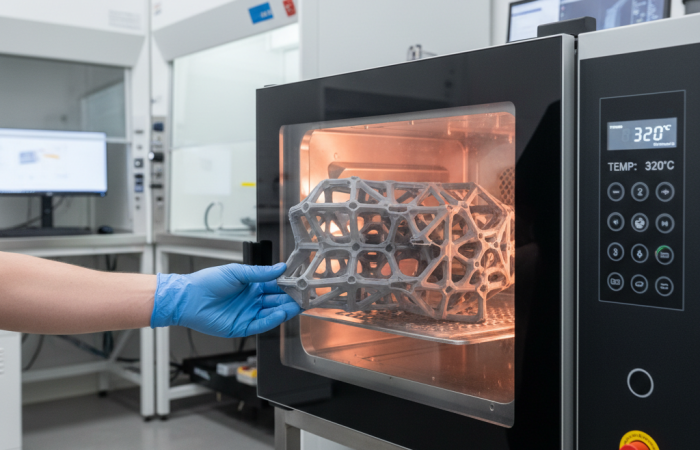
Thermal Post-Curing (Baking): This is the most critical step for maximizing the thermal properties of heat-resistant resins. After initial UV curing, the part must be subjected to a heat treatment, typically in an oven, at elevated temperatures (e.g., 180-250°C for resins like Siraya Sculpt). This thermal post-curing process drives further polymerization within the material, allowing it to reach its full Heat Deflection Temperature (HDT) and stabilizing its properties without softening or deforming. Without this crucial step, the part will not perform to its advertised heat resistance specifications. The precise temperature and duration of this thermal cure are material-specific and should always follow the manufacturer’s recommendations. Due to the low shrinkage characteristics of many heat-resistant formulations, extensive sanding or elaborate surface finishing after post-curing is often minimal.
Troubleshooting Common Challenges with Heat-Resistant Resin 3D Printing
While heat resistant resin 3d printing offers immense advantages, operators may encounter specific challenges. Understanding these pain points and implementing effective troubleshooting strategies is crucial for consistent success.
- Warping: This is a common issue with many resin prints, particularly when dealing with parts that require high dimensional stability under heat. To mitigate warping, it is essential to utilize optimal support structures during printing. During the critical thermal post-curing phase, ensure even heating in the oven to prevent localized stress buildup. Opting for low-shrinkage resin formulations, like those offered by Siraya, can significantly reduce the propensity for warping.
- Brittleness: High-HDT resins are inherently designed for rigidity rather than flexibility. This means they typically exhibit low elongation at break (often 1-5%), making them brittle and susceptible to snapping under impact or excessive bending. It is vital to use these parts for static load applications and where resistance to deformation under heat is the primary concern, rather than for components that will experience dynamic forces or impacts. This inherent characteristic differentiates them sharply from materials used in flexible resin 3d printing.
- Tolerances Post-Cure: Even with low-shrinkage resins, some minimal dimensional change can occur during the thermal post-curing process. It is prudent to account for this slight shrinkage during the design phase. For critical applications, conducting HDT exposure tests on sample parts after post-curing can verify that the final object maintains its integrity and dimensional accuracy under expected thermal loads.
- Chemical/Heat Failure: If a printed part fails prematurely when exposed to its intended thermal or chemical environment, the most common culprit is insufficient thermal post-curing. Ensure that the part has undergone the full, manufacturer-recommended heat treatment cycle. Additionally, always avoid exposing the resin beyond its specified maximum temperature and chemical compatibility limits to prevent material degradation or catastrophic failure.
Mastering these printing and post-processing techniques, and understanding the unique properties and limitations of heat-resistant resins, ensures you can confidently create durable, high-performance components. This detailed knowledge forms the foundation for diving into creating your own successful heat-proof parts, where the right approach leads directly to reliable results.
Unveiling the Science Behind Thermal Stability
Moving beyond the basic definition, the true marvel of heat resistant resin 3d printing lies in the intricate material science that allows these photopolymers to defy extreme temperatures. It’s not just “magic goo”; it’s precision engineering at a molecular level. Key to understanding this performance are two critical metrics: Heat Deflection Temperature (HDT) and Glass Transition Temperature (Tg).
HDT indicates the temperature at which a material deforms under a specific load. Imagine a printed bracket holding a light component; its HDT tells you the maximum temperature it can endure before it starts to bend or sag under that minimal weight. For instance, Siraya Tech Sculpt Clear/Grey boasts an impressive HDT of 180°C at 0.455 MPa, providing significant resilience for demanding applications.
The Glass Transition Temperature (Tg), on the other hand, marks the point where an amorphous polymer transitions from a rigid, glassy state to a more flexible, rubbery state. While not the point of deformation, it’s a critical indicator of material behavior under increasing heat. A higher Tg generally means a material will maintain its structural integrity over a broader temperature range before showing signs of softening. These figures are crucial for engineers and designers, moving from merely knowing a resin is “heat resistant” to understanding its precise thermal limits and capabilities.
Expanding the Horizon: Advanced Applications and Material Choices
The practical implications of these thermally stable properties extend far beyond simple prototypes, revolutionizing capabilities across various industries. While the delight of crafting custom chocolate molds (which, by the way, is a fantastic use case, especially for intricate designs like the one shown here!) is undeniable, the true power of these resins unfolds in demanding industrial contexts.
Consider sophisticated molding and casting processes. Heat-resistant resins enable the rapid production of low-run injection molds, which can withstand the heat and pressure of injecting molten plastics. They are also invaluable for creating patterns for vulcanized rubber molds or vacuum forming, where the master model must endure elevated temperatures without deforming. For precision industries like jewelry casting, resins such as Siraya Sculpt Ultra White, enhanced with ceramic composites, offer an HDT of 250°C. This exceptional stability, coupled with its low water absorption, makes it ideal for direct investment casting processes where the printed part is burned out at high temperatures, leaving a perfect cavity for metal.
For functional prototyping and industrial mock-ups, options like Phrozen TR300, with an HDT of 160°C and excellent toughness, strike a balance between thermal resistance and ease of use thanks to its low viscosity. Even more extreme requirements are met by materials like Ultracur3D® RG 3280, boasting an HDT exceeding 280°C, delivering extreme stiffness for aerospace-like demands or highly specialized jigs and fixtures that operate in thermally challenging environments, though it’s important to note these are typically for non-flight critical applications.
This diverse landscape of photopolymer 3D printing materials means designers can select the exact thermal performance required. While standard resins might struggle above 50-60°C, these specialized materials push boundaries, enabling applications from electronics enclosures that must dissipate heat to custom parts for motorsports that endure engine bay temperatures. However, it’s crucial to acknowledge the inherent trade-offs: while incredibly rigid and thermally stable, these resins are not designed for flexibility or high impact loads, unlike their counterparts in flexible resin 3D printing. For such advanced manufacturing capabilities, having access to high-precision industrial 3D printers is paramount, with leading systems like the Kings 6035Pro – Precision SLA 3D Printing for Industrial Use providing the speed and accuracy needed for these high-performance materials.
Mastering the Print: Best Practices and Post-Processing for Peak Performance
Achieving the full potential of heat resistant resin 3d printing goes beyond merely selecting the right material; it demands meticulous adherence to best practices throughout the entire printing and 3d printing post processing workflow.
Pre-Printing Preparation: Success begins before the first layer is cured. Heat-resistant resins often benefit from stable, controlled environments, minimizing temperature fluctuations that could impact resin viscosity or print stability. Printer calibration is vital, especially considering the minimal but present shrinkage properties of these materials. Optimizing support structures is also crucial; given their inherent rigidity (and often brittleness), robust supports are needed to prevent warping, particularly on larger or more complex geometries.
Optimizing Print Settings: When it comes to the actual print, exposure times must be precisely tuned to the resin’s specifications, ensuring complete polymerization without over-curing, which can exacerbate brittleness. A finer layer height often yields better resolution and surface finish, which is critical for molds or functional parts. The low viscosity of certain resins, such as Phrozen TR300, is a distinct advantage here, facilitating smoother printing and easier cleanup post-print. Always ensure your printing area is well-ventilated, as even low-odor resins can emit fumes.
The Critical Role of Thermal Post-Curing: While basic UV curing hardens the print, it’s the subsequent thermal post-curing that truly unlocks the material’s maximum heat resistance. This isn’t just an optional step; it’s a mandatory process where the part is carefully heated in an oven to a specific temperature (for example, Siraya Sculpt resins may require heating to 180-250°C) for a prescribed duration. This controlled heat treatment completes the chemical cross-linking within the polymer matrix, stabilizing its properties and allowing it to achieve its advertised HDT. Without this step, the part will soften and deform at temperatures far below its theoretical resistance. This crucial phase ensures the resin’s properties are fully developed, preventing premature softening and ensuring dimensional stability even under thermal stress.
Troubleshooting and Maximizing Reliability
Despite careful execution, challenges can arise. Warping, for instance, remains a common hurdle, often mitigated by strategically placed, robust supports and ensuring uniform heating during the thermal post-cure. For resins with higher HDT, lower shrinkage formulations (like many in the Siraya Sculpt series) also contribute significantly to dimensional accuracy.
Another consideration is the inherent brittleness of many high-HDT resins. With elongation at break values typically ranging from 1-5%, these materials are designed for static loads and thermal stability, not for impact or dynamic stress. Understanding this limitation is key to selecting the right application. Finally, precise tolerances can be a concern post-cure; while shrinkage is minimal, verifying the part’s integrity against its intended HDT exposure is a necessary step to ensure functional success and prevent chemical or heat-related failures.
By meticulously following these advanced protocols for both printing and post-processing, manufacturers and innovators can reliably produce high-performance parts that stand up to the heat, paving the way for further advancements in tooling, functional prototyping, and specialized components. The next frontier in heat resistant resin 3d printing promises even greater resilience and specialized properties, pushing the boundaries of additive manufacturing.
Conclusion
Heat resistant resin 3D printing stands as a pivotal advancement in additive manufacturing, empowering engineers and designers to overcome thermal limitations that previously constrained innovation. From high-precision molds and robust functional prototypes to critical industrial components, the ability to produce parts that maintain integrity under extreme heat is transformative. Resins like Siraya Sculpt and Phrozen TR300, with their impressive Heat Deflection Temperatures, are redefining what’s possible in diverse applications.
Achieving optimal performance hinges on a clear understanding of material properties, meticulous print settings, and especially, the vital thermal post-curing process. This ensures that the inherent strength and thermal stability of these advanced photopolymers are fully realized, mitigating common challenges like warping and brittleness.
The landscape of high-performance additive manufacturing continues to evolve rapidly. For those ready to elevate their capabilities, advanced printers like the Kings 800Pro – Fast, Reliable Industrial SLA 3D Printer offer the speed and precision required for demanding projects.
Whether you’re exploring robust prototyping with resins likeHigh-Performance UV Resin KS1208H for Detailed 3D Printing Applications, or delving into high-performance applications with KS608A UV SLA Resin – High Accuracy, Toughness & Low Shrinkage for 3D Printing, or KS608A UV SLA Resin – High Accuracy, Toughness & Low Shrinkage for 3D Printing, for extreme temperature stability, or precision casting with UV Resin KS168C – Precision Resin for High-Quality 3D Printing, the right material choice is paramount.
Embrace the power of heat-resistant 3D printing to unlock new frontiers in product development, manufacturing, and design. The future is hot, and your innovations can now withstand the heat.
Frequently Asked Questions
What exactly makes a 3D printing resin “heat-resistant”?
“Heat-resistant” resin for 3D printing refers to photopolymer resins specially formulated to maintain their structural integrity and shape when exposed to high temperatures. Unlike standard resins that deform or soften easily under heat, these materials are engineered for thermal stability, often measured by their Heat Deflection Temperature (HDT) and Glass Transition Temperature (Tg). This allows them to withstand environments where typical plastics would fail.
Why is thermal post-curing so crucial for heat-resistant 3D prints?
Thermal post-curing is a critical step to unlock the full heat resistance of these resins. After the initial UV curing, the printed part is baked in an oven at specific temperatures (e.g., 180-250°C for some Sculpt resins). This final heat treatment further cross-links the material, stabilizing its molecular structure and enabling it to reach its maximum specified HDT without softening or deforming. Without this step, the part will not achieve its intended thermal performance.
What’s the difference between Heat Deflection Temperature (HDT) and Glass Transition Temperature (Tg)?
Both HDT and Tg are key metrics for thermal performance. Heat Deflection Temperature (HDT) indicates the temperature at which a material deforms under a specific load, making it a practical measure for how a part will behave under stress at elevated temperatures. Glass Transition Temperature (Tg), on the other hand, marks the point where an amorphous polymer transitions from a rigid, glassy state to a more rubbery, flexible state. While related, HDT is often a more direct indicator of a material’s practical heat resistance for structural applications.
In which applications do heat-resistant resins truly excel?
Heat-resistant resins are ideal for applications demanding thermal durability where standard plastics would fail. This includes molding and casting, such as low-run injection molds, vulcanized rubber originals, or jewelry casting, where the mold needs to withstand hot pouring materials. They are also excellent for functional prototyping, industrial mock-ups, and creating jigs and fixtures in environments like motorsports or aerospace where components might experience elevated temperatures. For example, materials like Siraya Tech Sculpt Clear/Grey or Phrozen TR300 are popular choices in these fields.
Are all heat-resistant resins rigid, or can some also be flexible?
Generally, heat-resistant resins prioritize rigidity and thermal stability over flexibility. They are typically quite stiff and can be brittle, with low elongation at break (often 1-5%). This is a trade-off: the properties that make them resistant to heat also make them less pliable. If you need parts that are squishy or bendable, you would look into flexible resin 3D printing options, which are engineered for elasticity rather than thermal endurance.
What are some common challenges when 3D printing with heat-resistant resins?
Users often face challenges like warping during printing or post-curing, which can be mitigated with proper support structures and even heating during thermal post-cure. Brittleness is also inherent in many high-HDT resins, meaning they are best suited for static loads rather than impact-heavy applications. Achieving precise tolerances post-cure requires accounting for minimal shrinkage and carefully following manufacturers’ thermal curing guidelines to ensure structural integrity and dimensional accuracy.
What type of 3D printer is best suited for utilizing advanced heat-resistant resins?
High-performance photopolymer 3D printing resins, including heat-resistant varieties, typically perform best on advanced SLA, DLP, or LCD resin printers that offer precise control over exposure and stable build environments. Industrial-grade systems, such as the Nexa3D NXE400, are often preferred for their speed, accuracy, and robust build quality, which are essential for successfully printing with specialized engineering materials.
How do general-purpose resins compare to dedicated heat-resistant options in terms of thermal performance?
General-purpose resins, likeKS608A UV SLA Resin – High Accuracy, Toughness & Low Shrinkage for 3D Printing are excellent for rapid prototyping and concept models, offering good detail and ease of use at a lower cost. However, their thermal stability is significantly lower than specialized heat-resistant resins. For applications requiring improved mechanical properties and moderate thermal performance, other high-performance options like UV Resin KS808-BK – High-Performance Black Resin for Precision 3D Printing might be suitable. However, for demanding high-temperature environments, dedicated heat-resistant resins such as KS608A UV SLA Resin – High Accuracy, Toughness & Low Shrinkage for 3D Printing.
Related Posts