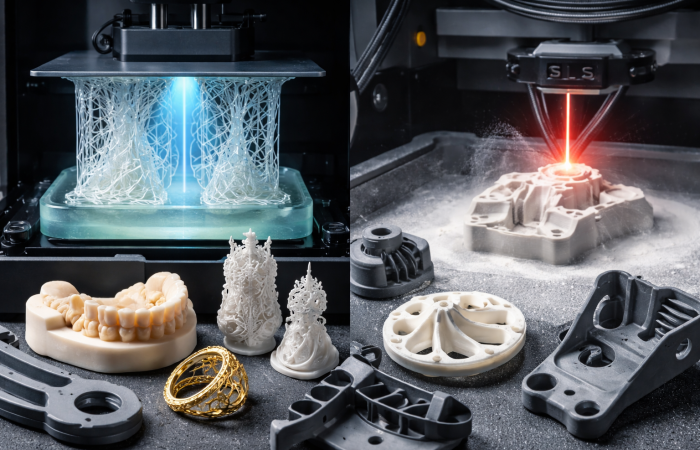
SLA vs FDM 3D Printer: A Comprehensive Comparison
If you’re working on a prototype, functional part, or visual model, choosing the right 3D printing method matters. Two of the most common options are SLA and FDM. Each has its place, and knowing when to use which can save you time, reduce waste, and improve part quality.
This article breaks down the real-world differences between an SLA and an FDM 3D printer without overcomplicating things. You’ll learn how each technology works, what materials it uses, and where it fits best—from detailed cosmetic models to durable tools.
Additive Plus offers both SLA and FDM 3D printing services, so you’re not locked into one method. Instead, you get honest advice and access to the right tools for your work, whether building early prototypes or production-ready parts.
If you’re comparing 3d printing FDM vs SLA, this guide is for you. Keep reading; when you’re ready to print, we’re here to help.
What Is SLA 3D Printing? A Closer Look At Resin-Based Precision

SLA, or stereolithography, is a 3D printing method that builds parts using light to cure liquid resin, one layer at a time. It’s best known for delivering smooth surfaces, sharp details, and accuracy.
Here’s how it works: a platform lowers into a resin tank. A laser or light source traces each layer of your design, curing the resin as it goes. After printing, the part is washed and cured to finalize its strength and stability.
SLA is one of the industry’s most widely used 3D printing methods. According to recent data, 29% of firms use SLA 3D printers, compared to just 15% using SLS. That makes SLA a go-to choice for applications that need detail and precision.
At Additive Plus, we offer SLA 3D printing services using various resins—from general-purpose to high-performance options, including ceramic-like and flexible materials. Whether prototyping, testing a design, or producing short-run models, we can help you get clean, high-quality results.
If you compare an SLA 3D printer to an FDM, SLA is often the right choice when surface quality and fine features are the priorities.
Buy High-Quality SLA Printers with Equipment Financing Today!
The Importance of Particle Analysis with CAMSIZER X2

FDM, or fused deposition modeling, is one of the industry’s most widely used 3D printing methods. It works by melting plastic filament and laying it down layer by layer to build up a solid part.
The process is straightforward. A filament spool feeds into a heated nozzle, which moves along the X and Y axes, tracing the shape of each layer. Once a layer is done, the build platform lowers, and the next layer is added. Over time, the full part takes shape.
FDM’s popularity isn’t just hype—it’s backed by numbers. As of 2021, over 70% of companies using 3D printing relied on FDM technology in-house, making it the most adopted method worldwide. That’s because it’s practical, affordable, and flexible enough for both prototypes and end-use parts.
Materials range from standard ABS and PLA to Nylon and carbon fiber-reinforced options, allowing for mechanical strength, impact resistance, and color variety.
SLA vs. FDM 3D Printer: Key Differences That Matter
When choosing between an SLA vs FDM 3d printer, it’s not just about resolution or cost. The real difference comes down to what you need the part to do—look sharp, hold up under stress, or both.
Here’s a practical breakdown of how these two technologies compare across the things that matter most:
SLA vs FDM 3D Printer: Key Differences
Feature | SLA 3D Printer | FDM 3D Printer |
Technology | Uses light to cure the liquid resin layer by layer | Extrudes melted thermoplastic filament |
Print Quality & Resolution | High resolution (as fine as 25 microns); ideal for small, detailed parts | Lower resolution; visible layer lines, good for basic functional prints |
Materials | Photopolymer resins (standard, flexible, ceramic-like, high-temp) | Thermoplastics like PLA, ABS, PETG, Nylon, and carbon fiber blends |
Surface Finish | Smooth, professional appearance; little or no finishing needed | Rougher surfaces may require sanding or post-processing for aesthetics |
Speed & Workflow | Longer print and post-processing times (washing, curing) | Faster setup and printing; minimal post-processing |
Typical Applications | Cosmetic prototypes, dental models, jewelry, precision parts | Jigs, fixtures, enclosures, test prototypes, and mechanical parts |
Part Strength | Best for appearance and detail; not ideal for heavy stress | Strong and durable; suitable for functional use |
Ease of Use | Requires more post-processing and handling | Easier to use for quick iterations and everyday printing |
Still trying to decide between 3d printing FDM vs FDM? The right choice depends on what you’re printing, how it’ll be used, and your timeline.
We’re here to help. Contact Additive Plus for advice or to get both types of parts printed in one order.
3D Printing SLA vs FDM: What Materials Can You Use?
When comparing an SLA vs. FDM 3D printer, material options play a major role. What your part is made of affects its strength, flexibility, cost, and even how it looks or feels. At Additive Plus, we offer a wide range of SLA and FDM printing materials to fit your specific needs.
Here’s a quick look at what each technology supports:

SLA Materials (Resin-Based)
- Standard resins – Great for visual prototypes and general-purpose models
- High-temperature resins – For parts exposed to heat
- Flexible resins – Mimic rubber-like properties
- Ceramic-like pastes – For detailed, brittle parts with a unique finish
- Silicone – Suitable for custom soft parts
- Additive Plus Resins – Our lineup, tuned for precision and stability
SLA materials are ideal when appearance, accuracy, and smooth finishes are the priority.

FDM Materials (Filament-Based)
- PLA – Easy to print and cost-effective
- ABS – Strong and impact-resistant
- PETG – Combines strength and flexibility
- Nylon (PA) – Durable, used for load-bearing parts
- Carbon fiber blends – Lightweight and mechanically strong
- Plastic pellets – Used for large-format printing
FDM materials are well-suited for practical, mechanical parts that need to withstand stress or wear
When weighing 3d printer FDM vs SLA, remember that SLA materials offer finer detail and finish, while FDM materials give you strength and real-world usability, often at a lower cost.
Where Each 3D Printer Fits: SLA vs FDM Applications By Industry
Choosing between an SLA and FDM 3D printer isn’t just about materials or print quality—it’s about the job the part needs to do. Different industries rely on 3D printing, FDM vs. SLA, for very different reasons.
Here’s a breakdown of where each technology shines.
So, if you’re comparing 3D printing SLA vs. FDM, ask yourself: What does this part need to do, and who will be using it?

FDM vs SLA: Workflow, Setup, And Post-Processing Compared
When comparing an FDM vs SLA 3D printer, it’s not just about what happens during printing. The steps before and after the print matter too, especially if you’re trying to save time or keep things simple.
Here’s how the 3D printing workflow differs between SLA and FDM:
3D Printer FDM vs SLA: Workflow and Post-Processing Comparison
Stage | SLA 3D Printer | FDM 3D Printer |
Setup & Preparation | Requires resin tank check, resin type selection, support orientation, and clean working area | Load filament, slice model, adjust print settings (layer height, infill, supports) |
Printing Process | Cures resin layer by layer with light; slower but more precise | Extrudes melted plastic onto heated bed; faster for basic and large shapes |
Post-Processing | Requires washing (usually in IPA), support removal, and UV curing | Remove from bed, clip supports, sanding, or polishing if appearance matters |
At Additive Plus, we manage both workflows for you, so whether you choose SLA vs FDM, you don’t need to worry about the cleanup, curing, or tuning. Just send your file and tell us what part you need to do.
Want help deciding which process fits your timeline or team setup? Get in touch and we’ll guide you.
3D Printing SLA vs FDM: Cost And Efficiency Breakdown
Budget matters—whether you’re a startup, lab, or manufacturer. Knowing the real cost per part and time required when choosing between an SLA and FDM 3D printer can help you make better decisions.
Here’s how the two compare:
Material Cost
- FDM materials like PLA or ABS are generally more affordable and easier to source. They offer a good balance of strength and cost, making them great for everyday parts or frequent iterations.
SLA resins are more specialized, cost more per liter, and often have a shorter shelf life. However, they provide a superior finish and precision for high-detail needs.
Print Speed and Throughput
- FDM is often faster when printing basic parts, especially when using low infill and thicker layers.
- SLA takes longer but produces better quality. Ideal for fewer, more detailed parts—not large batches.
Labor and Handling
- FDM usually requires less hands-on time. You can remove and use the part as-is or do the minor cleanup.
SLA requires extra steps like resin washing and UV curing, which take time and require more tools and safety precautions.
In short, if you need strong functional parts at a lower cost, FDM delivers more value per dollar. However, SLA is worth the extra investment if you focus on high detail and a smooth finish.
Choose The Right 3D Printing Method With Confidence
There’s no one-size-fits-all answer regarding 3D printing SLA vs. FDM. If you need high-detail parts with a clean surface finish, SLA is the clear choice. If strength, speed, and cost are more important, FDM delivers exactly that. Many teams use both—SLA for presentation and precision, FDM for durability and function.
Still unsure which one fits your project best? That’s what we’re here for. At Additive Plus, we provide both SLA and FDM 3D printing services—backed by material knowledge, expert guidance, and fast turnaround.
Send us your file or get in touch for a recommendation that fits your needs.
FAQ
Can I switch between FDM and SLA depending on the project?
Yes. Many companies use both depending on part goals. For example, you might create a rough draft with FDM and finalize with SLA. In many cases, using 3D printing FDM vs SLA together offers the best results—strength from FDM, finish from SLA.
What should I consider when buying a 3D printer, FDM vs SLA?
Start with what you’ll use it for the most. If you need strong parts with less fuss, FDM is reliable and budget-friendly. If you’re focused on presentation, tight tolerances, or small details, an SLA 3D printer vs FDM machine will give you better results, but expect a more involved process.
Which is more efficient for short-run production: FDM vs SLA?
FDM tends to be faster and more efficient for repeatable utility parts. However, SLA can still be effective in short-run batches, especially when quality and surface finish matter more than speed. Deciding between SLA vs FDM here depends on part complexity and aesthetic needs.
Are SLA parts weaker than FDM ones?
Typically, yes. Standard SLA resins are more brittle over time compared to tough thermoplastics used in FDM. If you’re comparing 3D printer FDM vs SLA for mechanical performance, FDM usually holds up better under repeated use or stress.
Is it common to mix SLA and FDM in one project?
Definitely. Designers often prototype the same product using both technologies at different stages. For example, a structural frame might be printed using FDM, while detailed components are produced with SLA. This mix of SLA vs FDM helps balance cost, strength, and appearance.
Related Posts
1. Introduction Additive manufacturing, commonly known as 3D printing, has fundamentally transformed modern product development,…
Metal additive manufacturing has fundamentally transformed the way industries approach design and production, enabling the…
Imagine a manufacturing process capable of producing parts measured in meters, not millimeters—components so vast…
If you’re working on a prototype, functional part, or visual model, choosing the right 3D…

Ashkhen Ovsepyan
Additive manufacturing expert and tech business leader, focused on global strategy, innovation, and advancing women in 3D printing.