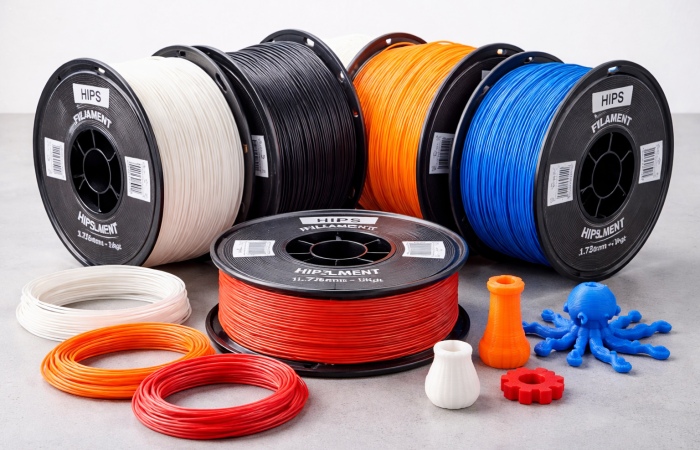
The Benefits Of HIPS Filament For Your 3D Printing Projects
High Impact Polystyrene, better known as HIPS filament, has become a staple in the world of 3D printing. Originally used as a support material, it’s now recognized for its versatility, durability, and ease of post-processing. Makers, engineers, and businesses rely on it not only to create dissolvable supports for ABS but also as a primary material for prototypes and functional parts.
In this article, we’ll take a closer look at what makes HIPS 3D printing filament unique, why it’s becoming increasingly popular, and how you can use it to improve your own projects.
From support structures to real-world applications, print settings, and comparisons with other filaments, you’ll learn how HIPS can take your 3D printing results to the next level.
What Is HIPS Filament?
HIPS, or High Impact Polystyrene, is a lightweight thermoplastic filament valued for its toughness, stability, and ease of post-processing. It’s widely used in 3D printing both as a primary material and as a dissolvable support.
In 2024, the global HIPS 3D printing filament market was valued at about USD 300 million and is projected to reach USD 1.2 billion by 2034, growing nearly 17.5% annually. The HIPS support filament market alone reached USD 142.3 million in 2024 and is forecast to grow 6.8% per year through 2033. These numbers highlight its growing role in dual-extrusion printing.
HIPS is also soluble in limonene, allowing support structures to dissolve away cleanly without damaging the main print. Compared to PLA and ABS, it strikes a balance, more durable than PLA, less warp-prone than ABS, and easier to finish for smooth results.
Why Choose HIPS Filament: Key Benefits
HIPS 3D printing filament offers several advantages that make it stand out among support and primary materials. Its density of around 1.05 g/cm³ and Rockwell hardness rating of R 95 give it strength and stability similar to ABS, but with the added benefit of easier post-processing.
- Support Material for Dual-Extruder Printers: HIPS is widely used alongside ABS in dual-extrusion printing. Because it dissolves in limonene, supports can be removed without damaging the final part, making it ideal for complex geometries.
- Versatility: Beyond support use, HIPS can serve as a primary material for durable parts. It prints smoothly, resists impact, and is suited for both prototypes and functional applications.
- Post-Processing Ease: Unlike rigid support filaments, HIPS dissolves cleanly in limonene, leaving behind smooth surfaces and eliminating time-consuming manual removal.
- Durability: Its impact resistance ensures that parts can withstand stress and wear, making it useful for industries that require tough, lightweight components.
In short, HIPS combines strength, ease of finishing, and compatibility with other materials, making it one of the most practical filaments for versatile 3D printing projects.
Real-World Applications Of HIPS Filament
HIPS is most commonly used as a support material for ABS, where its solubility in limonene makes it easy to remove without damaging detailed prints. This makes it a go-to choice for complex geometries, overhangs, and models that would be difficult to print otherwise.
Beyond supports, HIPS can be used for functional prototypes and durable models in industries such as automotive, consumer goods, and electronics. Its impact resistance and lightweight properties make it suitable for enclosures, housings, and parts that need to withstand daily use.
It’s also valued in rapid prototyping and testing, as supports dissolve cleanly, allowing faster iteration without the need for labor-intensive cleanup. For cosmetic and display models, HIPS offers a smooth finish after post-processing, making it ideal for presentation-ready parts that require both strength and aesthetics.
How to Print With HIPS Filament
HIPS is relatively straightforward to work with, but it performs best when printed under the right conditions. Proper settings not only ensure good adhesion and durability but also help avoid common issues like warping.
- Recommended Print Settings: HIPS typically prints at 230–250 °C, with a heated bed set between 90–110 °C. Consistent bed temperature is especially important for larger models to reduce warping.
- Printer Compatibility: HIPS can be used on both single and dual-extruder printers. On single extruders, it serves as a strong, durable main filament. On dual systems, it shines as a dissolvable support material paired with ABS.
- Adhesion Techniques: For best results, use a bed surface such as PEI, glass with glue stick, or Kapton tape. A brim or raft can also help with larger prints, keeping corners from lifting.
- Post-Processing: One of HIPS’s biggest advantages is its solubility in limonene, a citrus-based solvent. Supports can be fully dissolved by submerging the print, leaving behind clean surfaces without the risk of scratching or breaking delicate parts.
When handled with the right setup and care, HIPS filament delivers reliable results and clean finishes, making it an excellent choice for both functional parts and dissolvable supports.\
Also, read:
Comparing HIPS With Other Support Materials
Choosing the right support material depends on the project, printer setup, and final use. HIPS stands out in several ways when compared to other common options.
| Comparison | Other Material | Key Traits |
| HIPS vs. PVA | PVA is water-soluble, works well with PLA, but is more expensive, highly moisture-sensitive, and requires careful storage. | HIPS is more affordable, mechanically stronger, dissolves in limonene, pairs perfectly with ABS in dual extrusion, and is easier to store and handle without special conditions. |
| HIPS vs. PLA | PLA is beginner-friendly, easy to print, and biodegradable, but lacks impact resistance and durability. | HIPS is tougher and more impact-resistant, can be dissolved for clean support removal, and is better suited for complex dual extrusion projects requiring both strength and smooth finishes. |
| HIPS vs. ABS | ABS is strong and heat-resistant, but difficult to remove when used as a support material. | HIPS is chemically compatible with ABS, dissolves cleanly in limonene for effortless support removal, and doubles as both a durable main filament and a reliable support option. |
Overall, HIPS offers the best balance of cost, durability, and post-processing flexibility, especially for users working with ABS and complex dual-extrusion prints.
Bring Your Projects To Life With HIPS
Whether you’re prototyping, testing functional parts, or creating complex dual-extrusion models, HIPS gives you the flexibility to achieve high-quality results with less effort.
At Additive Plus, we go beyond simply supplying filament:
- A wide selection of HIPS 3D printer filament and other advanced materials.
- Professional 3D printing services for prototyping, functional parts, and complex models.
- Consulting and support to help you choose the right materials and workflows.
- Over a decade of expertise as an industrial integrator in additive manufacturing.
With this combination of products and services, we help engineers, designers, and businesses achieve stronger parts, cleaner supports, and more efficient results.
Explore our materials options today and see how Additive Plus can help you take your 3D printing projects further.
Shop Filament at Additive Plus
Frequently asked questions
Is HIPS filament easy to print with for beginners?
Yes, HIPS filament is generally straightforward to use, especially for those already familiar with ABS. It requires a heated bed and stable temperature control, but with the right settings, it delivers consistent and reliable results.
Can HIPS be used as both a support and a main printing material?
Absolutely. HIPS 3D printing filament is best known as a dissolvable support for ABS, but it’s also strong enough to be used as a primary material. Its impact resistance makes it suitable for functional prototypes, enclosures, and durable models.
How long does it take to dissolve HIPS filament in limonene?
The dissolving time depends on the size and density of the support structure. Thin supports can dissolve in just a few hours, while larger or denser structures may take 12–24 hours. Limonene fully removes HIPS without damaging the main print.
How should I store filament HIPS to prevent moisture absorption?
Like most thermoplastics, HIPS filament should be kept in a sealed container with desiccant packs to stay dry. Proper storage prevents moisture from causing bubbling, poor layer adhesion, or reduced surface quality during printing.
Is 3D HIPS filament environmentally friendly, and can it be recycled?
HIPS is not biodegradable like PLA, but it is recyclable under the right conditions. Check with local recycling facilities to see if polystyrene materials are accepted, and always dispose of used limonene responsibly.
Can HIPS 3D printer filament be painted or finished for cosmetic use?
Yes, one of the advantages of HIPS filament is its smooth surface and ease of finishing. It can be sanded, painted, or coated after printing, making it a popular choice for cosmetic models and presentation-ready prototypes.
Related Posts