Which 3D Filament Should You Use? Here’s the Breakdown
In the expanding world of desktop and industrial additive manufacturing, selecting the right filament is the foundation of a successful 3D print. Each project is unique, whether you’re prototyping a new product, printing a mechanical part, or crafting a decorative piece. Your choice of filament determines not only the final look of the part but also its strength, functionality, durability, and even safety.
There are many 3D filament types available, each tailored to specific requirements. Understanding the different types of 3D printer filament can help you avoid common problems like poor adhesion, brittleness, or warping. This guide walks you through the most widely used 3D printer filament types and uses, offering a breakdown of their properties, ideal applications, and compatibility considerations. Whether you are new to 3D printing or looking to expand your material knowledge, this guide will help you identify the best types of filament for 3D printing projects.
Section 1: Understanding 3D Printer Filament Types
What is a 3D Printer Filament?
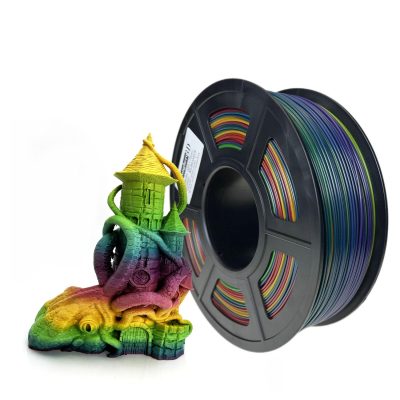
3D printer filament is a thermoplastic material supplied in spools and used in FDM (Fused Deposition Modeling) printing. The printer heats the filament, extrudes it through a nozzle, and deposits it layer by layer to form a three-dimensional object. The 3D printing filament types available today range from basic materials like PLA to advanced composites reinforced with carbon fiber, metal particles, or flexible polymers.
Why Filament Choice Matter
Choosing from various types of 3D printer filament isn’t just about price or color. Each material has unique thermal, mechanical, and aesthetic properties. Your selection directly affects:
- Print Quality: Filaments with high flow consistency and minimal warping provide smoother prints with finer details. For example, PLA and PETG are preferred for high-resolution prints.
- Mechanical Strength: When strength and durability are priorities, strong 3D print filament types like ABS, Nylon, and carbon fiber composites are ideal for functional components and load-bearing parts.
- Application Suitability: Aesthetic models may benefit from easy-to-print PLA, while industrial components may require abrasion-resistant or heat-resistant filaments.
- Environmental Factors: Filaments like ABS and Nylon may require enclosed printing chambers to control temperature and avoid warping, while materials like TPU are more forgiving.
Material Properties and Print Settings
Different types of filament for 3D printers require varying settings:
- Printing temperature ranges from 180°C for PLA to 260°C+ for Nylon.
- Bed temperature requirements vary; PLA can print on an unheated bed, while ABS needs a 90-110°C bed.
- Cooling settings, nozzle material, and speed should be adjusted for optimal results.
We’ll also introduce a handy 3D printer filament types chart comparing these materials at the end
Section 2: Common Types of 3D Filament and Their Uses
PLA (Polylactic Acid)
PLA filament is the most widely used material in 3D printing and is perfect for beginners. Made from renewable resources like cornstarch or sugarcane, it’s also one of the most environmentally friendly 3D filament types available.
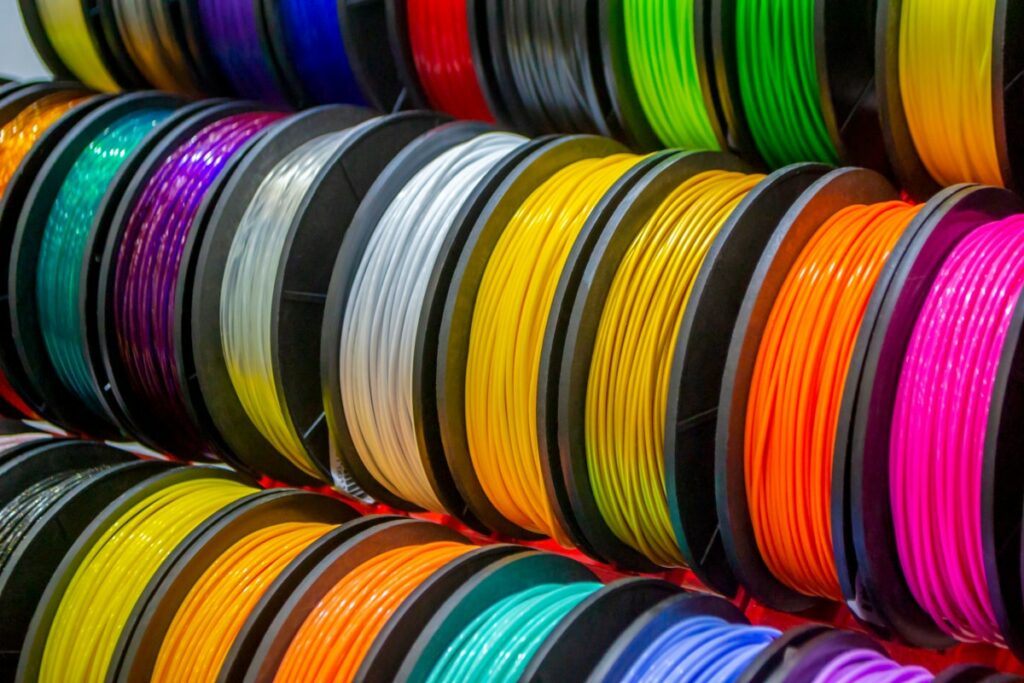
- Overview: PLA is easy to print, requires low extrusion temperatures (180–220°C), and rarely warps. It emits a faint sweet odor and prints with a glossy finish.
- Ideal For: Prototypes, decorative items, low-stress applications, educational use.
- Pros:
- Biodegradable and plant-based
- Does not require heated bed (or works fine at ~50°C)
- Available in a wide range of colors and blends
- Cons:
- Brittle under stress
- Not suitable for outdoor or high-heat environments
- Low impact resistance
ABS (Acrylonitrile Butadiene Styrene)
ABS filament is a high-strength material known for its durability and impact resistance. It was originally used in LEGO bricks and is popular for functional parts and engineering prototypes.
- Overview: Requires higher print temps (220–250°C) and a heated bed (~90°C+). Best used in an enclosed printer to avoid cracking or warping.
- Ideal For: Mechanical parts, protective casings, automotive components.
- Pros:
- Strong and impact-resistant
- Can be smoothed with acetone for a polished finish
- Withstands higher temperatures than PLA
- Cons:
- Emits fumes; proper ventilation is a must
- Prone to warping if not properly managed
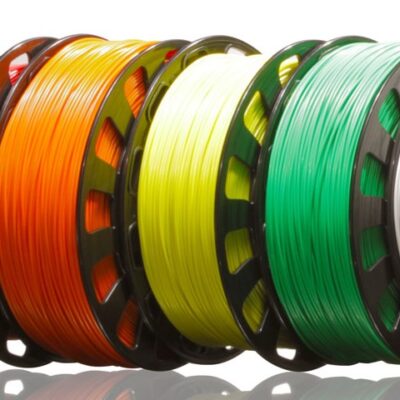
PETG (Polyethylene Terephthalate Glycol)
PETG filament is a tough and durable plastic that strikes a balance between PLA and ABS. It’s increasingly popular due to its strength, clarity, and ease of use.
- Overview: Prints at 220–250°C, bed temperature around 70°C. Less brittle than PLA and less warp-prone than ABS.
- Ideal For: Food containers, mechanical parts, functional prints.
- Pros:
- Moisture and chemical-resistant
- More flexible than PLA, stronger than ABS in some cases
- Excellent layer adhesion
- Cons:
- Slight stringing and oozing
- Sensitive to retraction settings
TPU (Thermoplastic Polyurethane)
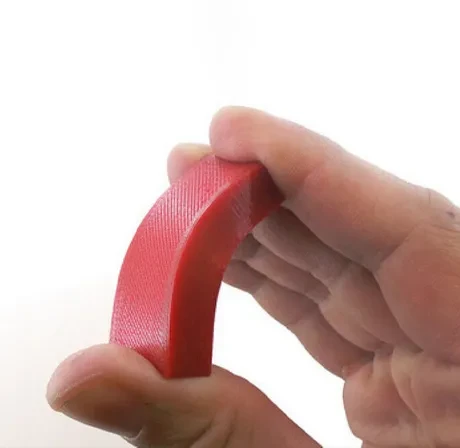
TPU filament is a flexible, rubber-like material ideal for parts that need to bend or stretch. It’s part of the flexible filament family.
- Overview: Prints at 220–250°C. Requires slow speeds and direct-drive extruders for best results.
- Ideal For: Phone cases, gaskets, seals, insoles.
- Pros:
- Highly elastic and flexible
- Abrasion and impact resistant
- Good layer bonding
- Cons:
- Difficult to print with Bowden-style extruders
- Stringing and slow print speeds required
Nylon
Nylon filament is one of the most versatile and strong 3D print filament types, ideal for mechanical and load-bearing parts.
- Overview: Requires high temperatures (240–260°C) and a dry environment, as it absorbs moisture from the air.
- Ideal For: Gears, hinges, structural parts, tool components.
- Pros:
- Extremely strong and wear-resistant
- Flexible and slightly bendable without breaking
- Long-lasting, great for engineering use
- Cons:
- Needs to be dried before use
- Warps without enclosure and proper setup
Other Specialty Filaments
Carbon Fiber-Infused
A composite material that blends standard polymers like PLA, PETG, or Nylon with chopped carbon fibers.
- Ideal For: Aerospace, drone frames, engineering applications
- Pros: Stiffer, lighter, stronger
- Cons: Abrasive; requires hardened steel nozzle
Wood-Filled
PLA-based filament with wood fibers added for aesthetic and scent.
- Ideal For: Art, sculptures, woodworking projects
- Pros: Wood-like texture and finish
- Cons: Brittle, prone to clogging
Metal-Filled
Blends PLA or ABS with metal powders (bronze, copper, steel).
- Ideal For: Jewelry, decorative items, parts with metallic weight and look
- Pros: Metallic shine and weight
- Cons: Requires high torque extruders
Section 3: How to Choose the Right 3D Printing Filament
When selecting from various types of 3D filament, consider these important criteria:
- Printer Compatibility: Not every printer can handle every filament. Check your printer specs for temperature ranges and extruder type.
- Part Functionality: Will the part experience stress, movement, or heat? Use ABS, Nylon, or carbon fiber for strength; TPU for flexibility.
- Visual Appeal: PLA or specialty filaments like wood-filled offer better finishes.
- Environmental Conditions: Outdoor parts need UV- and weather-resistant filaments like ASA or PETG.
- Budget and Availability: PLA and PETG are cost-effective and widely available, while Nylon and composites are pricier.
Section 4: Quick Comparison Chart of 3D Filament Types
Filament | Strength | Flexibility | Temp Range | Ease of Use | Best For |
PLA | Medium | Low | 180–220°C | ★★★★★ | Visuals, Prototypes |
ABS | High | Medium | 220–250°C | ★★★ | Functional Parts |
PETG | High | Medium | 220–250°C | ★★★★ | Food-safe, Containers |
TPU | Low | High | 220–250°C | ★★ | Flexible Parts |
Nylon | Very High | Medium | 240–260°C | ★★ | Mechanical Parts |
Carbon Fiber | Very High | Low | 240°C+ | ★★★ | Rigid, Lightweight Frames |
Wood-Filled | Medium | Low | 200–220°C | ★★★ | Decorative Items |
Conclusion
With so many 3D printer filament types on the market, the possibilities for innovation and creativity are endless. Understanding the types of 3D print filament and how they behave in different environments allows you to print with confidence and precision. From flexible TPU to ultra-strong Nylon, there’s a material for every use case.
Take the time to test and explore different types of 3D filament to discover what works best for your specific needs. Each material unlocks a new range of possibilities in form, function, and finish.
📅 Ready to level up your prints? Order professional 3D printing services at Additive Plus or get in touch with our team for expert, tailored advice!
Related Posts
1. Introduction Additive manufacturing, commonly known as 3D printing, has fundamentally transformed modern product development,…
Metal additive manufacturing has fundamentally transformed the way industries approach design and production, enabling the…
Imagine a manufacturing process capable of producing parts measured in meters, not millimeters—components so vast…

Ashkhen Ovsepyan
Additive manufacturing expert and tech business leader, focused on global strategy, innovation, and advancing women in 3D printing.