
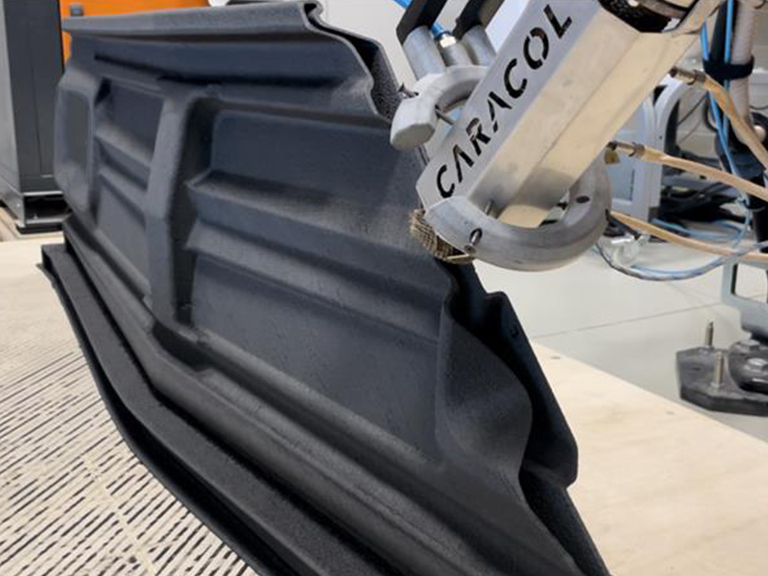
Most 3D printers build parts measured in centimeters. Large-Format Additive Manufacturing (LFAM) builds parts measured in meters. It scales the layer-by-layer deposition of conventional 3D printing up to industrial machinery that can produce boat hulls, large tooling, molds, and full-scale vehicle prototypes in a single build. Where standard additive manufacturing serves small-scale production and rapid prototyping, LFAM answers a different demand: enormous, complex structures that are slow, wasteful, or impossible to make by other means. This guide explains how LFAM works, which technologies and materials drive it, where it is used across industry, and the trade-offs to weigh before adopting it.
What LFAM is and why it is called Large-Format
Large-Format Additive Manufacturing is a 3D printing approach built for large, complex parts that often span several meters. Conventional desktop and professional printers top out at objects a few tens of centimeters across, sized to fit a benchtop. LFAM systems produce objects ranging from roughly one cubic meter to several meters in length. That build volume is the defining characteristic: it is what lets these machines fabricate an item as large as a boat hull or a vehicle prototype without splitting the design into sections.
To picture the scale, a conventional printer builds objects that sit on a desk, while an LFAM cell builds objects a person can stand next to or inside. The underlying process is identical; only the size of the machine and the volume of material change.
At its core, LFAM uses the same layer-by-layer deposition principle as smaller machines. Material is placed only where the design needs it, layer on layer, until the part is complete. The difference is the hardware around that principle: larger, more rigid frames, bigger extruders, and motion systems engineered to hold accuracy across a wide working area. Many systems rely on high-throughput, pellet-fed extruders that process raw plastic pellets rather than spooled filament. Pellets are far cheaper than filament and feed at higher rates, so this choice both speeds up deposition and cuts material cost. Together, higher throughput and lower feedstock cost are what make meter-scale parts economically practical.
Why standard 3D printers cannot make large parts
Small printers handle fine detail and fast iteration of compact designs well, but their limits show quickly on large parts. They lack the build volume, the material-handling capacity, and the structural rigidity needed for components measured in meters. Printing a large part on a small machine means breaking the design into many pieces and then assembling them, which introduces joints, weak points, added labor, and delay.
Before LFAM, large custom parts came from subtractive machining or injection molding. Machining cuts material away from a solid block, which is wasteful and slow for complex geometries and grows more expensive as parts get larger. Injection molding is efficient for high volumes but requires expensive, time-intensive tooling for each unique design, so it is impractical for low-volume or one-off large parts. Both routes carry significant material waste and long lead times, particularly on oversized or intricate components.
LFAM addresses these constraints directly. It produces parts on demand without molds or dedicated tooling, which shortens development cycles because a full-scale prototype can be printed and evaluated in the same loop, then revised and reprinted without re-cutting a mold. It also supports part consolidation: a complex, multi-function object can be printed as a single unit rather than an assembly of many smaller pieces. Consolidation removes fasteners and joints, which improves structural integrity and reduces weight. Removing the tooling step and consolidating assemblies are the two changes that most shift what is feasible at large scale, and they are the reasons LFAM is chosen for low-volume or bespoke parts that traditional lines cannot serve economically.
LFAM technologies and materials
Every LFAM technology shares the same principle: build the object layer by layer, depositing material only where the design calls for it. The scale is what demands specialized equipment. To cover large build volumes, LFAM uses large gantry architectures, robotic arms, or dedicated industrial platforms, all engineered for stable motion and precise control across a wide area. Path-planning and control software is essential at this size, since it manages the long tool paths and holds accuracy and repeatability over complex geometries where small errors accumulate across a large part.
Deposition technologies
- Industrial FDM/FFF — an industrial-scale form of fused deposition modeling that uses large-nozzle extruders for high-throughput deposition of polymers and composites. It is valued for its speed on large plastic components, where a wide nozzle lays down material quickly.
- Pellet extrusion — feeds polymer pellets directly into the extruder instead of filament. Pellets cost far less than filament and deliver higher material throughput, which lowers operating cost per part and is a large reason pellet-fed systems dominate high-volume LFAM work.
- Robotic LFAM — mounts the extruder on a robotic arm, allowing deposition in almost any orientation and onto large or irregularly shaped objects. The added axes of motion open up free-form and non-planar builds that a fixed gantry cannot reach.
- BAAM (Big Area Additive Manufacturing) — one of the earlier large-scale platforms. It demonstrated that substantial parts could be printed in polymers and fiber-reinforced composites, and it shaped much of the development that followed in the field.
- Other approaches — beyond extrusion, LFAM includes large-scale adaptations of Stereolithography (SLA) and Digital Light Processing (DLP) for sizable molds, Binder Jetting for large sand or metal cores, Powder Bed Fusion (PBF) for detailed metal parts, and Directed Energy Deposition (DED) for metal cladding and structural build-up at scale.
No single method fits every job. Extrusion-based systems dominate large polymer and composite work because of their throughput and low feedstock cost, while binder jetting, PBF, and DED extend LFAM into metals and cores where extrusion cannot reach. The choice depends on the part’s size, material, tolerance, and required mechanical properties.
Materials
The range of materials LFAM can process is broad, which is part of why it reaches so many sectors.
- Thermoplastics — common polymers such as PETG, ABS, PA, PP, and PC, chosen for their workability, durability, and low cost. These cover the bulk of general LFAM production.
- Composites — carbon or glass fibers added to a thermoplastic matrix produce fiber-reinforced parts with higher strength and stiffness at lower weight. That strength-to-weight balance matters most in aerospace and automotive work, where reducing mass is a direct design goal.
- Metals — for demanding structural applications that need higher strength and durability, DED and PBF-based LFAM processes print various metals and alloys, producing robust industrial components. Feedstock quality drives the result here; for background on the raw material, see our range of metal powders and our complete guide to metal 3D printing with powder.
The combination of large-format machinery, a broad material set, and precise motion control is what lets LFAM produce parts that were previously impractical or too expensive to manufacture.
Industrial applications
LFAM is used for direct digital manufacturing of end-use parts, tooling, and large structures, not only prototypes. Its reach spans several sectors, each drawing on a different strength of the process.
- Aerospace and defense — the priority is lightweight, robust components. LFAM produces large tooling, fixtures, and custom interior or structural parts. Printing a wing-section mold or a component for an unmanned aerial vehicle cuts lead time and material waste compared with machining from solid stock or welding assemblies, and it supports rapid iteration and deployment.
- Automotive — LFAM gives manufacturers an agile route for prototyping car bodies, molds, and custom components. Full-scale conceptual models and functional prototypes of chassis elements let engineers test aerodynamics, ergonomics, and structural behavior earlier in the development cycle, when changes are cheaper.
- Marine and shipbuilding — boat hulls, large molds for composite structures, and custom marine parts become more efficient to make. The gain is largest for custom vessels or low-volume runs, where traditional mold making is expensive and slow, and where complex hydrodynamic geometries are hard to produce otherwise.
- Construction — LFAM is applied to formwork, architectural panels, and some structural elements. Large, intricate concrete molds for building facades and custom prefabrication components shorten build times and widen architectural options. On-site fabrication also reduces logistics cost and transport impact.
- Energy — from oil and gas infrastructure to renewable systems, LFAM produces tooling and functional prototypes for oversized components, including turbine blades, large pipe fittings, and custom fixtures for maintenance and repair. It is useful where parts are obsolete or need custom sizing.
- Manufacturing and robotics — the process makes custom machinery parts, end-of-arm tooling for robotic systems, and large jigs and fixtures. Producing specialized tools on demand improves shop-floor flexibility and reduces downtime spent waiting on outside suppliers.
- Art and design — beyond industrial use, LFAM enables large sculptures, installations, and architectural models at a scale and level of detail that is difficult to reach by other methods.
Strategic advantages
Adoption is driven by a set of practical benefits that address long-standing problems in large-scale manufacturing. These translate into lower cost and faster response, not only technical capability.
- Cost reduction — the largest gains come with low-volume or highly customized large parts. Traditional methods carry high upfront cost for tooling and molds; LFAM prints the final or near-final component directly, which makes bespoke large-scale production viable where it was not before. Pellet-fed systems further reduce material waste and per-part cost.
- Design freedom — complex organic geometries, internal lattices for weight reduction, and part consolidation become practical rather than exceptions. This supports high-performance parts with optimized structure and lower material use, delivering meaningful weight savings in aerospace and automotive applications.
- Shorter lead times — moving from design concept to physical prototype or final part in days or weeks rather than months lets teams respond faster to demand and accelerate product development. Speed to market is often the deciding factor.
- Customization and localized production — each printed part can be tailored without an added cost penalty, which suits specialized components and personalized products. Printing closer to the point of use reduces global supply-chain dependence, transportation cost, and exposure to disruption.
Challenges
LFAM carries real constraints that affect timelines, cost, and outcomes. Planning for them is part of a successful rollout.
- Material range — the set of qualified materials for large-format systems is still narrower than for traditional manufacturing. Developing composites and high-performance polymers with consistent mechanical properties at scale remains active research and qualification work, which can limit design and application choices.
- Print speed and build time — even at high extrusion rates, the material volume in a meter-scale part means builds can run for many hours or days. This requires careful production planning and reflects a direct trade-off between scale and speed, most acute on the largest structures.
- Post-processing — large parts often need substantial finishing, including sanding, machining, or heat treatment, to reach the target surface finish, dimensional accuracy, and mechanical properties. This adds labor, time, and cost, and achieving a uniform finish is harder on oversized components.
- Infrastructure investment — the machines are a major capital purchase and need large installation space and specialized power infrastructure. That barrier can limit adoption for smaller shops or for facilities that are hard to adapt.
- Quality control and repeatability — holding consistent quality and dimensional accuracy across a very large build is difficult. Warping, distortion, and inconsistent layer adhesion from thermal gradients or material shrinkage are more pronounced at scale, so certified applications demand rigorous process control and monitoring.
- Skill gap — operating and tuning LFAM systems calls for engineers and technicians trained in large-scale additive design, materials science, and process control. That expertise is still in short supply and can slow effective integration.
Where LFAM is heading
Development is focused on closing current limitations and widening the range of parts LFAM can make.
- Materials and multi-material printing — work continues on high-performance polymers, composites with better strength-to-weight ratios, and multi-material builds that give a single part spatially varying properties tuned to its function.
- Automation, AI, and machine learning — later systems integrate more process control, predictive maintenance, and quality assurance. Algorithms adjust print parameters in real time to reduce defects such as warping, and machine learning helps predict material behavior and improve part consistency.
- Hybrid manufacturing — platforms that combine additive deposition with subtractive processes such as CNC machining in one workflow pair the design freedom and material efficiency of printing with the precision and surface finish of machining for critical features. This suits intricate or high-tolerance parts.
- Sustainability — pelletized and recycled feedstock, together with localized on-demand production, reduce material waste, energy use, and transport-related emissions, aligning with circular-economy goals.
- Wider industrial adoption — as the technology matures and its benefits are demonstrated, aerospace, construction, energy, and automotive are moving LFAM from rapid prototyping toward direct digital manufacturing at scale.
Conclusion
Large-Format Additive Manufacturing moves the question from whether a part can be 3D printed to how large, complex, and integrated it can be. It removes several limits of traditional manufacturing, producing oversized components with more design freedom and less waste, and it serves industries from aerospace to construction. The core benefits are clear: lower cost through reduced tooling, shorter lead times, and the ability to consolidate multiple parts into single optimized structures. Material development and process control remain open problems, but advances in robotic LFAM, hybrid systems, and automation are steadily addressing them. For organizations building large, complex, or customized parts, LFAM is a practical route to lower cost, faster development, and a wider set of design options.
Frequently asked questions
What truly sets LFAM 3D printing apart from standard 3D printing?
LFAM (Large-Format Additive Manufacturing) is defined by its ability to produce significantly larger parts, often measured in meters, far exceeding the build volumes of traditional desktop or industrial 3D printers. While standard printers handle objects up to tens of centimeters, LFAM systems are designed to create components ranging from one cubic meter to several meters in length. This dramatic increase in scale opens up new possibilities for manufacturing oversized items and complex geometries previously impossible with additive manufacturing.
What kinds of materials can LFAM 3D printers work with?
LFAM technologies boast considerable material flexibility, enabling them to process a range of substances. Commonly, they utilize pelletized thermoplastics (like PETG, ABS, PA, PP, PC), which are more cost-effective and allow for higher throughput compared to filament. Many systems also work with fiber-reinforced composites to achieve enhanced strength and lighter weight. Advanced LFAM processes, such as Powder Bed Fusion and Direct Energy Deposition, are also capable of printing with various metals and metal alloys, offering robust solutions for demanding industrial applications.
Which industries are benefiting most from large-scale additive manufacturing technologies?
LFAM 3D printing is rapidly reshaping multiple sectors due to its unique capabilities. Key industries include:
- Aerospace & Defense: For large tooling, fixtures, and custom structural components.
- Automotive: Used for prototyping car bodies, molds, and custom vehicle parts.
- Marine/Shipbuilding: Essential for creating boat hulls, large molds, and custom marine components.
- Construction: Enables formwork, architectural panels, and structural elements.
- Energy: Provides tooling and functional prototypes for oil, gas, and renewable energy sectors.
- Manufacturing & Robotics: For custom machinery parts and end-of-arm tooling.
- Art & Design: Allows for the creation of large-scale sculptures and installations.
These applications highlight LFAM's versatility in creating complex, oversized, and customized parts.
How does LFAM improve upon traditional manufacturing methods for big components?
LFAM 3D printing offers several key advantages over conventional manufacturing techniques for large components. It significantly reduces cost and lead times by eliminating the need for expensive, time-intensive molds or tooling. The technology allows for unprecedented design freedom, enabling the creation of complex, lightweight structures and part consolidation, where multiple small parts are integrated into one larger, stronger component. This results in weight savings and improved performance, particularly critical in industries like aerospace and automotive. Furthermore, LFAM facilitates on-demand production and local manufacturing, streamlining supply chains.
Are there any significant challenges or downsides to implementing LFAM 3D printing?
While powerful, LFAM 3D printing does come with its own set of challenges. Material limitations are a concern, as the range of qualified materials is narrower compared to traditional manufacturing. Even with advanced systems, printing very large parts still requires significant build times, often many hours or even days. Post-processing can be complex, requiring specialized techniques for achieving high accuracy, dimensional control, and surface finish. The initial machine costs and infrastructure requirements for LFAM systems are substantial, demanding large installation spaces and significant capital investment. Additionally, ensuring consistent quality and repeatability across oversized builds, especially concerning potential warping and distortion, remains a technical hurdle. Finally, a skill gap exists, necessitating specialized expertise in design and operation.
What is Robotic LFAM, and how does it differ from other LFAM systems?
Robotic LFAM refers to Large-Format Additive Manufacturing systems that utilize robot-mounted extruders or deposition heads. Unlike gantry-based systems which typically move along fixed axes, robotic arms offer six or more degrees of freedom, providing unparalleled flexibility in build orientation and geometry. This allows for printing on non-planar surfaces, creating parts with complex curves, and potentially unlimited build envelopes by manipulating the part or robot. Robotic LFAM is particularly favored for its ability to produce truly large, free-form, and complex structures that would be challenging or impossible with more constrained gantry systems, enhancing customization and scalability.
What does the future hold for LFAM technology and its applications?
The future of LFAM 3D printing is dynamic and promising. We can expect continued advancements in new materials and multi-material capabilities, including the integration of recycled plastics for greater sustainability. The role of automation, AI, and machine learning will expand significantly, enhancing process control, monitoring, and overall part quality. Hybrid manufacturing, which combines LFAM with subtractive processes like machining, is a growing trend, offering the best of both worlds for complex, high-precision needs. As these technologies mature, LFAM's market growth is projected to accelerate across various sectors, driving the transition from mere prototyping to widespread direct digital manufacturing at scale, fundamentally changing industrial production.
Have a question or a project? Let’s talk.
Tell us what you need — a real applications engineer replies within 24 hours. NDA on request, no sales script.