
1. Introduction
Aluminum powder plays a critical role in modern metal additive manufacturing, particularly in Laser Powder Bed Fusion (LPBF). Its unique combination of lightweight properties, mechanical strength, and thermal performance makes it one of the most widely adopted materials for industrial applications.
Among aluminum alloys, AlSi10Mg stands out as a reliable and versatile option. It enables manufacturers to produce complex, high-performance components that meet the demanding requirements of industries such as aerospace, automotive, and industrial manufacturing. As additive manufacturing continues to evolve, aluminum remains at the forefront of innovation due to its adaptability and efficiency.
2. Key Properties of Aluminum Powder (AlSi10Mg)
AlSi10Mg is specifically engineered for additive manufacturing and offers a well-balanced set of mechanical and physical properties. Its high strength-to-weight ratio allows manufacturers to create durable parts without adding unnecessary mass, which is critical in performance-driven applications.
The material also provides excellent thermal conductivity, making it ideal for components that require efficient heat dissipation. In addition, its strong corrosion resistance ensures durability in harsh environments, while good weldability supports post-processing and assembly.
Another key advantage is its heat-treatable nature, allowing manufacturers to further enhance mechanical properties after printing. These characteristics make AlSi10Mg suitable for both rapid prototyping and fully functional end-use parts.
3. Why Aluminum is Ideal for Industrial 3D Printing
Aluminum has become a preferred material in industrial 3D printing because it enables capabilities that traditional manufacturing methods cannot easily achieve. One of the most significant advantages is weight reduction. By producing lighter components without compromising strength, manufacturers can improve efficiency and performance across various applications.
Additive manufacturing also allows for complex internal geometries, such as lattice structures and conformal cooling channels. These designs improve functionality while reducing material usage. Aluminum’s natural thermal properties further enhance its value by improving heat dissipation in critical components.
Additionally, aluminum supports part consolidation, enabling multiple components to be combined into a single printed part. This reduces assembly time, lowers costs, and improves reliability.
4. Powder Characteristics and Quality Requirements
The success of aluminum additive manufacturing heavily depends on the quality of the powder used. High-quality powder ensures consistent printing results and optimal part performance.
Particle shape is a key factor, with spherical particles providing better flowability and uniform layer distribution. A well-controlled particle size distribution ensures consistent melting and high-density parts. Purity is equally important, as low contamination levels help maintain mechanical integrity and prevent defects.
Flowability is another critical characteristic, directly affecting how evenly the powder spreads during the printing process. Together, these factors determine the final part’s strength, surface finish, and overall reliability.
5. Industrial Applications
Aerospace & Defense
In aerospace and defense, aluminum additive manufacturing has become a critical technology for producing high-performance, lightweight components. The industry constantly seeks ways to reduce weight without compromising structural integrity, and aluminum alloys like AlSi10Mg provide an ideal solution.
Additive manufacturing is commonly used to produce:
- Lightweight structural brackets and supports
- UAV (drone) frames and internal components
- Satellite housings and aerospace-grade enclosures
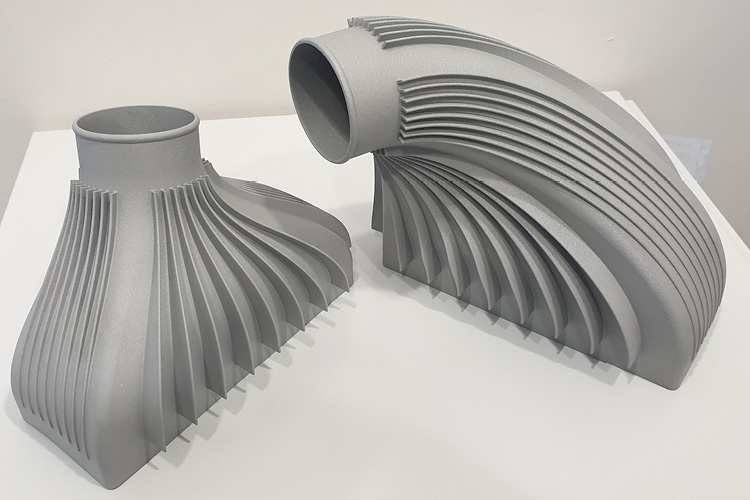
- Air ducting systems with complex internal geometries
One of the biggest advantages is the ability to design topology-optimized parts, where material is only placed where it is structurally needed. This significantly reduces mass while maintaining strength. In aerospace applications, even small weight reductions can translate into substantial fuel savings and improved payload capacity.
Additionally, aluminum’s corrosion resistance and thermal properties make it suitable for harsh operating environments, including high-altitude and space applications.
Automotive & Transportation
The automotive and transportation industries are rapidly adopting aluminum additive manufacturing to improve efficiency, reduce emissions, and enhance vehicle performance. Lightweighting is a key focus, especially as manufacturers transition toward electric mobility.
Aluminum powder enables the production of:
- Engine components such as pistons, housings, and manifolds
- Lightweight structural parts and brackets
- Battery enclosures and cooling systems for electric vehicles
- Customized performance parts for motorsports
In electric vehicles (EVs), reducing weight directly impacts battery efficiency and driving range. Additive manufacturing also allows for integrated cooling channels, which improve thermal management in battery systems and power electronics.
Another advantage is the ability to produce low-volume or customized parts without the need for expensive tooling, making aluminum AM ideal for prototyping, performance tuning, and specialized vehicle production.
Industrial Machinery
In industrial machinery, aluminum additive manufacturing offers flexibility and speed that traditional manufacturing methods often cannot match. It is widely used for both functional prototypes and end-use components.
Typical applications include:
- Custom machine parts tailored to specific equipment
- Lightweight housings and enclosures
- Corrosion-resistant components for harsh environments
- Replacement parts for legacy systems
One major benefit is on-demand manufacturing, which reduces downtime by enabling rapid production of replacement components. Instead of waiting for traditional supply chains, manufacturers can produce parts locally and quickly.
Additionally, aluminum’s machinability allows for easy finishing and integration with existing systems, making it a practical choice for industrial environments.
Energy & Thermal Management
Aluminum’s excellent thermal conductivity makes it one of the most effective materials for energy and thermal management applications. When combined with additive manufacturing, it enables entirely new levels of performance and efficiency.
Common applications include:
- Heat exchangers with optimized internal channel designs
- Cooling plates for electronics and power systems
- Components for renewable energy systems
- Thermal management solutions for data centers
Additive manufacturing allows engineers to create complex internal geometries, such as lattice structures and conformal cooling channels, which are impossible to achieve with traditional methods. These designs significantly improve heat transfer efficiency while reducing weight and material usage.
This is particularly important in industries where thermal control directly impacts performance, such as electronics, energy storage, and high-power systems.
Tooling & Manufacturing
In tooling and manufacturing environments, aluminum additive manufacturing is widely used to produce efficient, cost-effective tools and production aids. Its speed and flexibility make it especially valuable for rapid production cycles.
Key applications include:
- Jigs and fixtures for assembly lines
- Mold inserts with conformal cooling channels
- Rapid tooling for prototyping and short-run production
- Lightweight handling tools and guides
One of the most impactful use cases is conformal cooling in mold inserts, where internal channels are designed to follow the shape of the mold. This results in faster cooling times, improved part quality, and increased production efficiency.
Additionally, aluminum tools are easier to handle due to their reduced weight, improving ergonomics and safety for operators. The ability to quickly iterate and modify tooling designs also allows manufacturers to adapt to changing production needs without significant delays.
6. Featured Product: AlSi10Mg Aluminum Powder
For achieving consistent and high-performance results, selecting the right material is essential. A reliable option for industrial applications is alsi 10mg aluminum powder.
This aluminum powder is specifically designed for LPBF processes and delivers excellent performance in demanding environments. It features spherical morphology for smooth layer deposition, ensuring reliable and repeatable printing results.
Its heat-treatable properties allow for enhanced mechanical strength, while its compatibility with aerospace, automotive, and industrial applications makes it a versatile solution. This material supports the production of lightweight, complex, and fully functional components, helping manufacturers achieve better outcomes.
7. Design Guidelines for Aluminum AM
Designing for aluminum additive manufacturing requires a shift in mindset compared to traditional manufacturing. Uniform wall thickness is important to reduce the risk of warping and ensure consistent results.
Support structures should be carefully planned to balance stability and ease of removal. Topology optimization techniques can be used to reduce weight while maintaining structural integrity. Additionally, designers should consider thermal behavior during the printing process to improve heat management and minimize distortion.
Applying these design principles helps ensure successful builds and high-performance parts.
8. Post-Processing and Finishing Techniques
Post-processing is a critical stage in aluminum additive manufacturing, as it directly impacts the final mechanical properties, dimensional accuracy, and surface quality of printed parts. While parts produced through LPBF are near-net shape, additional finishing steps are often required to meet industrial standards and application-specific requirements.
One of the most important processes is heat treatment, which enhances strength, ductility, and overall material performance. For AlSi10Mg, heat treatment can relieve internal stresses generated during printing and improve microstructure uniformity, resulting in more reliable and durable components.
Machining is frequently used to achieve tight tolerances and precise geometries, especially for mating surfaces or critical features. CNC machining can refine holes, threads, and interfaces that require high precision beyond what additive manufacturing alone can deliver.
Surface quality is another key consideration. As-printed aluminum parts often have a relatively rough surface finish, so various surface finishing techniques are applied, including:
- Sandblasting or bead blasting for uniform texture
- Polishing for improved aesthetics and reduced friction
- Shot peening to enhance fatigue resistance
For applications requiring enhanced durability, anodizing is widely used. This electrochemical process increases corrosion resistance, improves wear properties, and allows for surface customization through color finishing. Anodized aluminum parts are particularly valuable in aerospace, automotive, and consumer-facing applications.
Additional processes such as Hot Isostatic Pressing (HIP) may also be applied in high-performance industries to reduce internal porosity and improve mechanical integrity.
Together, these post-processing techniques ensure that aluminum parts meet strict industrial requirements, both functionally and visually.
9. Advantages Over Traditional Manufacturing
Aluminum additive manufacturing offers a range of advantages compared to conventional methods such as casting, forging, and CNC machining. One of the most significant benefits is design freedom. Engineers can create highly complex geometries, including internal channels, lattice structures, and topology-optimized designs that are impossible or impractical with traditional techniques.
Another major advantage is material efficiency. Unlike subtractive manufacturing, where material is removed from a solid block, additive manufacturing uses only the material required to build the part. This significantly reduces waste and lowers material costs, especially when working with high-value alloys.
Faster production cycles are also a key benefit, particularly for low-volume production, rapid prototyping, and custom parts. Without the need for molds or tooling, manufacturers can move quickly from design to production, accelerating product development timelines.
Additionally, additive manufacturing enables part consolidation, where multiple components can be combined into a single, integrated design. This reduces the need for assembly, minimizes potential points of failure, and improves overall product reliability.
From a supply chain perspective, aluminum AM supports on-demand and localized production, reducing inventory requirements and shortening lead times. This flexibility is especially valuable in industries that require rapid iteration or customized solutions.
10. Challenges and Considerations
Despite its many advantages, aluminum additive manufacturing presents several technical and operational challenges that must be carefully managed to achieve consistent results.
One of the primary challenges is the sensitivity to process parameters. Factors such as laser power, scan speed, layer thickness, and build orientation must be precisely controlled to ensure proper melting and solidification. Small variations can lead to defects such as porosity, cracking, or incomplete fusion.
Another important consideration is the need for a controlled environment. Aluminum powder is highly reactive, requiring inert gas atmospheres (such as argon) during printing to prevent oxidation and ensure safety. Proper powder handling and storage protocols are also essential.
Residual stresses are a common issue in metal additive manufacturing. These stresses develop due to rapid heating and cooling cycles during the printing process and can lead to part distortion or warping. Techniques such as optimized support structures, build orientation, and post-process heat treatment are used to mitigate these effects.
Additionally, post-processing requirements can add time and cost to the overall production workflow. Achieving the desired surface finish, dimensional accuracy, and mechanical properties often involves multiple finishing steps.
Finally, there is a need for specialized expertise and equipment, which can present a barrier to entry for some organizations. However, as technology matures and becomes more accessible, these challenges are increasingly manageable.
With proper process optimization, material selection, and quality control, manufacturers can successfully overcome these limitations and fully leverage the benefits of aluminum additive manufa/////;’cturing.
11. Sustainability and Environmental Benefits
Aluminum additive manufacturing offers significant sustainability advantages, making it an attractive solution for companies seeking to reduce their environmental impact.
One of the most notable benefits is waste reduction. Traditional manufacturing methods often involve cutting away large amounts of material, whereas additive manufacturing builds parts layer by layer using only the necessary material. This results in a much higher material utilization rate.
Another key advantage is powder recyclability. Aluminum powder that is not fused during the printing process can often be collected, reconditioned, and reused in future builds. This minimizes material waste and improves overall resource efficiency.
Lightweight aluminum components also contribute to energy savings during use, particularly in transportation applications. Lighter vehicles require less energy to operate, leading to reduced fuel consumption and lower emissions over time.
Additive manufacturing also supports localized production, allowing parts to be manufactured closer to the point of use. This reduces the need for long-distance transportation and helps lower the carbon footprint associated with global supply chains.
Furthermore, the ability to produce optimized designs—such as lightweight structures and efficient thermal systems—contributes to improved performance and reduced energy consumption across a wide range of applications.
As industries continue to prioritize sustainability, aluminum additive manufacturing is positioned as a key technology for enabling more efficient and environmentally responsible production.
12. Future Trends
The future of aluminum in additive manufacturing looks promising. Ongoing developments in advanced aluminum alloys are expanding material capabilities and performance.
Improvements in printing technologies are increasing efficiency and reliability, making aluminum AM more accessible for large-scale production. The integration of generative design tools is also enabling more optimized and innovative component designs.
As industries continue to demand lightweight, high-performance solutions, aluminum will remain a key material driving the evolution of digital manufacturing.
Frequently asked questions
What makes aluminum powder suitable for industrial 3D printing?
Aluminum powder is ideal for industrial additive manufacturing due to its lightweight nature, strong mechanical properties, and excellent thermal conductivity. It enables production of high-performance parts with complex geometries.
What is the difference between aluminum casting and aluminum 3D printing?
Casting requires molds and tooling, while 3D printing builds parts layer by layer without tooling. Additive manufacturing allows more complex designs, faster production, and reduced material waste.
Why is AlSi10Mg preferred over pure aluminum in additive manufacturing?
Pure aluminum is too soft for structural applications, while AlSi10Mg provides improved strength, hardness, and thermal stability while still maintaining lightweight properties.
What is the typical density of aluminum 3D printed parts?
When properly processed, aluminum LPBF parts can achieve near full density (typically above 99%), depending on machine parameters and powder quality.
Can aluminum additive manufacturing produce functional end-use parts?
Yes, aluminum AM is widely used for end-use industrial components such as aerospace brackets, automotive housings, and thermal systems.
What industries use AlSi10Mg aluminum powder the most?
The aerospace, automotive, defense, energy, and industrial machinery sectors are the primary users of AlSi10Mg powder.
How strong are aluminum 3D printed parts compared to machined parts?
Properly processed aluminum AM parts can match or exceed the strength of cast aluminum components and, in some cases, approach machined part performance after heat treatment.
Does aluminum powder require special storage conditions?
Yes, it must be stored in a dry, controlled environment to prevent oxidation and contamination, ensuring consistent print quality.
What safety precautions are needed when handling aluminum powder?
Aluminum powder must be handled in inert environments with proper ventilation and anti-static measures due to its reactive nature in fine form.
What is the role of laser power in aluminum 3D printing?
Laser power controls the melting of powder layers. Too little power causes incomplete fusion, while too much can lead to defects like keyholing or porosity.
What causes porosity in aluminum additive manufacturing?
Porosity can result from incorrect laser settings, poor powder quality, trapped gas, or improper build parameters.
How does topology optimization benefit aluminum AM parts?
It removes unnecessary material while maintaining strength, resulting in lighter and more efficient designs.
Can aluminum AM parts be used in high-temperature environments?
Yes, but within limits. AlSi10Mg performs well in moderate temperature ranges, especially after heat treatment, but is not suitable for extreme high-temperature environments like titanium alloys.
What is the typical surface finish of aluminum 3D printed parts?
As-built surfaces are relatively rough compared to machined parts and often require post-processing like polishing or machining.
What is conformal cooling in aluminum manufacturing?
It is a design technique where cooling channels follow the shape of a part, improving thermal efficiency. It is widely used in tooling and mold inserts.
How does aluminum AM improve production efficiency?
It reduces tooling requirements, shortens production cycles, and enables on-demand manufacturing, improving overall operational efficiency.
What is the difference between LPBF and DED for aluminum?
LPBF uses a powder bed and laser for high precision, while DED (Directed Energy Deposition) feeds powder or wire directly into a melt pool for larger or repaired parts.
Can aluminum parts be recycled after printing?
Yes, unused powder can often be reused after sieving and quality checks, improving material efficiency.
What causes warping in aluminum 3D printing?
Warping is caused by thermal stress from uneven cooling during the printing process.
How is warping prevented in aluminum AM?
Through optimized support structures, controlled build orientation, and pre/post heat treatments.
What is the role of heat treatment in aluminum AM?
Heat treatment improves mechanical strength, reduces residual stress, and enhances microstructure uniformity.
What is the role of heat treatment in aluminum AM?
What is the role of heat treatment in aluminum AM?
How does aluminum compare to titanium in additive manufacturing?
Aluminum is lighter and more cost-effective, while titanium offers higher strength and temperature resistance. The choice depends on application requirements.
What is the most common aluminum alloy used in AM besides AlSi10Mg?
Other alloys include AlSi7Mg and specialized aerospace-grade aluminum formulations.
Can aluminum AM replace CNC machining completely?
Not entirely. It complements CNC machining by producing near-net shapes that often require finishing for tight tolerances.
What affects the cost of aluminum additive manufacturing?
Material cost, machine time, post-processing, and design complexity all influence total production cost.
How does powder reuse affect quality?
Reused powder must be carefully monitored, as repeated thermal exposure can slightly alter flowability and particle characteristics.
Is aluminum AM suitable for prototyping?
Yes, it is widely used for rapid prototyping due to its speed, flexibility, and ability to produce functional test parts.
What is the future of aluminum powder in additive manufacturing?
Future developments include stronger aluminum alloys, AI-driven process optimization, faster printers, and wider adoption in mass production environments.
Why is aluminum important for lightweight engineering?
Because it provides an excellent balance of strength and low density, making it essential for fuel efficiency and performance optimization.
Can aluminum AM be used in medical applications?
In some non-implant applications like equipment housings and devices, yes. However, biocompatibility requirements limit its use for implants compared to titanium.
What makes aluminum AM more sustainable than traditional manufacturing?
It reduces waste, allows powder reuse, lowers transport emissions, and supports energy-efficient lightweight designs.
Have a question or a project? Let’s talk.
Tell us what you need — a real applications engineer replies within 24 hours. NDA on request, no sales script.