1. Introduction Additive manufacturing, commonly known as 3D printing, has fundamentally transformed modern product development,…
What is SLS 3D Printing? Selective Laser Sintering Explained
Imagine a manufacturing technology so advanced it can create detailed, robust parts with a laser’s precision. SLS is a standout method in 3D printing that’s revolutionizing production across industries. In 2021, SLS was the second, most-used 3D printing technology in the world.
At Additive Plus, we provide SLS 3D printing services to deliver detailed customer requests, from components to custom automotive parts.
Defining Sintering And Its Meaning In 3D Printing
What does sintering mean? In simple terms, sintering is the process of turning powder into a solid mass using heat without melting it completely. This is crucial in 3D printing, where it turns loose powder into solid objects by bonding particles at the molecular level.
How sintering fits into additive manufacturing: In 3D printing, sintering is a game-changer. It allows 3D printers to construct detailed objects with strong materials, layer by layer. SLS uses sintering to expand what’s possible in terms of the shapes and sizes of parts that can be produced while also enhancing the strength and durability of these parts.
Each layer of powder is precisely sintered, meaning material is only added where necessary. This leads to minimal waste, contrasting sharply with traditional manufacturing processes that often cut away large portions of unused material. This efficiency is a key reason why industries quickly adopt SLS for more sustainable, cost-effective production cycles.
Through our exploration of SLS, we’re not just looking at how it works; we’re seeing its significant impact on manufacturing, making processes quicker, less wasteful, and more adaptable to complex designs.
-
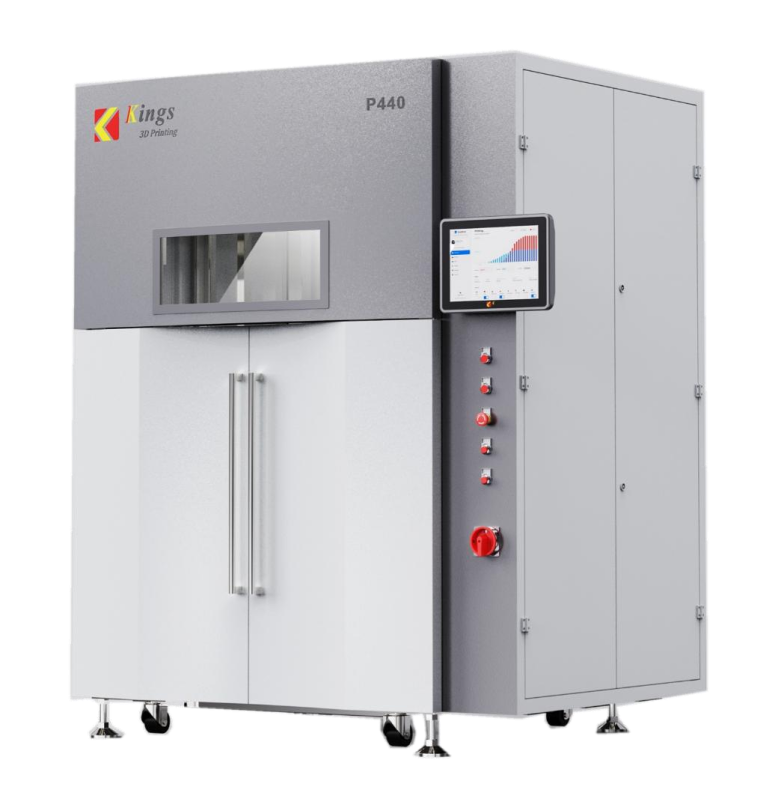
Kings P440 SLS 3D Printer: Selective Laser Sintering for Industrial Applications
Industrial SLS 3D Printer solution with 17.3*17.3*17.7 in build size.
-
Technology:
SLS
-
Materials:
Plastic Nylon Powders
-
Technology:
What Is Selective Laser Sintering In 3D Printing?
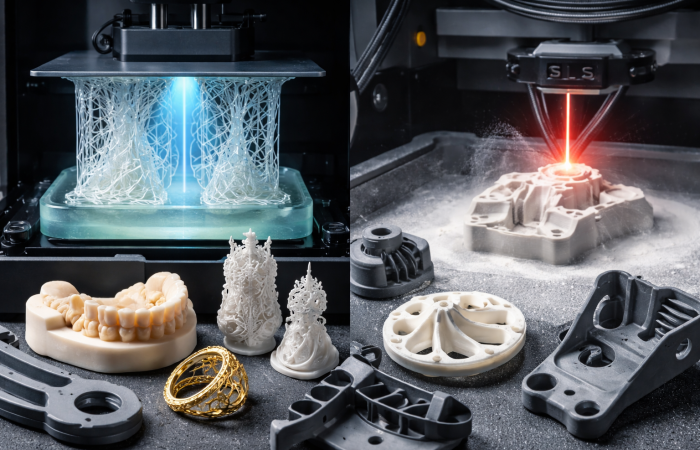
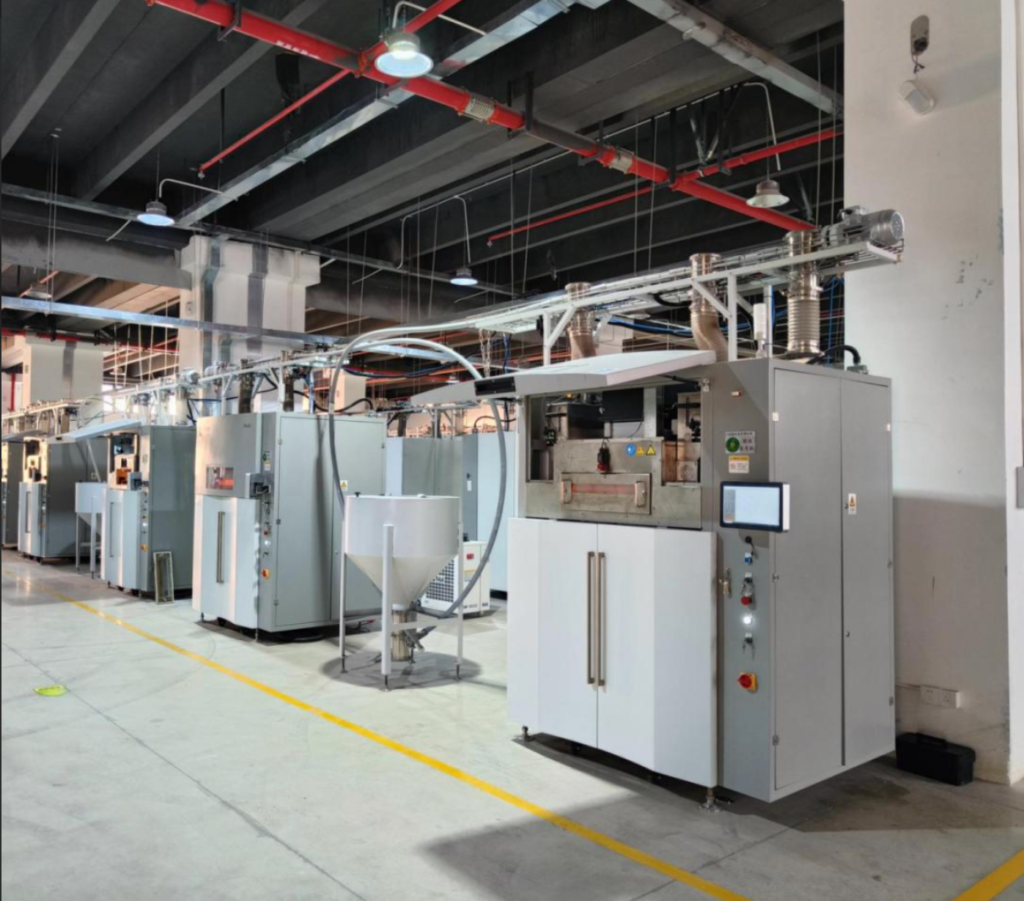
SLS is a powerful form of 3D printing that uses a high-powered laser to fuse small material particles into a solid structure, layer by layer. This technique is ideal for producing complex shapes that traditional methods can’t handle, making it invaluable for innovative manufacturing.
SLS makes a big splash in modern manufacturing by offering versatility and precision. It’s being adopted by sectors ranging from healthcare to consumer goods, helping them cut down on waste and speed up development without sacrificing quality.
Source: Britannica
SLS, which stands for Selective Laser Sintering, is a cornerstone of additive manufacturing. This method employs lasers to transform powdered materials into solid, three-dimensional objects, building them up one layer at a time.
Preparing the 3D Model and Material
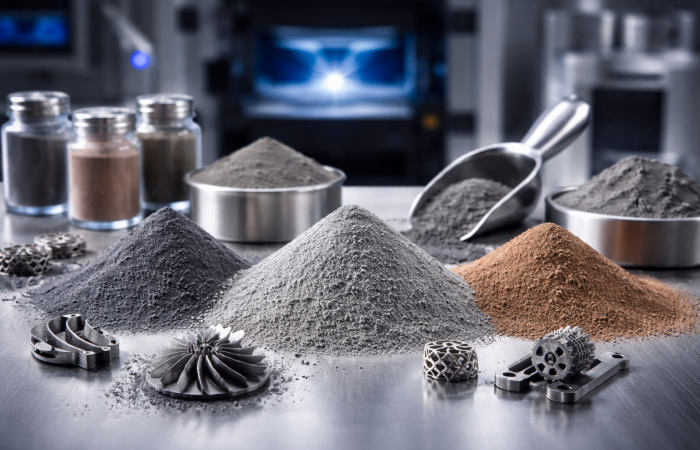
Before printing begins, a digital 3D model is created and converted into a format suitable for the SLS machine. Concurrently, the appropriate powdered material—be it plastic, metal, or ceramic—is prepared and loaded into the printer.
Layer-by-Layer Laser Sintering Process
The printing process starts with a thin layer of powder spread across the build platform. A laser then scans the surface, selectively sintering the powder to match the cross-section of the 3D model. After the first layer is complete, the platform lowers, and a new layer of powder is applied. The laser sintering continues, building the object layer by layer.
Cooling, Unpacking, and Post-Processing
Once the printing is finished, the build chamber is allowed to cool, ensuring the parts solidify properly. The finished object is then carefully excavated from the bed of unsintered powder. Excess powder is removed, often recycled for future prints. Finally, the object may undergo various post-processing steps, such as sandblasting or painting, to improve its surface finish and mechanical properties.
SLS vs. Other 3D Printing Methods
What’s particularly innovative about SLS is that the unsintered powder around each layer is a natural support for the object. This clever use of material means there’s no need for additional support structures, streamlining the process and allowing for the creation of complex geometries that would be challenging or impossible to achieve with other 3D printing methods.
-
Industrial Metal 3D Printing for Aerospace, Medical & Automotive Components
High-precision metal 3D printing for strong, complex, and fully dense functional parts.
-
Compatible platform:
Metal LPBF
-
Type:
Metal Powders
-
Compatible platform:
-
Nylon 3D Printing for Aerospace, Automotive & Engineering Parts
Durable nylon 3D printing for strong, impact-resistant, and complex functional parts.
-
On-Demand Thermoplastic 3D Printing for Industrial Applications
Affordable and versatile 3D printing for prototypes, functional parts, and end-use plastic components.
-
Rapid Resin 3D Printing for Functional Prototypes & High-Detail Models
Ultra-precise resin 3D printing for detailed prototypes with smooth surfaces and fine features.
Technology | Full Name | Description | Key Advantages |
SLS | Selective Laser Sintering | Uses a laser to sinter powdered material, building objects layer by layer. | No support structures needed, strong functional parts. |
FDM | Fused Deposition Modeling | Uses a thermoplastic filament, which is heated and extruded through a nozzle. | Easy to use, widely available, good for rapid prototyping. |
SLA | Stereolithography | Uses an ultraviolet laser to cure a resin, layer by layer. | High accuracy and smooth surface finishes. |
DLP | Digital Light Processing | Similar to SLA but uses a digital projector to flash a single image of each layer. | Faster than SLA due to layer-by-layer curing. |
MJF | Multi Jet Fusion | Spreads powder material and then prints binding agents, which are fused by heat. | High detail and durability, no supports needed. |
EBM | Electron Beam Melting | Uses an electron beam to melt metal powder in a vacuum. | Produces high-strength parts, suitable for aerospace and medical. |
Binder Jetting | Binder Jetting | Spreads powder and selectively jets a binder to form the part. | Can print in color, suitable for large parts and sand casting. |
CLIP | Continuous Liquid Interface Production | Grows parts from a pool of resin using a photochemical process. | Extremely fast, can produce complex geometries. |
DMLS | Direct Metal Laser Sintering | Similar to SLS but specifically used for metal powders. | Can produce complex metal parts with high precision. |
FGF | Fused Granular Fabrication | Uses granules of plastic which are heated and extruded. | Lower cost materials, good for large and durable parts. |
How Lasers Sculpt Precision In SLS Technology?
Lasers are the unsung heroes that bring the most intricate designs to life.
Here’s a look at how lasers play a key role in the selective laser sintering (SLS) process:
- Achieve Precision: The laser precisely melts and fuses powder.
- Enable Complex Designs: No support needed for intricate.
- Reduce Waste: Only necessery material is sintered, saving resources.
Cross-Industry Innovation With 3D Printing Selective Laser Sintering
Selective Laser Sintering (SLS) technology has carved out vital roles across various industries, enabling the creation of parts and components that were once thought impossible.
- Architecture: In the architecture sector, SLS is used to create complex models and functional components used in building design and construction. These can include detailed scale models, custom fixtures, and lightweight structural elements.
- Fashion and Jewelry: SLS technology allows designers in the fashion and jewelry industries to experiment with intricate, customizable designs that were previously difficult or impossible to produce. This includes items like bespoke jewelry pieces and complex, durable textile patterns.
- Education and Research: Universities and research institutions use SLS for creating detailed anatomical models for medical training and educational purposes, as well as for developing prototypes in engineering research projects.
- Art and Design: Artists and designers utilize SLS to bring complex artistic concepts to life, allowing for the creation of unique sculptures and installations that feature intricate details and robust structural integrity.
- Defense and Military: The defense sector uses SLS for manufacturing lightweight, durable parts for military equipment and vehicles. This includes components for personal gear, drones, and other machinery that benefit from the weight savings and complex geometries possible with SLS.
Also, read:
These applications showcase the versatility of SLS across different fields, highlighting its ability to produce intricate and durable items that meet specific industry needs.
Step Into The Future With SLS And Additive Plus
As we wrap up our look at Selective Laser Sintering (SLS), it’s clear that this technology is a game-changer in 3D printing. SLS is renowned for its precision and flexibility, allowing for the creation of complex designs while enhancing efficiency across industries like aerospace and healthcare. Its ability to work with various materials and produce robust yet lightweight parts makes it a key player in modern manufacturing.
At Additive Plus, we specialize in bringing these advanced 3D printing solutions into your daily operations. With our deep expertise and a wide range of high-quality equipment, we help businesses streamline their production and innovate effortlessly. Whether you’re prototyping or scaling up, our team is here to support you from start to finish.
Ready to transform your manufacturing process with SLS?
Request a quote today and see how Additive Plus can make a difference in your project’s success.
FAQ
What does SLS stand for in the context of 3D printing?
SLS stands for Selective Laser Sintering. It’s a form of additive manufacturing that uses a laser to sinter powdered material, creating three-dimensional objects layer by layer.
How does selective laser sintering work to create detailed parts?
SLS involves a laser that selectively fuses powdered material based on a 3D digital model. It builds objects by sintering each layer of powder, then lowering the build platform to add new layers until the part is complete.
Can you differentiate SLS 3D printing from other types of laser sintering?
While SLS specifically uses a laser to sinter polymer-based powders, other types of laser sintering might involve different materials like metals or ceramics, often under different operational conditions like higher temperatures or inert atmospheres.
What are some specific applications of laser sintering in modern industries?
Laser sintering is crucial in fields that require high precision and material versatility, such as aerospace for lightweight parts, automotive for complex assemblies, and healthcare for bespoke prosthetics.
What are the main benefits of using selective laser sintering over traditional manufacturing methods?
SLS offers several advantages, including the ability to produce complex geometries without the need for support structures, reduced waste, and the capacity for rapid prototyping and customization.
Is there a difference between the meaning of sintering in traditional processes and in 3D printing?
In traditional processes, sintering involves heating materials below their melting point to bond particles. In 3D printing, particularly SLS, sintering is precisely controlled by a laser to fuse powder particles in a predetermined pattern, layer by layer.
What materials are typically used in SLS 3D printing, and why?
SLS commonly uses polymers like nylon due to their excellent mechanical properties and versatility. However, advancements in SLS technology have expanded material options to include metals, ceramics, and composites for broader industrial applications.
What should companies consider before integrating SLS into their production processes?
Companies should evaluate the compatibility of SLS with their product requirements, consider the initial investment in equipment, assess the need for skilled operators, and ensure they have the capacity to handle the post-processing requirements.
Explore What’s New in 3D Printing
Innovative Composite 3D Printed Suspension Components for Lunar Rover
Top 5 Heat-Resistant Plastics for High-Temperature Applications
Polyamide vs Nylon: Key Differences, Strengths, and Best Uses
Join Additive Plus at RAPID + TCT 2025 for the Launch of AO Metal 3D Printers
TPR vs TPE: Understanding the Differences and Choosing the Right Material
Related Posts
Ashkhen Ovsepyan
Additive manufacturing expert and tech business leader, focused on global strategy, innovation, and advancing women in 3D printing.