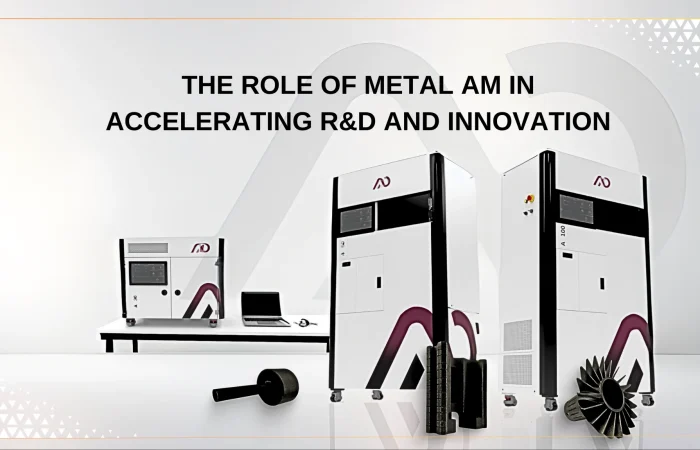
The Role of Metal Additive Manufacturing in Accelerating R&D and Innovation
R&D teams are under more pressure than ever. Timelines are tighter. Resources are limited. Yet expectations keep growing—faster testing, smarter parts, better materials.
That’s where metal additive manufacturing comes in.
Instead of waiting weeks for a machined prototype or working around design limits, you can print functional metal parts in your lab. You can try out new geometries. Fine-tune parameters. Move fast without cutting corners.
This article is written for teams like yours: researchers, engineers, educators, and developers who want more control over how they design, test, and build.
We’ll explain metal additive manufacturing, where metal laser sintering fits in, and how these tools support real innovation, not just big-budget production lines.
What Is Metal Additive Manufacturing? (And Why It’s Not Just Hype)
Metal additive manufacturing is a way to build real, functional metal parts—layer by layer—using digital 3D models. You don’t start with a block of material and cut away. You begin with metal powder and a plan.
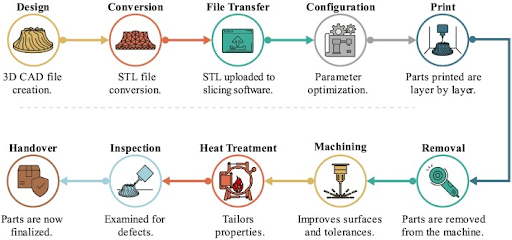
An example of a typical MAM process workflow.
Source: ScienceDirect
The most widely used method is metal laser sintering, where a high-powered laser melts precise areas of the powder. The result? Solid, dense parts with excellent detail and strength.
Unlike traditional machining or casting, metal additive manufacturing gives you more design freedom. You can build internal channels, lightweight structures, or custom shapes that are difficult or impossible to machine.
But this isn’t just about making “cool” parts. It’s about making your work more practical:
- Want to iterate faster? You can print a part, test it, tweak the design, and print again—all in-house.
- Need to try a new alloy or configuration? Metal additive tools support open parameters for research and development.
- Working with reactive metals like titanium or Inconel? Advanced printers can handle them reliably.
And yes, metal additive manufacturing is growing fast. But it’s not hype. It’s already used daily in aerospace labs, medical research centers, university programs, and startup R&D teams.
How Metal Additive Manufacturing Speeds Up R&D?
In research and development, time and flexibility matter. Metal additive manufacturing helps you move from concept to part without waiting on molds, tooling, or outsourced machining.
Here’s how it helps you work smarter:
- Faster iterations: Design, print, test, repeat. You can refine designs in days, not weeks.
- Low-volume part production: Make just one or a few parts without minimum order headaches.
- Material testing made easier: Test how new alloys behave under real conditions using metal laser sintering.
- Design freedom: Create parts with internal features, complex curves, or lightweight structures that machining can’t handle.
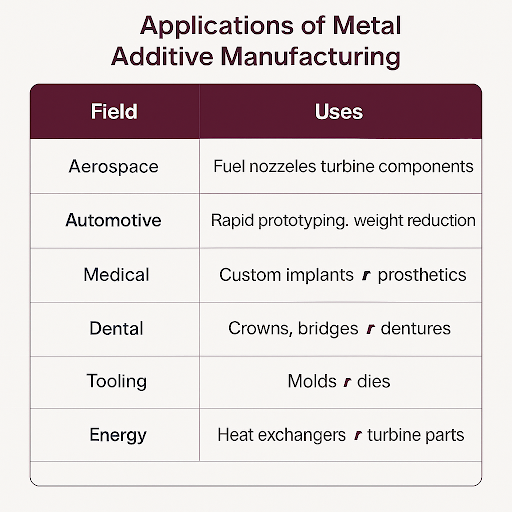
This flexibility makes metal Additive Manufacturing a tool for labs, startups, and R&D teams exploring new ideas or pushing technical limits.
How Does Metal Additive Manufacturing Help You Move Faster In R&D?
Metal additive manufacturing gives your team real control over timelines and testing. Instead of waiting weeks for outsourced parts or tooling, you can build functional metal components directly from your CAD files. This means quicker iterations, fewer delays, and faster decisions.
You can also design more freely. Complex geometries, internal cooling channels, lightweight lattice structures—what used to take days to machine can now be printed in hours. No need to compromise your design just to fit production limits.
Across industries, this is already becoming standard. According to Coherent Market Insights, the global market for metal additive manufacturing is expected to grow from $6.66 billion in 2025 to over $16.5 billion by 2032.
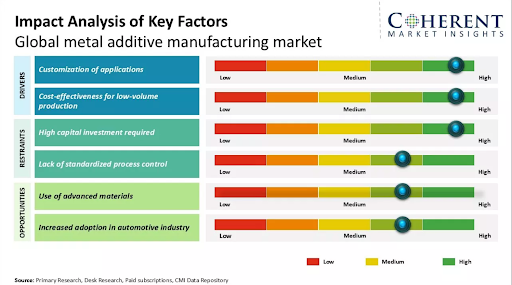
Source: Coherent Market Insights
If you’re working in research and need a faster way to test ideas or fine-tune materials, metal additive manufacturing is a practical solution. It helps you move quickly without relying on external shops or compromising quality.
Design-Test-Iterate: Speeding Up Product Development
Fast product development isn’t just nice to have; it’s often the difference between winning a contract and missing the deadline. That’s why metal additive manufacturing has become a valuable tool in R&D environments.
When you bring production closer to your team, iteration becomes faster and easier. Engineers and researchers can adjust and test designs the same day, without waiting for tooling or outsourcing.
Here’s what that can look like in practice:
- Design a prototype in CAD: Update the design based on performance data or a new idea.
- Print the part in metal using LPBF or DMLS: There is no tooling, no delay, just load the file, and print.
- Test and measure performance: Validate your part in the real world—whether that’s mechanical strength, thermal behavior, or fit.
- Refine and reprint: Make improvements based on test results and repeat the process as needed.
Instead of waiting weeks between iterations, teams using metal laser sintering can run through multiple design cycles in days. That means faster innovation and less risk at every stage of development.
Solving Material Challenges With Metal Laser Sintering
One of the most significant advantages of metal additive manufacturing is its ability to work with a wide range of advanced metals, many of which are difficult or expensive to shape using traditional methods.
Whether you’re developing a new alloy or testing the limits of existing ones, metal laser sintering gives you more control and freedom.
You can:
- Experiment with custom powders like refractory metals, high-strength alloys, or nickel-based superalloys
- Fine-tune process parameters to study how different temperatures, laser settings, or build orientations affect your material
- Print small batches or test specimens without wasting raw material or needing a full production setup.
- Evaluate mechanical properties using real parts instead of simulations.
For research labs and advanced development teams, this opens up real possibilities for faster materials testing and validation.
Want to print custom alloys or compare material behavior in-house? AO Metal printers support open parameters and quick material changeovers.
Faster Prototyping, Faster Results
When you’re building new products or testing new materials, speed matters; long lead times, tooling delays, and outsourcing costs can slow everything down.
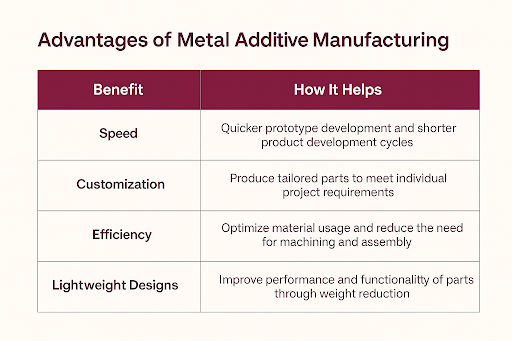
Metal additive manufacturing solves that.
With metal laser sintering, your team can:
- Go from CAD to part in hours or days: No waiting on molds, machining setups, or third-party suppliers.
- Print, test, and iterate multiple versions: Improve designs in real time, not weeks later.
- Test multiple alloys on the same system: This is useful for teams experimenting with mechanical properties or developing new materials.
This fast feedback loop helps you catch issues early, fine-tune performance, and move confidently from concept to validation.
It’s about reducing project risks, avoiding costly tooling changes, and getting better results faster.
AO Metal's Tools For R&D: Compact Metal Printers That Fit Your Workflow
Not every R&D lab needs a massive industrial setup. Sometimes, teams need a compact, reliable system that gives them control, flexibility, and results, without exhausting the budget or overcomplicating the process.
That’s exactly what AO Metal offers. Our printers are built with the needs of researchers, educators, and product developers. Whether you’re exploring a new alloy, printing test specimens, or optimizing parameters, our machines are designed to make metal additive manufacturing more accessible.
A Quick Look at the AO Metal Lineup:
Model | Build Volume | Best For | Key Features |
Ø30×60 mm | Universities, entry-level labs, early-stage R&D | Compact footprint, low power consumption, quick 1-hour powder changes | |
Ø50×100 mm | Prototyping, testing, and materials research | 300W fiber laser (optional blue laser), heated build plate, inert gas efficiency | |
Ø100×100 mm | Advanced alloy development, production-ready research | Dual-laser configuration, fast material swaps, support for hard-to-process metals |
These systems support metal laser sintering using various powders like stainless steel, Inconel, titanium, copper, and more. They’re designed for teams that need:
- Open-parameter control for testing and refining materials
- Small-batch production without a large-scale factory needs
- Affordable metal additive manufacturing without compromising part quality
- Smooth integration into existing lab setups
Whether you’re conducting academic research or working in a private-sector lab, our printers help shorten development cycles and bring new ideas to life faster and more affordably.
Post-Processing And Validation: What Happens After The Print
With metal additive manufacturing, printing the part is only part of the process. Post-processing and validation steps are often required to meet engineering and performance standards, especially in research and regulated fields.
Here’s what your team should be prepared for:
Common Post-Processing Steps
- Support Removal: Temporary supports (especially in complex builds) must be cut, machined, or ground away. This is typically the first step.
- Heat Treatment: Stress relief and aging treatments help improve part durability and reduce internal stresses caused during metal laser sintering.
- Surface Finishing: Depending on your application, parts might need bead blasting, polishing, or coating to achieve the required surface quality.
- CNC Machining: For tight tolerances or critical interfaces, post-machining ensures final specs are met. This is common in aerospace and medical parts.
Validation Tools & Quality Checks
- CMM Inspection: Coordinate measuring machines check if the final part geometry matches the CAD.
- CT Scans or X-ray: These are used for checking internal structures without cutting the part, and they are especially useful for research prototypes and medical applications.
- Microstructure Analysis: Examining grain structure and porosity helps researchers and developers understand how build parameters affected the metal’s properties.
Why This Matters in R&D
These steps help validate results and fine-tune the process when testing a new material or iterating on a design. Reliable post-processing and measurement ensure that findings are based on solid data, not surface-level assumptions.
Want to simplify your post-processing workflow?
Metal Additive Manufacturing Is A Tool For Real Progress
If you’re working in research, development, or product design, you know how often speed and accuracy are at odds. Metal additive manufacturing helps bridge that gap. It’s not about replacing your process — it’s about giving you more control, less delay, and better insight at every stage.
Whether testing alloys, refining part geometry, or exploring new ideas, metal laser sintering gives you a faster, more flexible way to work with metal. And when you pair it with a setup built for R&D — compact machines, open parameters, quick powder changes — the benefits go even further.
AO Metal offers systems for small teams, busy labs, and ambitious projects. They offer dependable hardware, innovative design, and a real support team that speaks your language.
👉 Ready to bring metal additive manufacturing into your workflow?
Contact Additive Plus for a quote or to explore our printer lineup, which is built for researchers, educators, and engineers.
FAQ
Can I use recycled or self-atomized metal powders in my research builds?
Some systems, including those designed for research applications, allow the use of recycled or self-made powders. However, proper sieving and storage methods are required to maintain powder quality and ensure part consistency. Always check your printer’s powder reuse guidelines.
What’s the best way to validate mechanical properties in metal-printed parts?
Mechanical testing, such as tensile strength, hardness, and fatigue performance, can be performed using standardized sample geometries. Coordinate measurement machines (CMM), CT scanning, and microstructure analysis are also common for in-lab validation.
How much technical experience is needed to run a metal additive manufacturing system in an R&D lab?
Most modern metal 3D printers are designed with user-friendly interfaces and automation features, but there’s still a learning curve. Teams typically need training on build prep, powder handling, post-processing, and safety protocols. Open-parameter systems may require more hands-on tuning but offer greater flexibility for research.
Is metal additive manufacturing safe to use in shared lab environments?
Yes, as long as you follow strict powder handling, ventilation, and PPE protocols. Some printers include closed powder systems and inert gas purging to minimize exposure risks. Before installing a system, verify compliance with local safety and environmental regulations.
How do I know if investing in a machine is better than outsourcing metal AM services?
It depends on how often you need parts, your turnaround expectations, and whether you’re doing material research. If your team frequently prototypes, iterates, or develops new alloys, owning a system usually offers more flexibility and cost efficiency over time.
What post-processing tools are essential for a basic research setup?
You’ll want powder removal, support cutting, and surface finishing equipment, at a minimum. An ideal furnace for stress relief or heat treatment is also ideal. Access to CNC or EDM equipment can help bring parts within spec for tighter tolerances.
Are there compact systems that still offer industrial-grade results?
Yes. Many lab-scale LPBF systems today offer high-resolution printing, quality thermal management, and broad material compatibility in small footprints. These are well-suited for universities, research institutes, and advanced R&D groups working with limited space.
Can I print with highly reflective or reactive metals like copper or magnesium?
Not all printers support them. If you’re working with difficult materials, look for systems with optional blue lasers or high-temperature platforms. These features improve energy absorption and process stability with metals that are typically challenging for infrared lasers.
Related Posts
1. Introduction Additive manufacturing, commonly known as 3D printing, has fundamentally transformed modern product development,…
Metal additive manufacturing has fundamentally transformed the way industries approach design and production, enabling the…
Imagine a manufacturing process capable of producing parts measured in meters, not millimeters—components so vast…
R&D teams are under more pressure than ever. Timelines are tighter. Resources are limited. Yet…

Ashkhen Ovsepyan
Additive manufacturing expert and tech business leader, focused on global strategy, innovation, and advancing women in 3D printing.